
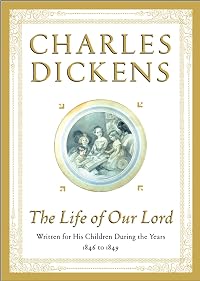
The Life of Our Lord: Written for His Children During the Years 1846 to 1849
by Charles Dickens
On This Page
Description
Dickens approaches his subject with simple reverence, retelling the New Testament in a manner suitable for his own young children who were, in fact, his only intended audience.Tags
Recommendations


















Member Reviews
Charming, though casually written and unedited, so there are typographical errors in it. However, it is also littered with inaccuracies and whitewashed depictions of Jewish history. Additionally, it depicts a works-based means of salvation (the “do good and be good and you can thereby gain entrance into heaven” idea) rather than what Jesus taught. It reads like a watered down retelling of the four gospels but with key details eliminated or rewritten to suit the author’s / period’s / locale’s narrative.
I think that Dickens misses the whole point of the life of Christ. He defines Christianity as doing your best to earn God's forgiveness. While I agree that it is good, noble, right, etc. to be kind to others, that is not the essential component to Christianity. I also was struck with what appeared to be antisemitism (Jesus vs. the Jews). That idea ignores the fact that Jesus and his 12 disciples were Jews themselves.
DIckens wrote this for his children and it remained in his family and unpublished by his request until the death of his last child in the 1920s. The family decided to publish it then. I have no idea how this came into my Mom's hands but it was among her books and also had a clipping from what seems to be the New York Times in 1950 of a parcel of Dicken's letters that were sold. It's a lovely book with beautiful illustrations, clearly for children. Dickens wrote that it was a very personal document of his faith and that is very clear.
In The Life of Our Lord, Charles Dickens retells the major events in the life of Jesus Christ. He obviously omits a lot, but he focuses on what he wants his children to know. It is an intriguing look at the life of Christ and at the specific faith of Charles Dickens. I appreciated the way he wrote as if speaking directly to a child, and I am glad I read it.
All that said, I wasn’t very impressed with this short children’s book. I don’t think it’s typical of Dickens. It was written for children and for specific children at that (his own). For that reason, the tone is incredibly casual. I felt like I was reading a personal letter from Dickens to his children.
I recommend reading The Life of Our Lord if you’re interested in show more Dickens’ faith and understanding of the life of Jesus Christ. The Life of Our Lord may interest you and inspire you, but I don’t think it’s full of quality Dickens writing.
More thoughts at my blog show less
All that said, I wasn’t very impressed with this short children’s book. I don’t think it’s typical of Dickens. It was written for children and for specific children at that (his own). For that reason, the tone is incredibly casual. I felt like I was reading a personal letter from Dickens to his children.
I recommend reading The Life of Our Lord if you’re interested in show more Dickens’ faith and understanding of the life of Jesus Christ. The Life of Our Lord may interest you and inspire you, but I don’t think it’s full of quality Dickens writing.
More thoughts at my blog show less
This is a wonderful, sweet retelling of the Bible stories of Jesus Christ. Since Dickens wrote it to his children, it comes across clearly as a loving father teaching his children and explaining the meaning of the parables and of the conflicts in the story.
I loved it, loved it, loved it. I'd give it 6 stars if I could.
I read a copy printed off from the internet.
I loved it, loved it, loved it. I'd give it 6 stars if I could.
I read a copy printed off from the internet.
Victorian religion for children. I do find the capitalisation of he, him, his when it refers to Jesus rather distracting. If you look at the photo of the first page of Dickens's own manuscript, you can see he doesn't do it, so why do the publishers think it necessary?
First published in 1934, this simple narrative, written by Dickens for his children, expresses the author's great faith and humility by retelling the story of the life, death, and resurrection of Jesus.
Members
- Recently Added By
Lists

Publisher's Weekly NON-Fiction list - 1912 - 1975
486 works; 4 members
Author Information

2,578+ Works 313,139 Members
Charles Dickens, perhaps the best British novelist of the Victorian era, was born in Portsmouth, Hampshire, England on February 7, 1812. His happy early childhood was interrupted when his father was sent to debtors' prison, and young Dickens had to go to work in a factory at age twelve. Later, he took jobs as an office boy and journalist before show more publishing essays and stories in the 1830s. His first novel, The Pickwick Papers, made him a famous and popular author at the age of twenty-five. Subsequent works were published serially in periodicals and cemented his reputation as a master of colorful characterization, and as a harsh critic of social evils and corrupt institutions. His many books include Oliver Twist, David Copperfield, Bleak House, Great Expectations, Little Dorrit, A Christmas Carol, and A Tale of Two Cities. Dickens married Catherine Hogarth in 1836, and the couple had nine children before separating in 1858 when he began a long affair with Ellen Ternan, a young actress. Despite the scandal, Dickens remained a public figure, appearing often to read his fiction. He died in 1870, leaving his final novel, The Mystery of Edwin Drood, unfinished. (Bowker Author Biography) show less
Some Editions
Awards and Honors
Distinctions
Notable Lists
Work Relationships
Common Knowledge
- Canonical title
- The Life of Our Lord: Written for His Children During the Years 1846 to 1849
- Alternate titles
- The Life of Our Lord Written By Charles Dickens for his own children
- Original publication date
- 1934 (published) (published); 1849 (written) (written)
- People/Characters
- Jesus of Nazareth
Classifications
Statistics
- Members
- 1,114
- Popularity
- 22,606
- Reviews
- 12
- Rating
- (3.69)
- Languages
- 9 — Dutch, English, Esperanto, French, German, Greek, Hungarian, Italian, Russian
- Media
- Paper, Audiobook, Ebook
- ISBNs
- 44
- UPCs
- 1
- ASINs
- 46