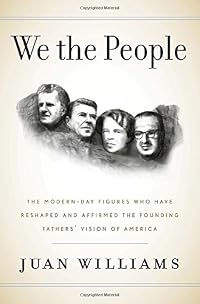
We the People: The Modern-Day Figures Who Have Reshaped and Affirmed the Founding Fathers' Vision of America
by Juan Williams
On This Page
Description
"What would the Founding Fathers think about America today? Over 200 years ago the Founders broke away from the tyranny of the British Empire to build a nation based on the principles of freedom, equal rights, and opportunity for all men. But life in the United States today is vastly different from anything the original Founders could have imagined in the late 1700s. The notion of an African-American president of the United States, or a woman such as Condoleezza Rice or Hillary Clinton as show more Secretary of State, would have been unimaginable to the men who wrote the Declaration of Independence and the Constitution, or who ratified the Constitution or the Bill of Rights. In a fascinating work of history told through a series of in depth profiles, prize-winning journalist, bestselling author, and Fox political analyst Juan Williams takes readers into the life and work of a new generation of American Founders, who honor the original Founders' vision, even as they have quietly led revolutions in American politics, immigration, economics, sexual behavior, and reshaped the landscape of the nation. Among the modern-day pioneers Williams writes about in this compelling new book are the passionate conservative President Reagan; the determined fighters for equal rights, Thurgood Marshall and Martin Luther King, Jr.; the profound imprint of Rev. Billy Graham's evangelism on national politics; the focus on global human rights advocated by First Lady Eleanor Roosevelt; the leaders of the gay community who refused to back down during the Stonewall Riots and brought gay life into America's public square; the re-imagined role of women in contemporary life as shaped by Betty Friedan. Williams reveals how each of these modern-day founders has extended the Founding Fathers original vision and changed fundamental aspects of our country, from immigration, to the role of American labor in the economy, from modern police strategies, to the importance of religion in our political discourse. America in the 21st Century remains rooted in the Great American experiment in democracy that began in 1776. For all the changes our economy and our cultural and demographic make-up, there remains a straight line from the first Founders' original vision, to the principles and ideals of today's courageous modern day pioneers"-- "In We the People, renown journalist, Fox political analyst, and bestselling author Juan Williams examines the lives of the men and women in the 20th century who have extended the Founding Fathers' original vision of the country and reshaped what America is"-- show lessTags
Recommendations


Member Reviews
Full disclosure: I received an ARC of this book through LibraryThing's Early Reviewers program.
When this book came up, I was thrilled as I love history. I was aware of Juan Williams reputation as a journalist and author, so figured I couldn't go wrong with this one. Sadly, I was mistaken. While there is a LOT of interesting information, it's presented so dryly in places, it was like reading a textbook. Some of the chapters are so slow and so boring you wonder why Mr. Williams bothered to write it (Kennedy's and immigration, for example). Others, like the sections on Eleanor Roosevelt and Dr. King were much livelier and interesting.
I had to struggle to finish this book, and was greatly relieved when it was done. If you're familiar with show more Mr. Williams' writing style or you love modern history, you will probably do fine with this book, but I was sad to have so much trouble reading it. show less
When this book came up, I was thrilled as I love history. I was aware of Juan Williams reputation as a journalist and author, so figured I couldn't go wrong with this one. Sadly, I was mistaken. While there is a LOT of interesting information, it's presented so dryly in places, it was like reading a textbook. Some of the chapters are so slow and so boring you wonder why Mr. Williams bothered to write it (Kennedy's and immigration, for example). Others, like the sections on Eleanor Roosevelt and Dr. King were much livelier and interesting.
I had to struggle to finish this book, and was greatly relieved when it was done. If you're familiar with show more Mr. Williams' writing style or you love modern history, you will probably do fine with this book, but I was sad to have so much trouble reading it. show less
 This review was written for LibraryThing Early Reviewers.
One of the first things that I noticed, as I delved into We the People: The Modern-Day Figures Who Have Reshaped and Affirmed the Founding Fathers’ Vision of What America Is, written by Juan Williams, is the concise, objective journalistic writing style used to create an easy-to-read narrative. In spite of the fact that I began reading the book with a somewhat curious, if not skeptical, attitude about the author’s premise that America has had other “Founding Fathers” besides the “originals”, I also found that, chapter by chapter and topic by topic, Mr. Williams makes a convincing case that throughout the course of American history, we have had many “Founding Fathers” as well as “Founding Mothers” in the great show more “experiment” we call the United States of America. Using many examples, Mr. Williams also makes the case that the United States Constitution is indeed a living document, open to interpretation by the people, and based on the times in which we live.
The opening introduction sets the scene, as the narrative delineates a direct contrast between the America that our original Founding Fathers knew and the America that we live in today. This comparison continues throughout the book. Mr. Williams personalizes his introduction by placing himself in history, giving the reader his birth year of 1954. Because he is about my age, I found myself “re-living” the history that he describes. Many of the names, places, events, and issues are familiar to me, but as I read in detail about them, I realized that I didn’t necessarily understand the context in which they occurred. This gift of historical perspective and the “filling in of the details” is laid out carefully by the author. As a lover of history, I was hooked on learning more about things I remember in my own lifetime, as well as learning more about events in my history textbooks.
Not only did I enjoy learning about the unknown details of the events I remember, but as I read, I also began to think of how high school and college students would benefit by having this book as part of their school curriculum. I believe that this book would serve as an outstanding supplemental guide for discussion of current events and topics relevant to young people’s interests. In my opinion, the tradition of “living history” is what young people need to understand about their country in order to counteract the abrasive, negative reports that they are inundated with in the news. By showing students how people have effected important change throughout American history, they may be inspired to become a bigger part of the process.
The book is parsed into chapter topics, representing major events, trends, and issues, as it acknowledges the people who have championed major changes in our evolving nation. Each chapter could be a “stand alone” reading. The subjects explored include immigration, civil rights, urban crime, the military, the economy, the shrinking of the middle class, income inequality, global human rights, labor unions, religious influences, women’s rights, racial equality, and citizens’ right to bear arms.
It is refreshing that Mr. Williams does not reveal his positions on any of these topics, but chooses instead to present the facts and let the reader consider them for himself. The objective narrative was so skillfully done that, based on new information, I found myself rethinking some of my opinions on certain subjects, or at least seriously considering the viewpoint of those who hold opposing beliefs to my own. This is another reason why this book needs an an audience. It could serve as a vehicle for meaningful dialog on the major issues of our time.
I would highly recommend this book to people of all ages, political persuasions, and cultures. This book is a reminder that “We the People” have a voice, and that we are an absolutely necessary voice in the survival of our democracy.
March 26, 2016 show less
The opening introduction sets the scene, as the narrative delineates a direct contrast between the America that our original Founding Fathers knew and the America that we live in today. This comparison continues throughout the book. Mr. Williams personalizes his introduction by placing himself in history, giving the reader his birth year of 1954. Because he is about my age, I found myself “re-living” the history that he describes. Many of the names, places, events, and issues are familiar to me, but as I read in detail about them, I realized that I didn’t necessarily understand the context in which they occurred. This gift of historical perspective and the “filling in of the details” is laid out carefully by the author. As a lover of history, I was hooked on learning more about things I remember in my own lifetime, as well as learning more about events in my history textbooks.
Not only did I enjoy learning about the unknown details of the events I remember, but as I read, I also began to think of how high school and college students would benefit by having this book as part of their school curriculum. I believe that this book would serve as an outstanding supplemental guide for discussion of current events and topics relevant to young people’s interests. In my opinion, the tradition of “living history” is what young people need to understand about their country in order to counteract the abrasive, negative reports that they are inundated with in the news. By showing students how people have effected important change throughout American history, they may be inspired to become a bigger part of the process.
The book is parsed into chapter topics, representing major events, trends, and issues, as it acknowledges the people who have championed major changes in our evolving nation. Each chapter could be a “stand alone” reading. The subjects explored include immigration, civil rights, urban crime, the military, the economy, the shrinking of the middle class, income inequality, global human rights, labor unions, religious influences, women’s rights, racial equality, and citizens’ right to bear arms.
It is refreshing that Mr. Williams does not reveal his positions on any of these topics, but chooses instead to present the facts and let the reader consider them for himself. The objective narrative was so skillfully done that, based on new information, I found myself rethinking some of my opinions on certain subjects, or at least seriously considering the viewpoint of those who hold opposing beliefs to my own. This is another reason why this book needs an an audience. It could serve as a vehicle for meaningful dialog on the major issues of our time.
I would highly recommend this book to people of all ages, political persuasions, and cultures. This book is a reminder that “We the People” have a voice, and that we are an absolutely necessary voice in the survival of our democracy.
March 26, 2016 show less
This review was written for LibraryThing Early Reviewers.In this collection of historical vignettes, Juan Williams seeks to connect the lives and legacies of a number of influential postwar Americans to the constitutional vision of the nation’s Founders. His success in this endeavor is uneven. If the Sons of Liberty had been gay, would they have joined in throwing rocks and bottles at the police during the 1969 Stonewall riots? Possibly so. Certainly, gays today would be justified in regarding that confrontation as the violent birth of a struggle for freedom and individual rights, much like the battles at Lexington and Concord. But that seems about as far as the comparison can be pressed.
The connection becomes even more subtle when Williams sets the founding of the United States against the show more social transformation stemming from the publication of Betty Friedan’s The Feminine Mystique. If his point is simply that the women’s movement changed America, fundamentally altering the way most Americans experience their culture, no one could demur. Parsing the book’s subtitle, it is arguably true that Friedan and her peers “reshaped ... the Founding Fathers’ vision of what America is.” But so did the San Francisco earthquake. Things were never quite the same again. In the final analysis, that may be all the author is getting at.
Williams’ accounts, often partly in first person, of the accomplishments of such liberal icons as Thurgood Marshall, Rachel Carson, and Daniel Patrick Moynihan are enlightening and sometimes inspiring. He has tougher sledding coming to grips with pivotal figures of a conservative or libertarian bent. Milton Friedman’s lasting contribution to American life, as Williams sees it, was to create “a greater separation between rich and poor, as well as an increasingly anxious middle class.” Friedman also gets the blame for “the erosion of common experiences, memories, and identity that defined America for much of the twentieth century,” and he even turns out to be responsible for “corporate scandals” that occurred long after his death. What any of this has to do with the Founding Fathers, it might be noted, is a mystery. And let’s not even talk about Charlton Heston!
If you are looking for some light bedside reading that applies a liberal, journalistic gloss to some of the most important Americans and events of the late 20th century, you could do worse than this volume. Unfortunately, if your taste runs more to analytical depth and balance, I can’t recommend it. show less
The connection becomes even more subtle when Williams sets the founding of the United States against the show more social transformation stemming from the publication of Betty Friedan’s The Feminine Mystique. If his point is simply that the women’s movement changed America, fundamentally altering the way most Americans experience their culture, no one could demur. Parsing the book’s subtitle, it is arguably true that Friedan and her peers “reshaped ... the Founding Fathers’ vision of what America is.” But so did the San Francisco earthquake. Things were never quite the same again. In the final analysis, that may be all the author is getting at.
Williams’ accounts, often partly in first person, of the accomplishments of such liberal icons as Thurgood Marshall, Rachel Carson, and Daniel Patrick Moynihan are enlightening and sometimes inspiring. He has tougher sledding coming to grips with pivotal figures of a conservative or libertarian bent. Milton Friedman’s lasting contribution to American life, as Williams sees it, was to create “a greater separation between rich and poor, as well as an increasingly anxious middle class.” Friedman also gets the blame for “the erosion of common experiences, memories, and identity that defined America for much of the twentieth century,” and he even turns out to be responsible for “corporate scandals” that occurred long after his death. What any of this has to do with the Founding Fathers, it might be noted, is a mystery. And let’s not even talk about Charlton Heston!
If you are looking for some light bedside reading that applies a liberal, journalistic gloss to some of the most important Americans and events of the late 20th century, you could do worse than this volume. Unfortunately, if your taste runs more to analytical depth and balance, I can’t recommend it. show less
This review was written for LibraryThing Early Reviewers.The concept of this book is compelling, and for the most part, it's well-executed, but I felt that Williams tried to do too much in each chapter. The book does provide an interesting glance at a number of different social issues and historical moments in the 20th century, and I think it's possible that for a different type of reader, or even me in a different mood, it would work well. In my experience, though, the main themes in each chapter -- the brief biography of a person, the overview of their cultural and political influences, the overview of the context in which they acted, and the changes to the American political system they were involved in -- fought each other for attention, and all were weaker for it.
Maybe it's that the show more book is too heavily influenced by a somewhat softened version of the old Great Man theory of history, in which the men and women in this book are key players just by their essence and their leadership. The book lists people and events they instigated, but doesn't explore the way in which these same events would or would not have come about without the key players. It also doesn't go into enough depth about the experiences which shaped the "modern founders" into the people who moved those events forward. Without either of these things, the reader has to take it on faith that these people had to be the ones who accomplished these changes in society, for better or worse. At the same time, the book provides more context than is truly necessary if you believe that all history needs to move along is heroes. I believe that a book with the same general premise could have been written without leaning on this historical theory, and would have been stronger and more interesting. Each chapter might have had to be longer, and perhaps that would mean fewer founders, but a richer story. show less
Maybe it's that the show more book is too heavily influenced by a somewhat softened version of the old Great Man theory of history, in which the men and women in this book are key players just by their essence and their leadership. The book lists people and events they instigated, but doesn't explore the way in which these same events would or would not have come about without the key players. It also doesn't go into enough depth about the experiences which shaped the "modern founders" into the people who moved those events forward. Without either of these things, the reader has to take it on faith that these people had to be the ones who accomplished these changes in society, for better or worse. At the same time, the book provides more context than is truly necessary if you believe that all history needs to move along is heroes. I believe that a book with the same general premise could have been written without leaning on this historical theory, and would have been stronger and more interesting. Each chapter might have had to be longer, and perhaps that would mean fewer founders, but a richer story. show less
This review was written for LibraryThing Early Reviewers.What would the Founding Fathers think about America today? Is the question that Juan Williams looks at in his new book, "We the People". Yet in trying to find the answer, Williams realized that the Founding Fathers would not recognize the United States of 2016 given what has occurred over the past 240 years, so he shifted his focus to those individuals who have shaped the nation since World War II by how they interpreted the words of the Founding Fathers.
Through 18 chapters, Williams examined numerous individuals and how they affected issues and movements that affect the United States today. These new members of the Found Father “family” as Williams calls them range from the notable such as Kennedy brothers, Martin Luther King Jr., show more Ronald Reagan, and Earl Warren to the lesser known such as Harry Hay, Robert Ball, and Robert Morris. The issues these individuals range from immigration to gun rights to environmentalism to the debate between the living constitution and originalism.
In each chapter, Williams gives an unbiased history of the issue under discussion as well as a biography of the individual or individuals that contributed to how the issue became important for us today. Although this might sound like it could be a plodding read, Williams writes in a crisp and engaging manner that results in the nearly 400 pages of text to pass swiftly for the reader while so informing them of the issue and individuals that made them important for 21st century Americans.
If there is one thing I wish Williams had done was a concluding chapter that would have addressed how some of the issues he presented interacted with one another. This would have also afforded Williams the opportunity while showing the interaction between issues to parallel how the interaction of 21st century issues to show parallels about 21st century issues interacted with one another just as issues the 18th century during the Founding Father era interacted with one another. I personally believe this reinforcing of his argument as well as the synthesis of the previous chapters would have created a stronger conclusion to the text than just the normal chapter ending that the reader got.
"We the People" could be seen as one of those “popular history” genre books glosses over things, but Williams’ prose and material goes deeper to give the reader a better understanding as to how 21st century America came to be as it is. The nearly 400 page of text is very reasonable for the average reader and the information provided within them really packs a punch. I would wholeheartedly recommend this book for those interested in history and/or politics. show less
Through 18 chapters, Williams examined numerous individuals and how they affected issues and movements that affect the United States today. These new members of the Found Father “family” as Williams calls them range from the notable such as Kennedy brothers, Martin Luther King Jr., show more Ronald Reagan, and Earl Warren to the lesser known such as Harry Hay, Robert Ball, and Robert Morris. The issues these individuals range from immigration to gun rights to environmentalism to the debate between the living constitution and originalism.
In each chapter, Williams gives an unbiased history of the issue under discussion as well as a biography of the individual or individuals that contributed to how the issue became important for us today. Although this might sound like it could be a plodding read, Williams writes in a crisp and engaging manner that results in the nearly 400 pages of text to pass swiftly for the reader while so informing them of the issue and individuals that made them important for 21st century Americans.
If there is one thing I wish Williams had done was a concluding chapter that would have addressed how some of the issues he presented interacted with one another. This would have also afforded Williams the opportunity while showing the interaction between issues to parallel how the interaction of 21st century issues to show parallels about 21st century issues interacted with one another just as issues the 18th century during the Founding Father era interacted with one another. I personally believe this reinforcing of his argument as well as the synthesis of the previous chapters would have created a stronger conclusion to the text than just the normal chapter ending that the reader got.
"We the People" could be seen as one of those “popular history” genre books glosses over things, but Williams’ prose and material goes deeper to give the reader a better understanding as to how 21st century America came to be as it is. The nearly 400 page of text is very reasonable for the average reader and the information provided within them really packs a punch. I would wholeheartedly recommend this book for those interested in history and/or politics. show less
This review was written for LibraryThing Early Reviewers.Juan Williams We the People
Surely, America is in the midst of her adolescence, if not by the calendar, then certainly by her attitude. The precocious child turned prodigy, we tend to forget in our youth of 240 years that there are many many societies who measure their achievements in millennia rather than centuries. Juan Williams book We the People looks at America from a wider perspective and asks who would be considered the “founding fathers” of our modern America. Who are the men and women that have sprung from the creation of the original founders to reshape the American Dream?
Williams looks at the greatest changes that have occurred in the 20th century, and those responsible for bringing them to fruition. Thurgood Marshall, show more Earl Warren, and Martin Luther King, Jr. helped rewrite the constitution and bring it closer to the ideal that all men are created equal. Milton Friedman provided and economic perspective that recognized the conjoined twins of economic and political freedoms. Henry Kissinger and Richard Nixon used the leverage of diplomacy to open relations with China and reduce tensions with the Soviet Union.
However, there were times when Williams seemed to miss the mark in selecting the tools responsible for crafting our modern nation. On other occasions, the craftsmen men he chose to credit with the work were a bit far fetched. General William Westmoreland is said to have been a significant influence on the restructuring of the United States military in the post-Vietnam era. Retiring from active service in 1972, three years before the end of the Vietnam War, there were others with much more influence. Billy Graham and the Christian right is another combination that seems a mixture of sugar and garlic. Sure, their both spices, at times even used in the same dish, but they hardly go together. Reverend Graham was welcomed in the Oval Office by every President in office before he retired from active ministry, and has always been associated with theology far more than ideology. Falwell and “moral majority”, were expressly dogmatic in their politics which often seemed to hold a greater importance to them than the faith they claimed to be their foundation.
Curious too were the areas that Williams appeared to ignore altogether. The Watson family who made first brought the power of computing into our lives and the founders of Intel who gave exponentially small yet more powerful computers are not included. The media revolution that has killed newspapers across the country, and made formats obsolete in the blink of an eye are also missing. You may not like Matt Drudge, the blogosphere, and do it yourself journalists, but there is no denying their influence.
I only know Juan Williams from his work on NPR and Fox News. It must be tough walking into a room knowing that almost everyone present is going to dislike 50% of what you do. Williams doesn’t seem to be attempting to be all things to all people, but it does look like he struggles to firmly plant his ideas.
Despite these shortcomings, the intrigue of the Mr. Williams concept, as well as his clean, straightforward, and honest style, make We the People an interesting read. show less
Surely, America is in the midst of her adolescence, if not by the calendar, then certainly by her attitude. The precocious child turned prodigy, we tend to forget in our youth of 240 years that there are many many societies who measure their achievements in millennia rather than centuries. Juan Williams book We the People looks at America from a wider perspective and asks who would be considered the “founding fathers” of our modern America. Who are the men and women that have sprung from the creation of the original founders to reshape the American Dream?
Williams looks at the greatest changes that have occurred in the 20th century, and those responsible for bringing them to fruition. Thurgood Marshall, show more Earl Warren, and Martin Luther King, Jr. helped rewrite the constitution and bring it closer to the ideal that all men are created equal. Milton Friedman provided and economic perspective that recognized the conjoined twins of economic and political freedoms. Henry Kissinger and Richard Nixon used the leverage of diplomacy to open relations with China and reduce tensions with the Soviet Union.
However, there were times when Williams seemed to miss the mark in selecting the tools responsible for crafting our modern nation. On other occasions, the craftsmen men he chose to credit with the work were a bit far fetched. General William Westmoreland is said to have been a significant influence on the restructuring of the United States military in the post-Vietnam era. Retiring from active service in 1972, three years before the end of the Vietnam War, there were others with much more influence. Billy Graham and the Christian right is another combination that seems a mixture of sugar and garlic. Sure, their both spices, at times even used in the same dish, but they hardly go together. Reverend Graham was welcomed in the Oval Office by every President in office before he retired from active ministry, and has always been associated with theology far more than ideology. Falwell and “moral majority”, were expressly dogmatic in their politics which often seemed to hold a greater importance to them than the faith they claimed to be their foundation.
Curious too were the areas that Williams appeared to ignore altogether. The Watson family who made first brought the power of computing into our lives and the founders of Intel who gave exponentially small yet more powerful computers are not included. The media revolution that has killed newspapers across the country, and made formats obsolete in the blink of an eye are also missing. You may not like Matt Drudge, the blogosphere, and do it yourself journalists, but there is no denying their influence.
I only know Juan Williams from his work on NPR and Fox News. It must be tough walking into a room knowing that almost everyone present is going to dislike 50% of what you do. Williams doesn’t seem to be attempting to be all things to all people, but it does look like he struggles to firmly plant his ideas.
Despite these shortcomings, the intrigue of the Mr. Williams concept, as well as his clean, straightforward, and honest style, make We the People an interesting read. show less
This review was written for LibraryThing Early Reviewers.Juan Williams has written a comprehensive review, update, and redefinition of the term “founding fathers.” A look at the 19 chapter headings in the table of contents presents a list of interesting familiar and not-so-familiar names to present day readers. How do these relate to the founding fathers? Williams will tell you in a fast reading, approximately 400 page book. I recommend budgeting time so you can read it in one session. Each chapter pulls the reader into the next account and I would have been annoyed if I had to stop for routine daily tasks. I read this on a Saturday and it took about six hours; it took longer than usual because I stopped to highlight things I found particularly interesting.
Just as family names span show more generations, think Roosevelt, Williams substitutes “founding fathers” for a family name. Many students in the USA think of Washington, Adams, Jefferson, the signers of the Declaration of Independence and the participants at the Constitutional Convention as the founding fathers; case closed. Williams suggests that later historical figures such as JFK, Martin Luther King, Eleanor and Franklin Roosevelt, through their interpretations and implementation of original founding father principles deserve to be in the extended founding father family.
The original founding fathers did not spend their lives only in pontification of great political and philosophical principles. They had jobs; Franklin was a printer; Jefferson was an inventor and farmer. Supporting this, Williams details the contributions of Charlton Heston, Rachel Carson, Betty Friedan, and Billy Graham, to name a few. These individuals were not primarily political; their non-political occupations affected political developments. The reader will also find accounts of Reagan, Kissinger, Goldwater, and key political figures who bent and twisted original principles to present day realities.
This is truly the age of the life-long learner, but for too many learning stops at a certain point, like at the point where all our attentions are focused on earning a living. The 50s, 60s, 70s, 80s, and 90s are familiar ground to me, at least in memory. Since we lived it, we know it, and don’t always pay a lot of attention. Kissinger, sure, I know all about him. In fact, once he left government service in the Reagan years, he dropped out of sight, at least for me. Williams provides an update to the question “Where are they now?” Influential people don’t always lose their influence just because they are out of the public eye. Williams makes this point repeatedly.
I liked the way that Williams makes a point, focuses on it, and resists the temptation to make mean spirited, unnecessary, sensationalist asides. In his chapter on Billy Graham, he mentions other influential religious figures, such a Jerry Falwell, Pat Robertson, and Jim Bakker. Only one paragraph is devoted to Jim Bakker and the reason for his success. Nothing else needed to be said, and it was not said.
Here are some of the things I found particularly interesting in the reading.
Williams explored the evolution of the “broken windows” theory of policing in chapter 4. Here, and elsewhere, in his chapter on Heston and gun control, Williams examines the necessary compromises a society must make between absolute security and absolute freedom.
In chapter six, Williams compares economic theories of Keynes and Friedman, describes their impacts on such present day realities as the minimum wage issue and entitlement programs, and includes these economic theory giants in the Founding Father family.
This is a carefully written, well referenced book. Occasionally I found myself in disagreement with an assertion. When I reread the section, I saw that statements were carefully phrased to include several variables. I only found myself in disagreement with him on one point.
In chapter 5, on the military, Williams writes that military reserves had not been called on to go to Vietnam. As a policy matter, units were not mobilized and deployed as a result of actions from the White House; that is correct. However, there were National Guard units that served. Some of them volunteered. Company D (Long Range Patrol) 151st Infantry Regiment, Indiana National Guard served in Vietnam.
I would be very happy to attend a university level class where this book serves as a text in a survey course on US history. show less
Just as family names span show more generations, think Roosevelt, Williams substitutes “founding fathers” for a family name. Many students in the USA think of Washington, Adams, Jefferson, the signers of the Declaration of Independence and the participants at the Constitutional Convention as the founding fathers; case closed. Williams suggests that later historical figures such as JFK, Martin Luther King, Eleanor and Franklin Roosevelt, through their interpretations and implementation of original founding father principles deserve to be in the extended founding father family.
The original founding fathers did not spend their lives only in pontification of great political and philosophical principles. They had jobs; Franklin was a printer; Jefferson was an inventor and farmer. Supporting this, Williams details the contributions of Charlton Heston, Rachel Carson, Betty Friedan, and Billy Graham, to name a few. These individuals were not primarily political; their non-political occupations affected political developments. The reader will also find accounts of Reagan, Kissinger, Goldwater, and key political figures who bent and twisted original principles to present day realities.
This is truly the age of the life-long learner, but for too many learning stops at a certain point, like at the point where all our attentions are focused on earning a living. The 50s, 60s, 70s, 80s, and 90s are familiar ground to me, at least in memory. Since we lived it, we know it, and don’t always pay a lot of attention. Kissinger, sure, I know all about him. In fact, once he left government service in the Reagan years, he dropped out of sight, at least for me. Williams provides an update to the question “Where are they now?” Influential people don’t always lose their influence just because they are out of the public eye. Williams makes this point repeatedly.
I liked the way that Williams makes a point, focuses on it, and resists the temptation to make mean spirited, unnecessary, sensationalist asides. In his chapter on Billy Graham, he mentions other influential religious figures, such a Jerry Falwell, Pat Robertson, and Jim Bakker. Only one paragraph is devoted to Jim Bakker and the reason for his success. Nothing else needed to be said, and it was not said.
Here are some of the things I found particularly interesting in the reading.
Williams explored the evolution of the “broken windows” theory of policing in chapter 4. Here, and elsewhere, in his chapter on Heston and gun control, Williams examines the necessary compromises a society must make between absolute security and absolute freedom.
In chapter six, Williams compares economic theories of Keynes and Friedman, describes their impacts on such present day realities as the minimum wage issue and entitlement programs, and includes these economic theory giants in the Founding Father family.
This is a carefully written, well referenced book. Occasionally I found myself in disagreement with an assertion. When I reread the section, I saw that statements were carefully phrased to include several variables. I only found myself in disagreement with him on one point.
In chapter 5, on the military, Williams writes that military reserves had not been called on to go to Vietnam. As a policy matter, units were not mobilized and deployed as a result of actions from the White House; that is correct. However, there were National Guard units that served. Some of them volunteered. Company D (Long Range Patrol) 151st Infantry Regiment, Indiana National Guard served in Vietnam.
I would be very happy to attend a university level class where this book serves as a text in a survey course on US history. show less
This review was written for LibraryThing Early Reviewers.Members
- Recently Added By
Lists

Books Read in 2016
4,666 works; 197 members
Author Information

14+ Works 1,796 Members
Juan Williams is a political analyst for Fox News, a regular panelist on Fox News Sunday, and a columnist for poxNews.com and for The Hill. He hosted NPR's Talk of the Nation and has anchored Fox News Channel's weekend daytime news coverage. He is the author of the bestsellers Enough and Eyes on the Prize.
Common Knowledge
- Original publication date
- 2016
- People/Characters
- John Fitzgerald "Jack" Kennedy; Robert F. Kennedy; Earl Warren; Martin Luther King, Jr.; Lyndon Baines Johnson; William Bratton (show all 25); William Westmorland; Milton Friedman; Eleanor Roosevelt; Robert Moses; William Leavitt; George Meany; Billy Graham; Betty Friedan; Henry Kissinger; Richard M. Nixon; Patrick Moynihan; Harry Hay; Barry Goldwater; Ronald Reagan; Edward Meese; Robert Ball; Rachel Carson; Jesse Jackson; Charleton Heston
- Important places
- USA
Classifications
- Genres
- Nonfiction, History, Biography & Memoir, General Nonfiction, Politics and Government
- DDC/MDS
- 973.3092 — History & geography History of North America United States Revolutionary War (1775-89) Personal narratives--American Revolution
- LCC
- E169.12 .W535 — History of the United States United States General
- BISAC
Statistics
- Members
- 99
- Popularity
- 324,869
- Reviews
- 28
- Rating
- (3.62)
- Languages
- English
- Media
- Paper, Ebook
- ISBNs
- 3
- ASINs
- 1