On This Page
Description
Text and numerous detailed illustrations introduce and explain the scientific principles and workings of hundreds of machines.Tags
Recommendations



















Member Reviews
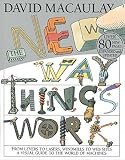
Many kids are questioning "Why" and "How" things work. This book can answer most of their questions. It covers topics such as how escalators, zippers, keys, planes, and so forth work. I love the use of the Woolly Mammoth to explain certain topics. It makes this book more amusing. However, I would have liked to see better drawings. It would have been better if the drawings were more detailed. This would have made it easier to understand how certain objects work.
I still believe this is a great book for students who are interested in the basic concepts of mechanics, electricity, etc.
I still believe this is a great book for students who are interested in the basic concepts of mechanics, electricity, etc.
Nonfiction - Informational
This book is (obviously) about how things work. It covers four sections which include movement, the elements, light and sound waves, and electricity and automation and puts these sections in the simplest terms while also being humorous. Because the topics in this book are so complex, the author puts everything into a very understandable form.
I thought that this was an average book mostly because I am simply not interested in the complexities of how things work. However, I do believe that this would be an excellent book to have in my classroom because there could be students who are incredibly interesting in these topics and could have a great time reading and discoing more.
This book is (obviously) about how things work. It covers four sections which include movement, the elements, light and sound waves, and electricity and automation and puts these sections in the simplest terms while also being humorous. Because the topics in this book are so complex, the author puts everything into a very understandable form.
I thought that this was an average book mostly because I am simply not interested in the complexities of how things work. However, I do believe that this would be an excellent book to have in my classroom because there could be students who are incredibly interesting in these topics and could have a great time reading and discoing more.
Wow this book is amazing to read before a STEM lesson. This book talks a lot about the 'How" of the electronics a lot of our kids are using and I think this would be great to help with that curiosity. I think of the impact it would have to have a lesson with ipads and then ask the question of "so why does the screen react when you touch it?" and then be able to read this book when talking about tech in the classroom.
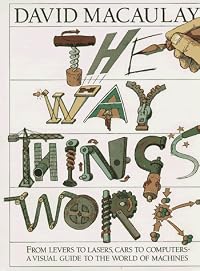
If you have ever taken apart a piece of machinery or googled "how does a hydrofoil work?" then you've found your book series. The Way Things Work is an illustrated look at the engineering behind some of our most used items in the modern world. David Macaulay looks at machine mechanics and how they move, harnessing the elements to make rockets and lightbulbs, how waves are used in color and telescopes and sound, and electricity and its complexities all with the help of a delightful wooly mammoth discovering along with us. Your readers can spend days, weeks, months learning the intricacies of invention and design with this wonderful book.
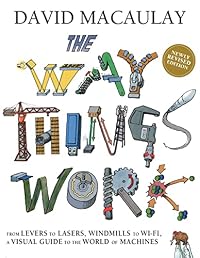
I was excited to read this book, the cover was very inviting. While the pictures inside were detailed and well colored, every page was so difficult to read. The font is small, and felt clumsy. The recommended age being 12 and up, I would be hard pressed to see middle school students picking this book up to read. This book may be best used as a read-aloud, or accompanied with other books.
With creative illustrations and writing that is clear yet creative, many machines, objects and other items are explained. The author and illustrator knows how to synthesize the visual and written word in sparse but colorful terms that inform in many ways.
Great book that explains how so many varied things work. Kids of all ages (and adults) will love this.
Members
- Recently Added By
Lists

Favorite Kids Science Books
129 works; 1 member

Youth: Science, Miscellaneous
34 works; 1 member
Author Information

David Macaulay was born on December 2, 1946 in Lancashire, England, but moved to Bloomfield, New Jersey when he was 11. He received a bachelor's degree in architecture from the Rhode Island School of Design (RISD). Before becoming an author and illustrator, he worked as an interior designer, a junior high school teacher, and instructor of interior show more design at RISD from 1969 to 1973. His first book, Cathedral: The Story of Its Construction, was published in 1973. His other books include City, Castle, Pyramid, Mill, Underground, Mosque, The Way Things Work, Rome Antics, Shortcut,and How Machines Work. He has received numerous awards including a Caldecott Honor Medal in 1991 for Black and White and the Washington Children's Book Guild Award for a Body of Non-Fiction Work in 1977. He won the Royal Society young people¿s book prize for the best science books for children for his book How Machines Work. (Bowker Author Biography) show less
Awards and Honors
Awards
Series

Common Knowledge
- Original publication date
- 2016
Classifications
- Genres
- Nonfiction, Technology
- DDC/MDS
- 600 — Applied science & technology Technology Technology (Applied sciences)
- LCC
- T47 .M18 — Technology Technology (General)
- BISAC
Statistics
- Members
- 955
- Popularity
- 27,616
- Reviews
- 13
- Rating
- (4.11)
- Languages
- English, German, Hungarian
- Media
- Paper, Ebook
- ISBNs
- 8
- ASINs
- 1