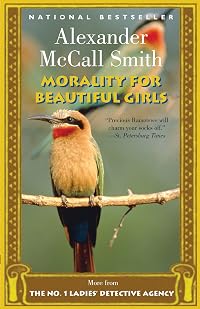
On This Page
Description
Fiction. Literature. Mystery. Humor (Fiction.) The quick-witted, good-natured detective Mma "Precious" Ramotswe shines in this irresistible bestseller. Between intriguing new cases and troubling personal developments, Precious' hands are full. The four Miss Beauty and Integrity pageant finalists may have questionable moral fiber, and the brother of an important government worker has allegedly been poisoned. On top of all that, Precious' reliable fiancE might be hiding something.Tags
Recommendations












Member Recommendations
Member Reviews
The lesson in this entry in the No. 1 Ladies' Detective Agency series is about morality, and it’s not just morality for beautiful girls. While Mma Makutsi does a little digging to find out which beauty queen is worthy of the Beauty and Integrity title, Mma Ramotswe muses about morality and its many aspects, such as established codes vs. personal morality, and cases where being a little underhanded might actually be the moral thing to do. As always, this has the three requisite cases although only two are successfully wrapped up at the end. As Mma Ramotswe puts it so well, “I think there are some matters that are best left undisturbed. ...We don’t want to know the answer to everything.”
This third book in the No. 1 Ladies' Detective Agency series finds Precious Ramotswe, Botswana's only female private investigator, with a lot on her plate, including a change in business arrangements, an unwell fiancé, a possible poisoning, and the discovery of a feral child in the bush.
Despite all of that, as in the first two books, the actual plot in this one is low-key almost to the point of being incidental, while the real focus is on the characters and their gentle ruminations on life, love, tradition, and morality in modern Botswana. I have ten more books in this series still sitting unread on my shelves, and I can imagine getting tired of this before I reach the end of them. But I haven't yet, and I still found this one show more charming and, in the end, satisfying. And I am delighted by the development that Mma Makutsi, Mma Ramotswe's secretary/assistant gets in this one. She's shaping up to be just as formidable a character as her employer, and I hope to see lots more of her in future volumes. show less
Despite all of that, as in the first two books, the actual plot in this one is low-key almost to the point of being incidental, while the real focus is on the characters and their gentle ruminations on life, love, tradition, and morality in modern Botswana. I have ten more books in this series still sitting unread on my shelves, and I can imagine getting tired of this before I reach the end of them. But I haven't yet, and I still found this one show more charming and, in the end, satisfying. And I am delighted by the development that Mma Makutsi, Mma Ramotswe's secretary/assistant gets in this one. She's shaping up to be just as formidable a character as her employer, and I hope to see lots more of her in future volumes. show less
After reading the No. 1 Ladies Detective Agency a couple of years ago, I accumulated a few of these, and went through 6 in less than a month. They're very quick reads - I read 2 and part-of-a-third in one day.
They're very entertaining, charming, and compulsively readable. Although marketed as mysteries; they're not, really. Rather they follow Mma Ramotswe and those around her through their daily lives - it's almost besides-the-point that the business she runs is a detective agency. The stories are suffused with McCall-Smith's obvious sincere love of Africa (where he grew up), and the reader feels that a genuine window has opened up into the lives and mindsets of ordinary Africans. I don't agree with many aspects of Precious Ramotswe's show more view on the world, and I probably wouldn't get along with her in real life - but these books made me feel like I might understand people like her more than before.
However... there's also a weird aspect to the books. They're so relentlessly cozy. It's not that McCall-Smith ignores the poverty, the devastation of AIDS, the lack of education, etc... these things are acknowledged, but then almost swept to the side. On the one hand, it's a celebration of the spirit of the people of Botswana and their love of their homeland... but on the other hand, it sometimes feels like a minimization of these things. It's not just larger social issues: there's domestic abuse, adultery, etc... all the normal foibles of humanity (although all reference to sex of any kind are totally non-existent)- but all the unpleasant things somehow get almost drowned out in the cozy, feel-good atmosphere of the books. Maybe it's just that I usually read darker, grittier material [especially in mysteries {McCall-Smith is no Stieg Larsson!}] but it felt a bit strange to me. I can't decide if it's a detriment or a positive asset to the books.
In 'Morality for Beautiful Girls,' Mma Ramotswe moves the offices of her detective agency into the premises of her fiance's business, Tlowkwong Road Speedy Motors. It's a bit odd to have a private detective's office in the midst of cars being fixed, but the ove makes financial sense. In addition to being Assistant Detective, Mma Makutsi also becomes Assistant Manager of the garage, using the skills she learned at the Botswana Secretarial College to get the bookkeeping in order. Meanwhile, Mma Ramotswe investigates a case of suspected poisoning, considers the mystery of a child possibly raised by lions, and investigates the good (or not-so-stellar) character of girls competing in a beauty pageant. show less
They're very entertaining, charming, and compulsively readable. Although marketed as mysteries; they're not, really. Rather they follow Mma Ramotswe and those around her through their daily lives - it's almost besides-the-point that the business she runs is a detective agency. The stories are suffused with McCall-Smith's obvious sincere love of Africa (where he grew up), and the reader feels that a genuine window has opened up into the lives and mindsets of ordinary Africans. I don't agree with many aspects of Precious Ramotswe's show more view on the world, and I probably wouldn't get along with her in real life - but these books made me feel like I might understand people like her more than before.
However... there's also a weird aspect to the books. They're so relentlessly cozy. It's not that McCall-Smith ignores the poverty, the devastation of AIDS, the lack of education, etc... these things are acknowledged, but then almost swept to the side. On the one hand, it's a celebration of the spirit of the people of Botswana and their love of their homeland... but on the other hand, it sometimes feels like a minimization of these things. It's not just larger social issues: there's domestic abuse, adultery, etc... all the normal foibles of humanity (although all reference to sex of any kind are totally non-existent)- but all the unpleasant things somehow get almost drowned out in the cozy, feel-good atmosphere of the books. Maybe it's just that I usually read darker, grittier material [especially in mysteries {McCall-Smith is no Stieg Larsson!}] but it felt a bit strange to me. I can't decide if it's a detriment or a positive asset to the books.
In 'Morality for Beautiful Girls,' Mma Ramotswe moves the offices of her detective agency into the premises of her fiance's business, Tlowkwong Road Speedy Motors. It's a bit odd to have a private detective's office in the midst of cars being fixed, but the ove makes financial sense. In addition to being Assistant Detective, Mma Makutsi also becomes Assistant Manager of the garage, using the skills she learned at the Botswana Secretarial College to get the bookkeeping in order. Meanwhile, Mma Ramotswe investigates a case of suspected poisoning, considers the mystery of a child possibly raised by lions, and investigates the good (or not-so-stellar) character of girls competing in a beauty pageant. show less
The third installment of The No. 1 Ladies' Detective Agency series, Morality for Beautiful Girls delves into the thorny issue of mental illness, the vagaries of family relationships, and the fact that even people who pride themselves on being intelligent can still harbor quite foolish ideas. The story also casts some doubt on the morality of "traditional Botswanan morality", at least insofar as it is applied by Mma Ramotswe and Mma Makutsi.
The main plot element of this book is neither of the two mysteries that inhabit its pages. Rather, the primary plot involves the relationship between Mma Ramotswe and Mr. J.L.B. Matekoni, and how it is affected by Matekoni's struggle with depression. Despite this story line centering almost entirely show more upon him, Matekoni almost doesn't appear in it, showing up in only a few scenes, and some of those he is merely the voice on the other end of a telephone conversation. But as he is afflicted with depression, this seems entirely fitting, as this is a disease that effectively erases people from their own lives. And Mma Ramotswe responds to this behavior by Matekoni with affection and understanding, even though it is clearly outside of her experience. She visits a doctor to find out what could be wrong, gets a book to try to understand this new and disconcerting disease in her life, and works to try to get Matekoni treatment even though he resists. The book could be criticized for making the treatment of depression seem too easy, but that seems like an unfair criticism given that the author took the issue on in such a respectful way to begin with.
The illness of Mr. J.L.B. Matekoni does allow for some substantial character development for Mma Makutsi. Already promoted to assistant detective in Tears of the Giraffe, Makutsi is thrust into the position of assistant manager of the Tlokweng Road Speedy Motors in conjunction with the move of the detective agency to the garage's offices. Despite her lack of knowledge about automobiles and inability to drive, Mma Makutsi puts the administrative and organizational skills that earned her the oft-mentioned score of 97% at the Botswana Secretarial College to good use, identifying and paying required bills, arranging to get parts delivered from suppliers, and getting the apprentices at the garage to actually work. And soon it becomes clear that Mr. J.L.B. Matekoni's frequently noted kindness may be more of a liability than one would think, as it seems to be the root cause of the laziness of his two apprentices and the various other problems that seem to have afflicted the garage such as the lack of parts delivery and the petrol supplier's lackadaisical attitude towards keeping the Tlokweng Road's fuel pumps supplied. Under Mma Makutsi's direction, the garage seems to turn all of these problems around, revealing that while it is clear that Matekoni is a superlative mechanic, he has some serious shortcomings as a businessman.
But alongside the everyday stories of the ordinary lives of the characters there are the mysteries. After all, this is a mystery novel, so one would expect that these story lines would be in the book. The primary mystery is handled by Precious Ramotswe, and involves a highly placed government official who is also connected the leadership of the parallel tribal hierarchy that exists in Botswana. This almost dual government that exists in many African nations has been lurking on the outskirts of previous books, but in Morality for Beautiful Girls it comes to the fore in the form of the "government man" (who is never more specifically identified in the book). He has a much younger brother that he says he loves very much, but who has married a woman he believes is trying to poison her husband. After first protesting that such a serious matter should be reported to the police, Mma Ramotswe agrees to go to the large and prosperous farm where the government man's family lives and investigate to find out if his suspicions about his sister-in-law are true. Once there, Mma Ramostwe uncovers the truth using her usual method of paying close attention to the people around her, and treating the staff and servants with respect and getting them to divulge the things they have seen to her. And as usual, the truth isn't quite what anyone thought it would be.
While Mma Ramotswe is away solving her case, Mma Makutsi is required to deal with a case of her own involving the selection of a winner for the Miss Beauty and Integrity contest. After being approached by the organizer of the contest, Mma Makutsi undertakes to make a moral evaluation of the four finalists to ensure that none of them have skeletons in their closet or propensities to behavior that would embarrass the contest should they win, with an implication that Mma Makutsi should pick the "correct" winner and the organizer will make sure she emerges victorious. Though Mma Makutsi seems to stumble to the "correct" answer, her handling of the case reveals that being practical and hard working is no defense against prejudice and pseudoscience, and "Botswanan morality" may not be as benign as the reader had been told in the previous two books. After settling on the possibility the phrenology would help her determine which contestants are "good" girls, Mma Makutsi is foiled by the fact that she can't see the exact shape of their heads due to their hair and has to fall back on her alternative of having them fill out a questionnaire using the ruse of being a newspaper reporter. Though the case reveals Mma Makutsi's ingrained prejudice against the kinds of women she decries as "bad" girls, and her investigation is almost farcical at times, she has the good fortune to find a candidate who we are meant to see as clearly being deserving of victory in the contest, and she is able to make a recommendation to her client.
The core theme of Morality for Beautiful Girls is the intersection of Botswanan culture and morality with the modern world, and how that intersection can find them serving complimentary roles, or find them coming into conflict. Despite the repeated praises bestowed by Mma Ramotswe on traditional Botswanan morality (which seems to encompass Botswanan culture as well), when Mma Makutsi finds herself investigating on her own, the somewhat darker and off-handedly judgmental side of Botswanan morality is revealed. The book also contains an interesting subplot involving a feral child found in the wilderness and transported to Mma Potokwane's orphan farm, but this seems to lead nowhere, left as a mystery to be solved in the future, if ever. The novel shines the most when it brings the African landscape into the story as an often foreboding but sometimes loving character, setting the doings of the book's human characters against its starkly beautiful vista. In the end, this novel, like the others in the series, is a gentle stroll through the ordinary lives of ordinary Africans trying to make their way in a dry and often uncompromising land.
This review has also been posted to my blog Dreaming About Other Worlds. show less
The main plot element of this book is neither of the two mysteries that inhabit its pages. Rather, the primary plot involves the relationship between Mma Ramotswe and Mr. J.L.B. Matekoni, and how it is affected by Matekoni's struggle with depression. Despite this story line centering almost entirely show more upon him, Matekoni almost doesn't appear in it, showing up in only a few scenes, and some of those he is merely the voice on the other end of a telephone conversation. But as he is afflicted with depression, this seems entirely fitting, as this is a disease that effectively erases people from their own lives. And Mma Ramotswe responds to this behavior by Matekoni with affection and understanding, even though it is clearly outside of her experience. She visits a doctor to find out what could be wrong, gets a book to try to understand this new and disconcerting disease in her life, and works to try to get Matekoni treatment even though he resists. The book could be criticized for making the treatment of depression seem too easy, but that seems like an unfair criticism given that the author took the issue on in such a respectful way to begin with.
The illness of Mr. J.L.B. Matekoni does allow for some substantial character development for Mma Makutsi. Already promoted to assistant detective in Tears of the Giraffe, Makutsi is thrust into the position of assistant manager of the Tlokweng Road Speedy Motors in conjunction with the move of the detective agency to the garage's offices. Despite her lack of knowledge about automobiles and inability to drive, Mma Makutsi puts the administrative and organizational skills that earned her the oft-mentioned score of 97% at the Botswana Secretarial College to good use, identifying and paying required bills, arranging to get parts delivered from suppliers, and getting the apprentices at the garage to actually work. And soon it becomes clear that Mr. J.L.B. Matekoni's frequently noted kindness may be more of a liability than one would think, as it seems to be the root cause of the laziness of his two apprentices and the various other problems that seem to have afflicted the garage such as the lack of parts delivery and the petrol supplier's lackadaisical attitude towards keeping the Tlokweng Road's fuel pumps supplied. Under Mma Makutsi's direction, the garage seems to turn all of these problems around, revealing that while it is clear that Matekoni is a superlative mechanic, he has some serious shortcomings as a businessman.
But alongside the everyday stories of the ordinary lives of the characters there are the mysteries. After all, this is a mystery novel, so one would expect that these story lines would be in the book. The primary mystery is handled by Precious Ramotswe, and involves a highly placed government official who is also connected the leadership of the parallel tribal hierarchy that exists in Botswana. This almost dual government that exists in many African nations has been lurking on the outskirts of previous books, but in Morality for Beautiful Girls it comes to the fore in the form of the "government man" (who is never more specifically identified in the book). He has a much younger brother that he says he loves very much, but who has married a woman he believes is trying to poison her husband. After first protesting that such a serious matter should be reported to the police, Mma Ramotswe agrees to go to the large and prosperous farm where the government man's family lives and investigate to find out if his suspicions about his sister-in-law are true. Once there, Mma Ramostwe uncovers the truth using her usual method of paying close attention to the people around her, and treating the staff and servants with respect and getting them to divulge the things they have seen to her. And as usual, the truth isn't quite what anyone thought it would be.
While Mma Ramotswe is away solving her case, Mma Makutsi is required to deal with a case of her own involving the selection of a winner for the Miss Beauty and Integrity contest. After being approached by the organizer of the contest, Mma Makutsi undertakes to make a moral evaluation of the four finalists to ensure that none of them have skeletons in their closet or propensities to behavior that would embarrass the contest should they win, with an implication that Mma Makutsi should pick the "correct" winner and the organizer will make sure she emerges victorious. Though Mma Makutsi seems to stumble to the "correct" answer, her handling of the case reveals that being practical and hard working is no defense against prejudice and pseudoscience, and "Botswanan morality" may not be as benign as the reader had been told in the previous two books. After settling on the possibility the phrenology would help her determine which contestants are "good" girls, Mma Makutsi is foiled by the fact that she can't see the exact shape of their heads due to their hair and has to fall back on her alternative of having them fill out a questionnaire using the ruse of being a newspaper reporter. Though the case reveals Mma Makutsi's ingrained prejudice against the kinds of women she decries as "bad" girls, and her investigation is almost farcical at times, she has the good fortune to find a candidate who we are meant to see as clearly being deserving of victory in the contest, and she is able to make a recommendation to her client.
The core theme of Morality for Beautiful Girls is the intersection of Botswanan culture and morality with the modern world, and how that intersection can find them serving complimentary roles, or find them coming into conflict. Despite the repeated praises bestowed by Mma Ramotswe on traditional Botswanan morality (which seems to encompass Botswanan culture as well), when Mma Makutsi finds herself investigating on her own, the somewhat darker and off-handedly judgmental side of Botswanan morality is revealed. The book also contains an interesting subplot involving a feral child found in the wilderness and transported to Mma Potokwane's orphan farm, but this seems to lead nowhere, left as a mystery to be solved in the future, if ever. The novel shines the most when it brings the African landscape into the story as an often foreboding but sometimes loving character, setting the doings of the book's human characters against its starkly beautiful vista. In the end, this novel, like the others in the series, is a gentle stroll through the ordinary lives of ordinary Africans trying to make their way in a dry and often uncompromising land.
This review has also been posted to my blog Dreaming About Other Worlds. show less
Mma Ramotswe finds herself in financial difficulty in the third installment of this popular series.
The No. One Ladies' Detective Agency books are all quick, charming reads in which Alexander McCall Smith's love of Africa shines through on every page, but I'm sorry to say that they're also rather sameish.
This one does have a lot going on. We've got a financial worries storyline, a revamping the garage storyline, a beauty pageant storyline, an alleged poisoning storyline, and a depression storyline, plus some stuff about a boy raised by lions. Sounds exciting, I know, but none of the storylines really get enough screen time. Mma Ramotswe is having money troubles. McCall Smith mentions them, provides her with a couple of possible show more solutions, and drops the issue. Mr J.L.B. Matekoni is depressed. We hear very little about it... and then the book ends. Mma Makutsi's improvements to the garage get a little bit more attention, but her investigation into the pageant contestants is quite brief and rather unsatisfying. Ditto for Mma Ramotswe's poisoning case. The lion boy is set up as an important mystery, but his story is never dealt with in any depth or properly resolved.
The book is charming and sweet, and McCall Smith's affection for his characters and for Botswana itself makes the story a joy to read. But it's nothing of any great consequence; it's pleasant, but ultimately unmemorable. There are lots of bits and pieces, but nothing is really deep enough to hold my attention. I decided after the second book that I'd start passing the series along if the third one didn't push things forward in a pretty big way. I'll continue to read the series, but it looks like they'll be heading to Cover to Cover instead of joining my permanent collection.
(A slightly different version of this review originally appeared on my blog, Stella Matutina). show less
The No. One Ladies' Detective Agency books are all quick, charming reads in which Alexander McCall Smith's love of Africa shines through on every page, but I'm sorry to say that they're also rather sameish.
This one does have a lot going on. We've got a financial worries storyline, a revamping the garage storyline, a beauty pageant storyline, an alleged poisoning storyline, and a depression storyline, plus some stuff about a boy raised by lions. Sounds exciting, I know, but none of the storylines really get enough screen time. Mma Ramotswe is having money troubles. McCall Smith mentions them, provides her with a couple of possible show more solutions, and drops the issue. Mr J.L.B. Matekoni is depressed. We hear very little about it... and then the book ends. Mma Makutsi's improvements to the garage get a little bit more attention, but her investigation into the pageant contestants is quite brief and rather unsatisfying. Ditto for Mma Ramotswe's poisoning case. The lion boy is set up as an important mystery, but his story is never dealt with in any depth or properly resolved.
The book is charming and sweet, and McCall Smith's affection for his characters and for Botswana itself makes the story a joy to read. But it's nothing of any great consequence; it's pleasant, but ultimately unmemorable. There are lots of bits and pieces, but nothing is really deep enough to hold my attention. I decided after the second book that I'd start passing the series along if the third one didn't push things forward in a pretty big way. I'll continue to read the series, but it looks like they'll be heading to Cover to Cover instead of joining my permanent collection.
(A slightly different version of this review originally appeared on my blog, Stella Matutina). show less
Asked to decide the winner, based on character, of a local beauty contest, Precious Ramotswe sets out to interview all of the contestants. More things happen along the way. There's never much of a mystery but these books are delightful all the same. I love to ride along through the old Botswana with Mme Ramotswe who investigates at her measured pace. Her assistant, Grace Makutsi, plays a larger role in this, the third of the series.
Change is afoot in Botswana. The Agency is losing money and so it must pick up and move. But what to do about the assistant detective? It seems Mma Makutsi has hidden talents besides being the assistant and top graduate of secretarial school! I love the development of this character. Meanwhile the orphanage has taken in a wild boy who seems to have been raised by animals. How can anyone communicate with him? The solution is a surprise! Despite her misgivings, Precious agrees to look for an American mother’s missing son. Mma Makutsi takes on a case on her own. And finally, Precious’s fiancé Mr JLB Matekoni becomes so ill, he’s quit working at Speedy Motors! A lot of serious story lines going on at one time. Another excellent book, show more third in the series. show less
Members
- Recently Added By
Lists

Crime and Mysteries to Read
746 works; 31 members

Best 21st Century Books (So Far)
670 works; 86 members

Female Protagonist
1,056 works; 57 members

Detective Stories
343 works; 5 members

Most Popular Books Tagged Africa
35 works; 3 members

Books tagged "feel good"
129 works; 20 members

Books read in 2015
213 works; 5 members
Author Information

310+ Works 125,272 Members
Alexander McCall Smith was born on August 24, 1948 in Zimbabwe. He was a professor of medical law at the University of Edinburgh, but he left in 2005 to focus on his writing. He has written over 60 books, including specialist academic titles including Forensic Aspects of Sleep and The Criminal Law of Botswana, short story collections including show more Portuguese Irregular Verbs, and children's books including The Perfect Hamburger. He is best known for the No. 1 Ladies' Detective Agency series. He also writes the Corduroy Mansions, Isabel Dalhousie and 44 Scotland Street series. He has received numerous awards, including The Crime Writers' Association Dagger in the Library Award and the 2004 United Kingdom's Author of the Year Award. His book, The Full Cupboard of Life, received the Saga Award for Wit in the United Kingdom. In 2007, he received a CBE for his services in literature. (Bowker Author Biography) show less
Some Editions
Awards and Honors
Series

Belongs to Publisher Series
Work Relationships
Is contained in
Has as a reference guide/companion
Has as a student's study guide
Common Knowledge
- Canonical title
- Morality for Beautiful Girls
- Original title
- Morality for Beautiful Girls
- Original publication date
- 2001-09-01
- People/Characters
- Precious Ramotswe (Mma); J.L.B. Matekoni; Grace Makutsi (Mma)
- Important places
- Gaborone, Botswana
- Related movies
- The No. 1 Ladiesʼ Detective Agency (2008 | IMDb)
- Dedication
- This book is for
Jean Denison
and
Richard Denison - First words
- Mma Ramotswe, the daughter of the late Obed Ramotswe of Mochudi, near Gaborone, Botswana, Africa, was the announced fiance of Mr J.L.B. Matekoni, son of the late Pumphamilitse Matekoni, of Tlokweng, peasant farmer and latterl... (show all)y chief caretaker of the Railway Head Office.
- Quotations
- "Who was to tell another person what size they should be? It was a form of dictatorship, by the thin, and she was not having any of it. If these thin people became any more insistent, then more generously sized people would j... (show all)ust have to sit on them. Yes, that would teach them! Hah!"
- Last words
- (Click to show. Warning: May contain spoilers.)Mr J.L.B. Matekoni nodded his head.
- Original language
- English
- Canonical DDC/MDS
- 823.92
Classifications
Statistics
- Members
- 6,572
- Popularity
- 1,842
- Reviews
- 112
- Rating
- (3.86)
- Languages
- 25 — Afrikaans, Catalan, Czech, Danish, Dutch, English, Estonian, Finnish, French, German, Hebrew, Hungarian, Indonesian, Italian, Japanese, Korean, Latvian, Lithuanian, Norwegian (Bokmål), Norwegian, Polish, Portuguese, Croatian, Spanish, Swedish
- Media
- Paper, Audiobook, Ebook
- ISBNs
- 75
- UPCs
- 3
- ASINs
- 29