I Can't Stop!: A Story about Tourette's Syndrome
by Holly L. Niner
On This Page
Description
A boy is diagnosed with Tourette syndrome and learns about constructive ways he can manage his condition. Includes nonfiction information from a physician.Tags
Recommendations
















Member Reviews
We meet young Nathan as he first starts to display the tics of Tourette Syndrome. His family’s frustrations lead to a diagnosis. At school, his friends’ frustrations lead him to “come out” to his entire class. Finally we see him shaking off the taunts of older kids as a self-confident kid hanging with his best friend. The story arc sees Nathan quickly get to a low of “my body won’t listen to me!” and then build confidence and self-esteem/confidence as he learns the details of his condition, masters methods of dealing with Tourette’s and educates those around him. So when to introduce... for the Tourette’s kid? Any age that they are capable of understanding the differences between them and other kids. It could be show more valuable to revisit as the child heads to early elementary grades. For other kids? After they have begun to have empathy for other people. Especially as they are constructing an internal menagerie of other types of people. Once they are exposed to (or are about to be exposed to) a “Nathan” it should rise to the top of the reading list. A book you will regret not having in your quiver when it is called for. show less
Tourettes is a disability that people like to assume they know about, but not a lot of people actually understand what it is. This does a nice job of explaining what causes it and what it is and it's different forms. I also like how it addresses the type of Tourettes that most people are familiar with, the uncontrollable cursing, and explains that that is not the only kind and it's not even the most common.
Nathan begins to have sudden episodes of blinking, eye flutters, sniffing, and twitching. His parents and friends think he is doing this intentionally, but when his mother finally brings him to a specialist, they discover that Nathan has Tourette Syndrome. Nathan's mom helps him to discover ways to lessen his episodes, she speaks to his classmates about Tourette as well, so they can understand Nathan.
Nathan's mom becomes his advocate in this book. I admire how she spoke to his class about his diagnosis, and made him feel comfortable. When children did laugh at Nathan he was not bothered by it.
Nathan's mom becomes his advocate in this book. I admire how she spoke to his class about his diagnosis, and made him feel comfortable. When children did laugh at Nathan he was not bothered by it.
When Nathan's winking, sniffling, and compulsive movements cause problems for him at home and school, he and his family learn that he has Tourette syndrome. With the help of his parents and a good friend, Nathan learns how to cope with this neurological tic disorder.
Nathan’s tics are causing problems for him at home and school. After visiting an eye doctor, Nathan and his parents see a specialist who informs them that Nathan has TS. Nathan ultimately shares the information with his classmates. With the help of his family and best friend, Josh, he practices strategies to cope with his disability.
I Can’t Stop! A Story About Tourette Syndrome is useful as a primer on this fairly common, “as many as one in a hundred,” neurological show more disorder. Nathan, the protagonist with TS, appears to be about 11 or 12 years old, but the book’s simplistic style and limited vocabulary is targeted to a younger audience, ‘Josh said ...“I’m your best friend, aren’t I?” Nathan felt better. “The best,” he said.’ The story line is also simple, and there is little information offered about Nathan other than his disability.
The book is factually accurate and offers an insider’s look at life with TS, however, at times it reads like a non-fiction book, “When you want to move any part of your body, one area of your brain sends a message to another, said Dr. Phillips. “Chemicals carry these messages. People with tics have too much of a chemical that turns movements on.”
Other times, the dialogue stretches the limits of credibility, as when Nathan tells Josh that he is having difficulty learning to change his tics and Josh replies, “That’s OK ... I practice my spelling words every day, and I still get some wrong.”
Author Holly Niner, was definitely not trying to curry favor with librarians in the writing of I Can’t Stop! When Nathan’s tics cause him to bark twice in the library, Nathan and Josh are summarily ejected by the librarian. While sports and exercise are strongly encouraged for children with TS, non-athletic children may also take issue with this book. Nathan’s only successes come from his prowess on the soccer field and the swim team.
Meryl Treatner’s illustrations are, for the most part, lifelike and believable, particularly Nathan’s facial tics and the expressions of his family members, showing in turn annoyance, concern, and happiness. The depictions of Nathan watching TV with his dad, tapping his pencil at school, and attending swim practice, could be illustrations of any child. Only Treatner’s interpretations of the insensitive children at school are exaggerated. In two instances, they are drawn standing in a group, pointing, snickering, and guffawing in a larger-than-life manner, lacking the deceitfulness which usually accompanies this type of teasing.
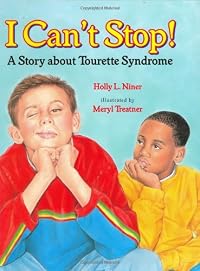
Every page but one is illustrated. The colors are realistic, but bright, and the details are meticulous – one can even read the time on Nathan’s mom’s wristwatch. The cover art is an engaging illustration of a winking Nathan and his friend, Josh.
I Can’t Stop! A Story About Tourette Syndrome, will most likely have limited appeal outside the friends, family, and teachers of children with Tourette’s. It is not without merit, but Marcia Byalick’s Quit It, set a standard for books on TS that I Can’t Stop, cannot top.
CONNECTIONS
For slightly older readers (ages 9 and up), suggest Quit It by Marcia Byalick. Carrie, Quit It's protagonist, is a likeable and believable character with the same issues that many children face, in addition to TS.
For parents or teachers of children with TS, suggest Children with Tourette Syndrome: A Parents' Guide, edited by Tracy Lynne Marsh. This book is in its second printing and was favorably reviewed by Library Journal and Kirkus Reports.
Public librarians can suggest I have Tourette's but Tourette's doesn't have me, a DVD produced by the Tourette Syndrome Association and HBO. show less
Nathan’s tics are causing problems for him at home and school. After visiting an eye doctor, Nathan and his parents see a specialist who informs them that Nathan has TS. Nathan ultimately shares the information with his classmates. With the help of his family and best friend, Josh, he practices strategies to cope with his disability.
I Can’t Stop! A Story About Tourette Syndrome is useful as a primer on this fairly common, “as many as one in a hundred,” neurological show more disorder. Nathan, the protagonist with TS, appears to be about 11 or 12 years old, but the book’s simplistic style and limited vocabulary is targeted to a younger audience, ‘Josh said ...“I’m your best friend, aren’t I?” Nathan felt better. “The best,” he said.’ The story line is also simple, and there is little information offered about Nathan other than his disability.
The book is factually accurate and offers an insider’s look at life with TS, however, at times it reads like a non-fiction book, “When you want to move any part of your body, one area of your brain sends a message to another, said Dr. Phillips. “Chemicals carry these messages. People with tics have too much of a chemical that turns movements on.”
Other times, the dialogue stretches the limits of credibility, as when Nathan tells Josh that he is having difficulty learning to change his tics and Josh replies, “That’s OK ... I practice my spelling words every day, and I still get some wrong.”
Author Holly Niner, was definitely not trying to curry favor with librarians in the writing of I Can’t Stop! When Nathan’s tics cause him to bark twice in the library, Nathan and Josh are summarily ejected by the librarian. While sports and exercise are strongly encouraged for children with TS, non-athletic children may also take issue with this book. Nathan’s only successes come from his prowess on the soccer field and the swim team.
Meryl Treatner’s illustrations are, for the most part, lifelike and believable, particularly Nathan’s facial tics and the expressions of his family members, showing in turn annoyance, concern, and happiness. The depictions of Nathan watching TV with his dad, tapping his pencil at school, and attending swim practice, could be illustrations of any child. Only Treatner’s interpretations of the insensitive children at school are exaggerated. In two instances, they are drawn standing in a group, pointing, snickering, and guffawing in a larger-than-life manner, lacking the deceitfulness which usually accompanies this type of teasing.
Every page but one is illustrated. The colors are realistic, but bright, and the details are meticulous – one can even read the time on Nathan’s mom’s wristwatch. The cover art is an engaging illustration of a winking Nathan and his friend, Josh.
I Can’t Stop! A Story About Tourette Syndrome, will most likely have limited appeal outside the friends, family, and teachers of children with Tourette’s. It is not without merit, but Marcia Byalick’s Quit It, set a standard for books on TS that I Can’t Stop, cannot top.
CONNECTIONS
For slightly older readers (ages 9 and up), suggest Quit It by Marcia Byalick. Carrie, Quit It's protagonist, is a likeable and believable character with the same issues that many children face, in addition to TS.
For parents or teachers of children with TS, suggest Children with Tourette Syndrome: A Parents' Guide, edited by Tracy Lynne Marsh. This book is in its second printing and was favorably reviewed by Library Journal and Kirkus Reports.
Public librarians can suggest I have Tourette's but Tourette's doesn't have me, a DVD produced by the Tourette Syndrome Association and HBO. show less
This is a very heart string puller, it toke me reading it twice not to cry. This is a story about tourettes syndrome. I found this book engaging, informative, and easy to follow. It is a long book but gets the point or plot of the story across in way that even adults can understand about this condition and the progress in the management of this condition. This book is mature reading, if the student is old enough to read on their own.
Age: 3-5 years old
Source: Pierce College Library at Fort Steilacoom
Age: 3-5 years old
Source: Pierce College Library at Fort Steilacoom
A story that is given a very clear picture about a child dealing with tourettes syndrome. Very good informational book about this syndrome, even gives a page to parents to better explain the syndrome.
About a boy who begins to experience symptoms of tourette's syndrome. He doesn't quite understand it but through the book his family and friend help him to accept it. At the end another child makes fun of him but him and his friend stand up to the bully and explain that its okay to be different.
Members
- Recently Added By
Author Information
5 Works 199 Members
Classifications
- Genre
- Children's Books
- DDC/MDS
- 616.83 — Applied science & technology Medicine & health Diseases, Allergies, Skin Conditions Nervous Disorders: Autism, Anorexia, OCD Other organic diseases of central nervous system
- LCC
- PZ7 .N62 — Language and Literature Fiction and juvenile belles lettres Fiction and juvenile belles lettres Juvenile belles lettres
- BISAC
Statistics
- Members
- 59
- Popularity
- 520,757
- Reviews
- 35
- Rating
- (4.33)
- Languages
- English
- Media
- Paper, Ebook
- ISBNs
- 4
- ASINs
- 1