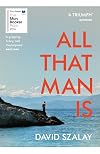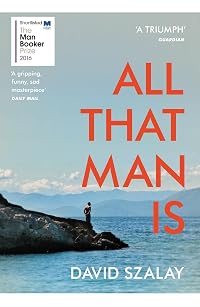
All That Man Is
by David Szalay
On This Page
Description
Here are nine men. Each of them is at a different stage in life, each of them is away from home, and each of them is striving - in the suburbs of Prague, in an over-developed Alpine village, beside a Belgian motorway, in a crap Cypriot hotel - to understand just what it means to be alive, here and now. Vibrating with detail and intelligence, pathos and surprise, All That Man Is is a portrait of contemporary manhood, contemporary Europe and contemporary life from a British writer of supreme show more gifts - the master of a new kind of realism. show lessTags
Recommendations








Member Reviews
"It depresses him. Depresses him out of all proportion, you would think, to what actually happened, embarrassing as that was." (pg. 396)
I'm staggered by our publishing culture sometimes, and not in a good way. This book was woefully inert. But before getting into a critique of the stories, it's also worth pointing out that, yes, these are stories. All That Man Is is a collection of nine short stories, linked together by the most desultory of threads so that the people behind the book can market it as a 'novel'. Novels sell better, you see, far better than short story collections; and they think you the reader (no, the consumer) are too thick to recognise this trend. Now, this didn't bother me so much, as I quite like short stories, but show more it was a further insult added to the criticisms I detail below. To my mind, writing that gets published nowadays often leaves a lot to be desired, but it seems that, increasingly, earnest readers aren't just being let down by the publishing industry, they're being actively scammed.
Once I acknowledged the sting of this slap, and with a genuine interest in engaging with short stories, I was appalled at how pointless all of the stories in All That Man Is were. It "chronicles ennui", they say, of this and books like this; it follows "directionless men" and "finds the dignity in ordinary lives". But that wasn't my experience of the book. Author David Szalay can write tolerably well – though there are caveats even of that slight praise – but he doesn't allow any of his characters any dignity. It's a sequence of wretched, feckless skirt-chasers mooching about; rootless, idle men engaging in tawdry, pitiful activities without any hope of improvement, or even change. Before reading the book, I was surprised to find that a book about masculinity had even been published in an industry dominated by painfully right-on, middle-class women, let alone nominated for a prestigious prize. But after reading – or rather, enduring – Szalay as he ritually flays, degrades and mocks his male characters, who are presented as useless, lazy, sex-obsessed shells without societal value or interests of their own, I'm no longer surprised. This is certainly not "all that man is", though it is, seemingly, all that our culture and our well-connected, artificially-elevated 'artists' can see them as.
The book is so banal that I felt humiliated; rather than any catharsis coming from laying into the author or the publishing culture, I feel embarrassed at airing my criticisms. I feel like the victim of a scam, reporting to the faceless authorities over the phone that I have been conned, and getting the impression that they think I ought to have known better. Even when Szalay's writing is tolerably good, he indulges in some basic blunders that any invested editor would have flagged. For example, Szalay has a penchant for unnecessary detail; he won't say sunglasses when he can say Ray-Ban Wayfarers, or car when he can say Audi Q3. Such detail is irrelevant and the fact that it survives in the final piece highlights that much of the rest is irrelevant too. None of the stories end with any sort of resolution or insight – not even a strong line – and the dialogue is so bland and so unconnected to anything in the plots (for what they're worth) that I just wanted everyone to stop speaking and for the book to be over already.
The problem, even then, isn't that Szalay's writing is depressing or insipid or featureless, or even that the book corrals its sad-sack male specimens simply to provide yet another morose cultural freakshow for the chattering classes to feel superior to. It's that Szalay doesn't even try to find purpose, dignity, or even a mere glimpse of clarity for his characters – and, by extension, for his readers, who presumably follow characters in order to invest in their stories and see them emerge. What sort of artist are we breeding, who doesn't see it as his purpose to elevate, through the medium of art – to provide insight or value? All That Man Is is just so damn pointless, and pointlessness appears to be the point. There are men in the world in need of direction, who might want a story to latch onto, an artist who speaks to them in their core, but they aren't likely to find it in a toneless story about a man chasing poon and being useless. No matter how craftily it's marketed.
You do have to wonder what these writers learn in their workshops, and what goes through the heads of agents and editors when they not only engage with this stuff, but choose it over the wealth of unpublished writing that must surely exist out there. Surely there must be something more original out there than this painful guff, if the self-satisfied denizens of the industry had the courage to look? There seem to be a lot of writers chronicling ennui and supposedly 'ordinary lives' nowadays, and I suspect it's because they want to be known as writers and they know the right people, but when it comes down to it none of them actually have a damn thing to say. show less
I'm staggered by our publishing culture sometimes, and not in a good way. This book was woefully inert. But before getting into a critique of the stories, it's also worth pointing out that, yes, these are stories. All That Man Is is a collection of nine short stories, linked together by the most desultory of threads so that the people behind the book can market it as a 'novel'. Novels sell better, you see, far better than short story collections; and they think you the reader (no, the consumer) are too thick to recognise this trend. Now, this didn't bother me so much, as I quite like short stories, but show more it was a further insult added to the criticisms I detail below. To my mind, writing that gets published nowadays often leaves a lot to be desired, but it seems that, increasingly, earnest readers aren't just being let down by the publishing industry, they're being actively scammed.
Once I acknowledged the sting of this slap, and with a genuine interest in engaging with short stories, I was appalled at how pointless all of the stories in All That Man Is were. It "chronicles ennui", they say, of this and books like this; it follows "directionless men" and "finds the dignity in ordinary lives". But that wasn't my experience of the book. Author David Szalay can write tolerably well – though there are caveats even of that slight praise – but he doesn't allow any of his characters any dignity. It's a sequence of wretched, feckless skirt-chasers mooching about; rootless, idle men engaging in tawdry, pitiful activities without any hope of improvement, or even change. Before reading the book, I was surprised to find that a book about masculinity had even been published in an industry dominated by painfully right-on, middle-class women, let alone nominated for a prestigious prize. But after reading – or rather, enduring – Szalay as he ritually flays, degrades and mocks his male characters, who are presented as useless, lazy, sex-obsessed shells without societal value or interests of their own, I'm no longer surprised. This is certainly not "all that man is", though it is, seemingly, all that our culture and our well-connected, artificially-elevated 'artists' can see them as.
The book is so banal that I felt humiliated; rather than any catharsis coming from laying into the author or the publishing culture, I feel embarrassed at airing my criticisms. I feel like the victim of a scam, reporting to the faceless authorities over the phone that I have been conned, and getting the impression that they think I ought to have known better. Even when Szalay's writing is tolerably good, he indulges in some basic blunders that any invested editor would have flagged. For example, Szalay has a penchant for unnecessary detail; he won't say sunglasses when he can say Ray-Ban Wayfarers, or car when he can say Audi Q3. Such detail is irrelevant and the fact that it survives in the final piece highlights that much of the rest is irrelevant too. None of the stories end with any sort of resolution or insight – not even a strong line – and the dialogue is so bland and so unconnected to anything in the plots (for what they're worth) that I just wanted everyone to stop speaking and for the book to be over already.
The problem, even then, isn't that Szalay's writing is depressing or insipid or featureless, or even that the book corrals its sad-sack male specimens simply to provide yet another morose cultural freakshow for the chattering classes to feel superior to. It's that Szalay doesn't even try to find purpose, dignity, or even a mere glimpse of clarity for his characters – and, by extension, for his readers, who presumably follow characters in order to invest in their stories and see them emerge. What sort of artist are we breeding, who doesn't see it as his purpose to elevate, through the medium of art – to provide insight or value? All That Man Is is just so damn pointless, and pointlessness appears to be the point. There are men in the world in need of direction, who might want a story to latch onto, an artist who speaks to them in their core, but they aren't likely to find it in a toneless story about a man chasing poon and being useless. No matter how craftily it's marketed.
You do have to wonder what these writers learn in their workshops, and what goes through the heads of agents and editors when they not only engage with this stuff, but choose it over the wealth of unpublished writing that must surely exist out there. Surely there must be something more original out there than this painful guff, if the self-satisfied denizens of the industry had the courage to look? There seem to be a lot of writers chronicling ennui and supposedly 'ordinary lives' nowadays, and I suspect it's because they want to be known as writers and they know the right people, but when it comes down to it none of them actually have a damn thing to say. show less
Daunted once again by the skills of a young author, [author:David Szalay|1360792], Canadian by birth and one of Granta's Top Novelists under Forty or whatever category they chose in 2013. [book:All That Man Is|26046318] at first is disconcerting because it is nine separate stories, largely unconnected, of dissatisfied men at various stages in their lives, living in European countries such as Italy, Cyprus, England, Hungary, Croatia, Belgium, and contemplating their futures through an episode of failed relationships or financial doubt. Most of the tales contain "a maelstrom of despair" as bad luck. hopeless sex and missed opportunities take their toll yet I couldn't stop reading, even knowing I would leave this particular character at show more the end of the chapter. The men look in the mirror. often hungover, to see "a dead-eyed flaccidity...a flushed indifference" in contemplating their future and current crisis. "Let us love what is eternal and not what is transient" reads a description in a Ravenna abbey in the last chapter as the protagonist contemplates the final mysteries. [Note to sister who spurns bleak stories, you can skip this book.] Its structure grew on me as I too contemplated the greater schemes of life and what it is left after seven decades. show less
From the nine stories in this collection, all that man is might seem to be a bit sad, a bit disappointed, and yet precious all the same. Of course David Szalay isn’t trying to capture all that man is. Rather, I suspect each story here captures its principal male lead at a moment in time that sums up his character. In that case, probably only Simon, from the first story, and Tony, Simon’s grandfather, from the final story (these are the only two stories that have a direct connection), are entirely positive portrayals. Each of the other men at the other stages of life between 18 and 73 are variously stunted, shallow, self-absorbed, despairing, or vile. So, not a pretty picture. Nevertheless, each of them is a compelling portrait show more running across types, European nations, and political persuasions. I was riveted.
The writing here is precise and nuanced. Szalay brings each story to life with just enough detail to allow us to situate his protagonist. And enough interiority for us to appreciate his plight. Sometimes these are men you don’t really want to spend too much time with, which lends support to the choice of form that Szalay has made. But with others, I would gladly have followed them over the course of a novel. So the brevity cuts both ways.
The overall impression is simply of a writer in complete command of his palette. If this is the first book by Szalay that you have read, as it was for me, you’ll immediately want to search out anything else he might have written and hope, given his relative youth, that there is a great deal more to come. Highly recommended. show less
The writing here is precise and nuanced. Szalay brings each story to life with just enough detail to allow us to situate his protagonist. And enough interiority for us to appreciate his plight. Sometimes these are men you don’t really want to spend too much time with, which lends support to the choice of form that Szalay has made. But with others, I would gladly have followed them over the course of a novel. So the brevity cuts both ways.
The overall impression is simply of a writer in complete command of his palette. If this is the first book by Szalay that you have read, as it was for me, you’ll immediately want to search out anything else he might have written and hope, given his relative youth, that there is a great deal more to come. Highly recommended. show less
3.5 to 4 stars
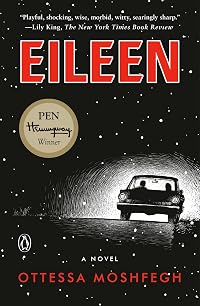
This was a welcome cleanse from Eileen.
David Szalay is erudite, cerebral and wise beyond his years. And sometimes a little boring.
In this work, he's woven the "everyday" lives of men into a wonderful tableau that offers the reader time to pause and reflect on the stages of one's life. He offers insight and wisdom by painting the minutiae of life so beautifully that one reconsiders the actions of one's life and realizes ... yes, it really was a work of art, having lived through those times. Our lives are all a work of art. It all depends on the perspective.
What I loved most about this introspective work is that none of the stories carries judgment on the lives lived: it is simply a mirror that shines back into the gazer's show more eyes. Very few authors seem to be able to step back and offer the unabridged versions of their characters: there is always some praise or condemnation, always some little aside that shows you the writer is in control. David Szalay offers none of this -- he just offers it to you clean, unspoilt and straightforward.
There are a few flagging moments, dead-centre-in-the-middle of the book, and I can't resolve in my mind if this is intentional, or just the author losing a little steam before he picks up again and flies to a very satisfying conclusion. My unresolve on this point makes me teeter between 3.5 and 4 stars. The rest is beautifully crafted. There is also my unresolved ambivalence of his treatment of women: they are depthless and superficial. But then, the author never purported to be writing a story of all that woman is, so on that point, I must abstain from judgment.
There is no guesswork trying to determine what it IS that man is. Szalay offers his vision of a man's life from the outset. Simon, a young dreamer in the first story, is reading The Ambassadors by Henry James, and he meaningfully highlights a passage for himself: Live all you can; it's a mistake not to. It doesn't so much matter what you do in particular so long as you have your life. If you haven't had that what have you had? … I haven’t done so enough before—and now I'm too old; too old at any rate for what I see. … What one loses one loses; make no mistake about that. … Still, we have the illusion of freedom; therefore don't be, like me, without the memory of that illusion. I was either, at the right time, too stupid or too intelligent to have it; I don’t quite know which. Of course at present I'm a case of reaction against the mistake. … Do what you like so long as you don't make my mistake. For it was a mistake. Live!
It sets the tone for the rest of the stories.
Each lives according to his own potential, his own terms.
(While there are those who consider Simon not "living live" by not choosing to take advantage of sexual favours offered him, I would disagree and suggest Simon is living exactly as he is meant to, being true to his inner nature and not succumbing to the pressures of his friend, and the greater expectations of what he "should" do as opposed to what he wants to do.)
I'm disappointed that this is a collection of short stories and not a novel for I feel Szalay has much to say and the confines of a short story do not offer him full potential to exercise his art fully.
I'm surprised that it's a Booker contender, based on the short-story format and would be surprised if it garnered the prize based on that alone. show less
This was a welcome cleanse from Eileen.
David Szalay is erudite, cerebral and wise beyond his years. And sometimes a little boring.
In this work, he's woven the "everyday" lives of men into a wonderful tableau that offers the reader time to pause and reflect on the stages of one's life. He offers insight and wisdom by painting the minutiae of life so beautifully that one reconsiders the actions of one's life and realizes ... yes, it really was a work of art, having lived through those times. Our lives are all a work of art. It all depends on the perspective.
What I loved most about this introspective work is that none of the stories carries judgment on the lives lived: it is simply a mirror that shines back into the gazer's show more eyes. Very few authors seem to be able to step back and offer the unabridged versions of their characters: there is always some praise or condemnation, always some little aside that shows you the writer is in control. David Szalay offers none of this -- he just offers it to you clean, unspoilt and straightforward.
There are a few flagging moments, dead-centre-in-the-middle of the book, and I can't resolve in my mind if this is intentional, or just the author losing a little steam before he picks up again and flies to a very satisfying conclusion. My unresolve on this point makes me teeter between 3.5 and 4 stars. The rest is beautifully crafted. There is also my unresolved ambivalence of his treatment of women: they are depthless and superficial. But then, the author never purported to be writing a story of all that woman is, so on that point, I must abstain from judgment.
There is no guesswork trying to determine what it IS that man is. Szalay offers his vision of a man's life from the outset. Simon, a young dreamer in the first story, is reading The Ambassadors by Henry James, and he meaningfully highlights a passage for himself: Live all you can; it's a mistake not to. It doesn't so much matter what you do in particular so long as you have your life. If you haven't had that what have you had? … I haven’t done so enough before—and now I'm too old; too old at any rate for what I see. … What one loses one loses; make no mistake about that. … Still, we have the illusion of freedom; therefore don't be, like me, without the memory of that illusion. I was either, at the right time, too stupid or too intelligent to have it; I don’t quite know which. Of course at present I'm a case of reaction against the mistake. … Do what you like so long as you don't make my mistake. For it was a mistake. Live!
It sets the tone for the rest of the stories.
Each lives according to his own potential, his own terms.
I'm disappointed that this is a collection of short stories and not a novel for I feel Szalay has much to say and the confines of a short story do not offer him full potential to exercise his art fully.
I'm surprised that it's a Booker contender, based on the short-story format and would be surprised if it garnered the prize based on that alone. show less
Beautifully written, but ultimately unsatisfying, this collection of short pieces could have been titled " The General Uselessness of Men". All that man is, suggests David Szalay, is ultimately not very much at all. Having just read "The Girls" by Emma Cline - where there is nary a male character in sight - it feels somehow appropriate to follow it by reading a book about men, in which almost every female merely exists to demonstrate to the male protagonists their own inferiority by being accessible to almost all males other than them. See the Serbian landlady in Story 1, Iveta from Latvia in Story 2, Emma the Hungarian pornstar / escort in Story 3, Ksena the trophy wife in Story 8 (hmm and they are mainly Eastern European too - what's show more going on there?)etc
In brief the 9 pieces, short stories if you like, follow everyman characters (although it must be said that most are comfortably white and middle class) through a lifetime of male crisis points. The early sexual hesitancy, chasing the unachievable, settling for what you can get, throwing yourself at what you've got, chasing and getting something you don't actually want, feeling there must be must be more to life that this, realising that what you do want is no longer available to you, losing everything and waiting for time to run out. Depressing no? But the characterisation is so good, that somehow its not depressing and you want to settle in with all of these characters for more than the 50 or so pages you get
And that's why this is unsatisfying ultimately. Szalay is so good at instantly setting a scene, at creating immediate empathy with these bumbling characters, has so many good jokes and nice points of observation that you want to stay with them for longer - well, other than Kristian the po-faced Danish journalist in Story 4, that is. In my view Szalay would have been better to choose one or two of these characters and create something richer. Nothing stopping him doing that in future of course, and I hope he does. This is very readable and entertaining but could have been more show less
In brief the 9 pieces, short stories if you like, follow everyman characters (although it must be said that most are comfortably white and middle class) through a lifetime of male crisis points. The early sexual hesitancy, chasing the unachievable, settling for what you can get, throwing yourself at what you've got, chasing and getting something you don't actually want, feeling there must be must be more to life that this, realising that what you do want is no longer available to you, losing everything and waiting for time to run out. Depressing no? But the characterisation is so good, that somehow its not depressing and you want to settle in with all of these characters for more than the 50 or so pages you get
And that's why this is unsatisfying ultimately. Szalay is so good at instantly setting a scene, at creating immediate empathy with these bumbling characters, has so many good jokes and nice points of observation that you want to stay with them for longer - well, other than Kristian the po-faced Danish journalist in Story 4, that is. In my view Szalay would have been better to choose one or two of these characters and create something richer. Nothing stopping him doing that in future of course, and I hope he does. This is very readable and entertaining but could have been more show less
Ha valaki nem szereti a nyitott végű novellákat, kézbe se vegye. Mindnek nyitva marad a vége. Kilenc történetben kilenc különböző férfi életének egy-egy fordulópontját látjuk, szépen felépítve, és lezárás nélkül otthagyva. A könyvben haladva egyre későbbi életszakaszban lévő főszereplőt kapunk, de nem csak a vége felé volt depresszív.
Eleinte annyira központi szerepet játszott a szex, hogy gondoltam, ha ez minden, ami férfi, akkor az azért nagyon kiábrándító. Aztán jött a nyelvész, és ott kezdett igazán tetszeni. Addig is láttam, hogy ez nagyon jól van megírva, de azt már szerettem is. Voltak iszonyúan kellemetlen főszereplők, akiknél alig vártam, hogy szabadulhassak a show more világukból, és voltak nagyon érdekes gondolatmenetek másoknál.
Az is eszembe jutott közben, hogy bár mindenféle nagy fordulópontokhoz érünk és idegeskednek, aggódnak, vívódnak, stb, valóban nincs az az őrületes érzelmi hullámzás vagy talán intenzitás, mint a nőknél (szokták mondani, hogy ez így van, a hormonok miatt, nem tudom, sosem voltam férfi). Mondjuk elég egy lehangolt állandó ez, akkor már inkább a hullámvasút. Viszont jó volt belelátni a férfilélekbe, a 4 3 2 1 is felidéződött bennem, amikor azt éreztem, hogy kissé talán illetéktelenül, kissé talán túlságosan belelátok remekül ábrázolt szereplők legszemélyesebb gondolataiba.
Közben bejártuk Európát, úgyhogy a nyelvmániámat abszolút kielégítette, egyedül a magyar szereplők neveit és bmegjeit volt furcsa angol szövegben olvasni – ez nyilván el is tűnik a magyar fordításban. (Látom, van olasz változat is, kíváncsi lennék, mihez kezdtek azzal a résszel, ahol a szereplő soronként fordítja az olasz kislány mondókáját.)
Nagyon tetszett, amikor felfedeztem, hogy az egyes novellák szereplői kapcsolódnak,például valószínűleg a mindenét elvesztett orosz jachtját látja a horvát tengerpartról az előző történet főszereplője; az utolsó történetben pedig valószínűleg az orosztól kapott bort issza a férfi, aki egészen biztosan az első novella főszereplőjének nagyapja.
Jó szöveg, akit a nyitott vég nem borít ki, olvassa bátran. show less
Eleinte annyira központi szerepet játszott a szex, hogy gondoltam, ha ez minden, ami férfi, akkor az azért nagyon kiábrándító. Aztán jött a nyelvész, és ott kezdett igazán tetszeni. Addig is láttam, hogy ez nagyon jól van megírva, de azt már szerettem is. Voltak iszonyúan kellemetlen főszereplők, akiknél alig vártam, hogy szabadulhassak a show more világukból, és voltak nagyon érdekes gondolatmenetek másoknál.
Az is eszembe jutott közben, hogy bár mindenféle nagy fordulópontokhoz érünk és idegeskednek, aggódnak, vívódnak, stb, valóban nincs az az őrületes érzelmi hullámzás vagy talán intenzitás, mint a nőknél (szokták mondani, hogy ez így van, a hormonok miatt, nem tudom, sosem voltam férfi). Mondjuk elég egy lehangolt állandó ez, akkor már inkább a hullámvasút. Viszont jó volt belelátni a férfilélekbe, a 4 3 2 1 is felidéződött bennem, amikor azt éreztem, hogy kissé talán illetéktelenül, kissé talán túlságosan belelátok remekül ábrázolt szereplők legszemélyesebb gondolataiba.
Közben bejártuk Európát, úgyhogy a nyelvmániámat abszolút kielégítette, egyedül a magyar szereplők neveit és bmegjeit volt furcsa angol szövegben olvasni – ez nyilván el is tűnik a magyar fordításban. (Látom, van olasz változat is, kíváncsi lennék, mihez kezdtek azzal a résszel, ahol a szereplő soronként fordítja az olasz kislány mondókáját.)
Nagyon tetszett, amikor felfedeztem, hogy az egyes novellák szereplői kapcsolódnak,
Jó szöveg, akit a nyitott vég nem borít ki, olvassa bátran. show less
Daunted once again by the skills of a young author, [author:David Szalay|1360792], Canadian by birth and one of Granta's Top Novelists under Forty or whatever category they chose in 2013. [book:All That Man Is|26046318] at first is disconcerting because it is nine separate stories, largely unconnected, of dissatisfied men at various stages in their lives, living in European countries such as Italy, Cyprus, England, Hungary, Croatia, Belgium, and contemplating their futures through an episode of failed relationships or financial doubt. Most of the tales contain "a maelstrom of despair" as bad luck. hopeless sex and missed opportunities take their toll yet I couldn't stop reading, even knowing I would leave this particular character at show more the end of the chapter. The men look in the mirror. often hungover, to see "a dead-eyed flaccidity...a flushed indifference" in contemplating their future and current crisis. "Let us love what is eternal and not what is transient" reads a description in a Ravenna abbey in the last chapter as the protagonist contemplates the final mysteries. [Note to sister who spurns bleak stories, you can skip this book.] Its structure grew on me as I too contemplated the greater schemes of life and what it is left after seven decades. show less
Members
- Recently Added By
Lists

Man Booker Prize Longlist 2016
13 works; 2 members

BBC Radio 4 Bookclub
341 works; 13 members

Books Read in 2018
4,360 works; 110 members

Books Read in 2026
2,036 works; 68 members
Author Information

9+ Works 2,249 Members
Awards and Honors
Awards
Distinctions
Series
Belongs to Publisher Series
Fabula [Adelphi] (324)
Work Relationships
Is contained in
Common Knowledge
Classifications
Statistics
- Members
- 723
- Popularity
- 39,283
- Reviews
- 26
- Rating
- (3.86)
- Languages
- 8 — Dutch, English, French, German, Italian, Portuguese, Serbian, Turkish
- Media
- Paper, Audiobook, Ebook
- ISBNs
- 30
- ASINs
- 9