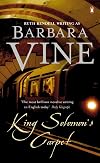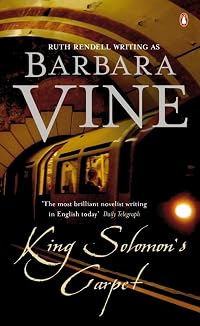
King Solomon's Carpet
by Barbara Vine
On This Page
Description
From an Edgar Award–winning author: Murder intrudes on a student's secret history of the London Underground in this "brilliantly unexpected" mystery (The Times, London). Jarvis Stringer is a young man of many peculiarities, but no obsession has taken hold quite like that of writing the strange and twisting history of the London Underground. To finance his project, he rents out cheap rooms in the long-disused West Hampstead schoolhouse he inherited—a crumbling monument to morbid local show more lore. The boarders, each eking out their invisible lives above—and beneath—the city's surface, are a collection of strays, waifs, subway buskers, and loners, who are raising the concern of Jarvis's relatives and more proper neighbors. But even Jarvis has become suspicious. One of his outcasts may be a killer who's plotting something unforgettable and catastrophic—and Jarvis himself has unwittingly become a conspirator. "A jolting novel of psychological suspense," King Solomon's Carpet was the recipient of the Crime Writers' Association Gold Dagger Award (The New York Times Book Review). Fiction. Mystery. show lessTags
Recommendations


















Member Reviews
A lot of how you respond to a book is to do with the expectations you bring to it. Given the author, whose works I often like, I expected this to be good, and moreover good in the ways that are typical of Ruth Rendell and of crime novels. But after about 50 pages, I was starting to wonder, and by the end I was sadly concluding that this is one of the worst in the CWA sequence so far.
The first thing you might expect of a crime novel is a central plot, a narrative focussed on a particular crime, its committal, its consequences, its detection (or, more broadly, a narrative structure generating tension and suspense and thrill). But it’s very hard to say what the plot of this book actually is. It centres around the oddball inhabitants of a show more sort-of squat (a Vine trope?), and seems to attempt a sort of panoptic insight into their lives and their associations; we follow first one, then another, then a third, as they drift around doing things. Occasionally we divert into following a friend or relative of one of our primary gang. We sometimes go even further from the core: for example, we get a couple of sections of a few pages each focussing on the person who nicked one of the more central character’s handbag, telling us what he did with the money and how he met his deserved sticky end. None of it adds up to anything.
Now admittedly, a few of th0se primary people are more intertwined and more focal than others. The three who come closest to forming a plot are Axel, a terrorist hatching an implausible scheme to bomb the London Underground; Alice, who Axel implausibly seduces as part of his implausible scheme; and Tom, who is implausibly infatuated with Alice and implausibly blind to her seduction. As you may have gathered, this is all very implausibly done, and don’t let me give the impression that this is the narrative engine of the book. There is no narrative engine. The events that do occur are telegraphed well ahead of their happening, just so we don’t get the notion that there’s any attempt being made here to build suspense.
The one thing that comes closest to uniting the various bits of the book is that they’re all connected, more or less, to the London Underground. Some of the cover blurb says that Vine “audaciously makes the Underground the central character”. I suppose if by that you mean “bangs on about it a lot” you’re right. There are many passages in the book reminiscent of that things that happens when you’re in London: you mention where you’re staying, and every Londoner in earshot tries to tell you how you must have got to wherever you are, by which lines, etc. I was going to type one of these passages out to prove it, but the one I picked has 10 mentions of various lines and stations in it, and I just cannot be bothered. You can read it yourself if you want.
It comes to seem like the ambition of the book is something in the vein of Balzac or Zola: a realist portrayal of a section of the populace executed via detailed description of their lives, sustained just by the interest of that description rather than by any real narrative driving it along. Now, that’s a fine enough ambition, but what a novel with those aims is doing in the crime writing awards I don’t know.
Besides, while we might give full marks for ambition, we have to give very few for execution. Rendell utterly fails to deliver her usual acute psychology; as I’ve suggested, nearly all the characters are implausibly motivated, implausibly irrational, and implausibly stupid. The settings, events, and so forth are all equally unconvincing. I’m sadly reminded of that awful Fleming novel: the same sense of someone trying to offer description and implicit comment on something they know nothing about.
To ice this terrible cake, the book is written in weird, stilted prose, like someone trying out English. For example there are lots of constructions of this kind:
“the chocolate bar that is called a Twirl”
“the kind of ice cream that is called a Dracula”
So many it must be deliberate. But to what end? Nobody thinks like this, nobody speaks like this, and it’s an utter mystery to me why anyone would want to write stuff like this. Or, indeed, to read it. show less
The first thing you might expect of a crime novel is a central plot, a narrative focussed on a particular crime, its committal, its consequences, its detection (or, more broadly, a narrative structure generating tension and suspense and thrill). But it’s very hard to say what the plot of this book actually is. It centres around the oddball inhabitants of a show more sort-of squat (a Vine trope?), and seems to attempt a sort of panoptic insight into their lives and their associations; we follow first one, then another, then a third, as they drift around doing things. Occasionally we divert into following a friend or relative of one of our primary gang. We sometimes go even further from the core: for example, we get a couple of sections of a few pages each focussing on the person who nicked one of the more central character’s handbag, telling us what he did with the money and how he met his deserved sticky end. None of it adds up to anything.
Now admittedly, a few of th0se primary people are more intertwined and more focal than others. The three who come closest to forming a plot are Axel, a terrorist hatching an implausible scheme to bomb the London Underground; Alice, who Axel implausibly seduces as part of his implausible scheme; and Tom, who is implausibly infatuated with Alice and implausibly blind to her seduction. As you may have gathered, this is all very implausibly done, and don’t let me give the impression that this is the narrative engine of the book. There is no narrative engine. The events that do occur are telegraphed well ahead of their happening, just so we don’t get the notion that there’s any attempt being made here to build suspense.
The one thing that comes closest to uniting the various bits of the book is that they’re all connected, more or less, to the London Underground. Some of the cover blurb says that Vine “audaciously makes the Underground the central character”. I suppose if by that you mean “bangs on about it a lot” you’re right. There are many passages in the book reminiscent of that things that happens when you’re in London: you mention where you’re staying, and every Londoner in earshot tries to tell you how you must have got to wherever you are, by which lines, etc. I was going to type one of these passages out to prove it, but the one I picked has 10 mentions of various lines and stations in it, and I just cannot be bothered. You can read it yourself if you want.
It comes to seem like the ambition of the book is something in the vein of Balzac or Zola: a realist portrayal of a section of the populace executed via detailed description of their lives, sustained just by the interest of that description rather than by any real narrative driving it along. Now, that’s a fine enough ambition, but what a novel with those aims is doing in the crime writing awards I don’t know.
Besides, while we might give full marks for ambition, we have to give very few for execution. Rendell utterly fails to deliver her usual acute psychology; as I’ve suggested, nearly all the characters are implausibly motivated, implausibly irrational, and implausibly stupid. The settings, events, and so forth are all equally unconvincing. I’m sadly reminded of that awful Fleming novel: the same sense of someone trying to offer description and implicit comment on something they know nothing about.
To ice this terrible cake, the book is written in weird, stilted prose, like someone trying out English. For example there are lots of constructions of this kind:
“the chocolate bar that is called a Twirl”
“the kind of ice cream that is called a Dracula”
So many it must be deliberate. But to what end? Nobody thinks like this, nobody speaks like this, and it’s an utter mystery to me why anyone would want to write stuff like this. Or, indeed, to read it. show less
Jarvis is a bit of an eccentric: having inherited an old school after his father’s suicide by hanging there, he picks up various people whom he meets and gives them rooms in which to live cheaply. His primary focus is on underground transit systems - the Tube in London of course, BART in the Bay Area, the Metro in France (and Montreal), and so on; he finances trips to these various places by renting the rooms in the school. Some of the characters he has chosen, however, are far more dangerous than he can know…. Barbara Vine is, of course, Ruth Rendell’s pseudonym which she used for her more psychological suspense tales, and "King Solomon’s Carpet" is no exception. In some ways not very much happens here, and what *does* happen show more here takes its sweet time to occur, but one doesn’t read Barbara Vine for thrilling adventures, one reads her for her deep characterizations of human flaws and grandeurs, small moments of emotional truth and odd bits of triumph in a daily, humdrum life. Lovely stuff. show less
Another Vine I couldn’t really get into. The inclusion of text from a fictional book about the distinctly real London Underground was distracting and to me, didn’t help with the plot or atmosphere. Ditto for some of the scenes showing how dangerous it could be for the uninitiated (the rich woman at the beginning who is trampled to death) or the stupid (Jasper’s train roof riding). It just didn’t convey anything for me since the essential plot seemed to be the manipulative useage of the unwary innocent.
It starts out by introducing Jarvis, train nut and inheritor of a dilapidated former primary school. He has just enough money to keep himself, but decides to supplement his income by ‘renting’ rooms to folks who appear to be show more needy. He gathers a group of down-and-outs and borderline losers around him. All are quirky, damaged and at times at odds with each other. On an extended journey out of the country to research his book, an enterprising Axel Jonas worms his way into the household and begins manipulating people at close range. His real target was Jarvis himself, but will make do with the ones who are left. His efforts coalesce around gaining access to parts of the underground that are normally off limits. Reports of bombs and other disturbances are peppered throughout the narrative. It’s clear that Axel and his pal Ivan are responsible.
Through a subtle reign of terror, Axel succeeds in putting the entire household into an uproar. Alliances and romances are broken. Children are frightened. Underlying psychological weaknesses are exploited. Overall that is a disturbingly interesting thing to read about. Axel was a very nicely written sociopath. I understood how people either fell under his spell or were instantly (and sometimes inexplicably) repelled.
But nothing much ever really happened. What did was presented as mundane and trivial. People are robbed. Mothers acknowledge their daughter’s lies and manipulations. Children defy adults and put themselves at great bodily risk. Old women have strokes and come to realize that they have always been in love with their best friend. It’s all sort of interesting, in a voyeuristic way, but none of it touched me at all. These people were just actors giving me a show. Weird since I usually connect more with Vine’s characters.
The ending is fairly tense, but again, things seem disconnected and the wrap up is ambiguous as usual. That didn’t bother me, but the dispassionate presentation did. show less
It starts out by introducing Jarvis, train nut and inheritor of a dilapidated former primary school. He has just enough money to keep himself, but decides to supplement his income by ‘renting’ rooms to folks who appear to be show more needy. He gathers a group of down-and-outs and borderline losers around him. All are quirky, damaged and at times at odds with each other. On an extended journey out of the country to research his book, an enterprising Axel Jonas worms his way into the household and begins manipulating people at close range. His real target was Jarvis himself, but will make do with the ones who are left. His efforts coalesce around gaining access to parts of the underground that are normally off limits. Reports of bombs and other disturbances are peppered throughout the narrative. It’s clear that Axel and his pal Ivan are responsible.
Through a subtle reign of terror, Axel succeeds in putting the entire household into an uproar. Alliances and romances are broken. Children are frightened. Underlying psychological weaknesses are exploited. Overall that is a disturbingly interesting thing to read about. Axel was a very nicely written sociopath. I understood how people either fell under his spell or were instantly (and sometimes inexplicably) repelled.
But nothing much ever really happened. What did was presented as mundane and trivial. People are robbed. Mothers acknowledge their daughter’s lies and manipulations. Children defy adults and put themselves at great bodily risk. Old women have strokes and come to realize that they have always been in love with their best friend. It’s all sort of interesting, in a voyeuristic way, but none of it touched me at all. These people were just actors giving me a show. Weird since I usually connect more with Vine’s characters.
The ending is fairly tense, but again, things seem disconnected and the wrap up is ambiguous as usual. That didn’t bother me, but the dispassionate presentation did. show less
I didn't really get into this book. It took me a while to figure out who all the characters were and how they all fit together. Once I did that, the book flowed much better for me as it switched from character to character.
Alice's character really annoyed me. She had no resolve, dedication, or personal strength. She gave up on every single decision she ever made. She couldn't rely on herself; she was always looking for someone else for direction, strength, encouragement, fulfillment...basically for everything. Very NON-self-sufficient.
There were parts of this book I really enjoyed. I thought Jasper was a very interesting character. I really enjoyed the bits about the London Underground and all the little stories that were show more included-however, they almost seemed to be teasing you with them and not telling the whole story.
I was disappointed that we never really discovered what Axel's motivation was. It was this question just dangling there at the end of the book. An interesting read, though not my favorite. show less
Alice's character really annoyed me. She had no resolve, dedication, or personal strength. She gave up on every single decision she ever made. She couldn't rely on herself; she was always looking for someone else for direction, strength, encouragement, fulfillment...basically for everything. Very NON-self-sufficient.
There were parts of this book I really enjoyed. I thought Jasper was a very interesting character. I really enjoyed the bits about the London Underground and all the little stories that were show more included-however, they almost seemed to be teasing you with them and not telling the whole story.
I was disappointed that we never really discovered what Axel's motivation was. It was this question just dangling there at the end of the book. An interesting read, though not my favorite. show less
The blurb on the back of this book stated that 'towards the end the tension is almost suffocating'. Absolutely true - I was experiencing considerable tension as I wondered if I had spent £7.99 on a book in which nothing was actually going to happen. So much time was spent creating 'atmosphere' that the plot was all but forgotten. A bit too arty and up-its-own-backside for my liking.
This was an enjoyable book by Barbara Vine (alter-ego of Ruth Rendell). It's well-written, without a false note (as they say), and takes its time coming to conclusion; meandering, circuitous, like the London Underground, which is a central part/theme of the story. The ending is particularly satisfying, happy for some characters, yet sad for others. It should be read with patience.
I should have trusted my instinct (which was that I wouldn't like another Barbara Vine book) but I was fooled by the blurb saying it was a modern-day take on Conrad's Secret Agent which I enjoyed immensely. Now that I have finished, I can somewhat comprehend that description but while Conrad's story thrilled & fascinated me, this one mostly bored me. It is a "psychological thriller"; apparently that means it is about people's thoughts & emotions with very little action (and most of that occurring off-stage). The one person in whose thoughts I would have been interested was of course the one whose thoughts and motivations are not given. And that is one of my biggest complaints of all -- in the end, there is no resolution or explanation. show more I could have put up with all the character-driven stuff if the plot had had some point! Why did Axel want to bomb the tube? Did it have something to do with his sister or was he driven by some anarchist philosophy or what?
Disappointing... show less
Disappointing... show less
Members
- Recently Added By
Lists

The Guardian's 1000 Novels Everyone Must Read
1,005 works; 550 members

Crime Writers' Association Daggers
76 works; 4 members

Novels with a city or town in the title
61 works; 1 member
Author Information

318+ Works 51,263 Members
Ruth Rendell (1930-2015) Ruth Rendell was born in Essex, England on February 17, 1930. She was educated at Loughton County High School. Rendell began her career as a journalist. She wrote six novels before sending her work in to a publisher. She writes crime novels and psychological thrillers, and is best known for her Inspector Wexford books. show more Rendell also writes under the pseudonym Barbara Vine. Rendell has received many awards for her writing, including the Silver, Gold, and Cartier Diamond Daggers from the Crime Writers' Association, three Edgars from the Mystery Writers of America, The Arts Council National Book Awards, and The Sunday Times Literary Award. She is a fellow of the Royal Society of Literature. Many of her titles have been made into films and made-for-tv movies. Rendell died on May 2, 2015. She was 85 years old. (Bowker Author Biography) show less
Some Editions
Awards and Honors
Awards
Notable Lists
Series
Belongs to Publisher Series
Penguin Audiobooks (PEN 153)
detebe (22736)
Common Knowledge
- Original title
- King Solomon's Carpet
- Original publication date
- 1991
- People/Characters
- Tom Murray; Jasper Dame; Axel Jonas; Cecilia Dame; Daphne Bleech-Palmer; Alice (show all 7); Jarvis Stringer
- Dedication
- To the men and women who work for London Transport Underground; and to those who make music in its tunnels.
- First words
- A great many things that other people did all the time she had never done.
- Last words
- (Click to show. Warning: May contain spoilers.)The train went on unharmed down to Finchley Road.
Classifications
Statistics
- Members
- 551
- Popularity
- 53,870
- Reviews
- 14
- Rating
- (3.47)
- Languages
- 8 — Danish, Dutch, English, French, German, Italian, Spanish, Swedish
- Media
- Paper, Audiobook, Ebook
- ISBNs
- 46
- ASINs
- 14