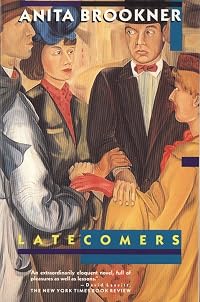
Latecomers
by Anita Brookner
On This Page
Description
Two middle aged men were brought as children out of Nazi Germany and parted from their parents forever. One forgets all memories while the other is a damaged person, a man of sorrows.Tags
Recommendations




























Member Reviews
Hartmann and Fibich come to England as children before the Second World War on the historic kindertransport. They are in every sense of the phrase: displaced persons, and remain so all their lives. They meet and bond with each other in a wretched boarding school. In London they spend their childhood and adolescent years with Hartmann's Aunt Marie, before moving on to lives as successful businessmen, though their business is a frivolous one, low-brow greeting cards at one point, that neither takes seriously. The overarching theme for Hartmann is one of sensuous burial in the present as a means of avoiding unpleasant memories. Yvette, his wife, is deliberately out of step with the liberated women of her generation. She has a severe show more deficit in the empathy department; and her shallowness is admirably reflected in her materialism, which makes her a perfect fit for Hartmann. Everything with Yvette is appearance, surface, display. Everything with Hartmann is pleasure, indulgence, release. Fibich by contrast is someone who has not left his past behind. He is haunted by the Shoah, particularly the loss of his parents. He suffers keenly all his life from what psychologists call "survivor guilt." He wishes to understand it, but it's too much cognitive dissonance that will never lend itself to neat answers. (One is reminded of the guard in Auschwitz who says to Primo Levi: "There is no why here.") The woman Fibich marries, Christine, is Aunt Marie's niece and a more self-effacing and humble character you are unlikely to come across this side of Dickens; though she is without the unbearable tics Dickens gives his characters, or the cloying cheerfulness. Fibich meets Christine when she arrives every Friday to help Aunt Marie prepare her only dish: braised tongue à l'orientale. She stays with Fibich during the aunt's precipitous decline and death, and by then they are bound to each other by mutual pain and loss. Life for Brookner's characters, some of them, is a constant risk and worry. Whatever they do they are marked by a certain paralysis by analysis, stuck to the point of inaction. Though they try they can never remedy their affliction. Such are Fibich and Christine, such is also Hartmann, though Yvette is all instinct, and intuitive grasping. As for the writing, the novel all but leaps to life in your hands. Brookner is such an efficient writer; by p. 84 she has gone through the upbringing, childhood and adult psychological life of all four main characters. The section in which Christine and Fibich have a son of their own, Toto, whose sheer life force all but bowls them over, is dazzling. Toto's familiar is Yvette, with whom he shares an adoration for surfaces. He wants to be an actor, and one has to admit that seems perfect for this debauched Narcissus. This is one of my favorite Brookner novels and I highly recommend it. show less
I wanted to read this after reading a recent Guardian article on Brookner's novels other than the Booker winner Hotel du Lac, which was the only one I had read. This is a poised and reflective study of memory, loss and how different people handle it. At its centre are Hartmann and Fibich, lifelong friends and business partners who met as schoolboy refugees from Germany in the Kindertransports. Brookner contrasts the "voluptuary" Hartmann with the haunted brooding Fibich, and gets inside the minds of all of her characters, drawing warm and humorous portraits of a close family against the backdrop of darker events.
As you can see from my reviews of Anita Brookner's novels which are within the obituary I wrote on the occasion of her death in 2016, I thought I had her 'pegged' as an author of bitter-sweet stories of intelligent middle-class older women reflecting on their poor choices and their wasted lives. These women were emotionally stilted, isolated from society and disappointed by men. I admired her writing, her brilliantly perceptive descriptions and her often droll style, but I always had to be 'in the mood' to read a Brookner.
But...
An episode of Backlisted (about Raymond Chandler, of all people!) began as usual with the chat about who'd been reading what, and Andy Miller told the listeners about a Brookner novel I didn't know, quite show more different to the others I had read:
Latecomers, he said, is an incredibly moving book about two men who came to England as evacuees on the Kindertransport. At first it seems like a book about the friendship between these two men, and about their lives and their families. But gradually you realise that Brookner is sketching a portrait of the effect of a terrible wrench away from home and family on a whole life. This trauma, he said, is rendered with great emotional and intellectual control. It appears elegant, subtle and understated, but it's incredibly ambitious.
Latecomers was on the TBR with a bunch of other Brookners that I'd found at Diversity Books.) January 27th is Holocaust Memorial Day 2023, so I decided to retrieve it from the shelf...
But first, a word about another book I've read about the Kindertransport experience. Years ago, at the Melbourne Writers Festival when it was at the Malthouse, I met the author of Serry and Me, Kindertransport & Beyond (2001) by Elfie Rosenberg. She had been just eight years old when in 1939 she was smuggled out of Nazi Germany with her fifteen-year-old sister and not reunited with her parents until eight years later. My most vivid memory of our conversation over lunch was her ambivalence. She said that she felt that compared to what others suffered in the Holocaust, her experience was 'not so bad' and that it had taken some persuasion for her to contribute her story to the Write Your Story Makor Project (now run by the Lamm Jewish Library of Australia.
Kindertransport, The Final Parting, by Frank Meisler, Hamburg Dammtor station (Wikipedia)
Elfie had stayed with a kindly family in Gloucestershire, and she had the companionship of her sister, but the trauma of the separation and her parents weeping on that last night stayed with her forever. And what she has in common with all other victims of the Nazis, is the horror that the country of her birth was implementing a monstrous genocide in pursuit of their absurd Aryan fantasy of a master race. In what must also have been a terrible wrench for Elfie's parents, they sent her to safety because her life was at risk.
It is this persisting trauma that Brookner portrays with such finesse. Her characters Hartmann and Fibich bond at boarding school over their shared experience of the Kindertransport, neither of them ever to see their family again. Yet they build a successful life in Britain, going into business together, printing greeting-cards and then running a photocopier business which enables them to live comfortably. They marry, and have children, and their very close friendship means that they live in the same block of flats and socialise with each other regularly.
Hartmann appears to come to terms with his losses by denying them.
To read the rest of my review please visit https://anzlitlovers.com/2023/01/24/latecomers-1988-by-anita-brookner/ show less
But...
An episode of Backlisted (about Raymond Chandler, of all people!) began as usual with the chat about who'd been reading what, and Andy Miller told the listeners about a Brookner novel I didn't know, quite show more different to the others I had read:
Latecomers, he said, is an incredibly moving book about two men who came to England as evacuees on the Kindertransport. At first it seems like a book about the friendship between these two men, and about their lives and their families. But gradually you realise that Brookner is sketching a portrait of the effect of a terrible wrench away from home and family on a whole life. This trauma, he said, is rendered with great emotional and intellectual control. It appears elegant, subtle and understated, but it's incredibly ambitious.
Latecomers was on the TBR with a bunch of other Brookners that I'd found at Diversity Books.) January 27th is Holocaust Memorial Day 2023, so I decided to retrieve it from the shelf...
But first, a word about another book I've read about the Kindertransport experience. Years ago, at the Melbourne Writers Festival when it was at the Malthouse, I met the author of Serry and Me, Kindertransport & Beyond (2001) by Elfie Rosenberg. She had been just eight years old when in 1939 she was smuggled out of Nazi Germany with her fifteen-year-old sister and not reunited with her parents until eight years later. My most vivid memory of our conversation over lunch was her ambivalence. She said that she felt that compared to what others suffered in the Holocaust, her experience was 'not so bad' and that it had taken some persuasion for her to contribute her story to the Write Your Story Makor Project (now run by the Lamm Jewish Library of Australia.
Kindertransport, The Final Parting, by Frank Meisler, Hamburg Dammtor station (Wikipedia)
Elfie had stayed with a kindly family in Gloucestershire, and she had the companionship of her sister, but the trauma of the separation and her parents weeping on that last night stayed with her forever. And what she has in common with all other victims of the Nazis, is the horror that the country of her birth was implementing a monstrous genocide in pursuit of their absurd Aryan fantasy of a master race. In what must also have been a terrible wrench for Elfie's parents, they sent her to safety because her life was at risk.
It is this persisting trauma that Brookner portrays with such finesse. Her characters Hartmann and Fibich bond at boarding school over their shared experience of the Kindertransport, neither of them ever to see their family again. Yet they build a successful life in Britain, going into business together, printing greeting-cards and then running a photocopier business which enables them to live comfortably. They marry, and have children, and their very close friendship means that they live in the same block of flats and socialise with each other regularly.
Hartmann appears to come to terms with his losses by denying them.
To read the rest of my review please visit https://anzlitlovers.com/2023/01/24/latecomers-1988-by-anita-brookner/ show less
Story of friends and business partners who first met at school in England as refugees from Germany, though like many of her books, if she didn't say when it was set, you probably wouldn't guess.
Fibich and Hartman are very different in personality and how they cope with loss and trauma from their childhoods, and indeed the troubles that come afterwards in their outwardly successful lives, but they have an intense friendship that lasts throughout their lives, so that each is closer to some members of the other's family than their own.
Most chapters focus on one character, but it manages not to be disjointed; instead you feel more empathy with and thus understanding of the character.
Fibich and Hartman are very different in personality and how they cope with loss and trauma from their childhoods, and indeed the troubles that come afterwards in their outwardly successful lives, but they have an intense friendship that lasts throughout their lives, so that each is closer to some members of the other's family than their own.
Most chapters focus on one character, but it manages not to be disjointed; instead you feel more empathy with and thus understanding of the character.
Not as good as other Brookner books, but it did keep my interest on the ipad. Life stories mainly of 2 men sacrificed as children in Berlin before the Holocaust. They hardly remember their parents of their childhoods and this past is very important to them. Epigenetics definitely involved as both attempt to be exceptional parents and employers. Most of the book takes place in England, although they also find travel very palliative. The ending is sad, but logical.
This isn't a book to read if you're looking for action or dialogue. It's a gentle, insinuating sort of novel. You come to care about the main characters very much, even though not a lot happens to them. It's almost a four-star read, but I did keep checking the page count to see how much further I had to go and that's my definition of a book that doesn't quite make the four-star grade.
Nicely written but just too slow to finish. Shame as the subject interested me.
Members
- Recently Added By
Lists

Books Read in 2025
4,091 works; 97 members
Author Information

35+ Works 12,795 Members
Anita Brookner was born in London, England on July 16, 1928. She received a BA in history from King's College London in 1949 and a doctorate in art history from the Courtauld Institute of Art in 1953. She went on to lecture in art at Reading University and the Courtauld Institute, where she specialized in eighteenth- and nineteenth-century French show more art. She became the first woman to be named as Slade Professor of Art at Cambridge University in 1967. Her first novel, A Start in Life, was published in 1981. Some of her other works include The Bay of Angels, The Next Big Thing, The Rules of Engagement, Latecomers, Leaving Home, Incidents in the Rue Laugier, Look at Me, and Strangers. Hotel du Lac won the Booker Prize for Fiction in 1984 and was adapted for television in 1986. She has also written scholarly works about Jacques Louis David, Jean Baptiste Greuze, and Jean-Antoine Watteau. She died on March 10, 2016 at the age of 87. (Bowker Author Biography) show less
Some Editions
Series
Belongs to Publisher Series
Penguin Decades (1980s)
Common Knowledge
- Original publication date
- 1988
- First words
- Hartman, a voluptuary, lowered a spoonful of brown sugar crystals into his coffee cup, then placed a square of bitter chocolate on his tongue, and, while it was dissolving, lit his first cigarette.
- Blurbers
- Leavitt, David
Classifications
Statistics
- Members
- 509
- Popularity
- 59,026
- Reviews
- 7
- Rating
- (3.73)
- Languages
- 5 — Dutch, English, French, Norwegian (Bokmål), Portuguese
- Media
- Paper, Audiobook, Ebook
- ISBNs
- 24
- UPCs
- 1
- ASINs
- 8