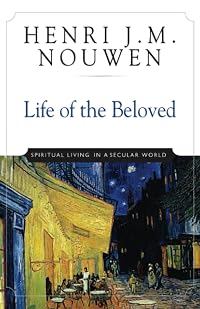
Life of the Beloved: Spiritual Living in a Secular World
by Henri J. M. Nouwen
On This Page
Description
Initially written for a Jewish friend, Life of the Beloved has become Henri Nouwen's greatest legacy to Christians around the world. This sincere testimony of the power and invitation of Christ is indeed a great guide to a truly uplifting spiritual life in today's world.Tags
Recommendations










Member Reviews
"Where is the gospel?" or so I found myself asking all throughout. In what is ostensibly an apologetic, Nouwen seems to shy away from any mention of what makes the Christian life at all distinctive and worthwhile: the redemptive power of Christ on the cross. One is taken and adopted as a child of God, through Christ's work. One is blessed and broken, as Christ was blessed and broken. One is given for others, because Christ first gave himself. Here the Eucharist is used as a framing device yet entirely emptied of its meaning and power. For one is beloved in the Beloved. It's no surprise, then, to find that his friends found the book uncompelling; how could it, without the gospel? What might have been a tender testament to the salvation show more that comes only from above becomes only impotent word-wrangling and hollow mysticism. show less
This was originally written by Henri Nouwen for a secular Jewish friend of his. He wanted not to 'convert' him, but to help him understand how much God loved him, to sense that he was a beloved child in a broken world.
The writing is powerful and moving, using as themes for individual chapters the four words: Taken, Blessed, Broken and Given. Nouwen examines what these concepts have meant to him over the years, and how he has - very slowly - come to accept the love of God no matter what his circumstances.
It's honest and often moving, and reads very much like a letter to a friend, although at times I forgot that there was a specific audience. There's a prologue and epilogue which talk more about it, but the bulk of the book - barring a show more few specific comments about the friendship - are relevant to anyone.
It's a short book, but very thought-provoking, so I didn't want to read too much at one time. I read just a chapter (or less) per day for nearly two weeks. Highly recommended. show less
The writing is powerful and moving, using as themes for individual chapters the four words: Taken, Blessed, Broken and Given. Nouwen examines what these concepts have meant to him over the years, and how he has - very slowly - come to accept the love of God no matter what his circumstances.
It's honest and often moving, and reads very much like a letter to a friend, although at times I forgot that there was a specific audience. There's a prologue and epilogue which talk more about it, but the bulk of the book - barring a show more few specific comments about the friendship - are relevant to anyone.
It's a short book, but very thought-provoking, so I didn't want to read too much at one time. I read just a chapter (or less) per day for nearly two weeks. Highly recommended. show less
I'm so thankful for Henri's voice. Having him speak quietly to me each morning for a week or so meant beginning my day out ahead of the madding crowd with all its noise and insidious prompting toward self-rejection.
Warm, wise, and insightful. Henri didn't accomplish what he set out to do -- speak to a secular friend about God -- but he did speak to me in the midst of my sacred and secular life.
This one goes on the shelf "to read once a year" (at least!).
Warm, wise, and insightful. Henri didn't accomplish what he set out to do -- speak to a secular friend about God -- but he did speak to me in the midst of my sacred and secular life.
This one goes on the shelf "to read once a year" (at least!).
I've heard people rave about this and other works by Nouwen many times, but I have to admit that I have never been able to get through this short little book. I'm not sure why, because he writes well. I guess I've always picked it up at times in my life when it wasn't what I needed to hear? But I would recommend it to someone craving reassurance of God's love for them; the book is intended to speak to both Christians and non-Christians.
I have to admit that while I enjoyed reading this, I could also identify to some degree with "Fred", who basically said this was so far beyond his experience and that of his friends that he couldn't really get that much out of it. I'm sure I got more out of it than Fred did. But, that doesn't mean I grasped - really grasped - what Nouwen was trying to convey, either. I also noted that Jesus, the Christ, did not come up in the book. Just God. Maybe this was deliberate, as Nouwen was writing this for a secular Jew and his friends. I don't know. But wouldn't it have been better to preach the Gospel as part of his explanation of the spiritual life?
The author is very clever, evidently aware that he must tamp a bottom onto each of his claims lest the argument held within drop out. Chosen but without exclusion. Broken but not better or worse. Blessed in dying but no worse for living. Reminds me of the platonic arguments in their good faith and positive directive, but also in their porous character, though Nouwen is clever enough to stop up what holes he can. However one is left with the question ‘what is the point’? the author hints at some eschatology with the ‘spirit of love, freed from our mortal bodies, will blow where it will, even when few will hear its coming and going.’ but are fulfillment, or ‘good tidings’, or even 'a pleasant abiding here and now' ends in show more themselves…
Platonic/buddhist argument: success, popularity, power, not the Good - problematic in excess. Love is a Good as such. Everything else dispatched by the dialectical approach (e.g. arrogance/self-confidence as a manifestation of self-rejection reaction formation)
“being the beloved” – beloved of Whom? And in what way (e.g. eros/agape/movement of the heavens and the earth for thee, is not that enough?)
“[to Christ from G-d] You are my son, the Beloved; my favor rests on You” to --> “[to the reader] you are my Beloved, on you my favor rests.”
Whispers of the Hegelian. Being the beloved (a reality) as contrasted with non-being of the beloved (a perception) --> becoming the beloved (an action), though it leaves space for another Becoming (the unbeloved). Zizek’s “unknown uknowns” completing the tetrad.
“Chosen” vs “Unchosen” ones
“attempting to avoid, repress, or escape pain is like cutting off a limb that could be healed with proper attention” – similar to adorno’s metaphor of tendrils in “genesis of stupidity”, though A. means something slightly different...
‘to live it as an unceasing “yes” to the truth of that Belovedness' (and those who don’t are living in a worldly ‘cursed’ state). That is distinctly Nietz’s verbiage, though he may have appropriated scripture himself… furthermore, divinity as unified experience of ‘living life in one reality’ among the light while diabolism as divided experience that splits united forces and sets them in opposition (‘the world of ephemeral desires’) though what directly follows from this is an implicit injunction against intersectionality - though really he has a lot in common with Benjamin on this point. Furthermore “people and events, art and literature, history and science, they all cease to be opaque and become transparent, pointing far beyond themselves to the place from where you come from and to where you will return” show less
Platonic/buddhist argument: success, popularity, power, not the Good - problematic in excess. Love is a Good as such. Everything else dispatched by the dialectical approach (e.g. arrogance/self-confidence as a manifestation of self-rejection reaction formation)
“being the beloved” – beloved of Whom? And in what way (e.g. eros/agape/movement of the heavens and the earth for thee, is not that enough?)
“[to Christ from G-d] You are my son, the Beloved; my favor rests on You” to --> “[to the reader] you are my Beloved, on you my favor rests.”
Whispers of the Hegelian. Being the beloved (a reality) as contrasted with non-being of the beloved (a perception) --> becoming the beloved (an action), though it leaves space for another Becoming (the unbeloved). Zizek’s “unknown uknowns” completing the tetrad.
“Chosen” vs “Unchosen” ones
“attempting to avoid, repress, or escape pain is like cutting off a limb that could be healed with proper attention” – similar to adorno’s metaphor of tendrils in “genesis of stupidity”, though A. means something slightly different...
‘to live it as an unceasing “yes” to the truth of that Belovedness' (and those who don’t are living in a worldly ‘cursed’ state). That is distinctly Nietz’s verbiage, though he may have appropriated scripture himself… furthermore, divinity as unified experience of ‘living life in one reality’ among the light while diabolism as divided experience that splits united forces and sets them in opposition (‘the world of ephemeral desires’) though what directly follows from this is an implicit injunction against intersectionality - though really he has a lot in common with Benjamin on this point. Furthermore “people and events, art and literature, history and science, they all cease to be opaque and become transparent, pointing far beyond themselves to the place from where you come from and to where you will return” show less
A book that I consider a spiritual classic. The prologue frames the background leading to the publication of this unique little book. A close-knit friendship with a young friend who considers himself a “secular Jew” leads to a pressing request of the author to “…speak a word of hope to people who no longer (come) to churches or synagogues and for whom priests and rabbis (are) no longer the obvious counselors.” This book is the result of that request. In the book, Nouwen challenges us to to hear God’s voice that says, “You are my beloved son; you are my beloved daughter. I love you with an everlasting love. I have molded you together in the depths of the earth. I have knitted you in your mother’s womb. I’ve written your show more name in the palm of my hand and I hold you safe in the shade of my embrace. I hold you. You belong to Me and I belong to you. You are safe where I am. Don’t be afraid. Trust that you are the beloved. That is who you truly are.” That voice is not a very loud voice because it is an intimate voice. It comes from a very deep place. It is soft and gentle. Nouwen challenges us, in the book, to gradually hear that voice. We both have to hear that voice and to claim for ourselves that that voice speaks the truth, our truth. It tells us who we are. That is where the spiritual life starts — by claiming the voice that calls us the beloved. show less
Members
- Recently Added By
Lists

Henri Nouwen, All Inclusive
100 works; 1 member

Mo's Reading List
218 works; 1 member

Mo's Reading List (Abridged)
75 works; 1 member
Author Information

317+ Works 44,168 Members
He was born in the Netherlands in 1932. An ordained priest and gifted teacher, he taught at several universities including Notre Dame, Harvard and Yale. He was a missionary in Peru. He died of a heart attack in 1996. (Publisher Provided) Henri J. M. Nouwen was born in Nijkerk, The Netherlands on January 24, 1932. He was ordained a priest in 1957. show more He taught theology at Yale University Divinity School from 1971 to 1981 and at Harvard Divinity School from 1983 to 1985. He was the pastor at Daybreak, the L'Arche community for the mentally handicapped in Toronto, Canada from 1986 to 1996. He wrote over 30 books on spirituality, healing, and ministry including Reaching Out, The Genesee Diary, The Wounded Healer, The Road to Daybreak, The Return of the Prodigal Son, and Can You Drink the Cup? He died of a heart attack on September 21, 1996 at the age of 64. (Bowker Author Biography) show less
Awards and Honors
Series
Belongs to Publisher Series
Work Relationships
Is contained in
Common Knowledge
- Canonical title*
- Du bist der geliebte Mensch
- Original title
- Life of the beloved; Life of the beloved: spiritual living in a secular world
- Alternate titles*
- Een parel in Gods ogen : gedachten over de betekenis van een mensenleven
- Original publication date
- 1992
- Dedication
- To Connie Ellis
in gratitude - First words*
- Seit du mich darum gebeten hast, dir und deinen Freunden etwas über das geistliche Leben zu schreiben, beschäftigt mich die Frage, ob es ein Wort gibt, von dem ich möchte, dass es dir nach dem Lesen all dessen, was ich dir... (show all) sagen möchte, im Gedächtnis haften bleibt.
- Last words*
- (Click to show. Warning: May contain spoilers.)Aber wenn ich diese Stimmen in den Hintergrund meines Lebens dränge und auf die leise, sanfte Stimme achte, die mich Gottes Geliebten Sohn nennen, weiss ich, dass ich vor nichts Angst zu haben brauche und dass das Sterben die grösste Tat der Liebe ist, die Tat, die mich in alle Ewigkeit in die Arme meines Gottes fallen lässt, dessen Liebe für immer fortdauert.
*Some information comes from Common Knowledge in other languages. Click "Edit" for more information.
Classifications
Statistics
- Members
- 2,434
- Popularity
- 7,994
- Reviews
- 26
- Rating
- (4.03)
- Languages
- 9 — Chinese, Danish, Dutch, English, German, Hungarian, Italian, Spanish, Swedish
- Media
- Paper, Audiobook, Ebook
- ISBNs
- 24
- ASINs
- 10