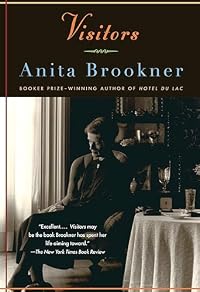
Visitors
by Anita Brookner
On This Page
Description
Widow Dorothea May's solitary world is thrown into disarray when she meets a young wanderer whose presence forces her to face both her past and her future.Tags
Recommendations


































Member Reviews
As the New York Times said, this "may be the book Brookner has spent her life aiming toward". It is contemplative, absorbing, complex, and features a woman in her seventies (as Brookner nearly was when she wrote it). Mrs. May lives a mostly solitary existence in her lovely generous apartment in London, quite satisfied to be who she is. She lost her husband some years before and has adjusted well to obligatory visits to his relatives, as she has none of her own. For she is a proper English lady, not given to emotional outbursts or close relationships.
She is startled to receive a call from her husband's cousin Kitty, who usually only called at certain times of the week. Kitty explains that her granddaughter is coming to London from show more America to be wed, and she, Kitty, needs to find a place for her fiance's best friend to stay. Mrs. May, Dorothea May, immediately says no, but is ultimately persuaded to let young Steve stay for a short while.
Unaccustomed to visitors, Dorothea nevertheless knows what is expected of a host. She provides a bedroom, fully outfitted, plus breakfast, and sometimes tea later. She is not especially welcoming, and neither is Steve all that lovable. She finds that all three of the young people who came to London are remarkably devoid of charm or any sense of its value.
Over time Dorothea finds the intrusion of this guest and the related visits to Kitty and Austin's home interesting and worthy of thought. It is a change from what she expected of her future. There is no fairytale ending here, with the flatmates becoming fond of each other, as you might expect with another author. I like that about this book. Yet his presence does lead to a gradual alteration in Mrs. May's vision of the world, of her place in it.
I found the book compelling in its quiet way, possibly because I am in my seventies too, and rarely read anything that I can relate to so well. I am not Mrs. May but I find her utterly believable. Many times she refers to herself as "boring" or "uninteresting" but she most certainly isn't. Her intelligence shines through, along with her quiet compassion, in a way I can only hope can be said of me after I'm gone. show less
She is startled to receive a call from her husband's cousin Kitty, who usually only called at certain times of the week. Kitty explains that her granddaughter is coming to London from show more America to be wed, and she, Kitty, needs to find a place for her fiance's best friend to stay. Mrs. May, Dorothea May, immediately says no, but is ultimately persuaded to let young Steve stay for a short while.
Unaccustomed to visitors, Dorothea nevertheless knows what is expected of a host. She provides a bedroom, fully outfitted, plus breakfast, and sometimes tea later. She is not especially welcoming, and neither is Steve all that lovable. She finds that all three of the young people who came to London are remarkably devoid of charm or any sense of its value.
Over time Dorothea finds the intrusion of this guest and the related visits to Kitty and Austin's home interesting and worthy of thought. It is a change from what she expected of her future. There is no fairytale ending here, with the flatmates becoming fond of each other, as you might expect with another author. I like that about this book. Yet his presence does lead to a gradual alteration in Mrs. May's vision of the world, of her place in it.
I found the book compelling in its quiet way, possibly because I am in my seventies too, and rarely read anything that I can relate to so well. I am not Mrs. May but I find her utterly believable. Many times she refers to herself as "boring" or "uninteresting" but she most certainly isn't. Her intelligence shines through, along with her quiet compassion, in a way I can only hope can be said of me after I'm gone. show less
I read this because of another group discussion in Reading the 20th Century - my eighth Brookner and fourth this year was one of the most enjoyable, as always full of perceptive observation and dry humour. The central character is Dorothea May (generally referred to as Mrs May), a widow who has lived alone in her substantial London flat for many years. Her orderly lifestyle is upset when one of her husband's sisters asks her to accommodate Steve, a young friend of her granddaughter while they prepare for the granddaughter's wedding.
I won't say more about the plot, but the interactions between the generations are both entertaining and eventually quite touching. Brookner is often described as bleak, but this book is ultimately rather life show more affirming.
I will finish with a quote that made me laugh, as it seems very true: "Loneliness is much feared by the gregarious, she reflected, whereas to the solitary the gregarious pose a much greater threat." show less
I won't say more about the plot, but the interactions between the generations are both entertaining and eventually quite touching. Brookner is often described as bleak, but this book is ultimately rather life show more affirming.
I will finish with a quote that made me laugh, as it seems very true: "Loneliness is much feared by the gregarious, she reflected, whereas to the solitary the gregarious pose a much greater threat." show less
Anita Brookner's books always leave me with a quiet sadness, and this one is no different. It is the story of an elderly widow whose life is disrupted by the arrival of a young man, who is staying with her while a wedding for her extended family members is planned. Her life is comprised of simple pleasures and this "visitor" creates a disquiet and an examination of end-of-life issues that magnify her loneliness.
Dorothea May, a 70-year-old widow, lives alone in her London flat and is totally fine with that. Her day is filled with the small things in life: going out to get a newspaper or shop for her dinner, or enjoying a cup of tea in her garden. Her sisters-in-law, Kitty and Molly, check on her through obligatory Sunday phone calls, polite exchanges with little emotional connection. Then one day, Kitty asks Dorothea to take on a houseguest. Kitty’s granddaughter, Ann, has been living in the States but is coming to London with her fiancé, David, to get married. Their best man, Steve, will join them and needs a place to stay. Dorothea has little choice but to say yes. Steve is wandering aimlessly through life, with no job or prospects. show more Dorothea offers bed and breakfast, and even hires a car for his use, but never gets over her discomfort at having another person in her flat. Meanwhile, Kitty is throwing herself into planning a lavish celebration that Ann and David don’t really want, and tensions run high. Over the course of the novel, Dorothea’s relationship with Kitty and the family moves from distant in-law to trusted confidante, and Dorothea begins to envision something different for herself as well.
Anita Brookner began writing fiction in her 50s, and this novel was published when she was about 70, the same age as her heroine. I can’t help but think she was using this book to work through her own conflicted feelings about aging and independence. The narrative was a bit repetitive in spots, but I found Dorothea likeable and admirable, and enjoyed her story. show less
Anita Brookner began writing fiction in her 50s, and this novel was published when she was about 70, the same age as her heroine. I can’t help but think she was using this book to work through her own conflicted feelings about aging and independence. The narrative was a bit repetitive in spots, but I found Dorothea likeable and admirable, and enjoyed her story. show less
Anita Brookner has a way of making you look at life i which is not always cheerful. Here we have Dorothea - 73 -lives alone (widowed for 15 years) in a London mansion flat. The cousins of her late husband telephone on a Sunday, and she has lunch in an Italian restaurant. That is her life. Until,that is, she is presuaded, to put up the best man of a small wedding party in her spare room. Steve is 22 - and his presence in her life changes Dorothea in small but meaningful ways.
This is beautifully written, Anita Brookner's world is one we recognise, although may not have lived oursleves. It is a world of gentility, mansion flats and London restaurants, noone seems really poor. Within 200 pages or so you come to understand everything about show more Dorothea'stime on this earth, her childhood, her late marriage, her old age. It's not always a happy picture, but it's so beautifully done, that you come to accept to melancholy feeling that always threatens to descend. show less
This is beautifully written, Anita Brookner's world is one we recognise, although may not have lived oursleves. It is a world of gentility, mansion flats and London restaurants, noone seems really poor. Within 200 pages or so you come to understand everything about show more Dorothea'stime on this earth, her childhood, her late marriage, her old age. It's not always a happy picture, but it's so beautifully done, that you come to accept to melancholy feeling that always threatens to descend. show less
This is the first book by Anita Brookner that I have read. Attracted at first to the lovely illustration on the cover and no more than a cursory glance at the jacket description, "(an exploration of) what happens when a woman's quiet resignation to fate is challenged by the arrogance of youth", I am left feeling gratified and moved by the authors insight and writing style. It has been many years since I have felt the need--or the desire--to heft a dictionary onto my lap as I read a book. The preciseness of the language and the acuity in which it is used has brought an unexpected depth to the simple story of an older woman faced with the disruption of having a young stranger stay in her spare room for an undetermined, but assumed brief show more amount of time.
In another mood and certainly in my own youth, I may have felt overwhelmed by the amount of introspection in this book; but now well-entrenched in middle-age, with experiences enough behind me for which to be somewhat introspective about, and my own old age ahead for which to speculate on, I find Brookner's Mrs. Mays' ruminations provocative. show less
In another mood and certainly in my own youth, I may have felt overwhelmed by the amount of introspection in this book; but now well-entrenched in middle-age, with experiences enough behind me for which to be somewhat introspective about, and my own old age ahead for which to speculate on, I find Brookner's Mrs. Mays' ruminations provocative. show less
I can't believe I finally finished this book. It was only 242 pages but I thought I'd never get to the end. For one thing, almost the entire book is comprised of a 70-something year old woman examining her own mind. Does she want solitude or does she want companionship? Does she want her day-to-day drudgery or does she want adventure?
"...loneliness, blighted hope and unfulfilled desire...the dignity of the struggle to get from one day to the next" is how Brookner books are generally described.
This is only my first Brookner but that description is spot on. On top of that, it seems every time I picked the book up and settled into my comfy chair, I'd only get to read a page or two and then I'd be interrupted by my Mom needing something or show more the cat needing something or a timer going off or by suddenly thinking of something I wanted to watch on Netflix. I think yesterday morning was the first long stretch of reading I was able to fit in and today was the second. But now I've finally finished it and can move on! Yay!
It's probably a 5 star book, but for me personally I liked it but I wasn't blown away by it, so I'm only giving 3 stars. show less
"...loneliness, blighted hope and unfulfilled desire...the dignity of the struggle to get from one day to the next" is how Brookner books are generally described.
This is only my first Brookner but that description is spot on. On top of that, it seems every time I picked the book up and settled into my comfy chair, I'd only get to read a page or two and then I'd be interrupted by my Mom needing something or show more the cat needing something or a timer going off or by suddenly thinking of something I wanted to watch on Netflix. I think yesterday morning was the first long stretch of reading I was able to fit in and today was the second. But now I've finally finished it and can move on! Yay!
It's probably a 5 star book, but for me personally I liked it but I wasn't blown away by it, so I'm only giving 3 stars. show less
Members
- Recently Added By
Author Information

35+ Works 12,760 Members
Anita Brookner was born in London, England on July 16, 1928. She received a BA in history from King's College London in 1949 and a doctorate in art history from the Courtauld Institute of Art in 1953. She went on to lecture in art at Reading University and the Courtauld Institute, where she specialized in eighteenth- and nineteenth-century French show more art. She became the first woman to be named as Slade Professor of Art at Cambridge University in 1967. Her first novel, A Start in Life, was published in 1981. Some of her other works include The Bay of Angels, The Next Big Thing, The Rules of Engagement, Latecomers, Leaving Home, Incidents in the Rue Laugier, Look at Me, and Strangers. Hotel du Lac won the Booker Prize for Fiction in 1984 and was adapted for television in 1986. She has also written scholarly works about Jacques Louis David, Jean Baptiste Greuze, and Jean-Antoine Watteau. She died on March 10, 2016 at the age of 87. (Bowker Author Biography) show less
Awards and Honors
Awards
Common Knowledge
- Canonical title
- Visitors
- People/Characters
- Dorothea May
- Important places
- England, UK
- First words
- Towards evening the oppressive heat was tempered by a slight breeze, although this merely served to power drifts and eddies of a warmth almost tropical in its intensity.
Classifications
Statistics
- Members
- 360
- Popularity
- 87,123
- Reviews
- 10
- Rating
- (3.59)
- Languages
- English, French
- Media
- Paper, Audiobook, Ebook
- ISBNs
- 16
- ASINs
- 1