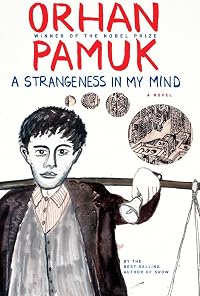
A Strangeness in My Mind
by Orhan Pamuk
On This Page
Description
"Since his boyhood in a poor village in Central Anatolia, Mevlut Karataş has fantasized about what his life would become. Not getting as far in school as he'd hoped, at the age of twelve he comes to Istanbul--"the center of the world"--And is immediately enthralled by both the old city that is disappearing and the new one that is fast being built. He follows his father's trade, selling boza (a traditional mildly alcoholic Turkish drink) on the street, and hoping to become rich, like other show more villagers who have settled the desolate hills outside the booming metropolis. But luck never seems to be on Mevlut's side. As he watches his relations settle down and make their fortunes, he spends three years writing love letters to a girl he saw just once at a wedding, only to elope by mistake with her sister. And though he grows to cherish his wife and the family they have, he stumbles toward middle age in a series of jobs leading nowhere. His sense of missing something leads him sometimes to the politics of his friends and intermittently to the teachings of a charismatic religious guide. But every evening, without fail, Mevlut still wanders the streets of Istanbul, selling boza and wondering at the "strangeness" of his mind, the sensation that makes him feel different from everyone else, until fortune conspires once more to let him understand at last what it is he has always yearned for."--Jacket. show lessTags
Recommendations












Member Reviews
“A Strangeness in My Mind” follows Mevlut Karatas as he adjusts to life in Istanbul following his migration from a small Anatolian village. Pamuk subtly weaves this personal story of a simple man who sells food on the streets of the city with descriptions of the cultural, political and physical changes that also occur in Istanbul from the 70’s to the present. Members of Melvut’s extended family living in Istanbul seem to be succeeding, often by taking advantage of the corruption that was prevalent in Turkey during this period. Meanwhile Melvut is somewhat melancholic about his own life. Notwithstanding his seeming failures, he derives a dreamy pleasure from seeing Istanbul at street level and interacting with its common people show more while selling boza. Despite some confusion about which sister he was actually wooing and eventually eloping with, Melvut also manages to develop a satisfying family life with the “wrong” sister.
Pamuk’s intention is to show how Turks come to terms with an Islamic heritage while living in an environment that is rapidly becoming Westernized and secular. His characters struggle with achieving this cultural balance, succeeding to varying extents. Not only is Melvut exposed to people who advocate for Turkey to return to its Islamic roots, but also to radicals who espouse revolution and adoption of communism. Others pay particular attention to the city’s opportunities for personal enrichment. In his travels, Melvut sees modernist trends, criminality, racial bigotry and corruption. He struggles to understand his own “strangeness” and where he fits in this mix. The reader becomes familiar with the other characters, most of whom are members of his extended family through first person monologues that Pamuk inserts into his third person narrative. This approach injects a humorous and unpretentious tone to the story.
Pamuk succeeds in evoking the setting of Istanbul during this period. He describes the crude dwellings built by the newcomers as a strategy to claim land on the hills surrounding the city and how these become replaced by sterile high-rise buildings. We experience the narrow alleys of the old city where inhabitants lower baskets to street level to obtain their boza. We follow Melvut into cemeteries where he is threatened by packs of feral dogs. We experience the tradition of inviting the boza seller up to the apartment. What results is a mood that is at times mysterious and threatening, while at others quite humane and inviting. Although the story develops slowly and lacks tension, Pamuk obviously delights in telling the story of his city and its people. This makes for an engaging and satisfying read. show less
Pamuk’s intention is to show how Turks come to terms with an Islamic heritage while living in an environment that is rapidly becoming Westernized and secular. His characters struggle with achieving this cultural balance, succeeding to varying extents. Not only is Melvut exposed to people who advocate for Turkey to return to its Islamic roots, but also to radicals who espouse revolution and adoption of communism. Others pay particular attention to the city’s opportunities for personal enrichment. In his travels, Melvut sees modernist trends, criminality, racial bigotry and corruption. He struggles to understand his own “strangeness” and where he fits in this mix. The reader becomes familiar with the other characters, most of whom are members of his extended family through first person monologues that Pamuk inserts into his third person narrative. This approach injects a humorous and unpretentious tone to the story.
Pamuk succeeds in evoking the setting of Istanbul during this period. He describes the crude dwellings built by the newcomers as a strategy to claim land on the hills surrounding the city and how these become replaced by sterile high-rise buildings. We experience the narrow alleys of the old city where inhabitants lower baskets to street level to obtain their boza. We follow Melvut into cemeteries where he is threatened by packs of feral dogs. We experience the tradition of inviting the boza seller up to the apartment. What results is a mood that is at times mysterious and threatening, while at others quite humane and inviting. Although the story develops slowly and lacks tension, Pamuk obviously delights in telling the story of his city and its people. This makes for an engaging and satisfying read. show less
I will be honest and say that until about page 250 I felt I was dragging myself through the book a bit. Suddenly, and OMG moment and I was glued to it right to the end. The tears are still drying on my cheeks as I write this review. Tears for love, for loss, for change, for intentions of the heart and intentions of the word. Mevlut, the dear boza selling protagonist takes us through the streets of Istanbul over fifty years of his life. Somehow he remains pure of heart despite the dramatic political, religious, economic, and sociological changes which occur during his lifetime. I will not soon forget this lovely, lovely man. I have a powerful yearning to walk the streets of the Istanbul neighborhoods in which he has walked nightly for show more fifty years, in which he found peace with the strangeness in his mind! show less
"A Strangeness in my Mind" is a Man Booker Prize finalist for 2016. Wanting to get to know a place better, we oft read the news and his history, trying to build a foundation of knowledge on the facts. It's difficult to capture a people, their attitudes, fears, inspiration and passions from facts, though. While the events that take place as background to a piece of fiction should be generally accurate, the rest of the work isn't bound by any kind of exactitude and is free to create personalities and situations to convey a particular feeling or idea. Orhan Pamuk does a superb job of capturing the character and transformation of modern Turkey by following a street vendor from Beyşehir in the Konya province who comes to live and work in show more Istanbul for most of his life. The main character, Mevlut, is a boza seller; boza is a traditional wheat-based drink that was once sold door-to-door in Turkey, as was yogurt. Through Mevlut, you get a good feel for Turkish attitudes, the tension between modernity and conservatism, the growing pains of a major metropolitan city, views on marriage, love, family, and the political shift as the socially conservative Justice and Development Party came to power in the new millennium. "A Strangeness in my Mind" is a human story, too, following Mevlut as a shy and unsure youth all the way to his senior years, through personal tragedy and rekindled dreams. The book does get slow in places, but it fits with the long inward journey of Mevlut and the pace of change in Turkey. Highly recommend for anyone interested in Turkey or who might be moving to Istanbul or Ankara. show less
"He didn't see it as a place that had existed before his arrival and to which he'd come as an outsider. Instead, he liked to imagine that Istanbul was being built while he lived in it and to dream of how much cleaner, more beautiful, and more modern it would be in the future."
"Mevlut liked to listen to him and daydream as he sat in the front seat of the Dodge, watching hundreds, thousands of lights shining out of cars and windows; the depths of the dark, velvety Istanbul night; and the neon-colored minarets going past. Mevlut used to toil on foot through mud and rain, up and down these very same streets, and now here they were slipping right through with ease. Life, too, slipped by in much the same way, speeding up as it ran along the show more tracks laid out by time and fortune."
~~~~~~~~~~~~~~~~~~~~~~~~~~~~~~~~~~~~~~~~~~~~~~~~~~~~~~~~~~~~~~~~~~~~~~
Orhan Pamuk's long novel is as much the story of Istanbul as it is the tale of Mevlut, a Boza seller who moves to Istanbul as a child in 1969 to learn the trade from his father. Mevlut falls in love with a girl he sees at his cousin's wedding; he begins to send her beautiful and heartfelt love letters and eventually they elope together with the assistance of yet another cousin. Mevlut almost immediately realizes that the girl with whom he has run away and to whom he is now committed for life is not the girl with whom he fell in love. Rather, this is her unattractive older sister. Thus begins the life of Melvut, a man of principle and ambition, and the family with whom he is forever bound. As Istanbul's population explodes, political winds shift, and modernity intrudes upon their culture, Mevlut and his cousins dream of wealth and property; their minimal education and the intractable class barriers make advancement difficult. But they also dream of love and hold fast to family; on these, only time can intrude.
I've never heard Pamuk speak but I believe he loves the city of Istanbul. This novel, a bit of a slog at times, was nonetheless enjoyable and a fascinating glimpse of Turkish culture and history since the 1960s. show less
"Mevlut liked to listen to him and daydream as he sat in the front seat of the Dodge, watching hundreds, thousands of lights shining out of cars and windows; the depths of the dark, velvety Istanbul night; and the neon-colored minarets going past. Mevlut used to toil on foot through mud and rain, up and down these very same streets, and now here they were slipping right through with ease. Life, too, slipped by in much the same way, speeding up as it ran along the show more tracks laid out by time and fortune."
~~~~~~~~~~~~~~~~~~~~~~~~~~~~~~~~~~~~~~~~~~~~~~~~~~~~~~~~~~~~~~~~~~~~~~
Orhan Pamuk's long novel is as much the story of Istanbul as it is the tale of Mevlut, a Boza seller who moves to Istanbul as a child in 1969 to learn the trade from his father. Mevlut falls in love with a girl he sees at his cousin's wedding; he begins to send her beautiful and heartfelt love letters and eventually they elope together with the assistance of yet another cousin. Mevlut almost immediately realizes that the girl with whom he has run away and to whom he is now committed for life is not the girl with whom he fell in love. Rather, this is her unattractive older sister. Thus begins the life of Melvut, a man of principle and ambition, and the family with whom he is forever bound. As Istanbul's population explodes, political winds shift, and modernity intrudes upon their culture, Mevlut and his cousins dream of wealth and property; their minimal education and the intractable class barriers make advancement difficult. But they also dream of love and hold fast to family; on these, only time can intrude.
I've never heard Pamuk speak but I believe he loves the city of Istanbul. This novel, a bit of a slog at times, was nonetheless enjoyable and a fascinating glimpse of Turkish culture and history since the 1960s. show less
This book sprawls across 40 years or so -- and describes the city of Istanbul as well as the life of Mevlut, a street vendor of a traditional slightly alcoholic drink called boza. It's a wonderful, captivating story about Mevlut, who falls in love at first sight with a young girl at a wedding, only to be tricked by his cousin into sending love letters to her older sister instead. But the older sister, whom he elopes with, proves to be the great love of his life. The strangeness in Mevlut's mind seems to be his desire to stick to the traditional ways of a street vendor rather than engaging in the political and financial machinations of his cousins and best friend, Ferhat. There is a constancy in Mevlut which contrasts with the show more geographical and political changes in Istanbul. The book is very well written and drew me in completely. show less
A big book in every sense but told simply, if subtly. I took my time with this, over about six weeks but my interest never flagged. It's not a thrilling sort of story but a very satisfying account of an ordinary street vendor's life in Istambul over the decades. Istambul itself is a principal character in the novel as much as Melvut and you really get a feel for the sights, sounds and smells of Istambul as well as its increasing secularization. I think Pamuk is quite critical of the modernisation of the city as it comes with a certain amount of cynicism and chicanery. Melvut is almost totally apolitical and just wants to provide for his wife and family.He's not totally innocent and will lie too but he's not impelled to get-ahead at any show more cost and is happy as a boza-seller as he is vitally connected to the city. Pamuk isn't condescending to him and he's as sympathetic as Joyce's Bloom and his own relationship to his city. I'm sure Pamuk himself is critical of religious fanaticism but he treats Melvut's personal form of spirituality with real understanding and sympathy. I think Pamuk succeeds better than Rushdie, say, in presenting a tale of an everyman and the vagaries of his life. I'll probably never make it to Istambul and much of the life recounted here is probably in the past but it made me feel like I'd fully inhabited Melvut's existence if only imaginatively. It's ultimately a profoundly human book. show less
This was an unexpectedly good read. I had hesitated to read it because I feared it would be as dense as 'My Name is Red' and I didn't know what to expect from such a weird title. But it turned out to be a delight. Immerse yourself in a love story that is also a family saga and a sweep of the changes Turkey underwent in the 20th century. Pamuk also managed to weave in key global events like 911. Mevlut is the book's unassuming hero - he married the sister of the woman he had yearned for accidentally but learned to love and rely on her; he learned not to hold on to the daughters he loved, and he continued to sell boza on the streets even when he didn't have to. It's a tragedy that his wife, Rayiha, died young. In a twist of fate, he still show more ended up marrying the woman he had originally loved but his number one love is still Rayiha. show less
Members
- Recently Added By
Lists

International Dublin Literary Award Longlist 2017
147 works; 3 members

Dublin Literary Award Longlist 2017
147 works; 2 members
Kirkus Starred Fiction Reviews of Books Published in 2015
310 works; 6 members

Kirkus Reviews Best Fiction of 2015
98 works; 6 members

Books recommended by Calgary Public Library staff
1,588 works; 4 members

Sense of place
156 works; 13 members
Author Information

107+ Works 32,966 Members
Orhan Pamuk was born in Istanbul, Turkey on June 7, 1952. After graduating from Robert College in Istanbul, he studied architecture at the Istanbul Technical University. After three years, he decided to become a writer and graduated from the Institute of Journalism at the University of Istanbul in 1976. In 1982, he published his first novel Cevdet show more Bey and His Sons, which received both the Orhan Kemal and Milliyet literary prizes. His novel, My Name Is Red, won the French Prix Du Meilleur Livre Etranger, the 2002 Italian Grinzane Cavour, and the 2003 International IMPAC Dublin Literary Award. He has received numerous Turkish and international literary awards for his works including the 2006 Nobel Prize in Literature. His recent work includes A Strangeness in My Mind. (Bowker Author Biography) Orhan Pamuk is the author of six previous novels, including "The White Castle" & "The New Life". He lives in Istanbul with his family. (Publisher Provided) show less
Some Editions
Awards and Honors
Awards
Distinctions
Series
Belongs to Publisher Series
Common Knowledge
- Canonical title
- A Strangeness in My Mind
- Original title
- Kafamda bir tuhaflık
- Alternate titles*
- 我心中的陌生人
- Original publication date
- 2014
- People/Characters
- Mevlut; Rayiha; Fatma; Ferhat; Fevizye; Suleyman (show all 7); Samiha
- Important places
- Istanbul, Turkey
- Dedication
- For Asli
- First words
- This is the story of the life and daydreams of Mevlut Karatas, a seller of boza and yogurt.
- Last words
- (Click to show. Warning: May contain spoilers.)"I have loved Rayiha more than anything in this world."
- Original language
- Turkish
*Some information comes from Common Knowledge in other languages. Click "Edit" for more information.
Classifications
- Genres
- Fiction and Literature, General Fiction, Historical Fiction
- DDC/MDS
- 894.3533 — Literature & rhetoric Literatures of other languages Literatures of Altaic, Uralic, Hyperborean, Dravidian languages; literatures of miscellaneous languages of south Asia Turkic languages Turkish Turkish fiction 1850–2000
- LCC
- PL248 .P34 .K3513 — Language and Literature Languages and literatures of Eastern Asia, Africa, Oceania Languages of Eastern Asia, Africa, Oceania Turkic languages
- BISAC
Statistics
- Members
- 1,106
- Popularity
- 23,009
- Reviews
- 35
- Rating
- (3.96)
- Languages
- 32 — Arabic, Bosnian, Bulgarian, Czech, Danish, Dutch, English, Finnish, French, Georgian, German, Greek, Hungarian, Italian, Japanese, Korean, Lithuanian, Norwegian, Farsi/Persian, Polish, Romanian, Russian, Serbian, Croatian, Slovak, Spanish, Swedish, Turkish, Vietnamese, Portuguese (Portugal), Portuguese (Brazil), Chinese, simplified
- Media
- Paper, Audiobook, Ebook
- ISBNs
- 73
- UPCs
- 1
- ASINs
- 18