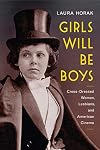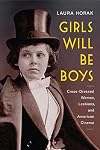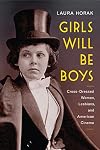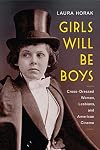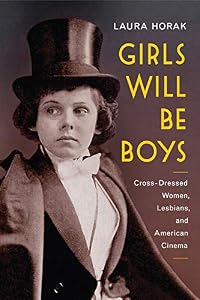
Girls Will Be Boys: Cross-Dressed Women, Lesbians, and American Cinema, 1908-1934
by Laura Horak
On This Page
Description
2016 Choice Outstanding Academic Title Finalist for 2016 Richard Wall Memorial Award by the Theatre Library Long listed for the 2017 Kraszna-Krausz Best Photography Book Award from the Kraszna-Krausz Foundation Marlene Dietrich, Greta Garbo, and Katharine Hepburn all made lasting impressions with the cinematic cross-dressing they performed onscreen. What few modern viewers realize, however, is that these seemingly daring performances of the 1930s actually came at the tail end of a long wave show more of gender-bending films that included more than 400 movies featuring women dressed as men. Laura Horak spent a decade scouring film archives worldwide, looking at American films made between 1908 and 1934, and what she discovered could revolutionize our understanding of gender roles in the early twentieth century. Questioning the assumption that cross-dressing women were automatically viewed as transgressive, she finds that these figures were popularly regarded as wholesome and regularly appeared onscreen in the 1910s, thus lending greater respectability to the fledgling film industry. Horak also explores how and why this perception of cross-dressed women began to change in the 1920s and early 1930s, examining how cinema played a pivotal part in the representation of lesbian identity. Girls Will Be Boys excavates a rich history of gender-bending film roles, enabling readers to appreciate the wide array of masculinities that these actresses performed-from sentimental boyhood to rugged virility to gentlemanly refinement. Taking us on a guided tour through a treasure-trove of vintage images, Girls Will Be Boys helps us view the histories of gender, sexuality, and film through fresh eyes. show lessTags
Recommendations










Member Reviews
While written for an academic audience, Girls Will Be Boys provides a fascinating analysis of the role of cross-dressed women and lesbians in early film. This is highly readable, even for the lay person. To my surprise, cross-dressed women were outright common in the early silent era, often utilized as part of a Strong Pioneer Woman archetype (and actually fed into white eugenics propaganda), and no bearing on the woman's perceived sexuality. It was only in the 1920s when lesbians became a "known" thing due to controversial movies and books, and that's when coding came in: i.e., a woman in pants must be a lesbian. More blatant depictions of lesbianism in the early 1930s sent censors into a tizzy, and so anti-perversion wording was added show more into the famed "Code" that dictated Hollywood productions for decades to come.
The book is sometimes redundant but I never found it outright slow. Some of the small details were especially intriguing. I was well aware of the term "pansy" for a wimpy boy in modern times or a gay man historically, but I had no idea that lesbians were dubbed "violets" after some coding used in the movie The Captive. I also didn't know that in the 1920s, "bisexual" literally meant a person possessing two sexes, and not someone attracted to men and women.
I highly recommend this book for anyone interested in LGBTQ history and/or early Hollywood. show less
The book is sometimes redundant but I never found it outright slow. Some of the small details were especially intriguing. I was well aware of the term "pansy" for a wimpy boy in modern times or a gay man historically, but I had no idea that lesbians were dubbed "violets" after some coding used in the movie The Captive. I also didn't know that in the 1920s, "bisexual" literally meant a person possessing two sexes, and not someone attracted to men and women.
I highly recommend this book for anyone interested in LGBTQ history and/or early Hollywood. show less
Ratings
Members
- Recently Added By
Lists

Queer History - Specialized
37 works; 1 member
Author Information
4 Works 51 Members
Awards and Honors
Awards
Classifications
- Genres
- Nonfiction, Sexuality and Gender Studies, LGBTQ+, General Nonfiction, History, Art & Design
- DDC/MDS
- 791.43 — Arts & recreation Recreation, sports, and performing arts Public performances Motion pictures, radio, television, podcasting Motion pictures
- LCC
- PN1995.9 .I43 .H67 — Language and Literature Literature (General) Literature (General) Drama Motion pictures
- BISAC
Statistics
- Members
- 32
- Popularity
- 853,752
- Reviews
- 1
- Rating
- (4.33)
- Languages
- English
- Media
- Paper, Ebook
- ISBNs
- 4
- ASINs
- 1