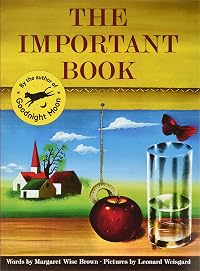
The Important Book
by Margaret Wise Brown
On This Page
Description
Relates what is important about glass, a spoon, a daisy, grass, rain, snow, an apple, wind, sky, a shoe and you.Tags
Recommendations


Member Recommendations

Member Reviews
Most books are written to be read. But occasionally one finds a book that is read to be written. By this I mean, upon reading the book one is drawn immediately to write in imitation of the author—adding pages of one’s own to extend the experience.
The Important Book, a children’s picture book by Margaret Wise Brown (Harper & Row, 1949), is an example.
Just listen to one page:
“The important thing about an apple is that it is round.
It is red.
You bite it,
and it is white inside,
and the juice splashes in your face,
and it tastes like an apple,
and it falls off a tree.
But the important thing about an apple is that it is round.”
Now imagine you’ve read similar pages—in exactly the same format, all illustrated by Leonard show more Weisgard—about a spoon, a daisy, rain, grass, snow, and the like. Prose that becomes almost Wordsworthian, imagery that reaches toward the poetic, a form that is Whitmanesque. You can’t stop yourself. You gotta write one of your own.
The important thing about peanut butter is that it shticks to the roof of your mouf.
Sometimes it’s smooth,
and sometimes it’s creamy,
and it’s good with jam and bread,
or on the end of a banana,
and you can’t stop with just one spoonful.
But the important thing about peanut butter is that it shticks to the roof of your mouf.
See what I mean.
Then you can’t stop.
The important thing about grandmothers is that they see you at your best . . . .
The important thing about cats is that they couldn’t care less . . . .
The important thing about escalators is that you move without moving . . . .
The important thing about roller coasters is the flip in the pit of your stomach . . . .
When you read The Important Book to children, they can immediately write (and illustrate) their own important book. When you read The Important Book to teenagers, even reluctant writers, they can write a book for younger siblings or cousins or kids they visit in a hospital. When you read The Important Book to adults, they have fun writing their own important books, and they can use them for all sorts of topics.
The important thing about Huck Finn is that he sees it like it is.
Oh, he wants to be like Tom Sawyer, who doesn’t.
He tries to get away with lying.
He knows that his Pappy isn’t really a pappy to him
and that ole Jim is
as they raft down the Mississippi,
and he tries to believe in the Duke and the Dauphin.
But the important thing about Huck Finn is that he sees it like it is.
And you know what? The funny thing about writing important books is that it helps kids and teenagers become better writers, sometimes even their teachers. I know. I’ve tried it. show less
The Important Book, a children’s picture book by Margaret Wise Brown (Harper & Row, 1949), is an example.
Just listen to one page:
“The important thing about an apple is that it is round.
It is red.
You bite it,
and it is white inside,
and the juice splashes in your face,
and it tastes like an apple,
and it falls off a tree.
But the important thing about an apple is that it is round.”
Now imagine you’ve read similar pages—in exactly the same format, all illustrated by Leonard show more Weisgard—about a spoon, a daisy, rain, grass, snow, and the like. Prose that becomes almost Wordsworthian, imagery that reaches toward the poetic, a form that is Whitmanesque. You can’t stop yourself. You gotta write one of your own.
The important thing about peanut butter is that it shticks to the roof of your mouf.
Sometimes it’s smooth,
and sometimes it’s creamy,
and it’s good with jam and bread,
or on the end of a banana,
and you can’t stop with just one spoonful.
But the important thing about peanut butter is that it shticks to the roof of your mouf.
See what I mean.
Then you can’t stop.
The important thing about grandmothers is that they see you at your best . . . .
The important thing about cats is that they couldn’t care less . . . .
The important thing about escalators is that you move without moving . . . .
The important thing about roller coasters is the flip in the pit of your stomach . . . .
When you read The Important Book to children, they can immediately write (and illustrate) their own important book. When you read The Important Book to teenagers, even reluctant writers, they can write a book for younger siblings or cousins or kids they visit in a hospital. When you read The Important Book to adults, they have fun writing their own important books, and they can use them for all sorts of topics.
The important thing about Huck Finn is that he sees it like it is.
Oh, he wants to be like Tom Sawyer, who doesn’t.
He tries to get away with lying.
He knows that his Pappy isn’t really a pappy to him
and that ole Jim is
as they raft down the Mississippi,
and he tries to believe in the Duke and the Dauphin.
But the important thing about Huck Finn is that he sees it like it is.
And you know what? The funny thing about writing important books is that it helps kids and teenagers become better writers, sometimes even their teachers. I know. I’ve tried it. show less
We read this book every once in a while, and we think of something new each time.
It's not that we necessarily agree that the only important thing about an apple is its roundness, nor that the only important thing about the sky is its color, it's that we use these statements as a way to jumpstart conversations.
We read, then we ask - do you think that? If yes, then why? If no, then why not, what *is* the most important thing? Why do you think she thinks this is important? When something doesn't match her description, is it no longer the sky, no longer an apple, no longer a shoe? Why or why not?
Any book can ultimately be used to start a conversation, but we happen to find that this book is particularly good for it - even after several show more readings. show less
It's not that we necessarily agree that the only important thing about an apple is its roundness, nor that the only important thing about the sky is its color, it's that we use these statements as a way to jumpstart conversations.
We read, then we ask - do you think that? If yes, then why? If no, then why not, what *is* the most important thing? Why do you think she thinks this is important? When something doesn't match her description, is it no longer the sky, no longer an apple, no longer a shoe? Why or why not?
Any book can ultimately be used to start a conversation, but we happen to find that this book is particularly good for it - even after several show more readings. show less
I enjoyed this story because it talked about the things used in ordinary life. It explained how they are used and what makes it important. The last page talked about the important thing about you is that you are you. It will encourage students to be themselves.
I decided to read this after seeing all the different opinions in the reviews. And I have to side with Kirei - if the idea is to let the child explore all the qualities of household objects and everyday events, why not let the child decide which is the important thing about each?
I know I certainly wouldn't say the important thing about snow is that it is white!
The cover throws me, too. Irl it looks even more like a Magritte mistake than it does in the image - that is to say, it 'vibes' surreal, but upon examination, there's actually nothing 'wrong' with it.
I had my insightful teen son read this, too, (without saying why) and he agrees with me.
I know I certainly wouldn't say the important thing about snow is that it is white!
The cover throws me, too. Irl it looks even more like a Magritte mistake than it does in the image - that is to say, it 'vibes' surreal, but upon examination, there's actually nothing 'wrong' with it.
I had my insightful teen son read this, too, (without saying why) and he agrees with me.
This book is a great read for in the classroom. It shows how everything around us is important and has a purpose. At the end of the book, the author also reminds the readers that they are important and their is no one like them in the world. I found the patterns interesting in the sentences as well as the illustrations throughout the book.
One thing that I love about this book is how it gets students to think differently about everyday things like a spoon or rain. Asking what is important about those things? The structure of starting and ending with the same line gives students a formula for their writing which can also be helpful.
This is book is thought provoking once you read it more than once. It builds up to the last point which is really sweet and comforting. I think this would be a perfect book to read to young kids because it's simple and the message it sends is clear and kind.
Members
- Recently Added By
Lists

Honey For a Child's Heart
1,152 works; 25 members

Picture Books to help teach Information Literacy Concepts
4 works; 1 member

Research/Inquiry - mentor texts
43 works; 2 members

Early Picture Books
467 works; 9 members
Author Information

Margaret Wise Brown was born on May 10, 1910 in Greenpoint, Brooklyn, New York, to Robert Brown, a Vice President at American Manufacturing Company and Maud Brown, a housewife. She attended school in Lausanne, Switzerland for three years, before attending Dana Hall in Wellesley, Massachusetts for two years. In 1928, she began taking classes at show more Hollis College in Virginia. In 1935, Brown began working at the Bank Street Cooperative School for student teachers. Two years later, her writing career took off with the publication of "When the Wind Blows." Over the course of fourteen years, Brown wrote over one hundred picture books for children. Some of her best known titles include Goodnight Moon, Big Red Barn and Runaway Bunny. Margaret Wise Brown died on November 13, 1952 of an embolism following an operation in Nice, France. (Bowker Author Biography) show less
All Editions
Common Knowledge
- Canonical title
- The Important Book
- Original publication date
- 1949
Classifications
Statistics
- Members
- 2,796
- Popularity
- 6,566
- Reviews
- 137
- Rating
- (3.89)
- Languages
- English, Japanese
- Media
- Paper
- ISBNs
- 11
- UPCs
- 2
- ASINs
- 7