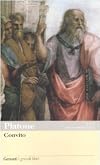
Symposium (Greek text and translation)
by Plato
37 Members (4.10)
On This Page
Description
Since 1923 the Sammlung Tusculum has published authoritative editions of Greek and Latin works together with a German translation. The original texts are comprehensively annotated, and feature an introductory chapter. In the new volumes, additional essays delve into specific aspects of the works, illuminating their historical context and reception to the present day. The high academic quality of the new editions together with clearly written essays and annotations make the Sammlung Tusculum show more essential reading for students who are discovering an ancient author for the first time as well as professional scholars who would like to gain a deeper understanding of specific aspects of a given work. Moreover, the series is ideal for lay readers who would like to engage with antiquity through a reliable German translation. The series contains over 270 titles, available in print and eBook editions, making previously out-of-print titles and rarities available again for the first time. In order to celebrate the 90th anniversary of the series, De Gruyter is proud to present Tusculum Online, an eBook package which contains all titles that appeared between 1923 and 2013 - a fitting tribute to an important part of German publishing history. For more information, please see www.degruyter.com/tusculum show lessTags
Recommendations



















Member Reviews
Members
- Recently Added By
Author Information

2,717+ Works 100,427 Members
Plato was born c. 427 B.C. in Athens, Greece, to an aristocratic family very much involved in political government. Pericles, famous ruler of Athens during its golden age, was Plato's stepfather. Plato was well educated and studied under Socrates, with whom he developed a close friendship. When Socrates was publically executed in 399 B.C., Plato show more finally distanced himself from a career in Athenian politics, instead becoming one of the greatest philosophers of Western civilization. Plato extended Socrates's inquiries to his students, one of the most famous being Aristotle. Plato's The Republic is an enduring work, discussing justice, the importance of education, and the qualities needed for rulers to succeed. Plato felt governors must be philosophers so they may govern wisely and effectively. Plato founded the Academy, an educational institution dedicated to pursuing philosophic truth. The Academy lasted well into the 6th century A.D., and is the model for all western universities. Its formation is along the lines Plato laid out in The Republic. Many of Plato's essays and writings survive to this day. Plato died in 347 B.C. at the age of 80. (Bowker Author Biography) show less
Series
Belongs to Publisher Series
Common Knowledge
- Canonical title
- Symposium (Greek text and translation) (Greek text and translation)
Classifications
Statistics
- Members
- 37
- Popularity
- 778,309
- Rating
- (4.10)
- Languages
- 7 — English, Finnish, German, Greek, Italian, Multiple languages, Spanish
- Media
- Paper, Ebook
- ISBNs
- 8