On This Page
Description
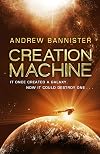
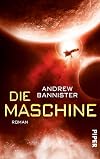
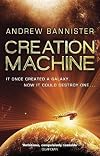
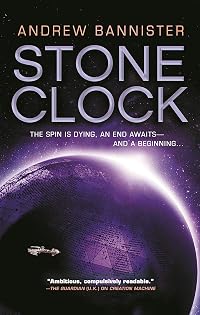
"In the vast artificial galaxy called the Spin, a rebellion has been crushed. Viklun Haas is eliminating all remnants of the opposition. Starting with his daughter. But Fleare Haas has had time to plan her next move from exile to the very frontiers of a new war. For hundreds of millions of years, the planets and stars of the Spin have been the only testament to the godlike engineers that created them. Now, beneath the surface of a ruined planet, one of their machines has been found."--Tags
Recommendations









Member Reviews
This one seems to be getting quite a push from Bantam (they were giving away free ARCs at Eastercon). First impression… well, it’s very Banksian. And that can’t be bad. The action takes place in the Spin, an “artificial galaxy”, although no real sense of the size or scale of this galaxy is apparent in the book. The heroine, Fleare Haas, who struck me as very much in a smiliar vein to Banks’s Lady Sharrow, is the daughter of the plutocrat who pretty much runs the Hegemony, the Spin’s most powerful government. She tried fighting against him in a breakaway army, but that ended badly. As the book opens, she’s a prisoner of an enigmatic ruin on one of the Spin’s worlds. She’s then rescued by an ex-colleague who is a cloud show more of nanobots (one of the novel’s more inventive elements), because she’s needed to prevent the Hegemony from doing something stupid with a powerful artefact that may be left over from the machine that built the Spin. That artefact is currently in the hands of a brutal regime which occupies a handful of worlds in the centre of the artificial galaxy. It’s all very twenty-first century space opera, very readable, quite inventive, with a slight twist of Banks and a mordant, albeit far more sweary, wit… But it’s also a space opera universe in which capitalism runs everything, and slavery, torture and brutality seem the default setting… In fact, there are no redeeming features to the societies depicted in the Spin. And I have to wonder, why would someone write a book like this? It feels like an attempt to writer a grimdark space opera – but since I think grimdark is a horrible thing, I can think of no good reason why anyone would want to do the same in space opera. I suspect this book will do quite well, but I’ll not be bothering with the sequels. show less
https://fromtheheartofeurope.eu/creation-machine-by-andrew-bannister/
Way back in 1989-90, as the world changed forever, I shared a house in Cambridge with a guy called Andrew. Years passed and we fell out of touch, and then it suddenly turned out that he was writing science fiction as a side gig from his environmental consultancy job, and we net for the first time in a quarter of a century at Eastercon in 2016. It is a small world sometimes.
This was his debut book, and I’m sorry to say that I’ve only now got around to reading it. It is jolly good. There are two and a half interlinked plots: one follows the memorable villain, the other the spunky heroine, with flashbacks to explain the history of her relationship with her AI show more guardian. Both villain and heroine are chasing abandoned ancient tech of mindblowing capability (the eponymous Creation Machine). It’s mostly space opera but leaps into cyberpunk at the end. I found it compellingly written, and I shall get the sequels in the trilogy – though I’m glad to say that this first volume is self-contained. show less
Way back in 1989-90, as the world changed forever, I shared a house in Cambridge with a guy called Andrew. Years passed and we fell out of touch, and then it suddenly turned out that he was writing science fiction as a side gig from his environmental consultancy job, and we net for the first time in a quarter of a century at Eastercon in 2016. It is a small world sometimes.
This was his debut book, and I’m sorry to say that I’ve only now got around to reading it. It is jolly good. There are two and a half interlinked plots: one follows the memorable villain, the other the spunky heroine, with flashbacks to explain the history of her relationship with her AI show more guardian. Both villain and heroine are chasing abandoned ancient tech of mindblowing capability (the eponymous Creation Machine). It’s mostly space opera but leaps into cyberpunk at the end. I found it compellingly written, and I shall get the sequels in the trilogy – though I’m glad to say that this first volume is self-contained. show less
Not bad, but the influence of Iain M. Banks is a bit too obvious for me, with less of the fun and more of the cruelty.
The pacing of the novel is good until the end when the denouement happens far too abruptly and you are left feeling cheated that it wasn’t entirely clear what happened and not nearly enough was made of it. Having assembled all the components of a decent sized space war by the end of the story, there was no war!
There is a law in fiction that if a gun appears in a story it has to be fired before the end. We got lots of guns, but not enough firing.
The pacing of the novel is good until the end when the denouement happens far too abruptly and you are left feeling cheated that it wasn’t entirely clear what happened and not nearly enough was made of it. Having assembled all the components of a decent sized space war by the end of the story, there was no war!
There is a law in fiction that if a gun appears in a story it has to be fired before the end. We got lots of guns, but not enough firing.
Although this is the author's first story, it isn't the first story he's had published, writing in all sorts of magazines but concentrating on science fiction topics and this is quite clear from this story, set in the Spin region of the Galaxy, set up hundreds of thousands of years ago and now largely ignored by the Galaxy as a whole. One of the more unpleasant civilisations to have grown up in the Spin is the self-proclaimed The Fortunate who have come into possession of an artefact used all those millennia ago to create the Spin and its artificial worlds and who's Final Prophet has deemed that the device should be used to conquer the rest of the Spin but the surrounding civilisations have other ideas.
Fleare Haas, daughter of the owner show more of the Haas Corporations, has fallen out with daddy to the extent of enlisting in the opposition, before being exiled to The Monastery where she awaits being ransomed back but she's rescued by one of her colleagues from the rebellion and they search out fellow survivors as they are fed the details of the artefact found by The Fortunate.
At first, the jumping around characters' timelines was a bit disconcerting but either I got used to this, or Bannister eased up on this as we got into the story. The story isn't explicitly marketed as the first in a series but I wasn't terribly surprised to find that there are more books in the timeline though it does more-or-less wrap itself up quite well show less
Fleare Haas, daughter of the owner show more of the Haas Corporations, has fallen out with daddy to the extent of enlisting in the opposition, before being exiled to The Monastery where she awaits being ransomed back but she's rescued by one of her colleagues from the rebellion and they search out fellow survivors as they are fed the details of the artefact found by The Fortunate.
At first, the jumping around characters' timelines was a bit disconcerting but either I got used to this, or Bannister eased up on this as we got into the story. The story isn't explicitly marketed as the first in a series but I wasn't terribly surprised to find that there are more books in the timeline though it does more-or-less wrap itself up quite well show less
Ratings
Members
- Recently Added By
Lists

Library Fantasy/Science Fiction
159 works; 2 members
Author Information

6 Works 202 Members
Some Editions
Series

Common Knowledge
- Original publication date
- 2019
Classifications
Statistics
- Members
- 113
- Popularity
- 287,940
- Reviews
- 4
- Rating
- (3.07)
- Languages
- English, German
- Media
- Paper, Ebook
- ISBNs
- 8
- ASINs
- 2