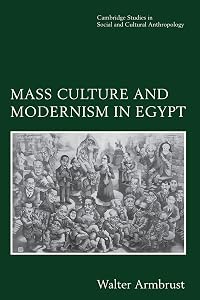
Mass Culture and Modernism in Egypt
by Walter Armbrust
Cambridge Studies in Social and Cultural Anthropology (102)
On This Page
Description
This study of Egyptian popular culture provides fresh and vital insights into the long struggle of modern Egypt to define its identity. Armbrust examines Egyptian television, recorded music, the press, and the cinema. These popular media have broken radically with cultural icons of Egypt's past, while offering ordinary people a way of coming to terms with the clashing values of nationalism, modernity, and Arab classicism. However, since the 1970s, popular culture has also become a subject of show more controversy. The delicate balance between conservative nationalist imagery and a modernist ethic has been increasingly put in question by producers and consumers of the media, reflecting a sense that the representations of modernity do not reflect the experience of Egyptians. show lessTags
Member Reviews
The author in this and a later work analyzes Egyptian social mores through cinema and other popular culture. Here, he traces the development, and eventual deterioration of the ideal of the modern Egyptian, one who accepts the benefits of the Western world while retaining the traditional foundation. In recent times, however, the chasm between "the ideology of the establishment-approved culture and the lives of many Egyptians have become glaringly obvious."
Particularly, "social mobility seems to have declined.... [Being] a college graduate [has] brought little in the way of security or income. Economically, education was an empty triumph." Yet the young are expected to pursue higher education and the modernist dream, despite its ruinous show more expenses and few practical rewards. Where earlier films were about the transformation of the simple man into the "modern man," new films are antimodernist: In a comparison of two versions of a story at opposite ends of this transition, "In the original film the movement was from the milieu of "sons of the country" to the middle class; in [the later version] the characters start out middle class and retreat to folkloric milieu." show less
Particularly, "social mobility seems to have declined.... [Being] a college graduate [has] brought little in the way of security or income. Economically, education was an empty triumph." Yet the young are expected to pursue higher education and the modernist dream, despite its ruinous show more expenses and few practical rewards. Where earlier films were about the transformation of the simple man into the "modern man," new films are antimodernist: In a comparison of two versions of a story at opposite ends of this transition, "In the original film the movement was from the milieu of "sons of the country" to the middle class; in [the later version] the characters start out middle class and retreat to folkloric milieu." show less
Members
- Recently Added By
Author Information
3 Works 24 Members
Walter Armbrust is a fellow at the Institute for the Transregional Study of the Contemporary Middle East, North Africa, and Central Asia, at Princeton University
Series

Common Knowledge
- Canonical title
- Mass Culture and Modernism in Egypt
Classifications
Statistics
- Members
- 5
- Popularity
- 3,433,143
- Reviews
- 1
- Rating
- (3.50)
- Languages
- English
- Media
- Paper
- ISBNs
- 2