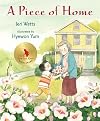
A Piece of Home
by Jeri Watts
On This Page
Description
A child-friendly story about the trials and triumphs of starting over in a new place while keeping family and traditions close. When Hee Jun's family moves from Korea to West Virginia he struggles to adjust to his new home. He can't understand anything the teacher says, and even the sky seems smaller and darker. Hee Jun begins to learn English words and make friends on the playground. One day at a classmate's house he sees a flower he knows from his garden in Korea: mugunghwa, or rose of show more Sharon. Hee Jun is happy to bring a shoot to his grandmother to plant a "piece of home" in their new garden. show lessTags
Recommendations















Member Reviews
A sweet story about a Korean family adjusting to life in America. We see Hee Jun's growing comfort with a strange new language, the English words transforming from "stones" to "bubbles" on his tongue. This story about the immigration experience is much more straightforward than the others I've read. There is no allegory or complex symbolism, just a simple and direct narrative of a young boy adjusting to a foreign place. He finds a "piece of home" in his new friend's garden when he sees a familiar flower, mugunghwa, and shares it with his homesick grandmother.
Side note: I'm noticing a trend...two-thirds of the books about immigrants I checked out from the library this week are authored by white women who are not immigrants. Concerning show more discovery. show less
Side note: I'm noticing a trend...two-thirds of the books about immigrants I checked out from the library this week are authored by white women who are not immigrants. Concerning show more discovery. show less
I purchased this book because I did not have one single book in my classroom library (or at home) with Asian characters. My best friend is Vietnamese, and I had students from China at my last school. I am happy I added this to my collection. This is a story about a family that is having a hard time adjusting to their new life in this country. I am thinking my Hispanic students will be able to relate to this story too. In the book, a gift changes everything because it reminds the grandma of her native country. I love the idea that a plant or a flower, or anything simple but familiar, can have that much impact on a person. I bought into it completely, because I still think of Colombia when I smell certain foods, or when I eat mangos and show more other fruit that I remember getting from trees when I was small. This book left me with a sense of hope at the end. show less
No bullies, no victims, no racism. Just the natural troubles of adjusting to a new home. By the end everything is better and looking up, but is by no means solved perfectly.
I think it's about universal feelings and therefore I'm not put off that it's not OwnVoices.
I think it's about universal feelings and therefore I'm not put off that it's not OwnVoices.
This book tells of the rough transition of Hee Jun's life from Korea to West Virginia. He goes from being an ordinary child in Korea to one who is considered quite different in America, not only in his appearance, but also in culture. Anyone who has ever been homesick can relate to Hee Jun's nostalgia for his home, far far away. He has a hard time adjusting to the new language sounds, and customs that the children have, but he eventually begins to see some similarities in the way things are done in America as well as Korea. This is a great book to teach children kindness and the act of welcoming anybody they may consider new or an outsider. I also particularly like how this book recounts how Hee Jun's sister is also having some show more difficulty adjusting, however, her difficulties are expressed outwardly in behavior problems. This exemplifies that everybody has a different reaction to a situation, and some may handle things differently than others. show less
Hee Jun lives Korea, until his father takes a new job in West Virginia. When they are there, Hee Jun, his sister, and his grandmother all have a hard time adjusting to the new culture. After a while, Hee Jun makes a friend and when he is at his friends house, he brings home a flower that grows in Korea. His grandmother plants the flower, and grows a whole bush so she has a piece of home with her. This would be a really good book to use to teach about the Korean culture, as well as blending into a new culture.
This story is told from the main character, Hee Jun's, point of view as a young girl from Korea. Hee Jun and her family immigrate to West Virginia from Korea, where she experiences difficulties socially and physically. She faces struggles with her appearance in comparison to her peers around her, as well as adjusting to the English language and life styles that her peers experience. At first, she has a hard time finding similarities between herself and her peers, as well as Korean culture and American culture, but eventually she finds them on her own. Not only is Hee Jun feeling like an outsider, her sister as well. This book is great when talking about diversity in traditions, life styles, and experiences of cultures, as well as being show more the new student in a new school. I think this a beneficial book for teaching students how to be accepting of others differences and how to always be welcoming to new students in school and in all situations of life. show less
I think this book is appropriate for both primary and intermediate readers.
This book is about Hee Jun and his family as they move from Korea to West Virginia. He struggles to settle in and feels like an outsider at school. He eventually begins to learn English and make friends. When he is at a friends house one day, they share knowledge about a flower and the friend gives him one to take home. He takes it home to his grandma because she had a garden of them back in Korea, she plants it, and they call it a piece of home.
I think this could be a good book for the classroom to share about identity, culture, family, and new friendships. I think it would also be good for independent readers.
This book is about Hee Jun and his family as they move from Korea to West Virginia. He struggles to settle in and feels like an outsider at school. He eventually begins to learn English and make friends. When he is at a friends house one day, they share knowledge about a flower and the friend gives him one to take home. He takes it home to his grandma because she had a garden of them back in Korea, she plants it, and they call it a piece of home.
I think this could be a good book for the classroom to share about identity, culture, family, and new friendships. I think it would also be good for independent readers.
Members
- Recently Added By
Author Information

5 Works 1,150 Members
Awards and Honors
Awards
Distinctions
Notable Lists
Classifications
Statistics
- Members
- 335
- Popularity
- 94,323
- Reviews
- 25
- Rating
- (4.09)
- Languages
- English
- Media
- Paper
- ISBNs
- 2