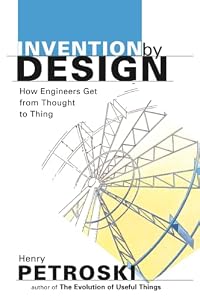
Invention by Design; How Engineers Get from Thought to Thing
by Henry Petroski
On This Page
Description
Engineering entails more than knowing the way things work. What do economics and ecology, aesthetics and ethics, have to do with the shape of a paper clip, the tab of a beverage can, the cabin design of a turbojet, or the course of a river? How do the idiosyncrasies of individual engineers, companies, and communities leave their mark on projects from Velcro to fax machines to waterworks? Invention by Design offers an insider's look at these political and cultural dimensions of design and show more development, production and construction. This book explores the nature of engineering and technology through case studies of familiar objects, from paper clips and aluminum cans to airplanes and modern high-rise buildings. These real-world artifacts (some of which I have written about before) are approached here from a perspective designed to illuminate different facets of the engineering enterprise -- design, analysis, failure, economics, aesthetics, communications, politics, and quality control, to name but a few. The case studies also touch on a variety of engineering fields, including aeronautical, civil, computer, electrical, environmental, manufacturing, mechanical, and structural engineering. - Preface. show lessTags
Recommendations























Member Reviews
A little uneven. Ends rather abruptly. Great References and Further Reading section. Much interesting minutiae. Most important lessons I take from this work (so far) is looking at a problem from different angles and imagining how any single issue/system interacts with others.
An excellent introductory book to Invention and Engineering. It seems fascinating to think, how simple a paper-clip could be iterated and had about 1000 patents. For every product, one could list the defects and then find a way to improvise it.
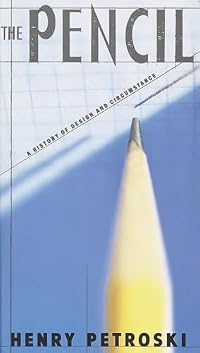
Petroski walks you through paper-clips, pencil-point, zippers, aluminum cans, facsimile, airplanes, water and society, bridges and buildings. Engineering comes into the context of political, social, economic context too. He gives an example of SF bridge.
My favorite chapter has been water and society. Worth giving a read to understand historical aspects of Engineering and invention
--Deus Vult
Gottfried
Petroski walks you through paper-clips, pencil-point, zippers, aluminum cans, facsimile, airplanes, water and society, bridges and buildings. Engineering comes into the context of political, social, economic context too. He gives an example of SF bridge.
My favorite chapter has been water and society. Worth giving a read to understand historical aspects of Engineering and invention
--Deus Vult
Gottfried
This book does a great job at explaining the engineering design process without the need for cartoonish diagrams.
Ratings
Members
- Recently Added By
Author Information

24+ Works 9,742 Members
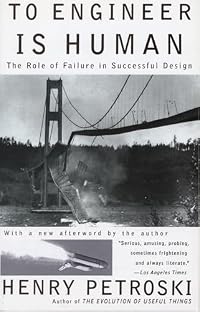
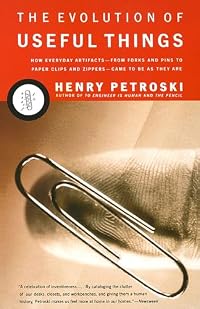
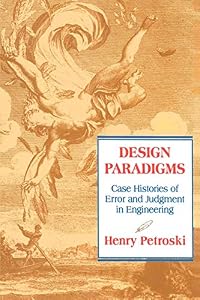
Henry Petroski is an American engineer with wide-ranging historical and sociocultural interests. He earned a Ph.D. in theoretical and applied mechanics from the University of Illinois at Urbana-Champaign in 1968, and became Aleksandar S. Vesic professor and chair of the Department of Civil and Environmental Engineering at Duke University. Petroski show more teaches traditional engineering subjects, as well as courses for nonengineering students, that place the field in a broad social context. One of the major themes that transcends his technical and nontechnical publications is the role of failure and its contribution to successful design. This is the central theme in his study To Engineer Is Human: The Role of Failure in Successful Design, which is accessible to both engineers and general readers. This theme is also incorporated into Petroski's The Pencil: A History of Design and Circumstance (1990), which relates the history of the pencil to broader sociocultural themes. The theme is expanded further, illustrating the relationship of engineering to our everyday life in The Evolution of Useful Things (1992). Petroski's most recent book, Design Paradigms: Case Histories of Error and Judgment in Engineering, is planned for publication in 1994. After that, he will begin a study of the complex interrelationships between engineering and culture. Widely recognized and supported by both the technical and humanities communities, Petroski's work has effectively conveyed the richness and essence of engineering in its societal context for the general reader. (Bowker Author Biography) show less
Awards and Honors
Notable Lists
Classifications
- Genres
- Nonfiction, Art & Design, General Nonfiction, Science & Nature, Technology, History
- DDC/MDS
- 620.0042 — Applied Science & Technology Engineering Mechanical & Civil Engineering General Engineering Special Topics Design
- LCC
- TA174 .P4735 — Technology Engineering Civil engineering (General). Engineering (General). Civil engineering (General) Engineering design
- BISAC
Statistics
- Members
- 386
- Popularity
- 80,637
- Reviews
- 3
- Rating
- (3.63)
- Languages
- English, Finnish, Portuguese (Portugal)
- Media
- Paper, Ebook
- ISBNs
- 7