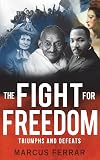
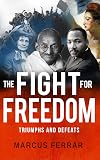
The Fight for Freedom
by Marcus Ferrar
On This Page
Description
The fight for freedom - waged by warriors, democrats, politicians, slaves, civil rights leaders, free-thinkers and ordinary human beings - has stirred passions for thousands of years. This moving narrative recounts the exploits of leaders such as Spartacus, Boadicea, Lincoln and Gandhi, through to heroes of the modern age - Martin Luther King, Nelson Mandela and Aung San Suu Kyi. Their enemies have been despots - for example Persia's Emperor Xerxes, Stalin and Hitler - but sometimes also show more religions, ideologies, and even liberation movement leaders who became new tyrants. Concise and accessible, this book introduces a subject at the forefront of human concerns, and examines its triumphs and the failures. The struggle never ends, and at crucial times it has brought the best out of human beings. Despite setbacks and controversies, the fight for freedom is a heart-warming story of human endeavour that has enriched mankind. show lessTags
Member Reviews
I did not manage to get past the first chapter of this book. As someone well-versed in classical history, I instantly recognized the cliches driving the descriptions of the Roman Empire and the Greek city-states. Whatever research went into this book must have consisted of Hollywood films and Wikipedia. Morever, a book that claims to be about "freedom" does not bother to define it from the beginning. Likewise, the author is dismissive of the problematic aspects of some cultures, while over-emphasizing those same issues in others (i.e. the slaves of the Greek cities get barely passing mention, while the Roman Republic's use of slaves damns the entire nation).
Utter drivel not worth spending not worth a moment of my time, nor yours.
Utter drivel not worth spending not worth a moment of my time, nor yours.
 This review was written for LibraryThing Early Reviewers.
This is a difficult book for me to review because it attempts to be so comprehensive in its coverage. There are so many parts and statements with which I disagree, but that does not go to the question of the value of the book. Ferrar gives us the purpose for the book when he writes (This book) “does not purport to be a comprehensive history of the fight for freedom, which would stretch to several volumes. It gives an overview of the struggle in a few hundred pages, and focuses on a few individuals who have distinguished themselves in the modern times.” (Kindle Locations 62-64). Ferrar fulfills his purpose.
I recommend this book be used in a carefully constructed survey course about freedom. This book would be one of several; the show more others would be chosen to focus on some of the complex issues that were glossed over in this book. It has value at grade levels eight and nine in a US high school. To be used in a curriculum, a knowledgeable teacher would be necessary to point out some of the inconsistencies that result from generalizing about such a vast temporal expanse of history.
Therefore, the book comes with warnings: Use cautiously, read at your own risk, and don’t accept a lot of these assertions as fact.
Perhaps because I am a student of history and political science, this book provided no (as in none or zero) new information for me. I was dismayed by the idea that a reader might finish the book and think they knew a lot of stuff about a lot of things and therefore did not have to do any more reading. That is why I included the warnings above.
The bibliography was good. Readers should select some books in their area of interest and do follow-up reading. My Kindle edition book has 141 cites notes. I would never cite the Encyclopedia Britannica, but that was the author’s choice.
The basic tenet of the book is that people, everyone, wants freedom. It is the central motivator for a person’s actions. Ferrar then goes on with specific instances, stories of specific personalities, to support his case. The specific examples are fine; it is the generalizations drawn from his chosen specifics that give me problems. But, as he writes, “that would stretch to several volumes.” (above) show less
I recommend this book be used in a carefully constructed survey course about freedom. This book would be one of several; the show more others would be chosen to focus on some of the complex issues that were glossed over in this book. It has value at grade levels eight and nine in a US high school. To be used in a curriculum, a knowledgeable teacher would be necessary to point out some of the inconsistencies that result from generalizing about such a vast temporal expanse of history.
Therefore, the book comes with warnings: Use cautiously, read at your own risk, and don’t accept a lot of these assertions as fact.
Perhaps because I am a student of history and political science, this book provided no (as in none or zero) new information for me. I was dismayed by the idea that a reader might finish the book and think they knew a lot of stuff about a lot of things and therefore did not have to do any more reading. That is why I included the warnings above.
The bibliography was good. Readers should select some books in their area of interest and do follow-up reading. My Kindle edition book has 141 cites notes. I would never cite the Encyclopedia Britannica, but that was the author’s choice.
The basic tenet of the book is that people, everyone, wants freedom. It is the central motivator for a person’s actions. Ferrar then goes on with specific instances, stories of specific personalities, to support his case. The specific examples are fine; it is the generalizations drawn from his chosen specifics that give me problems. But, as he writes, “that would stretch to several volumes.” (above) show less
This review was written for LibraryThing Early Reviewers.This was an informative yet very readable book on a very important subject. It is a valuable resource both as an introduction for some and a summary reminder for others of how important it is to keep fighting for freedom. A great one to have in the library.
This review was written for LibraryThing Early Reviewers.Reading "the Fight For Freedom" by Marcus Ferrar, I realized that I didn't really have a grasp on the subject. I really enjoyed how the author introduced you to important people that lay the foundations for our freedoms. In particular Boadicea from Britain in 43 a.d. I had no clue who she was but she played a very significant role in shaping our views on "Win the battle or perish" (Fight the fight,or go down swinging.) I have also been fascinated by the human spirit but this book has open up my eyes of what freedom can do if the freedom fighters start to become the people who try and control everything. It is an easy read and I would recommend it.
This review was written for LibraryThing Early Reviewers.A well written concise history of The Fight for Freedom through the ages. Marcus has written an “easy-read” history book for all ages. The first five chapters recapitulate the well known historical events up until the end of the 19th century and the remaining twelve chapters present an insight into the freedom fighters of the twentieth century right up to the present in the 21st. As a long time student of history, I must say that I found the whole book very interesting but I was particularly impressed with the author’s interpretation on ‘The Arab Spring’ (Chapter 15) and his insights into the ‘history’ that is still unfolding in our time. I would thoroughly recommend this book to every reader.
In the ‘Selected show more Bibliography’ I noted three books from which Marcus quoted for his source material and that I have read. The War That Ended Peace, by Margaret Macmillan, Profile Books, 2013 - Long Walk To Freedom by Nelson Mandela, ebook, 1995 -
Berlin: the Downfall 1945 by Antony Beevor, Viking, 2002. I would also like to refer the reader to another excellent title, not mentioned and unfortunately, now out of print – ‘No Price for Freedom’ by Philip Gibbs, published in 1956 by Hutchinson; the story of the Jewish Ghetto in Warsaw, Poland during WWII. You may be able to get a copy from your local library stack room. show less
In the ‘Selected show more Bibliography’ I noted three books from which Marcus quoted for his source material and that I have read. The War That Ended Peace, by Margaret Macmillan, Profile Books, 2013 - Long Walk To Freedom by Nelson Mandela, ebook, 1995 -
Berlin: the Downfall 1945 by Antony Beevor, Viking, 2002. I would also like to refer the reader to another excellent title, not mentioned and unfortunately, now out of print – ‘No Price for Freedom’ by Philip Gibbs, published in 1956 by Hutchinson; the story of the Jewish Ghetto in Warsaw, Poland during WWII. You may be able to get a copy from your local library stack room. show less
This review was written for LibraryThing Early Reviewers.Ratings
Members
- Recently Added By
Author Information
3 Works 31 Members
Classifications
- Genres
- History, Nonfiction
- BISAC
Statistics
- Members
- 13
- Popularity
- 1,766,883
- Reviews
- 5
- Rating
- (3.17)
- Languages
- English
- Media
- Paper, Ebook
- ISBNs
- 4
- ASINs
- 2