
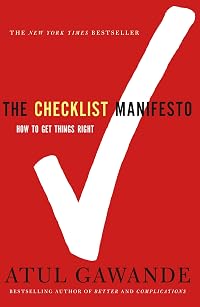
The Checklist Manifesto: How to Get Things Right
by Atul Gawande
On This Page
Description
Reveals the surprising power of the ordinary checklist now being used in medicine, aviation, the armed services, homeland security, investment banking, skyscraper construction, and businesses of all kinds.Tags
Recommendations





Member Reviews
I enjoyed this book immensely. It's about a lot more than the value of checklists, though it is absolutely about that. It's a practical treatise, though, on recognizing our own limitations and fallibilities. Even (or especially) if we are highly trained, specialized professionals. It has a lot to say about skepticism as the foundation of science, and how difficult it can be to remember that. Gawande relates the challenges he's faced in getting medical professionals to accept the benefits of this practice, even in the face of research--there is such a tendency to cling to intuition and gut reaction, even in the face of growing evidence that questions it.
Human beings make mistakes. It's a sad fact of life. Even intelligent, highly-trained people with lots and lots of experience at what they're doing make mistakes, especially in urgent or high-pressure situations. People get distracted at a crucial moment and miss a routine step, or they carry out routine steps on autopilot despite special circumstances that mean those steps should be skipped. Important information sometimes doesn't get to the people who need it most. People who notice problems sometimes don't say anything because they don't feel it's their place to speak up. And so on.
So, how do you deal with this? Well, enter the humble checklist. The airline industry has known about the power of a well-designed checklist for ages, but show more other areas that can seriously benefit from this practice have been slow to catch on, including Gawande's own field of surgery. But it turns out the introduction of checklists into the operating theater has astonishing, dramatic effects on reducing the rate of surgical complications and death from surgical complications. Of course, it has to be the right kind of checklist, and there's a real art to making them. A good checklist covers things that are important but easily missed, it fits quickly and easily into the natural workflow of the people using it, and, perhaps most critically, it increases communication among people who really need to make sure they're all properly informed and on the same page.
Gawande makes a strong, clear case for all of this, with a mixture of scientific data, case studies, personal anecdotes, and thoughtful examinations of how checklists are (or aren't) used in a variety of fields. You'd think this subject could get a bit dull, but Gawade's writing is vivid and readable, his experiences are relatable (even for those of us who aren't surgeons), and his examples and explorations are always interesting. I'd say this is a good read for anyone who is interested in how people get things done in general or in the practice of medicine in particular, and an essential one for anyone whose job involves making decisions about how to handle complex situations in which the stakes are high.
Rating: I'm going to give it a 4.5/5. Four of those stars are for being a good book, and the extra half-star is for being an important one. show less
So, how do you deal with this? Well, enter the humble checklist. The airline industry has known about the power of a well-designed checklist for ages, but show more other areas that can seriously benefit from this practice have been slow to catch on, including Gawande's own field of surgery. But it turns out the introduction of checklists into the operating theater has astonishing, dramatic effects on reducing the rate of surgical complications and death from surgical complications. Of course, it has to be the right kind of checklist, and there's a real art to making them. A good checklist covers things that are important but easily missed, it fits quickly and easily into the natural workflow of the people using it, and, perhaps most critically, it increases communication among people who really need to make sure they're all properly informed and on the same page.
Gawande makes a strong, clear case for all of this, with a mixture of scientific data, case studies, personal anecdotes, and thoughtful examinations of how checklists are (or aren't) used in a variety of fields. You'd think this subject could get a bit dull, but Gawade's writing is vivid and readable, his experiences are relatable (even for those of us who aren't surgeons), and his examples and explorations are always interesting. I'd say this is a good read for anyone who is interested in how people get things done in general or in the practice of medicine in particular, and an essential one for anyone whose job involves making decisions about how to handle complex situations in which the stakes are high.
Rating: I'm going to give it a 4.5/5. Four of those stars are for being a good book, and the extra half-star is for being an important one. show less
One of the best books I've read this year. It had me in tears in a couple of spots, which is hard to explain given it's essentially an argument for creating checklists for complicated tasks. But Gawande's description of surgery and what his team discovered are so moving; you immediately see how this technique is applicable to so many circumstances, and he makes the real human costs and benefits of getting this right crystal clear. This is neither a "big business idea" book, nor a "harrowing medical stories" book, but a hybrid better than both.
What if we had a relatively easy way to improve outcomes in a wide variety domains, but the technique made us feel a little less smart? In this book, Gawande argues that checklists are such a tool. Checklists are ubiquitous in commercial flight; they are starting to make inroads in medicine. They can decrease the incidence of the problems they are targeted to to degrees that would be considered huge successes for other interventions.
Yet when checklists are introduced into a new setting, there is often resistance. Gawande offers two reasons. First, we often feel that we don't need the checklists -- we're smart, and it's not like the information they're conveying is new. Second, good checklists are hard to design, and bad checklists waste show more time and increase frustration.
So why do checklists help? We're talking about smart people -- doctors, pilots, engineers. Don't they know this stuff already? Aren't their jobs too complicated to be reduced to a checklist? Gawande differentiates between three types of problems: simple problems, complicated problems, and complex problems. Simple problems are those where knowing the right techniques and following the recipe will give the right result. Complicated problems require coordination and planning. The parts may be individually simple or complex, but even if they're all simple, the sheer overhead of getting everything done and at the right time makes the problem challenging. Complex problems are those where every instance brings new challenges. The tools you use for simple and complicated problems may help, but fundamentally, complex problems require novel problem solving.
Checklists shine in the domain of the complicated, in the areas where each step is one where a trained practitioner would say "I know how to do that", but where, in the hectic conditions of the real world, it can be hard to actually remember to do each of the steps. Seeing improved outcomes when checklists are used does not mean that the practitioners are unskilled. Instead, checklists free up capacity for thinking about the complex aspects of a problem.
Freeing up capacity is not the only value checklists provide when dealing with complex problems. They can also be used to improve problem solving in a team setting. Checklists can provide communication checkpoints which can help with problem solving. E.g., by adding a step that gives everyone on the team a chance to express concerns they have about a procedure, you can reduce the incidence of conformity biases where people tend to feel less confident in their doubts if everyone else is confident.
The other common issue with checklists is that they can be bad. As Gawande puts it, "It is common to misconceive how checklists function in complex lines of work. They are not comprehensive how-to guides, whether for building a skyscraper or getting a plane out of trouble. They are quick and simple tools to buttress the skills of expert professionals."
What this means in practice is that checklists should be short, five to nine items is a good rule of thumb. They should be triggered by unambiguous pause points, e.g., just before making the first incision in an operation. The wording should be simple and exact; as implied above, a checklist should not be telling you how to do something, just that you should do it. Most importantly, a checklist should be tested under realistic conditions.
When is it worth doing all of this work to create a good checklist? Checklists should be targeted to situations where intervention can significantly change the odds of a good outcome. If the consequences of something being done wrong are not bad, cut it out of the list. If something is so ingrained that practitioners truly never forget it, cut it out of the list. But if there's something that's sometimes forgotten and makes a noticeable difference in aggregate, then that is a good candidate for a checklist.
In case you can't tell, I really liked this book and the message it conveys. This is not just because the specific ideas about checklists are useful. This book also expresses one of my core beliefs about process: a good process is one which allows people to feel like they are spending more time on what is most meaningful. A good process reduces the time spent on bureaucracy. A good process is the equivalent of automation for things that cannot yet be automated. Checklists are a good process. show less
Yet when checklists are introduced into a new setting, there is often resistance. Gawande offers two reasons. First, we often feel that we don't need the checklists -- we're smart, and it's not like the information they're conveying is new. Second, good checklists are hard to design, and bad checklists waste show more time and increase frustration.
So why do checklists help? We're talking about smart people -- doctors, pilots, engineers. Don't they know this stuff already? Aren't their jobs too complicated to be reduced to a checklist? Gawande differentiates between three types of problems: simple problems, complicated problems, and complex problems. Simple problems are those where knowing the right techniques and following the recipe will give the right result. Complicated problems require coordination and planning. The parts may be individually simple or complex, but even if they're all simple, the sheer overhead of getting everything done and at the right time makes the problem challenging. Complex problems are those where every instance brings new challenges. The tools you use for simple and complicated problems may help, but fundamentally, complex problems require novel problem solving.
Checklists shine in the domain of the complicated, in the areas where each step is one where a trained practitioner would say "I know how to do that", but where, in the hectic conditions of the real world, it can be hard to actually remember to do each of the steps. Seeing improved outcomes when checklists are used does not mean that the practitioners are unskilled. Instead, checklists free up capacity for thinking about the complex aspects of a problem.
Freeing up capacity is not the only value checklists provide when dealing with complex problems. They can also be used to improve problem solving in a team setting. Checklists can provide communication checkpoints which can help with problem solving. E.g., by adding a step that gives everyone on the team a chance to express concerns they have about a procedure, you can reduce the incidence of conformity biases where people tend to feel less confident in their doubts if everyone else is confident.
The other common issue with checklists is that they can be bad. As Gawande puts it, "It is common to misconceive how checklists function in complex lines of work. They are not comprehensive how-to guides, whether for building a skyscraper or getting a plane out of trouble. They are quick and simple tools to buttress the skills of expert professionals."
What this means in practice is that checklists should be short, five to nine items is a good rule of thumb. They should be triggered by unambiguous pause points, e.g., just before making the first incision in an operation. The wording should be simple and exact; as implied above, a checklist should not be telling you how to do something, just that you should do it. Most importantly, a checklist should be tested under realistic conditions.
When is it worth doing all of this work to create a good checklist? Checklists should be targeted to situations where intervention can significantly change the odds of a good outcome. If the consequences of something being done wrong are not bad, cut it out of the list. If something is so ingrained that practitioners truly never forget it, cut it out of the list. But if there's something that's sometimes forgotten and makes a noticeable difference in aggregate, then that is a good candidate for a checklist.
In case you can't tell, I really liked this book and the message it conveys. This is not just because the specific ideas about checklists are useful. This book also expresses one of my core beliefs about process: a good process is one which allows people to feel like they are spending more time on what is most meaningful. A good process reduces the time spent on bureaucracy. A good process is the equivalent of automation for things that cannot yet be automated. Checklists are a good process. show less
Gawande makes an important point: checklists are valuable to experts, not just novices. And they are useful across industries and occupations. Airline pilots, structural engineers and safety inspectors regularly use them to good effect. They can either be "do-check" or "run-do" and are utilised at specific pause points within a task. Value investors sometimes use checklists. Gawande presents some evidence that those that do fare better than "gut instinct".
Surgeons, he believes, should take the leap and use checklists. The point could have been made even more strongly by detailing the cognitive bias which affects most professionals, the one that makes the majority think they are above average. Specific to medicine, Gawande suggests some show more of the possible reasons checklists are eschewed: the need for doctors to "own" patient care through their own expertise; the media's idolisation of individual heroism; and the condescension with which some doctors hold professionals such as nurses who might well promote checklists.
What I love, therefore, about Gawande's approach is his insistence that checklists are a means of teams improving outcomes, not one of trying to bolster individual performance. Teams should introduce each other by name. Checklists in surgery should be verbal and can be run by any member of the team. This encourages knowledge sharing and holistic thinking. Gawande posits that successful results to complex problems are mostly due to effective teamwork and communication, not the heroism or brilliance of any individual. This story I can believe. show less
Surgeons, he believes, should take the leap and use checklists. The point could have been made even more strongly by detailing the cognitive bias which affects most professionals, the one that makes the majority think they are above average. Specific to medicine, Gawande suggests some show more of the possible reasons checklists are eschewed: the need for doctors to "own" patient care through their own expertise; the media's idolisation of individual heroism; and the condescension with which some doctors hold professionals such as nurses who might well promote checklists.
What I love, therefore, about Gawande's approach is his insistence that checklists are a means of teams improving outcomes, not one of trying to bolster individual performance. Teams should introduce each other by name. Checklists in surgery should be verbal and can be run by any member of the team. This encourages knowledge sharing and holistic thinking. Gawande posits that successful results to complex problems are mostly due to effective teamwork and communication, not the heroism or brilliance of any individual. This story I can believe. show less
Celebrated surgeon and author Atul Gawande is sold on the importance of checklists in all areas of professional life. In The Checklist Manifesto, he goes into great detail to sell the reader on them as well. Ok, ok, I'm convinced!
Gawande shares anecdotes from the several professional fields, including medicine, construction, finance, and aviation to illustrate his point: checklists add value by preventing errors and helping teams work more efficiently. But although the usefulness of checklists is readily apparent, several barriers stand in the way of widespread implementation. One is the common view of the lone surgeon, pilot or other expert as an autonomous "hero" who does not need to rely on anything as mundane as a checklist. show more Another is the fact that said hero needs to give up some of his power in order for the checklist to work its magic. Throughout the book, I felt Gawande personally struggling with his own fallibility, although in every case, his patients survive.
I didn't really enjoy reading this book, and felt that its contents could have been reduced to a few pages in graduate business or public administration program textbooks. But then the checklist concept would not have gotten all the attention that it deserves. show less
Gawande shares anecdotes from the several professional fields, including medicine, construction, finance, and aviation to illustrate his point: checklists add value by preventing errors and helping teams work more efficiently. But although the usefulness of checklists is readily apparent, several barriers stand in the way of widespread implementation. One is the common view of the lone surgeon, pilot or other expert as an autonomous "hero" who does not need to rely on anything as mundane as a checklist. show more Another is the fact that said hero needs to give up some of his power in order for the checklist to work its magic. Throughout the book, I felt Gawande personally struggling with his own fallibility, although in every case, his patients survive.
I didn't really enjoy reading this book, and felt that its contents could have been reduced to a few pages in graduate business or public administration program textbooks. But then the checklist concept would not have gotten all the attention that it deserves. show less
I checked out The Checklist Manifesto, by Atul Gawande, as part of an attempt to get my life more organized and better prioritized. (Let's just say I overcommitted a bit last spring.) I also have a tendency to write down too many items on my todo lists, and they can lose their usefulness quickly. I was hoping this would help me to use checklists more effectively.
I was wrong. Well, mostly. It turned out to be an argument for *doctors* to use checklists much more regularly in their operations, largely surgeries, in order to avoid forgetting to do obvious things. As it turns out, there is a need:
"In 2001, [a previous checklist study was performed]. Doctors are supposed to (1) wash their hands with soap, (2) clean the patient's skin with show more chlorhexidine antiseptic, (3) put sterile drapes over the entire patient, (4) wear a mask, hat, sterile gown, and gloves, and (5) put a sterile dressing over the insertion site once the line is in. Check, check, check, check, check. These steps are no-brainers; they have been known and taught for years. So it seemed silly to make a checklist for something so obvious. Still, Pronovost asked the nurses in his ICU to observe the doctors for a month as they put lines into patients and record how often they carried out each step. In more than a third of patients, they skipped at least one."
(pages 37-38, emphasis mine)
Yikes.
All very basic stuff huh? As a patient, I just kind of assume that these things are happening behind the scenes and that they'd never make a mistake as simple as forgetting to wash their hands. Evidently not.
In the next year the nurses were encouraged to correct the doctors when they witnessed steps being skipped. "The results were so dramatic that they weren't sure whether to believe them: the ten-day line-infection rate went from 11 percent to zero." (page 38) An estimated eight lives saved in one hospital, from making sure medical professionals remembered to sterilize everything!
Gawande then goes on to describe how checklists are used successfully in other fields, and this was surprisingly interesting as well. For example, construction of large buildings/skyscrapers is evidently done by breaking the design into multiple subsystems, and each team effectively has a giant checklist they're working through. And to make sure the different teams work nicely with each other, some of the tasks are communication-oriented, e.g. have a cross-team meeting to discuss potential issues after the water lines are put in. Gawande is advocating a similar approach in medicine; instead of having one exalted physician or surgeon, maybe we should entrust our health to multiple experts and attempt to do a better job communicating amongst themselves.
Aviation was presented as the gold standard in checklists. Evidently pilots have manuals which consist of hundreds of checklists on the plane every time they fly. Most are never used, but they'll describe every possible disaster scenario and the really obvious first steps that must be performed. One objection readers may have here and elsewhere is that in a crisis scenario the expert should be free to perform by intuition and not be restricted by red tape. Gawande would disagree, to a point. "The [airline] checklists have proved their worth--they work. However much pilots are taught to trust their procedures more than their instincts, that doesn't mean they will do so blindly. Aviation checklists are by no means perfect ... You want to keep the list short by focusing on what he called 'the killer items'--the steps that are most dangerous to skip and sometimes overlooked nonetheless." (pages 121, 123) And they must be short, in the 5-10 item, ~30 second range. At this point, the argument goes, you've removed the costliest, most frequent mistakes and it's time to let the experts act on their own and amaze us.
Gawande also believes that this line of reasoning could be extended to just about anything. Like investing - did you actually read Company X's cashflow statement before buying its stock? But I was a bit disappointed it wasn't more practical on a personal level. There are things that fit into this approach, like remembering to pay the credit card bill, but my life is less ... procedural ... than things in this book.
But it was still a fascinating book. Sometimes I amaze myself at the variety of things I can make myself interested in. To be fair, this wasn't the first medical book I've read and enjoyed, but it probably was the first analysis of construction that's been written interestingly enough to hold my attention! And in case you were wondering, Gawande did ultimately come up with a three-part, nineteen item checklist for use in surgeries that has performed well in testing so far. It's also been winning many converts from skeptical doctors who usually think a bit too highly of themselves and see it as a waste of time, until the checklist saves someone from a (literally) deadly mistake! Here's a sample of the current checklist:
"Before anesthesia, there are seven checks. The team members confirm that the patient (or the patient's proxy) has personally verified his or her identity and also given consent for the procedure. They make sure that the surgical site is marked and that the pulse oximeter--which monitors oxygen levels--is on the patient and working. They check the patient's medication allergies. They review the risk of airway problems--the most dangerous aspect of general anesthesia--and that appropriate equipment and assistance for them are available. And lastly, if there is a possibility of losing more than half a liter of blood (or the equivalent for a child), they verify that necessary intravenous lines, blood, and fluids are ready." (page 140)
Maybe our next visits will be just a little bit safer :)
4.5/5 - I might actually purchase this one someday
Review also posted to my blog at http://ojchase.blogspot.com/2012/09/the-checklist-manifesto.html show less
I was wrong. Well, mostly. It turned out to be an argument for *doctors* to use checklists much more regularly in their operations, largely surgeries, in order to avoid forgetting to do obvious things. As it turns out, there is a need:
"In 2001, [a previous checklist study was performed]. Doctors are supposed to (1) wash their hands with soap, (2) clean the patient's skin with show more chlorhexidine antiseptic, (3) put sterile drapes over the entire patient, (4) wear a mask, hat, sterile gown, and gloves, and (5) put a sterile dressing over the insertion site once the line is in. Check, check, check, check, check. These steps are no-brainers; they have been known and taught for years. So it seemed silly to make a checklist for something so obvious. Still, Pronovost asked the nurses in his ICU to observe the doctors for a month as they put lines into patients and record how often they carried out each step. In more than a third of patients, they skipped at least one."
(pages 37-38, emphasis mine)
Yikes.
All very basic stuff huh? As a patient, I just kind of assume that these things are happening behind the scenes and that they'd never make a mistake as simple as forgetting to wash their hands. Evidently not.
In the next year the nurses were encouraged to correct the doctors when they witnessed steps being skipped. "The results were so dramatic that they weren't sure whether to believe them: the ten-day line-infection rate went from 11 percent to zero." (page 38) An estimated eight lives saved in one hospital, from making sure medical professionals remembered to sterilize everything!
Gawande then goes on to describe how checklists are used successfully in other fields, and this was surprisingly interesting as well. For example, construction of large buildings/skyscrapers is evidently done by breaking the design into multiple subsystems, and each team effectively has a giant checklist they're working through. And to make sure the different teams work nicely with each other, some of the tasks are communication-oriented, e.g. have a cross-team meeting to discuss potential issues after the water lines are put in. Gawande is advocating a similar approach in medicine; instead of having one exalted physician or surgeon, maybe we should entrust our health to multiple experts and attempt to do a better job communicating amongst themselves.
Aviation was presented as the gold standard in checklists. Evidently pilots have manuals which consist of hundreds of checklists on the plane every time they fly. Most are never used, but they'll describe every possible disaster scenario and the really obvious first steps that must be performed. One objection readers may have here and elsewhere is that in a crisis scenario the expert should be free to perform by intuition and not be restricted by red tape. Gawande would disagree, to a point. "The [airline] checklists have proved their worth--they work. However much pilots are taught to trust their procedures more than their instincts, that doesn't mean they will do so blindly. Aviation checklists are by no means perfect ... You want to keep the list short by focusing on what he called 'the killer items'--the steps that are most dangerous to skip and sometimes overlooked nonetheless." (pages 121, 123) And they must be short, in the 5-10 item, ~30 second range. At this point, the argument goes, you've removed the costliest, most frequent mistakes and it's time to let the experts act on their own and amaze us.
Gawande also believes that this line of reasoning could be extended to just about anything. Like investing - did you actually read Company X's cashflow statement before buying its stock? But I was a bit disappointed it wasn't more practical on a personal level. There are things that fit into this approach, like remembering to pay the credit card bill, but my life is less ... procedural ... than things in this book.
But it was still a fascinating book. Sometimes I amaze myself at the variety of things I can make myself interested in. To be fair, this wasn't the first medical book I've read and enjoyed, but it probably was the first analysis of construction that's been written interestingly enough to hold my attention! And in case you were wondering, Gawande did ultimately come up with a three-part, nineteen item checklist for use in surgeries that has performed well in testing so far. It's also been winning many converts from skeptical doctors who usually think a bit too highly of themselves and see it as a waste of time, until the checklist saves someone from a (literally) deadly mistake! Here's a sample of the current checklist:
"Before anesthesia, there are seven checks. The team members confirm that the patient (or the patient's proxy) has personally verified his or her identity and also given consent for the procedure. They make sure that the surgical site is marked and that the pulse oximeter--which monitors oxygen levels--is on the patient and working. They check the patient's medication allergies. They review the risk of airway problems--the most dangerous aspect of general anesthesia--and that appropriate equipment and assistance for them are available. And lastly, if there is a possibility of losing more than half a liter of blood (or the equivalent for a child), they verify that necessary intravenous lines, blood, and fluids are ready." (page 140)
Maybe our next visits will be just a little bit safer :)
4.5/5 - I might actually purchase this one someday
Review also posted to my blog at http://ojchase.blogspot.com/2012/09/the-checklist-manifesto.html show less
Members
- Recently Added By
Published Reviews
ThingScore 81
I already know that "The Checklist Manifesto" will be on my list of best books this year. Gawande writes with gusto, humor and clarity. He features his mistakes -- always a good sign in a reporter -- including the one that ends the book.
added by stephmo
Read this book and you might find yourself making checklists for the most mundane tasks—and be better off for it.
added by stephmo
But that narrative gift doesn't transfer automatically to accounts of in-flight safety checks and structural engineering near-misses. Gawande's style is always clear, with the crispy lilt that is a trademark of the New Yorker, where he is also a staff writer. But there's no escaping the fact that this is a book about, well, checklists. Hemingway would struggle to make it gripping. Gawande does show more well to pull off engaging. show less
added by stephmo
Lists

To Read - Medicine
18 works; 1 member

Non-Fiction Worth Reading
1,015 works; 261 members

Big Data
52 works; 2 members

Books To Get From The Library
115 works; 5 members

Mind Expanding Books by hackerkid
581 works; 8 members

Books Read in 2017
4,249 works; 130 members

Books Read in 2022
5,166 works; 114 members

Books Read in 2025
4,091 works; 97 members

Books Read in 2019
4,052 works; 108 members

Suggested Reading for Stage Managers
42 works; 1 member
Author Information

12+ Works 16,959 Members
Atul Gawande is a surgical resident in Boston and staff writer on medicine and science for The New Yorker. A former Rhodes scholar, he received his M.D. from Harvard Medical School. He lives with his wife and three children in Newton, Massachusetts. (Publisher Fact Sheets) Atul Gawande is a surgeon at Brigham and Women's Hospital in Boston, a show more staff writer for The New Yorker, and a professor at Harvard Medical School and the Harvard School of Public Health. He is also the Executive Director of Ariadne Labs and chairman of Lifebox, a nonprofit organization making surgery safer globally. He has written several books including Complications, Better, The Checklist Manifesto, and Being Mortal: Medicine and What Matters in the End. He has won the Lewis Thomas Prize for Writing about Science and two National Magazine Awards. He will be appearing at the 2015 Auckland Writers Festival in New Zealand. He won the prize for Adult Non-fiction in the Indies Choice Book Awards 2015 with Being Mortal: Medicine and What Matters in the End. (Bowker Author Biography) show less
Some Editions
Awards and Honors
Distinctions
Common Knowledge
- Canonical title
- The Checklist Manifesto: How to Get Things Right
- Original publication date
- 2009-12-22
- Dedication
- For Hunter, Hattie and Walker
- First words
- Introduction
I was chatting with a medical school friend of mine who is now a general surgeon in San Francisco.
Some time ago I read a case report in the Annals of Thoracic Surgery. - Quotations
- Faulty memory and distraction are a particular danger in what engineers call all-or-none processes: whether running to the store to buy ingredients for a cake, preparing an airplane for takeoff, or evaluating a sick person in... (show all) the hospital, if you miss just one key thing, you might as well not have made the effort at all.
...the real lesson is that under conditions of true complexity—where knowledge required exceeds that of any individual and unpredictably reigns—efforts to dictate every step from the center will fail. People need room to... (show all) act and adapt. Yet they cannot succeed as isolated individuals, either—that is anarchy. Instead, they require a seemingly contradictory mix of freedom and expectation—expectation to coordinate, for example, and also to measure progress toward common goals. - Last words
- (Click to show. Warning: May contain spoilers.)"Yes," he said, "I'd be glad if you did."
- Publisher's editor
- Hocherman, Riva
- Canonical DDC/MDS
- 640.43
Classifications
- Genres
- Business, General Nonfiction, Nonfiction
- DDC/MDS
- 640.43 — Applied science & technology Home economics & family management Home and family Specific aspects of home management Management of time
- LCC
- RA399 .A1 .G39 — Medicine Public aspects of medicine Public aspects of medicine Medicine and the state Regulation of medical practice. Evaluation and
- BISAC
Statistics
- Members
- 4,225
- Popularity
- 3,588
- Reviews
- 146
- Rating
- (3.98)
- Languages
- 11 — Chinese, Dutch, English, French, German, Italian, Korean, Polish, Portuguese, Spanish, Turkish
- Media
- Paper, Audiobook, Ebook
- ISBNs
- 28
- UPCs
- 1
- ASINs
- 29