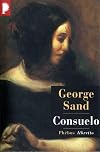
Consuelo
by George Sand
On This Page
Description
In what is considered Sand's masterpiece, a gifted gypsy singer, Consuelo, climbs above her humble beginnings and becomes the Prima Donna in Venice. Consuelo's talent and artistry is admired by all, and leads to passionate love affairs and adventures across Europe. An emotional rollercoaster, Consuelo has many choices to make throughout her love life and career.Tags
Recommendations
























Member Reviews
This is the first of a two-part romance about Consuelo, a poor but spirited heroine who grows up in 18th century Venice. She is taken in by the Baroness Amelia and brought to live with her at Castle Rudolstadt in Bohemia and be her companion. There Consuelo meets the melancholy Count Albert upon whom she exerts a beneficial effect. The story is filled with the joys of music and poetry laced with vivid descriptions of psychic experiments and experiences.
Il s'agit de la principale somme romanesque de George Sand, œuvre de sa maturité (1842), dont elle renferme les secrets. L'héroïne est une cantatrice. La première partie se déroule à Venise, c'est une nouvelle musicale avec une intrigue amoureuse ; la deuxième est un roman historique et fantastique, situé à Riesenburg ; la troisième, récit de voyage, d'aventures, musical et historique, se tourne vers Vienne, où se passe la quatrième, ainsi qu'à Prague, qui mélange tous les éléments précédents. L'action se déroule entre 1742 et 1755. Consuelo est d'abord un roman d'aventures passionnant. Mais la trame soutient les idées historiques, sociales, politiques, esthétiques, musicales. La protagoniste est une fille du show more peuple, comme l'auteur par sa mère. Elle vivra entourée d'hommes, jusqu'à son mariage avec le comte de Rudolstadt. Tome II : Consuelo, devenue comtesse de Rudolstadt, connaît un chevalier errant, redresseur de torts et consolateur des affligés. Les plus grands mérites du livre sont dans les réflexions et les suggestions qu'il nous propose. Ainsi sur la musique, qui transporte dans un autre monde, sur la propriété, qui est le mal, sur les classes sociales, qu'il faut abolir, sur la religion de l'humanité, qui doit remplacer les autres. La grandeur de Consuelo et de La comtesse de Rudolstadt est de proposer un monde complet, dans un style aisé, familier, avec ses hauts et ses bas, ses moments sublimes et son côté mélodramatique. show less
Nov 21, 2010French
Ratings
Members
- Recently Added By
Lists

1898 C.K. Shorter List of Best 100 Novels
100 works; 34 members
F. B. Perkins' List of 100 Best Fiction
100 works; 5 members

French Fiction of the 18th and 19th Centuries in English Translation
169 works; 3 members
150 Best Novels Selected by Brander Matthews (1883)
150 works; 7 members
Author Information

453+ Works 6,433 Members
George Sand began life as Aurore Dupin, the daughter of a count and a dressmaker. Educated both on her aristocratic grandmother's estate and in a Parisian convent, at 18 she married Casimer Dudevant, a provincial gentleman whose rough temperament was the opposite of her own, and from whom she obtained a separation several years later. At 31 she show more moved to Paris, where she changed her name and plunged into the bohemian world of French romanticism. Frequently dressed in men's clothing, she participated actively in literary debates, cultural events, and even the revolution of 1848. Sand was friend and correspondent with many of the major artists and writers of her age, including Balzac, Flaubert, and Liszt. Her love affairs with the poet Musset and the composer Chopin were the stuff of legend, chronicled in her own Story of My Life. Sand's immensely popular novels ranged from sentimental stories of wronged women, to utopian socialist fictions, such as her masterpiece in Consuelo, 1842, to explorations of pastoral themes written when she retired, late in life, to her estate in Berry. Though frequently dismissed as overblown or too sentimental, Sand's fiction has recently undergone a revaluation, emerging as an influential body of women's writing. As both a writer and an intellectual personality, Sand is a central figure in nineteenth-century French cultural life. George Sand died in 1876 (Bowker Author Biography) show less
Awards and Honors
Common Knowledge
- Canonical title*
- Taiteilijattaren tarina
- Original title
- Consuelo
- Original publication date
- 1842
- Original language*
- ranska
*Some information comes from Common Knowledge in other languages. Click "Edit" for more information.
Classifications
Statistics
- Members
- 189
- Popularity
- 173,385
- Reviews
- 2
- Rating
- (4.07)
- Languages
- 8 — Czech, English, Estonian, Finnish, French, Hungarian, Polish, Russian
- Media
- Paper, Ebook
- ISBNs
- 32
- ASINs
- 7