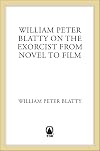
William Peter Blatty On The Exorcist: From Novel To Film
by William Peter Blatty
On This Page
Description
In William Peter Blatty on The Exorcist: From Novel to Film, the New York Times bestselling author reveals the real-life incidents that inspired his famous novel and how it evolved into the groundbreaking Academy Award-winning screenplay of the 1973 groundbreaking William Friedkin film.Featuring the original, controversial ending of the novel, and both the first draft of the screenplay and the shooting script, Blatty presents his behind-the-scenes commentary on the differences between the show more book and screenplays, detailing the specific reasons why the changes were made for the final cut.This is the true story of the making of The Exorcist, an insider's guide to Hollywood in one of its most creative eras.Includes photographsAt the Publisher's request, this title is being sold without Digital Rights Management Software (DRM) applied. show lessTags
Recommendations

















Member Reviews
This book contains the first draft of the screenplay to the movie, as well as a portion of the script with scene settings. The most important parts of this volume are the Introduction and Why Changes Were Made in the Screenplay. Blatty gives some biographical material on himself and on the genesis and production of the novel. He also includes information on the way the film adaptation was birthed. I found this to be a fascinating addition to the novel. Fans of the movie might be so interested in these details. There are some excellent film production photos (b&w only). Blatty writes that he thought he was writing a book which would promote faith in the goodness of humanity by showing how a person could sacrifice their life for another, show more even if that person (the person possessed) were shown to be physically degraded beyond all human measure of known spiritual oppresion.
Blatty also writes that there were forces which many times almost stopped the film (not the book) from being made. He talks about how he wanted to have Jane Fonda play the role of the mother but she “didn’t believe in magic.” This happened in 1973. Fonda had earlier gone to Hanoi, where the Hanoi Hilton was located, and placed her celebrity at the service of a regime which was in the process of torturing and killing over one hundred US military prisoners. Many memoirs of these US POWs imply that evil was present during these ‘interrogation sessions.’ Apparently, Fonda not only didn't believe in magic, she couldn't sense the presence evil. Shirley MacLaine provided inspiration for the character dialogue of the non-believing mother. Overall, these two short essays are wonderful to read. The way the studios routinely tried to swindle writers, among others, (Warner in this case) is always good fun. Blatty didn’t like when audiences thought that ‘evil won’ (Karras dying) by his ending. That may not have been his intent but cinematically that was a legitimate conclusion. It was my own as well. show less
Blatty also writes that there were forces which many times almost stopped the film (not the book) from being made. He talks about how he wanted to have Jane Fonda play the role of the mother but she “didn’t believe in magic.” This happened in 1973. Fonda had earlier gone to Hanoi, where the Hanoi Hilton was located, and placed her celebrity at the service of a regime which was in the process of torturing and killing over one hundred US military prisoners. Many memoirs of these US POWs imply that evil was present during these ‘interrogation sessions.’ Apparently, Fonda not only didn't believe in magic, she couldn't sense the presence evil. Shirley MacLaine provided inspiration for the character dialogue of the non-believing mother. Overall, these two short essays are wonderful to read. The way the studios routinely tried to swindle writers, among others, (Warner in this case) is always good fun. Blatty didn’t like when audiences thought that ‘evil won’ (Karras dying) by his ending. That may not have been his intent but cinematically that was a legitimate conclusion. It was my own as well. show less
This was a weird book, and it really felt more like a quick way to cash in a make a few more bucks off The Exorcist. Most of it was the scripts from the movie, though the initial part was the story of him coming to write the novel, as well as getting himself on as producer for the move. Another short section was some of the stuff that was cut from the movie.
Like I said, weird book.
The one thing that never fails to amaze me is how Blatty can crack self-effacing jokes yet somehow still come off as an officious, conceited dick at the same time.
Overall, it's a reasonably interesting behind-the-scenes look at the book and the movie, but mostly it's kind of not worth the ride.
Like I said, weird book.
The one thing that never fails to amaze me is how Blatty can crack self-effacing jokes yet somehow still come off as an officious, conceited dick at the same time.
Overall, it's a reasonably interesting behind-the-scenes look at the book and the movie, but mostly it's kind of not worth the ride.
Ratings
Members
- Recently Added By
Author Information

46+ Works 9,835 Members
William Peter Blatty was born in Manhattan, New York on January 7, 1928. He graduated from Georgetown University in 1950. After serving in the Air Force, he worked for the United States Information Agency in Beirut. He returned to the United States for a public relations job in Los Angeles, where he hoped to begin his career as a writer. In 1961, show more he appeared as a contestant on You Bet Your Life. He and a fellow contestant won $10,000. He quit his day job and become a full-time writer. He collaborated with the director Blake Edwards on the screenplays for several films including A Shot in the Dark, What Did You Do in the War, Daddy?, Darling Lili, and Gunn. He wrote several horror fiction books including The Exorcist, The Ninth Configuration, and Legion. All of the books were adapted into movies with the screenplays written by Blatty. He won an Academy Award for The Exorcist screenplay. He also adapted his novel John Goldfarb, Please Come Home! for the screen. He wrote several memoirs including Which Way to Mecca, Jack?, I'll Tell Them I Remember You, and Finding Peter. He died from multiple myeloma on January 12, 2017 at the age of 89. (Bowker Author Biography) show less
Common Knowledge
- Related movies
- The Exorcist (1973 | IMDb)
Classifications
Statistics
- Members
- 49
- Popularity
- 615,946
- Reviews
- 2
- Rating
- (3.44)
- Languages
- English, Spanish
- Media
- Paper, Ebook
- ISBNs
- 4
- ASINs
- 2