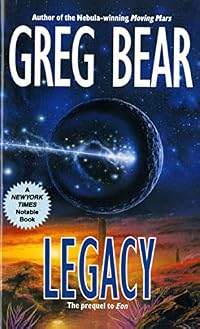
On This Page
Description
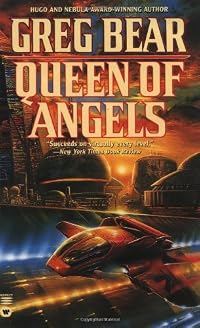
A new world has been discovered via a time tunnel. It is called Lamarckia and it is home to novel forms of life, among them hybrids of plants and animals. But access is restricted and the story concerns an agent investigating illegal immigration to this new world.Tags
Recommendations














Member Reviews
"The gate will only open somewhere interesting."
Or so I paraphrase the keywarden, as he opens a path from the artificial axis universe stored within the generation ship Thistledown to the planet Lamarckia, and ushers our protagonist, Olmy, on a secret mission to scout a renegade colony of anti-technology utopians. The problem is that the keywarden lies, or at least only partially tells the truth.
Greg Bear's whole thing is a kind of Ultra-Orthodox Hard SciFi, a dazzling display of ideas where the characters and plot take a back seat, and this book delivers. Lamarckia, the centerpiece of the book, is a planet dominated by the ecoi, continental scale organisms that express themselves as scions, sub-organs ranging from tree-analogous to show more mobile tenders and spies to stranger creatures that influence whole weather systems. The renegade utopians were 5000 colonists under the leader Able Lenk, but his community has fractured politically, and is riven by famine, war, and threatened by the ecoi, which they lack the scientific base to understand.
Olmy's ostensible mission is to find a clavicle, a device which would open a gate back to Thistledown, but instead he arrives in the middle of a war between Lenk and the renegade Brion, and then signs up on a scientific voyage to circumnavigate the world. The book takes on a tinge of Moby Dick, with a captain obsessed with finding a queen of the ecoi, a mythical self-aware center to the landscape. The actual plot wanders, and Olmy is a cipher as a protagonist.
I read this book because it came first in my Eon collection, which probably was a mistake. I'm looking forward to Thistledown as a setting. show less
Or so I paraphrase the keywarden, as he opens a path from the artificial axis universe stored within the generation ship Thistledown to the planet Lamarckia, and ushers our protagonist, Olmy, on a secret mission to scout a renegade colony of anti-technology utopians. The problem is that the keywarden lies, or at least only partially tells the truth.
Greg Bear's whole thing is a kind of Ultra-Orthodox Hard SciFi, a dazzling display of ideas where the characters and plot take a back seat, and this book delivers. Lamarckia, the centerpiece of the book, is a planet dominated by the ecoi, continental scale organisms that express themselves as scions, sub-organs ranging from tree-analogous to show more mobile tenders and spies to stranger creatures that influence whole weather systems. The renegade utopians were 5000 colonists under the leader Able Lenk, but his community has fractured politically, and is riven by famine, war, and threatened by the ecoi, which they lack the scientific base to understand.
Olmy's ostensible mission is to find a clavicle, a device which would open a gate back to Thistledown, but instead he arrives in the middle of a war between Lenk and the renegade Brion, and then signs up on a scientific voyage to circumnavigate the world. The book takes on a tinge of Moby Dick, with a captain obsessed with finding a queen of the ecoi, a mythical self-aware center to the landscape. The actual plot wanders, and Olmy is a cipher as a protagonist.
I read this book because it came first in my Eon collection, which probably was a mistake. I'm looking forward to Thistledown as a setting. show less
My suspicion is that Bear wanted to do a novel using the strange ecology and biology of Lamarckia and decided to incorporate it into his Way series.
This book is narrated by Olmy, military man, secret agent, and fixer for the Hexamon. We finally learn the details of the mission that got him the gratitude of the Hexamon and an extra bodily incarnation.
It’s a prequel to all the Way novels. Besides Olmy, the only characters that seem to be present from the other books is the gate opener Ry Ornis and Konrad Korzenowski, here still, of course, a downloaded mind residing in an implant in Olmy’s skull.
We hear more of Olmy’s upbringing. While he had Naderite parents, he has Geshel sympathies (hence the implants). He’s ambitious and show more serving in the Hexamon defense forces and, by his own admission, somewhat callow.
He is selected to go on a secret mission to Lamarckia, one of those planets accessed through the Way. Lamarckia has a strange biology. As the name suggests, life does not operate there on the principles of Darwinian evolution. The planet is divided into zones, ecoi, ruled over by a scion, an entity that creates new biological forms and “samples” (as in taking genetic samples) new lifeforms (even humans) entering its zone and generates new forms. This is not evolution by random mutation sieved through fitness criteria determined by the environment or sexual competition. In fact, there is no sexual reproduction. The different scions don’t reproduce with each other. It is speculated that there may be an intelligence, a queen, directing Lamarckia’s version of evolution in each ecoi.
The political aspects of the story involve a breakway group of Naderites, about 4,000, “divarticates”, who secretly settle Lamarckia and take two of the “clavicles”, the instruments that manipulate openings in the Way, with them. The group was led by Jamie Carr Lenk aka Able Lenk.
The various factions of the upper Hexamon government want to know what’s been happening on Lamarckia and the return of those clavicles.
Stripped of his implants to maintain his cover, Olmy is dumped on Lamarckia.
What he finds when he gets to Lamarckia is that 35 years have passed on the planet, not ten, due to the differential rates of time when passing through an imprecisely tuned gate. Second the colony has experienced famine and now is in the midst of a civil war.
Right from the start, Lenk’s conspiracy was undercut by people who followed him onto Lamarckia but had their own agenda. The inability to grow a lot of normal crops on the planet and its lack of metals further exacerbated the strife.
There were breakaway groups of radical feminists resentful of their status as little more than baby factories. Piracy exists. Children are kidnapped to prop up declining populations. Others have become wistful for the medicines and other technologies they abandoned in the Way. There’s even a small underground expecting a Hexamon agent like Olmy.
I liked the political aspects of the novel, and the final revelations of the personal rancor and slights behind a major political schism seemed realistic.
But I found the exploration of the alien biology tedious at times. Olmy goes on a voyage to finally complete the circumnavigation of Lamarckia and makes friends and starts a love affair.
It all goes wrong at the end. The brutality on Lamarckia ends with an ecological change unleashed by a breakaway group. Olmy, who has been appalled by what he sees in the colony, reconciles himself to it. It’s just another unpleasant episode in human history.
Of course, Olmy survives all this – but not before living a along and unpleasant life on Lamarckia before he is rescued. In keeping with a theme that runs throughout the series, there is an argument on the value of death in human societies.
I’d say, despite the biological speculation – a Bear specialty – this is the least appealing of the Way novels. show less
This book is narrated by Olmy, military man, secret agent, and fixer for the Hexamon. We finally learn the details of the mission that got him the gratitude of the Hexamon and an extra bodily incarnation.
It’s a prequel to all the Way novels. Besides Olmy, the only characters that seem to be present from the other books is the gate opener Ry Ornis and Konrad Korzenowski, here still, of course, a downloaded mind residing in an implant in Olmy’s skull.
We hear more of Olmy’s upbringing. While he had Naderite parents, he has Geshel sympathies (hence the implants). He’s ambitious and show more serving in the Hexamon defense forces and, by his own admission, somewhat callow.
He is selected to go on a secret mission to Lamarckia, one of those planets accessed through the Way. Lamarckia has a strange biology. As the name suggests, life does not operate there on the principles of Darwinian evolution. The planet is divided into zones, ecoi, ruled over by a scion, an entity that creates new biological forms and “samples” (as in taking genetic samples) new lifeforms (even humans) entering its zone and generates new forms. This is not evolution by random mutation sieved through fitness criteria determined by the environment or sexual competition. In fact, there is no sexual reproduction. The different scions don’t reproduce with each other. It is speculated that there may be an intelligence, a queen, directing Lamarckia’s version of evolution in each ecoi.
The political aspects of the story involve a breakway group of Naderites, about 4,000, “divarticates”, who secretly settle Lamarckia and take two of the “clavicles”, the instruments that manipulate openings in the Way, with them. The group was led by Jamie Carr Lenk aka Able Lenk.
The various factions of the upper Hexamon government want to know what’s been happening on Lamarckia and the return of those clavicles.
Stripped of his implants to maintain his cover, Olmy is dumped on Lamarckia.
What he finds when he gets to Lamarckia is that 35 years have passed on the planet, not ten, due to the differential rates of time when passing through an imprecisely tuned gate. Second the colony has experienced famine and now is in the midst of a civil war.
Right from the start, Lenk’s conspiracy was undercut by people who followed him onto Lamarckia but had their own agenda. The inability to grow a lot of normal crops on the planet and its lack of metals further exacerbated the strife.
There were breakaway groups of radical feminists resentful of their status as little more than baby factories. Piracy exists. Children are kidnapped to prop up declining populations. Others have become wistful for the medicines and other technologies they abandoned in the Way. There’s even a small underground expecting a Hexamon agent like Olmy.
I liked the political aspects of the novel, and the final revelations of the personal rancor and slights behind a major political schism seemed realistic.
But I found the exploration of the alien biology tedious at times. Olmy goes on a voyage to finally complete the circumnavigation of Lamarckia and makes friends and starts a love affair.
It all goes wrong at the end. The brutality on Lamarckia ends with an ecological change unleashed by a breakaway group. Olmy, who has been appalled by what he sees in the colony, reconciles himself to it. It’s just another unpleasant episode in human history.
Of course, Olmy survives all this – but not before living a along and unpleasant life on Lamarckia before he is rescued. In keeping with a theme that runs throughout the series, there is an argument on the value of death in human societies.
I’d say, despite the biological speculation – a Bear specialty – this is the least appealing of the Way novels. show less
This book is a prequel to the two previous novels, 'Eon' and 'Eternity', looking at the early career of the Hexamon politician Olmy, and it deals with him being sent on a mission to a world that a group of dissidents opened a gate to from the Way, the mathematical space/time construct that formed the setting for much of the other two novels. As a prequel, it might be thought that it could be read as a stand-alone novel or even read first; I would not recommend that. Although the plot generally does not need a lot of knowledge of the events of the first two novels, a knowledge of the background will explain much about the motivations and mind-sets of most of the characters.
As Ser Olmy explores the world of Lamarckia, he gets more heavily show more involved in the politics of the dissidents; because of the nature of the Way, although only five years have passed in the Hexamon since the dissidents left, on the other side of the gate forty years have passed. Indeed, the Hexamon has become something of a myth, with a particular sect of the dissidents having come to almost see the Hexamon as potential future angelic saviours.
The main feature of the world Lamarckia is its semi-sentient ecologies, formed of continent-spanning bioforms which employ a number of different subforms to communicate, scavenge and possibly reproduce. These bioforms play a key role in the action of the plot, as one faction of the dissidents claims to have found ways to bend the bioforms and their products to human needs.
There are numerous changes in direction in the story; once we have got away from the Hexamon and the Way, it might seem that we are plunged into a classic planetary romance (indeed, at one point I found myself wishing for a map!); then Olmy signs up on board a research ship, and we're heading off into Herman Melville territory; then finally he meets up with the leaders of the two political factions and suddenly we are in a journey such as experienced in 'Heart of Darkness' or 'Apocalypse Now'.
Of course, Bear was always going to have a problem with this story; how to bring Olmy's tale to a close, knowing that he survives to play his part in 'Eon' many years later? The assumption is that he will be rescued, and this is signalled some distance out from the end; yet those events are in some way secondary, and problematical because the one surviving clavicle, the device used to open gates to and from the Way, may well be lost. The answer relies on the knowledge and application of Hexamon technology in the end; and this is one point where reading this book as a standalone would not satisfy, as it's important to know the Hexamon's abilities in that direction to understand quite what has been going on there.
This book is important, though, for explaining a lot about Ser Olmy's motivations in the other books of the series, especially in 'Eternity'. It does prompt the question with me as to quite when Bear saw the idea for this book; the Ser Olmy of 'Eon' is not as well-drawn as his much younger self is here, and this is not just another example of Bear's novels getting more complex with time and experience. But I ultimately found this a satisfying and engaging experience. show less
As Ser Olmy explores the world of Lamarckia, he gets more heavily show more involved in the politics of the dissidents; because of the nature of the Way, although only five years have passed in the Hexamon since the dissidents left, on the other side of the gate forty years have passed. Indeed, the Hexamon has become something of a myth, with a particular sect of the dissidents having come to almost see the Hexamon as potential future angelic saviours.
The main feature of the world Lamarckia is its semi-sentient ecologies, formed of continent-spanning bioforms which employ a number of different subforms to communicate, scavenge and possibly reproduce. These bioforms play a key role in the action of the plot, as one faction of the dissidents claims to have found ways to bend the bioforms and their products to human needs.
There are numerous changes in direction in the story; once we have got away from the Hexamon and the Way, it might seem that we are plunged into a classic planetary romance (indeed, at one point I found myself wishing for a map!); then Olmy signs up on board a research ship, and we're heading off into Herman Melville territory; then finally he meets up with the leaders of the two political factions and suddenly we are in a journey such as experienced in 'Heart of Darkness' or 'Apocalypse Now'.
Of course, Bear was always going to have a problem with this story; how to bring Olmy's tale to a close, knowing that he survives to play his part in 'Eon' many years later? The assumption is that he will be rescued, and this is signalled some distance out from the end; yet those events are in some way secondary, and problematical because the one surviving clavicle, the device used to open gates to and from the Way, may well be lost. The answer relies on the knowledge and application of Hexamon technology in the end; and this is one point where reading this book as a standalone would not satisfy, as it's important to know the Hexamon's abilities in that direction to understand quite what has been going on there.
This book is important, though, for explaining a lot about Ser Olmy's motivations in the other books of the series, especially in 'Eternity'. It does prompt the question with me as to quite when Bear saw the idea for this book; the Ser Olmy of 'Eon' is not as well-drawn as his much younger self is here, and this is not just another example of Bear's novels getting more complex with time and experience. But I ultimately found this a satisfying and engaging experience. show less
I really enjoyed this book. Its been a while since I read any of this series, so I really don't understand how this is a prequel, but it didn't matter. This was quite enjoyable as a stand-alone book. If you haven't read the other books in the series it really doesn't matter. The generation ship/asteroid Thistledown is on its way across space while at the same time it is the source of The Way - the wormhole/tunnel through space and time that lets the crew travel away from the asteroid. A few members of the crew/passengers break away and settle the Earth like world of Lamarkia. A agent is sent after them to see how they are doing and this is the plot of the entire novel. Fortunately or unfortunately, Lamarkia is already controlled by show more aware ecosystems that compete with each other and the new invaders, the humans. Exploring the world and determining the fate of the humans on it is the mission of the agent sent to them.
There's a few things that are a bit contrived - why is it so hard to get to Lamarkia from The Way? Why is just one person sent to investigate, without any of the super enhancements you'd expect from a far future sci-fi novel? (There's no internet on Lamarkia! The horror!). It ends up being more of a Lewis and Clarke type travel/adventure novel than it does sci-fi. The adventure is good and the characters interesting, I enjoyed it. show less
There's a few things that are a bit contrived - why is it so hard to get to Lamarkia from The Way? Why is just one person sent to investigate, without any of the super enhancements you'd expect from a far future sci-fi novel? (There's no internet on Lamarkia! The horror!). It ends up being more of a Lewis and Clarke type travel/adventure novel than it does sci-fi. The adventure is good and the characters interesting, I enjoyed it. show less
Very solid, both in terms of the SF speculation, characterization and overall writing, but it was a slog for me to finish. I've not read the books it is a prequel to. Fans of Eon and Eternity may find resonances and foreshadowing that make the story more engaging. It's your basic "fish out of water" story, with an agent (loosely speaking) of an advanced human society, sent to a planet colonized half a century earlier (with some time distortions involved) by several thousand rebels. The story follows the main character as he slowly learns about the lifeforms on the planet, reminiscent of James White's continent-spanning creatures in Major Operation, and the political and social intricacies of the colonies. Until the very end he is show more primarily an observer. Many things happen, characters change, but none of it really meant much to me. It was all just events in a row. Definitely something I kept feeling like I should like more than I did. show less
This book is a continuation of Eon, or more precisely, a prequel dealing with one of the main characters, Olmy.
It explores the history and effects of The Way further, and describes an adventure Olmy has on one of the worlds reachable by The Way.
Even though I liked Eon a lot better, I did love this book. The whole philosophy of The Way, and what all they can do is very interesting, as is Olmy's adventure in a world that is like our own, but yet completely different. A very nice book, also readable stand-alone.
It explores the history and effects of The Way further, and describes an adventure Olmy has on one of the worlds reachable by The Way.
Even though I liked Eon a lot better, I did love this book. The whole philosophy of The Way, and what all they can do is very interesting, as is Olmy's adventure in a world that is like our own, but yet completely different. A very nice book, also readable stand-alone.
This was a disapointing read from the usually reliable Bear. The best part of this book was the very discriptive way that Bear brought another world to life but too much of the book was on a boat and at times felt more like a O'Brien adventure.
Members
- Recently Added By
Author Information

140+ Works 47,088 Members
Greg Bear was born in San Diego, California, on August 20, 1951. He received a Bachelor of Arts degree from San Diego State University in 1973. At age 14, he began submitting pieces to magazines and at 15 he sold his first story to Robert Lowndes' Famous Science Fiction. It would be five years before he sold another piece, but by 23 he was selling show more stories regularly. He has written more than 30 science fiction and fantasy books and has won numerous awards for his work. In 1984, Hardfought and Blood Music won the Nebula Awards for best novella and novelette; Blood Music went on to win the Hugo Award. The novel version of that story, also called Blood Music, won the Prix Apollo in France. In 1987, Tangents won the Hugo and Nebula awards for best short story. He also won a Nebula in 1994 for Moving Mars and in 2001 for Darwin's Radio. Both Dinosaur Summer and Darwin's Radio have been awarded the Endeavour for best novel published by a Northwest science fiction author. He is also an illustrator and his work has appeared in Galaxy, Fantasy and Science Fiction, and Vertex, and in both hardcover and paperback books. He was a founding member of ASFA, the Association of Science Fiction Artists. His works include City at the End of Time, Hull Zero Three, The Mongoliad, Mariposa, Halo: Cryptum, Halo: Primordium and Halo: Silentium. (Bowker Author Biography) show less
Some Editions
Series


Belongs to Publisher Series
Work Relationships
Is contained in
Common Knowledge
- Canonical title
- Legacy
- Original title
- Legacy
- Original publication date
- 1995
- People/Characters
- Olmy (Hexamon agent)
- Important places
- Lamarckia
- Dedication
- For Bertha Merriman
A pioneer who lived in a tougher time
With love from a grandchild - First words
- PROLOGUE: JOURNEY YEAR 753
I stood on the lip of the souther bore hole, clutching a service line, and for the first time in my life, stared beyond the mass of Thistledown at the stars. - Blurbers
- Brin, David
- Original language
- English
Classifications
Statistics
- Members
- 1,458
- Popularity
- 15,936
- Reviews
- 14
- Rating
- (3.40)
- Languages
- 5 — Dutch, English, French, Italian, Spanish
- Media
- Paper, Audiobook, Ebook
- ISBNs
- 18
- ASINs
- 9