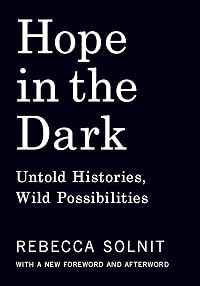
Hope in the Dark: Untold Histories, Wild Possibilities
by Rebecca Solnit
On This Page
Description
With Hope in the Dark, Rebecca Solnit makes a radical case for hope as a commitment to act in a world whose future remains uncertain and unknowable. Drawing on her decades of activism and a wide reading of environmental, cultural, and political history, Solnit argued that radicals have a long, neglected history of transformative victories, that the positive consequences of our acts are not always immediately seen, directly knowable, or even measurable, and that pessimism and despair rest on show more an unwarranted confidence about what is going to happen next. Originally published in 2004, now with a new foreword and afterword, Solnit's influential audio book shines a light into the darkness of our time in an unforgettable new edition. show lessTags
Recommendations










Member Reviews
Rebecca Solnit wrote this book on the eve of George W. Bush's ill-fated decision to start the Second Iraq War, but this little book functions as a sort of all-purpose devotional for leftist activists of all stripes who find themselves faced with bleak prospects. Solnit deftly connects disparate strands of history, arguing that even failed attempts at improving our world may have far-reaching effects that we may not be able to predict. The author borrows heavily -- and skillfully -- from Vaclav Havel's ideas about hope, which do not require a specific plan of action or favorable odds but only the belief that somewhere and somehow, things can be made better. Solnit provides some wonderful examples of how unpredictable activism can be: an show more anti-nuclear testing program in Nevada led to an alliance between Americans and Kazakhs. Activists who dreamed of a better world have drawn inspiration from figures separated by both oceans and eons. Solnit's main point here is that trying to make a better world justifies itself and that even movements that seem to have failed may eventually bear fruit. As we look down the barrel of a second Trump administration, it's a message that I -- and maybe all of us -- needed to hear.
Unlike the author, I can't really describe myself as a politically active person. However, I much of "Hope in the Dark" to be useful from a purely personal perspective. Solnit's beliefs that impossible odds are not an excuse to not give things a try, that despair is often a logical but emotionally comfortable option, and that power often disguises itself as normalcy can be applied in both the political and the personal spheres of one's life. I should also probably mention that there are some elements of "Hope in the Dark" that I can't get behind under any circumstances, much as I admire Solnit's courage and her writing. She's rather further to the left than I am, so I'm not really prepared to hear nice things said about the Chavista regime in Venezuela, nor do I think, despite some very real examples of creative mutual support, that the crash of 2001 did very much but cause irreparable damage to Argentine society. Even so, this one is recommended to anyone, lefties and Never Trumpers alike, who need assurance that all is not lost. show less
Unlike the author, I can't really describe myself as a politically active person. However, I much of "Hope in the Dark" to be useful from a purely personal perspective. Solnit's beliefs that impossible odds are not an excuse to not give things a try, that despair is often a logical but emotionally comfortable option, and that power often disguises itself as normalcy can be applied in both the political and the personal spheres of one's life. I should also probably mention that there are some elements of "Hope in the Dark" that I can't get behind under any circumstances, much as I admire Solnit's courage and her writing. She's rather further to the left than I am, so I'm not really prepared to hear nice things said about the Chavista regime in Venezuela, nor do I think, despite some very real examples of creative mutual support, that the crash of 2001 did very much but cause irreparable damage to Argentine society. Even so, this one is recommended to anyone, lefties and Never Trumpers alike, who need assurance that all is not lost. show less
I should definitely have read one of Solnit’s books before, as I’ve enjoyed her writing online and found ‘Hope in the Dark’ a moving, thought-provoking, and deeply satisfying read. I love her elegant, measured style. While writing with passion and feeling, she also qualifies and hedges her statements in a way that really speaks to me as I tend to do the same. (Note the hedging use of ‘tend to’, because I don’t always!) I found her reasons to hope in horrifying political times inspiring and encouraging. Although she was writing during the Bush years, it is all very much applicable to the Time of Trump. Solnit is clear about the many problems of the world and does not downplay them, yet she argues persuasively that people show more are capable of wonderful things, including systemic change.
As I read this book on a (delayed) train, I noticed a great many astute and appealing parts for such a short book. An initial example:
There’s a great deal of wisdom in just that one paragraph. It perfectly pins down Trump’s rhetoric (although that term seems too generous, ‘noise’ is more accurate) of victimhood and persecution despite also being President and claiming to have omnipotent control over America. It gently yet firmly counters fatalism and inaction, in a manner that made me want to revisit Paul Kingsnorth’s [b:Confessions of a Recovering Environmentalist and Other Essays|31450661|Confessions of a Recovering Environmentalist and Other Essays|Paul Kingsnorth|https://images.gr-assets.com/books/1483077976s/31450661.jpg|52153539] for comparison purposes. Read together, his essays make a sophisticated and thoughtful argument for despair. Solnit gives a powerful counterpoint, drawing on a wide range of examples and writers - including Borges, to my delight.
Another particularly important point:
This is part of a wider critique of simplistic dichotomous thinking, which I found valuable and well-expressed. (However, I would suggest a moratorium on celebrating very slight improvements in the inclusiveness of advertising as victories for feminism and LGBT rights.)
Solnit’s commentary on the altruism, co-operation, and desire for belonging in human nature also reminded me of a talk I went to by George Monbiot on his latest book, [b:Out of the Wreckage: A New Politics in the Age of Crisis|32171783|Out of the Wreckage A New Politics in the Age of Crisis|George Monbiot|https://images.gr-assets.com/books/1498931739s/32171783.jpg|52808178]. The ways she puts it is as succinct and profound as the rest of the book:
Like Monbiot, Solnit then argues that, ‘The embrace of local power doesn’t have to mean parochialism, withdrawal, or intolerance, only a coherent foundation from which to navigate the larger world.’ This a radically hopeful and utopian notion at a time of rising neo-fascist nationalism, an ideology that fears and distrusts both the local and the global. Yet Solnit’s faith in people, and ability to back it up with logic and evidence, lends considerable conviction.
She also gave me a very helpful insight into my parents’ generation, whose pessimism can be startling and frustrating at times :
Despite Solnit ending with a chapter on climate change, I finished the book feeling more hopeful. Surely that’s as high a recommendation as I could offer. show less
As I read this book on a (delayed) train, I noticed a great many astute and appealing parts for such a short book. An initial example:
Left despair has many causes and many varieties. There are those who think that turning the official version inside out is enough. To say that the emperor has no clothes is a nice anti-authoritarian gesture, but to say that everything is without exception going straight to hell is not an authoritarian vision but only an inverted of the mainstream’s “everything’s fine”. Then, failure and marginalisation are safe - you can see the conservatives who run the United States claim to be embattled outsiders, because that means they can deny their responsibility for how things are and their power to make change, and because it is a sense of being threatened that rallies their troops. The activists who deny their own power and possibility likewise choose to shake off their sense of obligation: if they are doomed to lose, they don’t have to do very much except situate themselves as beautiful losers or at least virtuous ones.
There’s a great deal of wisdom in just that one paragraph. It perfectly pins down Trump’s rhetoric (although that term seems too generous, ‘noise’ is more accurate) of victimhood and persecution despite also being President and claiming to have omnipotent control over America. It gently yet firmly counters fatalism and inaction, in a manner that made me want to revisit Paul Kingsnorth’s [b:Confessions of a Recovering Environmentalist and Other Essays|31450661|Confessions of a Recovering Environmentalist and Other Essays|Paul Kingsnorth|https://images.gr-assets.com/books/1483077976s/31450661.jpg|52153539] for comparison purposes. Read together, his essays make a sophisticated and thoughtful argument for despair. Solnit gives a powerful counterpoint, drawing on a wide range of examples and writers - including Borges, to my delight.
Another particularly important point:
Both versions are defeatist because they are static. What’s missing from these two ways of telling is an ability to recognise a situation in which you are travelling and have not arrived, in which you have cause both to celebrate and fight, in which the world is always being made and never finished. [...] “We are winning” said the graffiti in Seattle, not “We have won”. It’s a way of telling in which you can feel successful without feeling smug, in which you can feel challenged without feeling defeated. Most victories will be temporary, or incomplete, or compromised in some way, and we might as well celebrate them as well as the stunning victories that come from time to time.
This is part of a wider critique of simplistic dichotomous thinking, which I found valuable and well-expressed. (However, I would suggest a moratorium on celebrating very slight improvements in the inclusiveness of advertising as victories for feminism and LGBT rights.)
Solnit’s commentary on the altruism, co-operation, and desire for belonging in human nature also reminded me of a talk I went to by George Monbiot on his latest book, [b:Out of the Wreckage: A New Politics in the Age of Crisis|32171783|Out of the Wreckage A New Politics in the Age of Crisis|George Monbiot|https://images.gr-assets.com/books/1498931739s/32171783.jpg|52808178]. The ways she puts it is as succinct and profound as the rest of the book:
Hollywood movies and too many government pandemic plans still presume that most of us are cowards or brutes, that we panic, trample each other, rampage, or freeze helplessly in moments of crisis and chaos. Most of us believe this, even though it is a slander against the species, an obliteration of what actually happens, and a crippling blow to our ability to prepare for disasters. Hollywood likes this view because it paves the way for movies starring some superman in the foreground and hordes of stamping, screaming extras. Without stupid, helpless people to save, heroes become unnecessary. Or rather, without them, it turns out we are all heroes.
Like Monbiot, Solnit then argues that, ‘The embrace of local power doesn’t have to mean parochialism, withdrawal, or intolerance, only a coherent foundation from which to navigate the larger world.’ This a radically hopeful and utopian notion at a time of rising neo-fascist nationalism, an ideology that fears and distrusts both the local and the global. Yet Solnit’s faith in people, and ability to back it up with logic and evidence, lends considerable conviction.
She also gave me a very helpful insight into my parents’ generation, whose pessimism can be startling and frustrating at times :
A friend born in the 1950s reminds me that his generation in their youth really expected a revolution - the old kind where people march with weapons and overthrow the government and establish a utopia - and were permanently disappointed that it hadn’t come to pass. When I was young, people still jestingly said, “After the revolution,” but the catchphrase came from the idea that regime change was how to change everything, and nothing short of regime change mattered. Though everything had changed - not enough on many fronts, but tremendously.
Despite Solnit ending with a chapter on climate change, I finished the book feeling more hopeful. Surely that’s as high a recommendation as I could offer. show less
****.5
First published in 2004, a lot of the content revolves around the turn of the new millennium, the aftermath of 9/11, the Bush Administration, and the Iraq War. I listened to the updated 2016 version of the audiobook, which has a new introduction and conclusion, and overall is still extremely relevant to what's going on today. The names and places may have changed, but the parallels are stark and the themes are the same ones we are grappling with today: Climate change, right wing politicians ruining everything, warmongering regimes trampling on the Constitution, leftist purity tests, doomerism, etc.
The message of the book is that despite the horribleness of it all, Hope is still possible and even essential if we are to get through show more it. Sure, things are extremely frustrating but if we despair then they will only get worse. By focusing on the progress and chipping away at the problems, we have the best chance at success, and at staying sane during the process. Which is an absolutely vital message right now. show less
First published in 2004, a lot of the content revolves around the turn of the new millennium, the aftermath of 9/11, the Bush Administration, and the Iraq War. I listened to the updated 2016 version of the audiobook, which has a new introduction and conclusion, and overall is still extremely relevant to what's going on today. The names and places may have changed, but the parallels are stark and the themes are the same ones we are grappling with today: Climate change, right wing politicians ruining everything, warmongering regimes trampling on the Constitution, leftist purity tests, doomerism, etc.
The message of the book is that despite the horribleness of it all, Hope is still possible and even essential if we are to get through show more it. Sure, things are extremely frustrating but if we despair then they will only get worse. By focusing on the progress and chipping away at the problems, we have the best chance at success, and at staying sane during the process. Which is an absolutely vital message right now. show less
After the results of the U.S. election came in and everyone was feeling pretty down, the publisher made an ebook version of this book free for download for about a week. I didn't read it immediately. I think I was still hoping for something Drastic to happen that would change everything, but obviously we're here now, post inauguration, and we need a book telling us about hope in the dark.
That said, this is in a lot of ways a historical document about the Bush years, years I didn't think I could remember as clearly because I was young. When I started reading this book I thought I was going to learn something more about this time I might have missed, this time I might not have had perspective on. But in 2004 I was a teenager--a young show more teenager, but I was reading and writing about so many of the same topics. I read out loud a political essay I wrote about the war in Iraq to my grade 9 English class. Sometimes I had my political views from Rolling Stone, sometimes from Noam Chomsky. I was actually much more aware of the political scene at the time than I thought (and this is what reminds me of how much teen voices matter, and how much I knew that at the time, and how much I hate when people dismiss them).
None of this tells you much about the book, which is a history of several significant protests of recent decades and a solid encouragement to remain an activist and keep protesting. Perhaps it's not the first Solnit book I'd recommend someone interested in reading her, but I could happily recommend it to people looking for someone to tell them about why these fights were worth fighting. The central message, that the effects of protests and activism are seldom direct (planting seeds in a garden you will never see sort of thing), is pretty essential to my understanding of how our actions and narratives change the world. I'm not for a revolution in power when revolution means a half-turn of the wheel, someone else (or just some other ideology) occupying the place that was at the top of the circle previously, and Solnit underlines that in her hopeful visions of the future. show less
That said, this is in a lot of ways a historical document about the Bush years, years I didn't think I could remember as clearly because I was young. When I started reading this book I thought I was going to learn something more about this time I might have missed, this time I might not have had perspective on. But in 2004 I was a teenager--a young show more teenager, but I was reading and writing about so many of the same topics. I read out loud a political essay I wrote about the war in Iraq to my grade 9 English class. Sometimes I had my political views from Rolling Stone, sometimes from Noam Chomsky. I was actually much more aware of the political scene at the time than I thought (and this is what reminds me of how much teen voices matter, and how much I knew that at the time, and how much I hate when people dismiss them).
None of this tells you much about the book, which is a history of several significant protests of recent decades and a solid encouragement to remain an activist and keep protesting. Perhaps it's not the first Solnit book I'd recommend someone interested in reading her, but I could happily recommend it to people looking for someone to tell them about why these fights were worth fighting. The central message, that the effects of protests and activism are seldom direct (planting seeds in a garden you will never see sort of thing), is pretty essential to my understanding of how our actions and narratives change the world. I'm not for a revolution in power when revolution means a half-turn of the wheel, someone else (or just some other ideology) occupying the place that was at the top of the circle previously, and Solnit underlines that in her hopeful visions of the future. show less
“Resistance is first of all a matter of principle and a way to live, to make yourself one small republic of unconquered spirit. You hope for results, but you don’t depend on them.”
“It’s always too soon to go home. Most of the great victories continue to unfold, unfinished in the sense that they are not yet fully realized but also in the sense that they continue to spread influence. A phenomenon like the civil rights movement created a vocabulary and a toolbox for social change used around the globe, so that its effects far outstrips its goals and specific achievements—and failures.”
Rebecca Solnit wrote this during the time of the Bush administration. A time that also saw the largest global protest–against the US show more invasion of Iraq. The message remains pertinent now, as we see ourselves gripped with a global pandemic, a return of regressive nationalism, & a dismantling of social welfare that affects & kills so many. How do we speak of hope in such terrible times? She writes of how hope always seems to shine in the dark. In great disruption often comes great opportunity to practice our most humane selves, & to rethink the way we behave, & the system that governs us.
Rebecca Solnit begins by establishing that hope isn’t utopian fantasising, but a realist way of positioning one self. Being utopian & being pessimistic are both states where an individual absolves themselves from doing anything. Either because things will magically be ok, or because they’re convinced things will be hopeless. But hope, for Solnit, is the belief that the process of participating, of trying, is in itself meaningful, with full awareness that “failure” is very much possible.
Even the conception of “failure” is problematized, because every action is precious. She mentions how even though the Iraq war still happened, the protests delayed the invasion for months, possibly allowing Iraqis to prepare & evacuate, & they also managed to turn the administration from performing “shock and awe” saturation bombing which would have killed many more lives. We never know how actions that seem to yield nothing in the present may inspire someone else & create change in the future. Think of how revolutions in France & Russia went on to inspire so many other revolutions worldwide, or how Greta’s action snowballed into worldwide strikes by students in a matter of a year. What made the book especially interesting was also her sharing of her experiences in movements, the people she has met, & the wisdom they share. I especially enjoyed her insights about the environmentalist movement and how it had to strain and face its elitism. Also that bit about how sometimes victory can look a lot like nothing happened! A field unravaged, a land undrilled, a forest uncut.. makes me thankful for what is left to simply be, and how so much courage might have been practiced just to simply let things be. show less
“It’s always too soon to go home. Most of the great victories continue to unfold, unfinished in the sense that they are not yet fully realized but also in the sense that they continue to spread influence. A phenomenon like the civil rights movement created a vocabulary and a toolbox for social change used around the globe, so that its effects far outstrips its goals and specific achievements—and failures.”
Rebecca Solnit wrote this during the time of the Bush administration. A time that also saw the largest global protest–against the US show more invasion of Iraq. The message remains pertinent now, as we see ourselves gripped with a global pandemic, a return of regressive nationalism, & a dismantling of social welfare that affects & kills so many. How do we speak of hope in such terrible times? She writes of how hope always seems to shine in the dark. In great disruption often comes great opportunity to practice our most humane selves, & to rethink the way we behave, & the system that governs us.
Rebecca Solnit begins by establishing that hope isn’t utopian fantasising, but a realist way of positioning one self. Being utopian & being pessimistic are both states where an individual absolves themselves from doing anything. Either because things will magically be ok, or because they’re convinced things will be hopeless. But hope, for Solnit, is the belief that the process of participating, of trying, is in itself meaningful, with full awareness that “failure” is very much possible.
Even the conception of “failure” is problematized, because every action is precious. She mentions how even though the Iraq war still happened, the protests delayed the invasion for months, possibly allowing Iraqis to prepare & evacuate, & they also managed to turn the administration from performing “shock and awe” saturation bombing which would have killed many more lives. We never know how actions that seem to yield nothing in the present may inspire someone else & create change in the future. Think of how revolutions in France & Russia went on to inspire so many other revolutions worldwide, or how Greta’s action snowballed into worldwide strikes by students in a matter of a year. What made the book especially interesting was also her sharing of her experiences in movements, the people she has met, & the wisdom they share. I especially enjoyed her insights about the environmentalist movement and how it had to strain and face its elitism. Also that bit about how sometimes victory can look a lot like nothing happened! A field unravaged, a land undrilled, a forest uncut.. makes me thankful for what is left to simply be, and how so much courage might have been practiced just to simply let things be. show less
This is an incredible little book, about the stories we tell ourselves about change, and a guide for changing the stories we tell ourselves. I got this from Haymarket Books in the days after the 2016 election, when they were giving it away for free, and I'm convinced now that that was the best thing anyone could have done. I'm susceptible to pessimistic politics myself, but Solnit doesn't shame you for that tendency, only admits that it's easy and offers another way forward.
"A victory doesn't mean that everything is now going to be nice forever.... A victory is a milestone on the road, evidence that sometimes we win, and encouragement to keep going, not to stop."
Before typing in that quotation from the Foreword to the Third Edition I checked the GR quotes pages for it. Four pages of quotes... many of which I hit 'like' on, but not that one. I have a feeling I'll be typing more in. This book is definitely more than a coffee mug; I hope it inspires me. Because I am tired.
Short essays, big words. No narrative. A book to read in little bits.
Ok done. The inspiration is here. It comes in being repeatedly reminded that every little bit one does makes a difference, and that life without purpose is not living, show more leads to ennui, so find your purpose, and if you don't like what you see in the news, make your own.
"The Old Testament God rules with a heavy hand over a static moral world.... Many North American creation myths... portray... a world... made by flawed humorous creatures who never finished the job.... Coyote's world is more complicated."
('More like the real world' is Solnit's point. She's especially addressing activists. Probably white activists, given the unfortunate use of the word "myths"... she didn't use that word in reference to Yahweh's world. But it's a valid point, memorably made.)
(Stretching the metaphor, she makes another important point:)
"Coyote asks us to trust in the basic eccentricity of the world, in its sense of humor, and in its resiliency... sometimes army bases become... wildlife preserves.... Sometimes Las Vegas-style casinos give Native Americans visibility and political clout. Sometimes corporations and the military demand affirmative action because it benefits them too."
([sic]... sometimes she who writes with grace and power comes up with awfully awkward constructions, too... ;)
"This is Earth. It will never be heaven. There will always be cruelty, always be violence, always be destruction."
"wait and hope are the same words in Spanish" (?)
Y'know, now that I'm done writing this review, processing what I read, I think more and more about the value of good science fiction. SF explores possible alternate futures (and histories), and explores the perspective of non-human sapient beings. For example, if we could bring about a sort of heaven on Earth, what would it look like, and how would it be done, and would everyone be happy, and if some weren't, what would be done about them, and would that society be able to last, especially, would it last in the face of challenges?
Which reminds me of the meme of "First World Problems." People ranting about their freedoms being taken away if they're asked to wear a face mask. People on NextDoor, which was built to foster community, about dog poop on their sidewalk. There are other issues that these wannabe activists could be fighting for, life-and-death issues... but no, these are the privileged, these are the people who think that they live in a little bubble of heaven right now, and anyone who shows them anything imperfect deserves condemnation and ostracization. show less
Before typing in that quotation from the Foreword to the Third Edition I checked the GR quotes pages for it. Four pages of quotes... many of which I hit 'like' on, but not that one. I have a feeling I'll be typing more in. This book is definitely more than a coffee mug; I hope it inspires me. Because I am tired.
Short essays, big words. No narrative. A book to read in little bits.
Ok done. The inspiration is here. It comes in being repeatedly reminded that every little bit one does makes a difference, and that life without purpose is not living, show more leads to ennui, so find your purpose, and if you don't like what you see in the news, make your own.
"The Old Testament God rules with a heavy hand over a static moral world.... Many North American creation myths... portray... a world... made by flawed humorous creatures who never finished the job.... Coyote's world is more complicated."
('More like the real world' is Solnit's point. She's especially addressing activists. Probably white activists, given the unfortunate use of the word "myths"... she didn't use that word in reference to Yahweh's world. But it's a valid point, memorably made.)
(Stretching the metaphor, she makes another important point:)
"Coyote asks us to trust in the basic eccentricity of the world, in its sense of humor, and in its resiliency... sometimes army bases become... wildlife preserves.... Sometimes Las Vegas-style casinos give Native Americans visibility and political clout. Sometimes corporations and the military demand affirmative action because it benefits them too."
([sic]... sometimes she who writes with grace and power comes up with awfully awkward constructions, too... ;)
"This is Earth. It will never be heaven. There will always be cruelty, always be violence, always be destruction."
"wait and hope are the same words in Spanish" (?)
Y'know, now that I'm done writing this review, processing what I read, I think more and more about the value of good science fiction. SF explores possible alternate futures (and histories), and explores the perspective of non-human sapient beings. For example, if we could bring about a sort of heaven on Earth, what would it look like, and how would it be done, and would everyone be happy, and if some weren't, what would be done about them, and would that society be able to last, especially, would it last in the face of challenges?
Which reminds me of the meme of "First World Problems." People ranting about their freedoms being taken away if they're asked to wear a face mask. People on NextDoor, which was built to foster community, about dog poop on their sidewalk. There are other issues that these wannabe activists could be fighting for, life-and-death issues... but no, these are the privileged, these are the people who think that they live in a little bubble of heaven right now, and anyone who shows them anything imperfect deserves condemnation and ostracization. show less
Members
- Recently Added By
Published Reviews
ThingScore 100
With great care, Solnit — whose mind remains the sharpest instrument of nuance I’ve encountered — maps the uneven terrain of our grounds for hope.
Hope in the Dark is a robust anchor of intelligent idealism amid our tumultuous era of disorienting defeatism — a vitalizing exploration of how we can withstand the marketable temptations of false hope and easy despair.
Hope in the Dark is a robust anchor of intelligent idealism amid our tumultuous era of disorienting defeatism — a vitalizing exploration of how we can withstand the marketable temptations of false hope and easy despair.
added by elenchus
Lists

Top Five Books of 2018
802 works; 264 members

The Guardian's 100 best books of the 21st century
100 works; 21 members

Blackwell's Five Foot Bookshelf
72 works; 4 members

Books Read in 2022
5,166 works; 112 members
Author Information

47+ Works 17,158 Members
Rebecca Solnit writes extensively on photography and landscape. She is a contributing editor to Art Issues and Creative Camera and is the author of three books. She has contributed essays to several museum catalogues including Crimes and Splendors: The Desert Cantos of Richard Misrach and the Whitney Museum's Beat Culture and the New America. She show more was a 1993 recipient of a National Endowment for the Arts Fellowship. (Bowker Author Biography) show less
Awards and Honors
Common Knowledge
- Canonical title
- Hope in the Dark: Untold Histories, Wild Possibilities
- Original title
- Hope in the Dark: The Untold History of People Power
- Original publication date
- 2004 (First edition) (First edition); 2006 (Second edition) (Second edition); 2016 (Third edition) (Third edition)
- Epigraph
- Nothing that has ever happened should be regarded as lost for history.
--Walter Benjamin
If you don't like the news . . . go out and make some of your own.
--Newsman Wes Nisker's closing salutation on radio station KSAN in the 1970s - First words
- On January 18, 1915, six months into the First World War, as all Europe was convulsed by killing and dying, Virginia Woolf wrote in her journal, "The future is dark, which is on the whole, the best thing the future can be, I ... (show all)think."
- Last words
- (Click to show. Warning: May contain spoilers.)And if you've read this far, for you.
- Original language
- English
Classifications
- Genres
- General Nonfiction, Nonfiction, History, Philosophy
- DDC/MDS
- 303.4 — Society, government, & culture Social sciences, sociology & anthropology Social processes Social change
- LCC
- HN18 .S653 — Social sciences Social history and conditions. Social problems. Social reform Social history and conditions. Social problems.
- BISAC
Statistics
- Members
- 1,523
- Popularity
- 15,099
- Reviews
- 37
- Rating
- (3.87)
- Languages
- 9 — Catalan, Dutch, English, French, German, Italian, Polish, Spanish, Swedish
- Media
- Paper, Audiobook, Ebook
- ISBNs
- 26
- ASINs
- 7