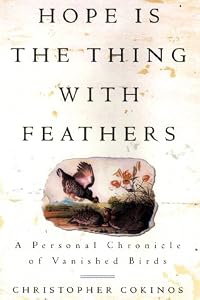
Hope Is the Thing with Feathers: A Personal Chronicle of Vanished Birds
by Christopher Cokinos
On This Page
Description
"There was a time when massive flocks of Passenger Pigeons blotted out the sun, and bright green Carolina Parakeets were so numerous that they looked, according to an early American pioneer, "like an atmosphere of gems." But these birds - as well as the Labrador Duck, the Ivory-billed Woodpecker, the Heath Hen, and the Great Auk - now live only as tantalizing but hazy legends." "Driven by a desire to understand how and why this came to be, Christopher Cokinos embarked on ten years of show more detective work. Traveling from Bird Rock in the Gulf of St. Lawrence to Louisiana's tangled bayous in search of those who stalked these birds and those who tried to save them, he discovered strange stories and glorious quests, tales of scientific heroism and political stupidity, of inconceivable apathy and equally astonishing personal devotion." "Much more than an account of the last days of six vanished species, Hope Is the Thing with Feathers is a window into American history. Cokinos portrays a country economically reliant on unbelievable quantities of wild birds, where market stalls overflowed with Heath Hens, fashionable women adorned their hats with entire dead birds, and nearly everyone relished a hearty pie made from Passenger Pigeons. He describes a 1935 expedition to record as many bird songs as possible across much of the United States - an unprecedented 15,000-mile journey of enormous difficulty into this country's unspoiled wilderness - and investigates a mysterious April 1999 sighting of Ivory-billed Wodpeckers, long held to be extinct. He unravels the bizarre account of the world's last wild Passenger Pigeon, and delves into an incredible plan now afoot on Martha's Vineyard to create new Heath Hens."--Jacket. show lessTags
Recommendations






Member Reviews
This work compiles the stories of the extinction of six North American bird species. The demises seems to cluster between the last half of the Nineteenth Century and the fist half of the Twentieth. There is an uncomfortable sameness to the final years: too little too late organized action and almost frenzied destruction triggered by the nearness of extinction. Much of the writing is poetic and evocative as this is obviously a heartfelt subject to the author. Some of the stories are really cruel tragedies: one of the last Ivory-Billed Woodpeckers imprisoned and dying in a hotel room to serve as a model and Martha, perhaps the last Passenger Pigeon, shuffling alone and scruffy in a Cleveland zoo. Other subjects are the colorful Carolina show more Parakeets, there social clustering good defense against hawks but poor for shotguns. Watching the last of the Heath Hens waste away on Martha's Vineyard could be a stand-in for the shape of all the species' demises, including the Labrador Duck and preyed upon Great Auk. show less
Cokinos spent ten years researching the life and subsequent extinction of six birds: Passenger Pigeon, Carolina Parakeet, Labrador Duck, Ivory-Billed Woodpecker, Heath Hen, and the Great Auk.
I find it terribly sad that no one knows the exact date of the demise of the Carolina Parakeet, but then again that's probably true of many extinct species. Right? How do we really know when we have seen the very last whatever? Here are details from Hope is the Thing with Feathers that will stick with me for a very long time: the Heath Hen has been compared to the Greater Prairie Chicken for their myriad of similarities. Their mating sounds are practical identical. Is that why no one took the extinction of the Heath Hen seriously? Were they so show more abundant they fell victim to overhunting; were they that easy to massacre? Is that what happened to the Passenger Pigeon? The cruelty inflicted on these birds was difficult to read. Cokinos gets into the question of cloning. Can you clone a species which has gone completely extinct? Can we have a Jurassic Park moment on a less dangerous scale?
Besides hunting, another factor wreaking havoc on bird populations was deforestation. Singer Sewing Machine purchased the nesting grounds of Lord God birds. Then they sold the rights to logging companies who cleared the land, destroying everything in its path. This happened over and over again. show less
I find it terribly sad that no one knows the exact date of the demise of the Carolina Parakeet, but then again that's probably true of many extinct species. Right? How do we really know when we have seen the very last whatever? Here are details from Hope is the Thing with Feathers that will stick with me for a very long time: the Heath Hen has been compared to the Greater Prairie Chicken for their myriad of similarities. Their mating sounds are practical identical. Is that why no one took the extinction of the Heath Hen seriously? Were they so show more abundant they fell victim to overhunting; were they that easy to massacre? Is that what happened to the Passenger Pigeon? The cruelty inflicted on these birds was difficult to read. Cokinos gets into the question of cloning. Can you clone a species which has gone completely extinct? Can we have a Jurassic Park moment on a less dangerous scale?
Besides hunting, another factor wreaking havoc on bird populations was deforestation. Singer Sewing Machine purchased the nesting grounds of Lord God birds. Then they sold the rights to logging companies who cleared the land, destroying everything in its path. This happened over and over again. show less
A very informative and easy read about several extinct American birds. The section on the Carolina Parakeet was especially interesting, since the local museum I am with has a mounted specimen
A well-written and affecting look at the extinctions of several American bird species.
... in regards to this book, charity is hard to find.
Extinct birds > North America
Members
- Recently Added By
Lists

Recommended Nature Writing
346 works; 180 members
Author Information

7 Works 467 Members
Christopher Cokinos is an award-winning writer and poet, and a professor of English at Utah State University. He has received the Whiting Writers' Award, the Glasgow Prize for an emerging writer in nonfiction, and the Sigurd Olson Nature Writing Award.
Awards and Honors
Common Knowledge
- Original publication date
- 2000
- Important places
- Martha's Vineyard, Massachusetts, USA; Cincinnati Zoo, Cincinnati, Ohio, USA
- Important events
- Anthropocene extinction
Classifications
- Genres
- Science & Nature, Nonfiction, General Nonfiction, Biography & Memoir
- DDC/MDS
- 598.168 — Natural sciences & mathematics Animals Birds Specific topics [Reptiles now at 597.9] Categories of birds [Sauropterygia now at 567.93] Endangered and rare
- LCC
- QL676.8 .C65 — Science Zoology Zoology Chordates. Vertebrates Birds
- BISAC
Statistics
- Members
- 272
- Popularity
- 118,249
- Reviews
- 7
- Rating
- (4.08)
- Languages
- English
- Media
- Paper, Ebook
- ISBNs
- 5
- ASINs
- 5