On This Page
Description
On a stormy February afternoon, little Stella Rivers disappears - never to be seen again. There were no clues, no demands and no traces. And there was nowhere else for Wexford and his team to look. All that remained was the cold fear and awful dread that touched everyone in Kingsmarkham.Just months later, another child vanishes - five-year-old John Lawrence. Wexford and Inspector Burden are launched into another investigation and, all too quickly, they discover chilling similarities to the show more Stella Rivers case.Then the letters begin. The horrifying, evil, threatening letters of a madman. And suddenly Wexford is fighting against time to find the missing boy, before he meets the same fate as poor Stella ... show lessTags
Recommendations









Member Reviews
Finally!
I don't know what has kept me coming back to this series, but I'm glad I held on. Perhaps it was the strength of the later, stand-alone novels I'd read of Rendell's, but this series had so many problems in the first five volumes. What made the difference? Two things: characters, and technology.
Primarily, this series is about what all good series (hold on a sec, maybe I'm jumping the gun on "good" for the Wexford series) are: the characters. What has been odd at times is the focus Rendell places on Burden, the nudge-winkingly named understudy of the titular Wexford who seems to be so much more interesting to the author. Yet, the books are a part of the Wexford series. Still, I'm starting to see what she's doing now, even if she show more wasn't aware of it in the beginning. Much like Doyle's detective, these stories are really about Burden, much as the Holmes stories are about Watson (Really, they are). Wexford comes in to make the intuitive leap (Holmes never really deduces anything-- he's really all about inductive reasoning) and the human drama centers around Burden, who in this novel is still grieving the loss of his wife, who apparently died in between books. The focus on Burden becomes necessary because Rendell's made Wexford too perfect; the worst you can say about him is he can be a bit prickly. Burden, who is so stoic and conservative in the earlier novels, here reveals a vulnerability, even a recklessness, that while not Rebus in nature by any stretch, gives us a chance to see a more dimensional character. Finally. I'm still digesting, but it seems as though Rendell has created (at least in this novel, but it seems to be pointing in a particular direction--we'll see how it goes) Wexford as a comic foil to Burden's pathos.
The second thing that makes this book so much better is a minor thing, but it goes far in correcting a near-fatal error for me. Rendell largely avoids technology. More than anything else, technology can date a story, and in the earlier books Rendell clearly, obviously, places her stories in the 60s. I kid you not, the installation of an elevator plays centrally in the previous novel as an intruding, unwanted advancement, and the novel instantly becomes a period piece as a result. This novel? No technology. It could have happened (almost) at any time. It almost makes up for the fact that Wexford is a grandfather in this book and, 40 years later is newly retired. How old is this guy?
OK, rambling. This is a welcome change, and I can only hope it is a trend going forward. We'll see tonight... show less
I don't know what has kept me coming back to this series, but I'm glad I held on. Perhaps it was the strength of the later, stand-alone novels I'd read of Rendell's, but this series had so many problems in the first five volumes. What made the difference? Two things: characters, and technology.
Primarily, this series is about what all good series (hold on a sec, maybe I'm jumping the gun on "good" for the Wexford series) are: the characters. What has been odd at times is the focus Rendell places on Burden, the nudge-winkingly named understudy of the titular Wexford who seems to be so much more interesting to the author. Yet, the books are a part of the Wexford series. Still, I'm starting to see what she's doing now, even if she show more wasn't aware of it in the beginning. Much like Doyle's detective, these stories are really about Burden, much as the Holmes stories are about Watson (Really, they are). Wexford comes in to make the intuitive leap (Holmes never really deduces anything-- he's really all about inductive reasoning) and the human drama centers around Burden, who in this novel is still grieving the loss of his wife, who apparently died in between books. The focus on Burden becomes necessary because Rendell's made Wexford too perfect; the worst you can say about him is he can be a bit prickly. Burden, who is so stoic and conservative in the earlier novels, here reveals a vulnerability, even a recklessness, that while not Rebus in nature by any stretch, gives us a chance to see a more dimensional character. Finally. I'm still digesting, but it seems as though Rendell has created (at least in this novel, but it seems to be pointing in a particular direction--we'll see how it goes) Wexford as a comic foil to Burden's pathos.
The second thing that makes this book so much better is a minor thing, but it goes far in correcting a near-fatal error for me. Rendell largely avoids technology. More than anything else, technology can date a story, and in the earlier books Rendell clearly, obviously, places her stories in the 60s. I kid you not, the installation of an elevator plays centrally in the previous novel as an intruding, unwanted advancement, and the novel instantly becomes a period piece as a result. This novel? No technology. It could have happened (almost) at any time. It almost makes up for the fact that Wexford is a grandfather in this book and, 40 years later is newly retired. How old is this guy?
OK, rambling. This is a welcome change, and I can only hope it is a trend going forward. We'll see tonight... show less
Kidnapped or Murdered?
Review of the Arrow Books/Cornerstone Digital Kindle eBook edition (2010) of the original Hutchinson hardcover (1971)
This continues my 2023 binge read / re-read of Ruth Rendell's (aka Barbara Vine) novels and it is the 6th in the Inspector Wexford series. Part of the joy with Wexford is the number of literary quotes and allusions which Rendell inserts into the text, but which are usually not explained. The above quote is an exception as it hints that the name "Mr. Casaubon" is associated with writer George Eliot. We can share and enjoy Wexford's surprise that the small time crooks he meets would have any knowledge of the Middlemarch novel.
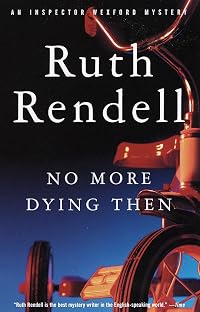
See cover at https://upload.wikimedia.org/wikipedia/en/5/53/Nomoredyingthen.jpg
Cover image for the original Hutchinson hardcover edition from 1971. Image sourced from Wikipedia.
No More Dying Then is otherwise a novel about a child abduction which hints back to an earlier disappearance and possible murder of another child in the same vicinity. Wexford's assistant Mike Burden is still mourning the loss of his wife and is distracted from his police duties. An extensive subplot involves him becoming involved with the divorced mother of the 2nd abducted child and the reader will become concerned that the woman may in fact be a suspect. The tension increases when the body of the first child is found even while the second is still missing. It is all wrapped up with a twist ending.
Another favourite quote from the book:
Trivia and Links
No More Dying Then was adapted for television as part of the Ruth Rendell / Inspector Wexford Mysteries TV series (1987-2000) as Season 3 Episodes 1 to 3 in 1989 with actor George Baker as Inspector Wexford. You can watch the entire 3 episodes on YouTube show less
Review of the Arrow Books/Cornerstone Digital Kindle eBook edition (2010) of the original Hutchinson hardcover (1971)
Wexford gave a tiny sigh, the outward and audible sign of an inward and outraged scream. ‘I don’t believe it,’ he said thinly. ‘Just enlighten me as to which one of you two intellectuals is acquainted with George Eliot.’ Far from living up to Monkey’s image of a man intimidated by the police, Mr Casaubon had brightened as soon as Wexford spoke and now rejoined in thick hideous cockney, ‘I see him once. Strangeways it was, 1929. They done him for a big bullion job.’ ‘I fear,’ Wexford said distantly, ‘that we cannot be thinking of the same person. - Inspector Wexford reacts uponshow more
being introduced to blackmailer 'Mr. Casaubon' by small-time crook Monkey Matthews. Mr. Casaubon is otherwise the name of a character in George Eliot’s (penname of Mary Ann Evans (1819-1880)) novel Middlemarch.
This continues my 2023 binge read / re-read of Ruth Rendell's (aka Barbara Vine) novels and it is the 6th in the Inspector Wexford series. Part of the joy with Wexford is the number of literary quotes and allusions which Rendell inserts into the text, but which are usually not explained. The above quote is an exception as it hints that the name "Mr. Casaubon" is associated with writer George Eliot. We can share and enjoy Wexford's surprise that the small time crooks he meets would have any knowledge of the Middlemarch novel.
See cover at https://upload.wikimedia.org/wikipedia/en/5/53/Nomoredyingthen.jpg
Cover image for the original Hutchinson hardcover edition from 1971. Image sourced from Wikipedia.
No More Dying Then is otherwise a novel about a child abduction which hints back to an earlier disappearance and possible murder of another child in the same vicinity. Wexford's assistant Mike Burden is still mourning the loss of his wife and is distracted from his police duties. An extensive subplot involves him becoming involved with the divorced mother of the 2nd abducted child and the reader will become concerned that the woman may in fact be a suspect. The tension increases when the body of the first child is found even while the second is still missing. It is all wrapped up with a twist ending.
Another favourite quote from the book:
Night is a time for conjecture, dreams, mad conclusions; morning a time for action.
Trivia and Links
No More Dying Then was adapted for television as part of the Ruth Rendell / Inspector Wexford Mysteries TV series (1987-2000) as Season 3 Episodes 1 to 3 in 1989 with actor George Baker as Inspector Wexford. You can watch the entire 3 episodes on YouTube show less
I can't say this was my favourite of Rendell's but a good read nonetheless. I particularly enjoyed Burden's character as a fallible, lost man who crosses over the professional line due to his mental vulnerability.
(11) In this installment two children have gone missing in Kingsmarkham and Wexford and Burden are on the case. Except this time, it appears that between this book and the last, Burden has been widowed. No more is he the contented do-gooder husband, loyal sidekick of Wexford but troubled and lonely. He falls in 'love' with the mother of the missing little boy and we bear witness to his inner turmoil.
The cases themselves are no great shakes as usual - the solution seems to come out of nowhere and is not 'guessable.'- at least by me. I am not sure I have ever truly figured out any of these 'whodunnits.' I am not sure that is the point. I am realizing that the Inspector Quirke novels written by John Banville are a bit derivative of show more Rendell - the boozy, brooding, atmospheric type detecting where the detectives are often as flawed as the criminals. There always seems to be one character on the 'good' side who is dealing with dark thoughts that Rendell decides to let us in on. In this case, Burden's lust and bizarre jealousy of her missing son.
I liked this about the same as the others in the Wexford cannon thus far. Eminently readable (read in about two sittings) but not nearly as good as her stand-alones. Her stand-alones that I have read are much more compelling from a psychologic and literary lens. It is nice though to have a substitute for Grafton's Kinsey Milhone. These are about the same caliber though very different atmospherically. show less
The cases themselves are no great shakes as usual - the solution seems to come out of nowhere and is not 'guessable.'- at least by me. I am not sure I have ever truly figured out any of these 'whodunnits.' I am not sure that is the point. I am realizing that the Inspector Quirke novels written by John Banville are a bit derivative of show more Rendell - the boozy, brooding, atmospheric type detecting where the detectives are often as flawed as the criminals. There always seems to be one character on the 'good' side who is dealing with dark thoughts that Rendell decides to let us in on. In this case, Burden's lust and bizarre jealousy of her missing son.
I liked this about the same as the others in the Wexford cannon thus far. Eminently readable (read in about two sittings) but not nearly as good as her stand-alones. Her stand-alones that I have read are much more compelling from a psychologic and literary lens. It is nice though to have a substitute for Grafton's Kinsey Milhone. These are about the same caliber though very different atmospherically. show less
A little boy teased by his friends on a playground runs away and vanishes. Is the case related to the disappearance of an older girl six months before?
Wexford is now fully realised as the character I know from some of the later books. Burden's sufferings are sympathetically portrayed, perhaps more so than they would be nowadays. However, the solution is not quite so satisfying as in some of Rendell's other works.
Wexford is now fully realised as the character I know from some of the later books. Burden's sufferings are sympathetically portrayed, perhaps more so than they would be nowadays. However, the solution is not quite so satisfying as in some of Rendell's other works.
No More Dying Then concerns the abduction of two children, a 12-year-old girl and, months later, a 5-year-old boy. The stepfather of one of the children could well be called a jinx because disasters (for other persons) follow in his wake. What we learn about one of those disasters shows how appallingly callous Ivor Swan is.
I've never liked Inspector Wexford's prim and proper assistant, Inspector Burden. In this book Mike Burden is still so grief-stricken over his wife's death from cancer (nearly a year ago now) that he is neglecting his work and his children. Good thing that John and Pam have their Aunt Grace, their mother's sister, looking after them. Grace, a nurse, is fed up with Mike's neglect of his children. She also wants her show more life back.
Mike becomes infatuated with the missing boy's mother and falls off the prim-and-proper bandwagon. He's still being very selfish. A less understanding supervisor would probably have sacked (fired) him.
Will he shape up and fly right?
The investigation into the personalities involved and the descriptions of places are compelling.
This book is is copyrighted 1971, so perhaps we should not be surprised that callous reporter Harry Wild references the real-life Cannon Chase Murders (also known as the A34 Murders) in chapter 8. The murders of 5-year-old Diane Tift and 6-year-old Margaret Reynolds occurred in 1965. Raymond Leslie Morris was considered the prime suspect in their deaths, but he was convicted for the 1967 rape and murder of 7-year-old Christine Darby, for which he died in prison in 2014. http://www.dailymail.co.uk/news/article-2789355/notorious-child-killer-died-jail... (If you're interested in the paranormal, Cannon Chase also has been known for sightings of various kinds.)
I also enjoyed learning about 'St. Luke's Little Summer' in chapter one. (Here in the US we would call it 'Indian summer'.)
Technically, the Inspector Wexford series is a police procedural, but fans of cozy and classic mysteries like it too. show less
I've never liked Inspector Wexford's prim and proper assistant, Inspector Burden. In this book Mike Burden is still so grief-stricken over his wife's death from cancer (nearly a year ago now) that he is neglecting his work and his children. Good thing that John and Pam have their Aunt Grace, their mother's sister, looking after them. Grace, a nurse, is fed up with Mike's neglect of his children. She also wants her show more life back.
Mike becomes infatuated with the missing boy's mother and falls off the prim-and-proper bandwagon. He's still being very selfish. A less understanding supervisor would probably have sacked (fired) him.
Will he shape up and fly right?
The investigation into the personalities involved and the descriptions of places are compelling.
This book is is copyrighted 1971, so perhaps we should not be surprised that callous reporter Harry Wild references the real-life Cannon Chase Murders (also known as the A34 Murders) in chapter 8. The murders of 5-year-old Diane Tift and 6-year-old Margaret Reynolds occurred in 1965. Raymond Leslie Morris was considered the prime suspect in their deaths, but he was convicted for the 1967 rape and murder of 7-year-old Christine Darby, for which he died in prison in 2014. http://www.dailymail.co.uk/news/article-2789355/notorious-child-killer-died-jail... (If you're interested in the paranormal, Cannon Chase also has been known for sightings of various kinds.)
I also enjoyed learning about 'St. Luke's Little Summer' in chapter one. (Here in the US we would call it 'Indian summer'.)
Technically, the Inspector Wexford series is a police procedural, but fans of cozy and classic mysteries like it too. show less
Rendell is in full force here, offering her trademark insightful reflections on a wide variety of characters, including, this time, Wexford’s colleague Mike Burden.
I enjoyed the plot, in which her many red herrings swim back and forth between two missing child cases months apart. Despite the fact that I was struggling with the YouTube app (not, IMO, a user-friendly interface but the only audio option I could find), I stayed engaged through the end.
For the first time in the series (to my recollection) there are some interesting women in [b:No More Dying Then|83432|No More Dying Then (Inspector Wexford, #6)|Ruth Rendell|https://i.gr-assets.com/images/S/compressed.photo.goodreads.com/books/1403168226l/83432._SY75_.jpg|2013066]! Although show more I found one of them to be somewhat unbelievable, others were fully realized adults. Definitely a move in the right direction.
It has been so many years since I originally read this series that each book I now revisit as part of a group read is a refreshing experience. So glad I'm participating! show less
I enjoyed the plot, in which her many red herrings swim back and forth between two missing child cases months apart. Despite the fact that I was struggling with the YouTube app (not, IMO, a user-friendly interface but the only audio option I could find), I stayed engaged through the end.
For the first time in the series (to my recollection) there are some interesting women in [b:No More Dying Then|83432|No More Dying Then (Inspector Wexford, #6)|Ruth Rendell|https://i.gr-assets.com/images/S/compressed.photo.goodreads.com/books/1403168226l/83432._SY75_.jpg|2013066]! Although show more I found one of them to be somewhat unbelievable, others were fully realized adults. Definitely a move in the right direction.
It has been so many years since I originally read this series that each book I now revisit as part of a group read is a refreshing experience. So glad I'm participating! show less
Members
- Recently Added By
Lists

British Mystery
469 works; 14 members

New York Times Best Mysteries of the Year
18 works; 2 members
Author Information

318+ Works 51,236 Members
Ruth Rendell (1930-2015) Ruth Rendell was born in Essex, England on February 17, 1930. She was educated at Loughton County High School. Rendell began her career as a journalist. She wrote six novels before sending her work in to a publisher. She writes crime novels and psychological thrillers, and is best known for her Inspector Wexford books. show more Rendell also writes under the pseudonym Barbara Vine. Rendell has received many awards for her writing, including the Silver, Gold, and Cartier Diamond Daggers from the Crime Writers' Association, three Edgars from the Mystery Writers of America, The Arts Council National Book Awards, and The Sunday Times Literary Award. She is a fellow of the Royal Society of Literature. Many of her titles have been made into films and made-for-tv movies. Rendell died on May 2, 2015. She was 85 years old. (Bowker Author Biography) show less
Some Editions
Awards and Honors
Series

Belongs to Publisher Series
Il giallo Mondadori (1241)
rororo thriller (2878)
Common Knowledge
- Canonical title
- No More Dying Then
- Original title
- No More Dying Then
- Alternate titles
- Some Lie and Some Die
- Original publication date
- 1971; 1971-10-04
- People/Characters
- Mike Burden (Detective Inspector, still mourning the loss of Jean Woodville Burden); Reginald Wexford (Chief Inspector); Grace Woodville (a nurse, caring for her late sister's family); John Burden (Mike and Jean's son); Pam Burden (Mike and Jean's daughter); Station Sergeant Camb (show all 56); Sergeant Martin; Sergeant Mathers; Constable Peach; Dora Wexford (Reginald's wife, mother of his daughters, Stella & Sheila); Gemma Lawrence (beautiful, divorced, lives in a house inherited from a great-aunt); John Lawrence (Gemma's missing beloved 5-year-old son); Ivor Lionel Fairfax Swan (handsome procrastinator, doesn't like to be bothered); Rosalind Rivers Swan (adores her 2nd husband); Stella Rivers (Ivor's missing adoring 12-year-old stepdaughter often used his surname); Harry Wild (the 'Kingsmarkham Courier' chief reporter); Loring (policeman); Gates (policeman); Gary Dean (5 years old, John Lawrence's friend); Mrs. Crantock (Gemma's neighbour); Julian Crantock (Mrs. Crantock's son); Crantock (Julian's 14-year-old sister); Mrs. Dean (Gary's mother); Mrs. Mitchell (spry elderly woman who mentioned the man hanging around the playground); Mrs. Eileen Rushworth (mother of Andrew, & the woman to whom Mrs. Mitchell mentioned the man); Mr. Bob Rushworth (a Kinsgmarkham estate agent with 4 unruly children); Rushworth; Stewart McDowell (didn't see the man); Ian McDowell (Stewart's twin, he discussed the limping man with chum Gary Dean); Miss Williams (runs Equita Riding School, where Stella Rivers was a pupil); Mrs. Margaret E. Fenn (Miss Williams' assistant); Dr. Lomax (called to treat Gemma); Matthew Lawrence (John's father, TV actor, used to squire ballet dancer Leonie West); Peter Rivers (Stella's father); Sherry (Ivor Swan's horse); Gudrun (the Swans' au pair girl); Bryant (police officer); Dr. Crocker; Monkey Matthews (a small time crook, wants Ivor's uncle's reward for Stella); Policewoman Polly Davies; Mr. Casaubon (old blackmailer, real name Charles Albert Catch - working with MONKEY); Mr. Crantock (head cashier, Kingsmarkham branch of Lloyd's Bank); mysterious letter writer/caller claiming to have John Lawrence; Mrs. Foster (lives in Sparta Grove, did she spill the beans about John being missing?); Bridget Melinda Scott (11-year-old who drowned in 1957); Mr. Ralph Edward Scott (plumbing engineer, Bridget was the apple of her father's eye); Mrs. Scott (more attached to their sons); Bernard Varney Fresham (he was Ivor Swan's friend in 1957); Jesus (Fresham's manservant, Spanish, says his parents are Maria & Joseph); Thomas & William Thetford (brothers who helped search for John Lawrence); Mrs. Thetford (William's wife, cleans for Mrs. Dean); Arnold Charles Bishop (the Fosters' next-door neighbour); Raymond Bishop (Arnold's young son); Paul Rushworth (Andrew's older brother); Silver (a horse belonging to Miss Williams of Equita Riding School); Leonie West (once-famous ballet dancer, lamed in an accident)
- Important places
- Kingsmarkham, West Sussex, England, UK (village); 61 Fontaine Road, Stowerton, West Sussex, England, UK; Equita Riding School, Mill Lane, near Forby, West Sussex, England, UK; Saltram House, Mill Lane, West Sussex, England, UK (a ruined big house); Fieldenwater Lake, Cumbria, England, UK
- Related movies
- Ruth Rendell Mysteries: No More Dying Then: Part One (1989 | IMDb); Ruth Rendell Mysteries: No More Dying Then: Part Two (1989 | IMDb); Ruth Rendell Mysteries: No More Dying Then: Part Three (1989 | IMDb)
- Epigraph
- So shalt thou feed on death that feeds on men,
And death, once dead, there's no more dying then.
-Shakespeare, Sonnet 146 - Dedication
- For Gerald Austin
- First words
- The spell of fine weather which so often occurs in the middle of October is know as St. Luke's Little Summer.
- Last words
- (Click to show. Warning: May contain spoilers.)Grace led him back to the fire, sat down beside him and ssid, as if already she half understood, "It'll be all right, Mike." She leaned towards him, her face serious and intent. "Let's talk," she said.
- Blurbers
- Grafton, Sue; Cornwall, Patricia; Mortimer, John
- Original language*
- Inglés
*Some information comes from Common Knowledge in other languages. Click "Edit" for more information.
Classifications
Statistics
- Members
- 629
- Popularity
- 46,258
- Reviews
- 15
- Rating
- (3.63)
- Languages
- 10 — Danish, Dutch, English, Finnish, French, German, Italian, Portuguese, Spanish, Swedish
- Media
- Paper, Audiobook, Ebook
- ISBNs
- 49
- ASINs
- 13