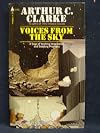
Voices from the Sky
by Arthur C. Clarke
On This Page
Tags
Recommendations





Member Reviews
These essays are upwards of sixty years old and a little dated in places. At the time the Space Race was in full swing and the Americans had imported a Nazi to head up their efforts. Obviously, that would never happen today.
Clarke’s foresight’s really quite amazing, whether he’s talking about mobile phones, or AI, or the hole in the ozone layer. Particularly interesting is The Social Consequences of Communications Satellites. As far as I can see the only consequence of the geo-synchronous orbit was MTV, but if you switch out ‘communications satellites’ for ‘the internet’ you have an astounding read in which Clarke, in only a few pages, sets out the main pros and cons.
‘The communications network we are building may be show more such a technological masterpiece, such a miracle of power and speed and complexity, that it will have no place for man’s slow and limited brain. In the end there will be a time when only machines can talk to machines, and we must tiptoe away and leave them to it.’
So if anyone asks, Arthur C. Clarke first proposed the dead internet theory in his address to the XIIth International Astronautical Congress in Washington, 1961.
He’s at his best when he’s describing space flight and relativity and the sheer distances involved. He has a knack of shrinking you down in the face of the profundity of the universe. show less
Clarke’s foresight’s really quite amazing, whether he’s talking about mobile phones, or AI, or the hole in the ozone layer. Particularly interesting is The Social Consequences of Communications Satellites. As far as I can see the only consequence of the geo-synchronous orbit was MTV, but if you switch out ‘communications satellites’ for ‘the internet’ you have an astounding read in which Clarke, in only a few pages, sets out the main pros and cons.
‘The communications network we are building may be show more such a technological masterpiece, such a miracle of power and speed and complexity, that it will have no place for man’s slow and limited brain. In the end there will be a time when only machines can talk to machines, and we must tiptoe away and leave them to it.’
So if anyone asks, Arthur C. Clarke first proposed the dead internet theory in his address to the XIIth International Astronautical Congress in Washington, 1961.
He’s at his best when he’s describing space flight and relativity and the sheer distances involved. He has a knack of shrinking you down in the face of the profundity of the universe. show less
This brilliant book is divided into three sections. The first is about space travel and other aspects of the new space age, how our concept of time must be modified when we travel long distances, the space seas of tomorrow, uses of the moon, how lower gravity will affect the sports of space colonists, and other fascinating ideas. The second part is about communications satellites, a field in which the author has already played the role of true prophet. The third section ranges widely over the side implications of the space age - scientific meddling, the lunatic fringe and the moral obligations of scientists.
Divided into three sections, Voices from the Sky delivers a series of enjoyable essays--some prescient, others less so--on topics ranging from spaceflight and communication satellites to the future of human culture as shaped by technological advancement. While many of Clarke's predictions have come to pass, others miss the mark including the elimination of business travel and the obsolescence of cities as a result of video conferencing and a global communications network. So enthusiastic was he about the U.S.A.'s burgeoning space program of the 1960s, that Clarke predicted mankind's expansion to the moon, Mars, and beyond. He could not have known that budget cuts would curtail our space program by the 1990s. Still, Clarke's considerable show more talents as a science fiction writer and science communicator, combined with his cosmopolitan viewpoint, provide fascinating insights from a time when humanity was just entering the space age. show less
This is a collection of various essays Clarke wrote throughout the 50s, 60s, and 70s, mostly on science and the future of technology. Much of it, sadly, seems hopelessly (even humorously) naive with the benefit of hindsight. Clarke talks enthusiastically about the "certainty" that we will have a lunar colony and a manned mission on Mars by the year 2000, and just in general comes off as overly optimistic about the future. This unfortunately means that most of the essays are hopelessly out of date and are really only of interest as historical curiosities.
The one essay that I really enjoyed was the last one in the book, in which Clarke talks about his various ways of responding to the huge amount of mail he got from crackpots, show more non-constructive critics, and malcontents. Some of his methods of response are downright hilarious, although they do tend to make one wonder how he has enough time on his hands to come up with them.
In short, I would only recommend this book to the kind of diehard Clarke fan that won't rest until they lay hands on everything he's written. If this doesn't describe you, it's probably best for you to avoid it. show less
The one essay that I really enjoyed was the last one in the book, in which Clarke talks about his various ways of responding to the huge amount of mail he got from crackpots, show more non-constructive critics, and malcontents. Some of his methods of response are downright hilarious, although they do tend to make one wonder how he has enough time on his hands to come up with them.
In short, I would only recommend this book to the kind of diehard Clarke fan that won't rest until they lay hands on everything he's written. If this doesn't describe you, it's probably best for you to avoid it. show less
Ratings
Members
- Recently Added By
Lists

The Non-Fiction Works of Arthur C. Clarke
27 works; 2 members
Author Information

860+ Works 130,169 Members
Arthur C. Clarke was born in Minehead, Somerset, England, on December 16, 1917. During World War II, he served as a radar specialist in the RAF. His first published piece of fiction was Rescue Party and appeared in Astounding Science, May 1946. He graduated from King's College in London with honors in physics and mathematics, and worked in show more scientific research before turning his attention to writing fiction. His first book, Prelude to Space, was published in 1951. He is best known for his book 2001: A Space Odyssey, which was later turned into a highly successful and controversial film under the direction of Stanley Kubrick. His other works include Childhood's End, Rendezvous with Rama, The Garden of Rama, The Snows of Olympus, 2010: A Space Odyssey II, 2062: Odyssey III, and 3001: The Final Odyssey. During his lifetime, he received at least three Hugo Awards and two Nebula Awards. He died of heart failure on March 19, 2008 at the age of 90. (Bowker Author Biography) show less
Common Knowledge
- Canonical title
- Voices from the Sky
- Original publication date
- 1965
- Dedication
- TO GEORGE best and most patient of editors
Classifications
Statistics
- Members
- 195
- Popularity
- 167,509
- Reviews
- 4
- Rating
- (3.67)
- Languages
- English
- Media
- Paper, Ebook
- ISBNs
- 3
- ASINs
- 16