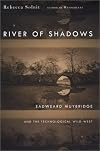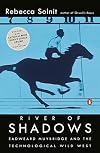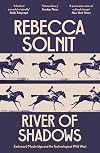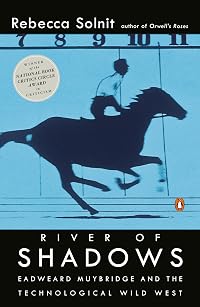
River of Shadows: Eadweard Muybridge and the Technological Wild West
by Rebecca Solnit
On This Page
Description
A survey of the historical contributions of Eadweard Muybridge documents his role in filmmaking technology and as a war photographer before standing trial for the murder of his wife's lover.Tags
Recommendations













Member Reviews
Basically amazing. Rebecca Solnit surveys Eadweard Muybridge's life and career, tracing the changing effects of space and time throughout his photographic work. At the same time, Muybridge is but a tiny corner in the story, simply the distillation of the larger cultural currents at play—the annihilation of space and time by railroads, telegraphs, and photography that radically changed our sense of what distance meant and made the world accessible (in a certain sense) to all.
Solnit also pulls off one of the my favorite opening chapters of all time, up there with Caro's survey of Robert Moses' power in the opening to The Power Broker. Read it!
Solnit also pulls off one of the my favorite opening chapters of all time, up there with Caro's survey of Robert Moses' power in the opening to The Power Broker. Read it!
Overall a great lense on Muybridge's life and work. Solnit focuses on how Muybridge helped change the way we exist in the world today, connecting him to the railroads, Sitting Bull, Hollywood, Silicon Valley, and the state of California (among many many other things). Despite the complicated web of connections, for most of the book she exibits enough restraint to maintain the central narrative and keep it from becoming too unweildy. There's a sense that in the last chapter she gives up on that restraint (somehow connecting Star Trek's captain Sulu with the Modic Wars, for instance), but being at the end of the book there's a sense that she earned it. Overall it tells Muybridge's story in a unique, interesting, and sometimes surprising way.
Overall a great lense on Muybridge's life and work. Solnit focuses on how Muybridge helped change the way we exist in the world today, connecting him to the railroads, Sitting Bull, Hollywood, Silicon Valley, and the state of California (among many many other things). Despite the complicated web of connections, for most of the book she exibits enough restraint to maintain the central narrative and keep it from becoming too unweildy. There's a sense that in the last chapter she gives up on that restraint (somehow connecting Star Trek's captain Sulu with the Modic Wars, for instance), but being at the end of the book there's a sense that she earned it. Overall it tells Muybridge's story in a unique, interesting, and sometimes surprising way.
For Solnit, Eadweard Muybridge (née Edward Muggeridge) was a representative figure in the development of technologies that transformed human perceptions of time and space, a transformation toward ‘modernity’ that also excited alienation and dislocation. Hers is a familiar take on the Industrial Age. In a pneumatic clock designed by Muybridge, with a series of pumps attached to a master clock controlling the motion of slave clocks, Solnit sees not only a device for the regulation of time but a metaphor for a mechanical universe. Metaphor, denotation and ironic juxtaposition mark her prose. In his large-plate photographs of Yosemite, Muybridge undercut the Victorian penchant for grandeur by presenting the tumult of raging water, show more glacial scree, gnarled tree trunks, and jagged boulders. His stop-action motion studies of running horses and flying birds changed the art of painting, and in a series of images for the Pennsylvania Academy in Philadelphia captured the excruciating efforts of a 340-pound woman getting up from the ground to stand. Sarah Winchester passed the last two decades of her life in a house under continuous construction in order to ward off the spirits of the Indians killed by the repeating rifles invented by her late husband. When reservation police arrived to arrest Sitting Bull for inciting insurrection, his trained horse, a gift from Buffalo Bill, began dancing at the sound of the gunfire that killed the great Lakota chief. The River of Shadows rambles around, but in a mostly pleasant and informative way. In the last few pages, when Solnit likens the hideout of a Modoc rebel in the lava beds of northern California to Plato’s Cave, you have the sense that she has crossed out everything in her notebook, and told her story well. show less
River of Shadows tells the story of Eadweard Muybridge: entrepreneur, photographer, bookseller and murderer. Solnit traces his life from his birth in England in 1830, through the start of his career as a photographer and bookseller in 1850s San Francisco, where he stood trial for killing his wife's lover, to his eventual return to England and his death in 1904.
Solnit's lyrical, vivid writing brings the period to life. The book is at its best when describing the society Muybridge lived in and helped transform. It conveys the impact on Muybridge's innovations - his ability to capture movement, and his invention of the Zoopraxiscope, precursor of motion pictures. The book's one weakness is a lack of clarity in describing the technical show more side of his inventions. Though the impact of this long-outdated technology was brilliantly described, I did not understand exactly how it worked. That said, this is certain worth reading for the beautiful writing and the interesting, evocative description of the era. show less
Solnit's lyrical, vivid writing brings the period to life. The book is at its best when describing the society Muybridge lived in and helped transform. It conveys the impact on Muybridge's innovations - his ability to capture movement, and his invention of the Zoopraxiscope, precursor of motion pictures. The book's one weakness is a lack of clarity in describing the technical show more side of his inventions. Though the impact of this long-outdated technology was brilliantly described, I did not understand exactly how it worked. That said, this is certain worth reading for the beautiful writing and the interesting, evocative description of the era. show less
In many ways, more a history of west than a simple biography, Solnit has a compelling, sometimes dazzling way of weaving anecdotes from the era together -- I particularly loved the passages about the Ghost Dance. I did, however, feel the author occasionally got carried away with flimsy connections and forced analogies ("the man who was destroyed by speed [in a stagecoach accident] would be reborn by speed [by capturing high speed motion photographically]" -- really?).
This is a biography of an early photographer and then a whole lot more; the west, industrialization, Stanford, Hollywood, Silicon Valley, and Captain Jack. Wild and rambling, making sweeping surprising connections. All great fun and thought provoking.
Members
- Recently Added By
Lists

Recommend the 20 best books you've read in the last five years
2,168 works; 601 members

TED 2013 Summer Reading List
190 works; 13 members

Mustich's 1000 Books to Read Before You Die: A Life Changing List
1,001 works; 18 members

Books in the Bibliography of The Alchemy of Us by Ainissa Ramirez
181 works; 1 member
Author Information

47+ Works 17,113 Members
Rebecca Solnit writes extensively on photography and landscape. She is a contributing editor to Art Issues and Creative Camera and is the author of three books. She has contributed essays to several museum catalogues including Crimes and Splendors: The Desert Cantos of Richard Misrach and the Whitney Museum's Beat Culture and the New America. She show more was a 1993 recipient of a National Endowment for the Arts Fellowship. (Bowker Author Biography) show less
Awards and Honors
Awards
Distinctions
Notable Lists
Common Knowledge
- Canonical title
- River of Shadows: Eadweard Muybridge and the Technological Wild West
- Original publication date
- 2003
- People/Characters
- Eadweard Muybridge; William Henry Jackson; Leland Stanford
- Important places
- USA; American West
- Original language
- English
- Canonical DDC/MDS
- 778.53092
- Canonical LCC
- TR849.M87
- Disambiguation notice
- Full title (2003, US): River of shadows : Eadweard Muybridge and the technological wild west / Rebecca Solnit; full title (2003, UK) ... (show all)cn.loc.gov/2003430701" rel="nofollow" target="_new">Motion studies : Eadweard Muybridge and the technological wild west / Rebecca Solnit
Classifications
- Genres
- Nonfiction, History, Art & Design, Technology, Biography & Memoir, General Nonfiction, Science & Nature
- DDC/MDS
- 778.53092 — Arts & recreation Photography Specific fields and special kinds of photography Film making Film Making and Editing Biography; History By Place Biography
- LCC
- TR849 .M87 — Technology Photography Photography Cinematography. Motion pictures
- BISAC
Statistics
- Members
- 651
- Popularity
- 44,263
- Reviews
- 15
- Rating
- (4.22)
- Languages
- English
- Media
- Paper, Ebook
- ISBNs
- 7
- ASINs
- 6