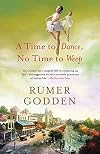
A Time to Dance, No Time to Weep
by Rumer Godden
On This Page
Description
The first volume of the writer's autobiography spanning the years 19071946. Tells the story of her childhood in India, her marriage, and her life bringing up two children alone in poverty.Tags
Recommendations



























Member Reviews
In A Time to Dance, No Time to Weep, Godden describes her life from childhood until she was 38. Her stories of her early life in India with her 3 sisters and her Fa and Mam are magical:
'The feel of the sunbaked Indian dust between sandals and bare toes; that and the smile. It was the honey smell of the fuzz-buzz flowers, of thorn trees in the sun, and the smell of open drains and urine, of coconut oil on shining black human hair, of mustard cooking oil and blue smoke from cow dung used as fuel; it was a smell redolent of the sun, more alive and vivid than anything in the 'West.'
After a brief sojourn in England for the minimal education she received, she returned to India for her debut and the social whirl of the next few years as a show more privileged young woman of the Raj. She became pregnant, and married a man who at the beginning of World War II left her for another woman, as well as leaving her with huge gambling debts, which she paid with the bulk of her royalties from Black Narcissus. She then wondered what if: 'instead of living to get money to spend, we lived by not spending? Somewhere away, where it would be so quiet and simple that a little would go a long way?'
She and her daughters moved to Kashmir, which she describes so, so beautifully that at times I felt I was there, and moved into an abandoned house, which she fixed up enough to make habitable. There was no running water, no indoor plumbing, and no electricity, and they grew most of their own food. She continued to write, now the sole support of her family. The book ends with the end of World War II.
While Godden has been praised for her depictions of the details and the panorama of life in India, in this book the Indian people are depicted only as servants. Even when she was so 'poor' in Kashmir that she had to grow her own food, she had a cook (who in an interesting side story tried to poison her and her daughters by putting ground glass and opium in their food). Here's an example of how I see she viewed her relationship with the Indian people:
'The Bloomfield's own home was in one of the wide tree-shaded roads of New Dehli, with spacious houses and gardens, even the roundabouts set with fountains and flowers, all seeming so rich that it was a shock to see an old woman, in a tattered grey-white sari, sweeping up dust and leaves with a twig-broom; to see among the gleaming cars and carriages rickshaws pulled by straining little men, sweat pouring down their faces, muscles over-bulging on their poor thin leg; few rickshaw men survive after they are thirty years old.' Of course, the rajahs are quite another matter.l
I enjoyed the feel of the natural beauty of India Godden is able to convey. However, given the time at which Godden wrote the book (1987), I am appalled at her failure to acknowledge her position as a privileged member of the Raj and that she did not truly know 'the real India,' nor did she apparently care to.
Although she has written a second volume, A House With Four Rooms, which describes her life in England after World War II up to her 70's, I probably won't read it. show less
'The feel of the sunbaked Indian dust between sandals and bare toes; that and the smile. It was the honey smell of the fuzz-buzz flowers, of thorn trees in the sun, and the smell of open drains and urine, of coconut oil on shining black human hair, of mustard cooking oil and blue smoke from cow dung used as fuel; it was a smell redolent of the sun, more alive and vivid than anything in the 'West.'
After a brief sojourn in England for the minimal education she received, she returned to India for her debut and the social whirl of the next few years as a show more privileged young woman of the Raj. She became pregnant, and married a man who at the beginning of World War II left her for another woman, as well as leaving her with huge gambling debts, which she paid with the bulk of her royalties from Black Narcissus. She then wondered what if: 'instead of living to get money to spend, we lived by not spending? Somewhere away, where it would be so quiet and simple that a little would go a long way?'
She and her daughters moved to Kashmir, which she describes so, so beautifully that at times I felt I was there, and moved into an abandoned house, which she fixed up enough to make habitable. There was no running water, no indoor plumbing, and no electricity, and they grew most of their own food. She continued to write, now the sole support of her family. The book ends with the end of World War II.
While Godden has been praised for her depictions of the details and the panorama of life in India, in this book the Indian people are depicted only as servants. Even when she was so 'poor' in Kashmir that she had to grow her own food, she had a cook (who in an interesting side story tried to poison her and her daughters by putting ground glass and opium in their food). Here's an example of how I see she viewed her relationship with the Indian people:
'The Bloomfield's own home was in one of the wide tree-shaded roads of New Dehli, with spacious houses and gardens, even the roundabouts set with fountains and flowers, all seeming so rich that it was a shock to see an old woman, in a tattered grey-white sari, sweeping up dust and leaves with a twig-broom; to see among the gleaming cars and carriages rickshaws pulled by straining little men, sweat pouring down their faces, muscles over-bulging on their poor thin leg; few rickshaw men survive after they are thirty years old.' Of course, the rajahs are quite another matter.l
I enjoyed the feel of the natural beauty of India Godden is able to convey. However, given the time at which Godden wrote the book (1987), I am appalled at her failure to acknowledge her position as a privileged member of the Raj and that she did not truly know 'the real India,' nor did she apparently care to.
Although she has written a second volume, A House With Four Rooms, which describes her life in England after World War II up to her 70's, I probably won't read it. show less
Godden writes of the years from her 1907 to 1946 when she returns to England with her two children after the war's end. The story is a familiar one: her father worked for one of the many companies based in India so the family, four girls and parents, travelled back and forth in various combinations. Most of her childhood was spent in a big house in a small town in the Narayanganj (in present-day Bangladesh). She had a fine teacher during a sojourn at a good progressive school in England who recognized her potential and asked her not to even try to publish anything until she was 26, which promise Godden kept. The story wanders a bit and feels very disjointed -- this happened and then that happened, dogs come and go, houses and show more possessions come and go, marriages fail and everyone soldiers on. The care and coherence of her novels is in absolute contrast to the chaos of her life, but she certainly lived things fully and completely as she was in the midst of them! That might be my biggest takeaway. For those who love reading about British India, both fictionally and non -- this is the real deal. ***1/2 show less
I very much enjoyed this memoir by Rumer Godden. It tells about her life from birth until the publishing of her novels. She has a wonderful way of taking you by the hand and making you feel that you were right there with her. And what an amazing life she had. Going back and forth between India and Great Britain (by boat!), opening a dance studio in India (I had no idea she was a dancer), her unhappy marriage, raising two young children and trying to write while her husband more or less deserts her and the amazing people all along the way.
An inspirational life well recounted. I get the feeling that while biographically very accurate and open, Rumer Godden in this memoir somewhat censored her innermost life - the emotions, etc, which are mostly evidenced in diary/correspondence excerpts. Or beautifully written in her novels, which, it turns out, are often highly autobiographical.
Her style of writing can be interesting (which is to say, confusing). Also interesting is learning how the events in her life inspired her books.
2326 A Time to Dance, No Time to Weep, by Rumer Godden (read 20 Sep 1990) This is the first volume of the author's autobiography. She was born in 1907 and spent most of her life up to 1945 in India. She tells of her youth, her unsuccessful marriage, her years in World War II in India. She writes well, but I am not sure it is worth reading.
i thought this would be better. disjointed but maybe her life was disjointed. something was wrong but i don't quite know what.
Members
- Recently Added By
Author Information

88+ Works 15,219 Members
Margaret Rumer Godden was born Dec. 10, 1907, in Sussex, England. She was nine months old when her family moved to India, where her father ran a shipping line. She returned to London at age 20 to learn how to teach dance to children, and opened a school back in India. Returning to England while she was pregnant, she wrote her first book, "Chinese show more Puzzle," published in 1936. Her marriage to a stockbroker, Laurence Sinclair Foster, ended in 1941, leaving her penniless. In an effort to pay off her former husband's debts, Godden moved her family into a mountain cottage where she ran a school, made herbal teas for sale, and wrote books. Another novel of India, "The River," published in 1949, was one of her most acclaimed books and was made into a film by Jean Renoir in 1951. She returned to England to stay in 1945. Rumer Godden was the author of more than 60 books, including novels, short story collections, poetry, plays and non-fiction. She published her 21st novel, "Cromartie vs. the God Shiva," in 1997. Rumer Godden died a year later on November 8, 1998, in Thornhill, Scotland, at the age of 90. (Bowker Author Biography) show less
Some Editions
Common Knowledge
- Original publication date
- 1987
- Dedication
- For Jane and Paula
- First words
- I suppose we are what we are because of our parents - parentage is a better word because it goes further back than that.
Jon and I stood together on the quay at Plymouth watching as the luggage was unloaded into the Customs Shed from the liner that had brought us from India. - Prologue - Quotations
- A time to every purpose under heaven - but not always...
This book is my life as a young writer; to me and my kind life itself is a story and we have to tell it in stories - that is the way it falls. I have told the truth and nothing but the truth, yet not the whole truth, because ... (show all)that would be impossible.
- R. G.
To every thing there is a season, and a time to every purpose under the heaven: a time to be born, and a time to die; a time to plant, and a time to pluck up that which is planted; a time to kill, and a time to heal; a time t... (show all)o break down, and a time to build up; a time to weep, and a time to laugh; a time to mourn, and a time to dance; a time to cast away stones, and a time to gather stones together; a time to embrace, and a time to refrain from embracing; a time to get, and a time to lose; a time to keep, and a time to cast away; a time to rend, and a time to sew; a time to keep silence, and a time to speak; a time to love, and a time to hate; a time of war, and a time of peace.
-
Ecclesiastes 3: i-ix - Last words
- (Click to show. Warning: May contain spoilers.)We could start over again.
Classifications
Statistics
- Members
- 222
- Popularity
- 146,179
- Reviews
- 8
- Rating
- (3.84)
- Languages
- English
- Media
- Paper
- ISBNs
- 8
- ASINs
- 2