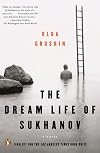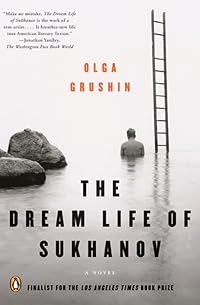
The Dream Life of Sukhanov
by Olga Grushin
On This Page
Description
Olga Grushin's astonishing literary debut has won her comparisons with everyone from Gogol to Nabokov. A virtuoso study in betrayal and its consequences, it explores--really, colonizes--the consciousness of Anatoly Sukhanov, who many years before abandoned the precarious existence of an underground artist for the perks of a Soviet apparatchik. But, at the age of 56, his perfect life is suddenly disintegrating. Buried dreams return to haunt him. New political alignments threaten to undo him. show more Vaulting effortlessly from the real to the surreal and from privilege to paranoia, The Dream Life of Sukhanov is a darkly funny, demonically entertaining novel. show lessTags
Recommendations



















Member Recommendations
DLSmithies Just because I found myself reminded, as Sukhanov's past envelops him, of that amazing moment in Proust when he trips over the paving slab and right there, standing outside the party, has his epiphany about time.

Member Reviews
The Dream Life of Sukhanov is a five-star marvel, and all the more so because it is the debut novel of an author who writes with the depth of heart and the intellectual confidence of a mature artist, whereas even now she is only in her early forties.
Olga Grushin's work is brilliant in the way that the greatest Russian novels are brilliant. It is suffused with their flavor and character, an ineffable Russianness that is as distinctive as incense in the air and yet (for me) as elusive to pinpoint. Yet there is something more, very much more, because she is also a Western author with a Western sensibility. She depicts the paranoid torments and rhapsodic triumphs of the Slavic soul with compassion and insight, although not, ultimately, as show more if they were her own. This dual perspective allows us to traverse the misty terrain of illusion, dream, and mad hallucination with Sukhanov while still in the end finding our way to solid ground, whether or not Sukhanov does.
As in The Line, her second novel, which I read first, redemption is to be found, unconditionally if not without cost.
The writer in me loves the fact that Grushin does not obey the rules propounded and hammered on by contemporary speakers, authors, and advisors on the craft of writing. Like Sukhanov the painter, she goes her own way, following a compelling vision and not any formula. The lesson of trusting one's own gift could not be clearer. show less
Olga Grushin's work is brilliant in the way that the greatest Russian novels are brilliant. It is suffused with their flavor and character, an ineffable Russianness that is as distinctive as incense in the air and yet (for me) as elusive to pinpoint. Yet there is something more, very much more, because she is also a Western author with a Western sensibility. She depicts the paranoid torments and rhapsodic triumphs of the Slavic soul with compassion and insight, although not, ultimately, as show more if they were her own. This dual perspective allows us to traverse the misty terrain of illusion, dream, and mad hallucination with Sukhanov while still in the end finding our way to solid ground, whether or not Sukhanov does.
As in The Line, her second novel, which I read first, redemption is to be found, unconditionally if not without cost.
The writer in me loves the fact that Grushin does not obey the rules propounded and hammered on by contemporary speakers, authors, and advisors on the craft of writing. Like Sukhanov the painter, she goes her own way, following a compelling vision and not any formula. The lesson of trusting one's own gift could not be clearer. show less
Olga Grushin is my newest favorite author. Although she has only written two books, The Dream Life of Sukhanov and The Line, they are both are so superb that I am convinced that anything she writes will be good.
Anatoly Sukhanov is a successful art magazine editor with a beautiful wife, an ambitious son, and a rebellious teenage daughter. At fifty-six, Anatoly has mastered the ability of writing about art without ruffling Soviet ministerial feathers: which topics to avoid, which names to redact, and whose opinion to follow. The key is not to think too much and definitely avoid remembering a different time, when he had different dreams, during the heady days of the Khrushchev Thaw. But overnight Sukhanov’s world is turned upside down. show more An uncomfortable meeting with an former friend, colleagues who talk about a new freedom to express themselves, and cracks within the comfortable routine of his home life, all come together to shake Sukhanov’s vow not to remember the past. Memories begin to leak into his mind until they become a torrent, and he finally has to face a decision he made many years before and its repercussions.
Grushin’s prose has a dream-like quality that perfectly suits the mood of the novel. Although the descriptions and phrasing seem a bit forced in the beginning (a first-time author trying too hard?), Grushin finds her voice, resulting in beautifully constructed images and descriptions. Equally impressive is how she is able to portray the life of an ordinary, long-time Soviet official suddenly faced with glasnost. Although too young to have experienced it herself, she was born in Moscow in 1971, Grushin is able to authentically portray the internal confusion of a man who made difficult choices in order to survive repressive regimes and is now faced with an openness that seemingly condemns those choices. It is a situation millions of Russians faced in the late 1980s, and the consequences of that internal dislocation have contributed to the backlash against free market democracy and the rise of a modern repressive state. Grushin does a nice job of creating a character that is fascinating on his own and yet representative of an entire generation.
Highly recommended. show less
Anatoly Sukhanov is a successful art magazine editor with a beautiful wife, an ambitious son, and a rebellious teenage daughter. At fifty-six, Anatoly has mastered the ability of writing about art without ruffling Soviet ministerial feathers: which topics to avoid, which names to redact, and whose opinion to follow. The key is not to think too much and definitely avoid remembering a different time, when he had different dreams, during the heady days of the Khrushchev Thaw. But overnight Sukhanov’s world is turned upside down. show more An uncomfortable meeting with an former friend, colleagues who talk about a new freedom to express themselves, and cracks within the comfortable routine of his home life, all come together to shake Sukhanov’s vow not to remember the past. Memories begin to leak into his mind until they become a torrent, and he finally has to face a decision he made many years before and its repercussions.
Grushin’s prose has a dream-like quality that perfectly suits the mood of the novel. Although the descriptions and phrasing seem a bit forced in the beginning (a first-time author trying too hard?), Grushin finds her voice, resulting in beautifully constructed images and descriptions. Equally impressive is how she is able to portray the life of an ordinary, long-time Soviet official suddenly faced with glasnost. Although too young to have experienced it herself, she was born in Moscow in 1971, Grushin is able to authentically portray the internal confusion of a man who made difficult choices in order to survive repressive regimes and is now faced with an openness that seemingly condemns those choices. It is a situation millions of Russians faced in the late 1980s, and the consequences of that internal dislocation have contributed to the backlash against free market democracy and the rise of a modern repressive state. Grushin does a nice job of creating a character that is fascinating on his own and yet representative of an entire generation.
Highly recommended. show less
There’s so much to like in this book, which is the story of a middle aged art critic in the Soviet Union in 1985 who was himself once an avant-garde artist. Grushin’s writing is lush and brilliant, and she deftly weaves between reality and Sukhanov’s inner world of memories as the book progresses until the full story is known for what happened between him, another up and coming young artist, and the daughter of a wealthy artist who produced banal Soviet ‘socialist realism’ paintings.
Spoiler alert in the next few paragraphs.
Sukhanov’s choices were made much more difficult by the constraints Soviets placed on art, and now, in middle age, he finds his world crumbling – his wife disinterested, his children adults and no show more longer seeing him as someone they should look up to, his job threatened, and other people showing him what being true to himself would have been like. He wants to reconnect and share personal things with his kids and wife, but finds the moments to have done so passed. On top of it all, his memory is starting to get a little fuzzy on everyday details, but haunts him about things in the past.
And yet, it’s never too late to redeem oneself. In sometimes absurd ways, life has conspired to break his comfortable life apart, to bring him low, so that he can pursue art once again. Tellingly, one of the lenses in his glasses break towards the end, distorting his impression of objects and people in surrealist ways. Sukhanov has struggled in life, made compromises, and let the dream go dormant, but ultimately he can still find himself, and live up to his father’s advice to “never let them clip your wings.”
In that way the novel feels Russian-American (which of course Grushin is) – Russian in having followed in the tradition of Gogol, Dostoevsky, and other great Russian masters in the absurd and cynical ways life plays out, and yet American in the sense of ultimate optimism. I really enjoyed her references to art and Russian literature, and she shows us that the worlds within - our thoughts, memories, and dreams - are as big a part of our lives as our consciousness and the ‘real world’ which others see. I will definitely read more from this author.
Quotes:
On art, and Salvador Dali:
“True, the man once had undeniable talent. His early visions are haunting, don’t you find – those pulpy, dripping clocks, those burning giraffes, Venus de Milo with drawers carved all along her body – great, dark metaphors for our nightmarish century. Unfortunately, after these first brilliant steps, he stopped striving and began to repeat himself – more clocks, more giraffes, more drawers, all those sleek juxtapositions of random objects that seem striking for a moment but are devoid of any real meaning, all those amusing tricks for the eye, like Raphael’s Madonna fitted into an ear, you know it? He managed to trivialize himself completely. True art, in my modest opinion, must uphold a harmonious balance between form and content, and content is precisely what he’s lost.”
On art, and medieval icons; I found this perspective interesting:
“Of course, in its technical aspects, the manner of icon painting is medieval and therefore by necessity flawed. And yet, I insist, it is perfect, insofar as by ‘perfect’ I mean simply the form most suitable to its subject. What better way is there to portray man’s unearthly aspirations, I ask you, than by ignoring irrelevant flesh with its trappings of chiaroscuro and perspective, and presenting instead these floating, pure colors, these insubstantial bodies, these luminous faces, these enormous, mournful eyes? These works create an impression of a door in our dim, mundane lives, opening for a moment to reveal an ethereal glimpse of heaven, a golden flash of God’s paradise. The effect becomes far less wondrous if one dilutes such stark, glowing purity with even the smallest dose of your accurately rendered reality.”
And this reply, a contrary view:
“Art is not about some common purpose or noble mission. It’s an expression of an artist’s soul, his individual, titanic struggle to rise above the ordinary, to speak a word unheard before, to extract an unexpected, mysterious, radiant nugget of beauty from the many obscure layers of our existence, to glimpse a bit of the infinite in everyday life – and truly great art comes to us like an ecstatic revelation, it sets our whole being on fire! And your medieval wall-painters were nothing but practitioners of applied arts, obedient illustrators of a few stale, commonplace truths about a small man’s eternity. Crushed by the weight of their own credo ‘Blessed are the poor in spirit,’ they never took risks, never overstepped their boundaries, never tried to set vibrating some new, previously untouched chord in our souls…”
On beauty:
“Her hand felt cool in mine, and in my stunned mind, Pushkin’s immortal tribute to his beloved rang out like a clear crystal bell: Chisteishei prelesti chisteishii obrazets. The purest image of the purest charm.”
And this one, on the timelessness of the beauty of art:
“And so I sat alone in the theater, and the lights began to come on while pale angels and saints were still passing before me, and I thought, yes, you were right about that day, our world really is dark and ignorant, just as it was in Rublev’s time – but you were also wrong, because in spite of all the injustices, and horrors, and stupidity, beauty always survives, and there will never be a higher mission than making the world richer and purer by adding more beauty to it, by making one single person cry like a child and the age of fifty-three…”
On decisive moments in life:
“Today she wore no sparkling earrings, no clinking bracelets, and her features, bereft of the glossy glamour that makeup lent them, seemed soft and hazy, as if glimpsed imprecisely through a light curtain of rain. Suddenly, prompted by an oddly urgent impulse, he swore to himself that if she looked up, if only for an instant, he would reenter the pink stuffiness of the room – and talk to her, talk to her, for the first time in who knew how long. He would confess what he had felt when he had seen Belkin walk away in a downpour; he would share with her the happy childhood memory of his father and the upsetting dream about her flying away; he would take her in his arms and tell her that she still looked beautiful, in spite of those resentful lines tugging at her mouth … For a long moment he waited, but she did not look up.
He nodded curtly and left.”
And this one, while seeing Botticelli’s ‘The Birth of Venus’ for the first time, is fantastic:
“In anyone’s life there can be only a few such moments – moments when a long, ringing hush fills your hearing, the world stands still as if under a magic spell, and thoughts and feelings course freely through your being, traversing the whole of eternity in the duration of a minute, so that when time resumes and you return from whatever nameless, dazzling void you briefly inhabited, you find yourself changed, changed irrevocably, and from then on, whether you want it or not, your life flows in a different direction.”
On solitude, on a crowded train:
“…random lives thrown together for one moment, squashed against each other in the dim, narrow confines of a crammed car, sharing space and time, mingling their breaths in a parody of human closeness, yet each of them remaining tragically, eternally alone…”
On youth, and aging:
“You remember, don’t you, Tolya? Our days flowed into nights, our nights were endless, and every windbag who talked about Russia, God, and art was a brother, every artist a genius, every painting a miracle – and the world did not know us yet, but we were together, we were brilliant, we were destined to light up the skies … And then you blink, and all at once you yourself are in your fifties, still poor but no longer so sure of all those eternal truths, and alone now, because most of your old friends have crawled into their own nooks and crannies of misery and your wife has left to have children with another man. … And then all those things that seemed so earth-shattering in the past, all those experiments with religion, eroticism, surrealism, abstraction, all those exuberant departures from the commonplace, appear for what they are in the harsh light of the day – self-indulgent exercises in passing time, pathetic imitations of fashions the West tried and discarded decades ago.” show less
Spoiler alert in the next few paragraphs.
Sukhanov’s choices were made much more difficult by the constraints Soviets placed on art, and now, in middle age, he finds his world crumbling – his wife disinterested, his children adults and no show more longer seeing him as someone they should look up to, his job threatened, and other people showing him what being true to himself would have been like. He wants to reconnect and share personal things with his kids and wife, but finds the moments to have done so passed. On top of it all, his memory is starting to get a little fuzzy on everyday details, but haunts him about things in the past.
And yet, it’s never too late to redeem oneself. In sometimes absurd ways, life has conspired to break his comfortable life apart, to bring him low, so that he can pursue art once again. Tellingly, one of the lenses in his glasses break towards the end, distorting his impression of objects and people in surrealist ways. Sukhanov has struggled in life, made compromises, and let the dream go dormant, but ultimately he can still find himself, and live up to his father’s advice to “never let them clip your wings.”
In that way the novel feels Russian-American (which of course Grushin is) – Russian in having followed in the tradition of Gogol, Dostoevsky, and other great Russian masters in the absurd and cynical ways life plays out, and yet American in the sense of ultimate optimism. I really enjoyed her references to art and Russian literature, and she shows us that the worlds within - our thoughts, memories, and dreams - are as big a part of our lives as our consciousness and the ‘real world’ which others see. I will definitely read more from this author.
Quotes:
On art, and Salvador Dali:
“True, the man once had undeniable talent. His early visions are haunting, don’t you find – those pulpy, dripping clocks, those burning giraffes, Venus de Milo with drawers carved all along her body – great, dark metaphors for our nightmarish century. Unfortunately, after these first brilliant steps, he stopped striving and began to repeat himself – more clocks, more giraffes, more drawers, all those sleek juxtapositions of random objects that seem striking for a moment but are devoid of any real meaning, all those amusing tricks for the eye, like Raphael’s Madonna fitted into an ear, you know it? He managed to trivialize himself completely. True art, in my modest opinion, must uphold a harmonious balance between form and content, and content is precisely what he’s lost.”
On art, and medieval icons; I found this perspective interesting:
“Of course, in its technical aspects, the manner of icon painting is medieval and therefore by necessity flawed. And yet, I insist, it is perfect, insofar as by ‘perfect’ I mean simply the form most suitable to its subject. What better way is there to portray man’s unearthly aspirations, I ask you, than by ignoring irrelevant flesh with its trappings of chiaroscuro and perspective, and presenting instead these floating, pure colors, these insubstantial bodies, these luminous faces, these enormous, mournful eyes? These works create an impression of a door in our dim, mundane lives, opening for a moment to reveal an ethereal glimpse of heaven, a golden flash of God’s paradise. The effect becomes far less wondrous if one dilutes such stark, glowing purity with even the smallest dose of your accurately rendered reality.”
And this reply, a contrary view:
“Art is not about some common purpose or noble mission. It’s an expression of an artist’s soul, his individual, titanic struggle to rise above the ordinary, to speak a word unheard before, to extract an unexpected, mysterious, radiant nugget of beauty from the many obscure layers of our existence, to glimpse a bit of the infinite in everyday life – and truly great art comes to us like an ecstatic revelation, it sets our whole being on fire! And your medieval wall-painters were nothing but practitioners of applied arts, obedient illustrators of a few stale, commonplace truths about a small man’s eternity. Crushed by the weight of their own credo ‘Blessed are the poor in spirit,’ they never took risks, never overstepped their boundaries, never tried to set vibrating some new, previously untouched chord in our souls…”
On beauty:
“Her hand felt cool in mine, and in my stunned mind, Pushkin’s immortal tribute to his beloved rang out like a clear crystal bell: Chisteishei prelesti chisteishii obrazets. The purest image of the purest charm.”
And this one, on the timelessness of the beauty of art:
“And so I sat alone in the theater, and the lights began to come on while pale angels and saints were still passing before me, and I thought, yes, you were right about that day, our world really is dark and ignorant, just as it was in Rublev’s time – but you were also wrong, because in spite of all the injustices, and horrors, and stupidity, beauty always survives, and there will never be a higher mission than making the world richer and purer by adding more beauty to it, by making one single person cry like a child and the age of fifty-three…”
On decisive moments in life:
“Today she wore no sparkling earrings, no clinking bracelets, and her features, bereft of the glossy glamour that makeup lent them, seemed soft and hazy, as if glimpsed imprecisely through a light curtain of rain. Suddenly, prompted by an oddly urgent impulse, he swore to himself that if she looked up, if only for an instant, he would reenter the pink stuffiness of the room – and talk to her, talk to her, for the first time in who knew how long. He would confess what he had felt when he had seen Belkin walk away in a downpour; he would share with her the happy childhood memory of his father and the upsetting dream about her flying away; he would take her in his arms and tell her that she still looked beautiful, in spite of those resentful lines tugging at her mouth … For a long moment he waited, but she did not look up.
He nodded curtly and left.”
And this one, while seeing Botticelli’s ‘The Birth of Venus’ for the first time, is fantastic:
“In anyone’s life there can be only a few such moments – moments when a long, ringing hush fills your hearing, the world stands still as if under a magic spell, and thoughts and feelings course freely through your being, traversing the whole of eternity in the duration of a minute, so that when time resumes and you return from whatever nameless, dazzling void you briefly inhabited, you find yourself changed, changed irrevocably, and from then on, whether you want it or not, your life flows in a different direction.”
On solitude, on a crowded train:
“…random lives thrown together for one moment, squashed against each other in the dim, narrow confines of a crammed car, sharing space and time, mingling their breaths in a parody of human closeness, yet each of them remaining tragically, eternally alone…”
On youth, and aging:
“You remember, don’t you, Tolya? Our days flowed into nights, our nights were endless, and every windbag who talked about Russia, God, and art was a brother, every artist a genius, every painting a miracle – and the world did not know us yet, but we were together, we were brilliant, we were destined to light up the skies … And then you blink, and all at once you yourself are in your fifties, still poor but no longer so sure of all those eternal truths, and alone now, because most of your old friends have crawled into their own nooks and crannies of misery and your wife has left to have children with another man. … And then all those things that seemed so earth-shattering in the past, all those experiments with religion, eroticism, surrealism, abstraction, all those exuberant departures from the commonplace, appear for what they are in the harsh light of the day – self-indulgent exercises in passing time, pathetic imitations of fashions the West tried and discarded decades ago.” show less
At first, the long, flowery sentences overfilled with adjectives put me off the story a little bit. But for just a few pages... because, somehow, the story, the writing morphed and these became beautiful, startling descriptions. Melancholy. Surrealism. Art. Life. Youth. Aging.
Truly, this book is sublime. It's like a breathtaking painting put into words. Grushin has an incredible talent for merging the real with the unreal, a current life and a dream. You smoothly drift from reality to dream and back again....
Definitely recommended, especially if you enjoy art (Grushin's art background shines here) and have at least a passing acquaintance with surrealist artists including Chagall, Dali, Magritte, etc....
Read it & savor the beauty.
Truly, this book is sublime. It's like a breathtaking painting put into words. Grushin has an incredible talent for merging the real with the unreal, a current life and a dream. You smoothly drift from reality to dream and back again....
Definitely recommended, especially if you enjoy art (Grushin's art background shines here) and have at least a passing acquaintance with surrealist artists including Chagall, Dali, Magritte, etc....
Read it & savor the beauty.
Anatoly Sukhanov is a Soviet apparatchik, editor of Moscow's Art of the World magazine and author of such Party-approved works as "Surrealism and other Western "Isms" as Manifestations of Capitalist Insolvency". As the novel begins, in a Soviet Union shortly after the ascension of Gorbachev, he is simply another soulless Soviet official ready to be mocked and condemned by another Russian novelist. As the novel unfolds, however, that is not what happens. As glasnost begins to thaw the political environment around him, Sukhanov's past, which he has long frozen out of his consciousness, also thaws and bubbles up first through his dreams, then takes over his waking life as he suffers what appears to be a nervous breakdown.
Grushin's novel show more ultimately raises interesting questions. In a totalitarian society, is it more admirable to stay true to yourself, or to do what you must to provide for those you love? If it is admirable to risk severe hardship for your ideals, does that remain the case when your family shares your fate with you? And what cost can those choices exact?
A very good book, especially if you have an interest in art and Russia. show less
Grushin's novel show more ultimately raises interesting questions. In a totalitarian society, is it more admirable to stay true to yourself, or to do what you must to provide for those you love? If it is admirable to risk severe hardship for your ideals, does that remain the case when your family shares your fate with you? And what cost can those choices exact?
A very good book, especially if you have an interest in art and Russia. show less
Colour infuses The Dream Life of Sukhanov and the writing is some of the loveliest I have encountered this year, which is all the more interesting given the setting (late Soviet Russia) and the subject matter (in the crudest sense, a mid-life crisis). The beauty of Grushin's prose pulls the reader into Sukhanov's glittering but agonisingly discordant life and draws you along as he falls further and further into his "dream life". Somehow the wonderful language infuses all Sukhanov's blind blunderings, which I would otherwise have found unbearable, with an air of hope. The gradual revelations of Sukhanov's story make this novel a vociferous indictment of Soviet Russia, but it's the emotional veracity of the personal tragedy which really show more makes it worth reading. The only thing which jarred slightly for me was the ending - somehow I felt that my feet had been swept away from underneath me and I was lost, falling, without the resolution I'd hoped for. But perhaps that's exactly where Grushin wanted me to be. show less
This is an excellent book – gorgeously written with evocative imagery, nicely paced and unpredictable, with sympathetic character portraits of even those who might seem unlikeable at first. Anatoly Sukhanov is a well-off and respected Soviet critic and editor with a seemingly perfect family. A series of small incidents unhinge him and lead him to revaluate his choices and his past. He remembers his childhood in the 1930’s and through the war in straitened circumstances, his development as an artist, his relationship with his wife Nina and his decision to turn to inoffensive articles and books. The book shifts between the gritty realism of the past, the cushy present life of Sukhanov and the surreal life in Sukhanov’s dreams. The show more surreal aspects of the book are handled very well and eventually Sukhanov’s past, present and hallucinations collide.
Sukhanov hardly seems like a character to inspire sympathy. For all his Soviet credentials, he is nothing so much as a petty smug bourgeois. He can barely remember the names of “the help” and is cold to those out of favor. He’s easily offended, self-righteous and terribly rude, traits easily seen in the contrast between him and the other characters – tactful Nina, his kind daughter Ksenya, his eager-to-please cousin and his old friend Lev Belkin. At a party to celebrate his father-in-law, a successful but clearly pandering painter, Sukhanov runs into Belkin and shakes him off. From there he begins to have flashes from the past and is disconcerted when a long-lost cousin comes to stay. However, even at the beginning, the reader can’t wholly dismiss Sukhanov. He genuinely loves his family and is proud of his children. As his world crumbles around him, he is hurt and confused as much as whiny and angry. He’s done what was expected of him and can’t adapt to the changes of the 1980’s. This is a universal conflict though Sukhanov obviously is on the wrong side of history. But the flashbacks - the deprived childhood of Sukhanov, his intense fear of being different and his previous uncertain days as an avant-garde artistic radical - make his current contentment understandable. It’s easy to condemn those who collaborated with the repressive Soviet machine and churned out dull, uncritical praises of the system but the choice that Grushin depicts isn’t easy. It’s not a choice between artistic greatness and conforming – Grushin questions whether the art that Sukhanov abandoned was even worth it. She is also critical of those who put art ahead of everything else and has some of the characters who made decisions based on this ideal not happy with their choices later on.
The surreal aspects of the novel are well-done. At first, it starts out a bit predictable with Sukhanov having symbolic dreams, for example one of Nina flying away from him as she becomes distant in real life. Later, though, images of flying appear in the past and present, and hover over the plot as symbols. Sukhanov’s paintings in the past also provide another surreal view of life. In both realities, characters analyze the surreal art of Dali and Chagall. Some of the events in Sukhanov’s present life become distinctly nightmarish – a claustrophobic party that seems to have materialized out of nowhere, a neverending train ride and struggle to get home. The past and present bleed together. Grushin uses first person in the past and third person in the present but as the story moves to its end, there is less distinction between the tenses. Some artists turned to absurdism, symbolism or fantasticism in response to the Soviet system and though it happens here, it is also a response to Sukhanov’s situation – he survived the USSR under Stalin and reversals under Khrushchev but is now trapped by the increased freedom. He did in some measure come to believe in his conformity - he was never so cynical as to pretend to abandon his art but keep at it. Sukhanov went along with the prevailing current and had a wife he loved, a comfortable life, successful children. Now he learns that parts of his life are a sham, his wife is impossibly distant from him, both children find him a disappointment and he is behind the times at his job. What else can he do but fully embrace the absurdity of the situation? The book is perhaps a bit too neat in its comparisons. For example, Sukhanov’s two children provide rebukes to him but diametrically opposite ones. His daughter Ksenya is liberal, intellectual and warmhearted (though she feels some contempt and pity for her father) and rejects him for his pettiness and conformity. His son Vasily is cold and self-interested – he scorns his father for not using his position and connections to climb even farther. Sukhanov also has his match in an artist who didn’t sell out like he did. His cousin is a threat both professionally and personally. There is a surreal explanation given as an alternative for the events and I really liked it – could explain some of the matching. show less
Sukhanov hardly seems like a character to inspire sympathy. For all his Soviet credentials, he is nothing so much as a petty smug bourgeois. He can barely remember the names of “the help” and is cold to those out of favor. He’s easily offended, self-righteous and terribly rude, traits easily seen in the contrast between him and the other characters – tactful Nina, his kind daughter Ksenya, his eager-to-please cousin and his old friend Lev Belkin. At a party to celebrate his father-in-law, a successful but clearly pandering painter, Sukhanov runs into Belkin and shakes him off. From there he begins to have flashes from the past and is disconcerted when a long-lost cousin comes to stay. However, even at the beginning, the reader can’t wholly dismiss Sukhanov. He genuinely loves his family and is proud of his children. As his world crumbles around him, he is hurt and confused as much as whiny and angry. He’s done what was expected of him and can’t adapt to the changes of the 1980’s. This is a universal conflict though Sukhanov obviously is on the wrong side of history. But the flashbacks - the deprived childhood of Sukhanov, his intense fear of being different and his previous uncertain days as an avant-garde artistic radical - make his current contentment understandable. It’s easy to condemn those who collaborated with the repressive Soviet machine and churned out dull, uncritical praises of the system but the choice that Grushin depicts isn’t easy. It’s not a choice between artistic greatness and conforming – Grushin questions whether the art that Sukhanov abandoned was even worth it. She is also critical of those who put art ahead of everything else and has some of the characters who made decisions based on this ideal not happy with their choices later on.
The surreal aspects of the novel are well-done. At first, it starts out a bit predictable with Sukhanov having symbolic dreams, for example one of Nina flying away from him as she becomes distant in real life. Later, though, images of flying appear in the past and present, and hover over the plot as symbols. Sukhanov’s paintings in the past also provide another surreal view of life. In both realities, characters analyze the surreal art of Dali and Chagall. Some of the events in Sukhanov’s present life become distinctly nightmarish – a claustrophobic party that seems to have materialized out of nowhere, a neverending train ride and struggle to get home. The past and present bleed together. Grushin uses first person in the past and third person in the present but as the story moves to its end, there is less distinction between the tenses. Some artists turned to absurdism, symbolism or fantasticism in response to the Soviet system and though it happens here, it is also a response to Sukhanov’s situation – he survived the USSR under Stalin and reversals under Khrushchev but is now trapped by the increased freedom. He did in some measure come to believe in his conformity - he was never so cynical as to pretend to abandon his art but keep at it. Sukhanov went along with the prevailing current and had a wife he loved, a comfortable life, successful children. Now he learns that parts of his life are a sham, his wife is impossibly distant from him, both children find him a disappointment and he is behind the times at his job. What else can he do but fully embrace the absurdity of the situation? The book is perhaps a bit too neat in its comparisons. For example, Sukhanov’s two children provide rebukes to him but diametrically opposite ones. His daughter Ksenya is liberal, intellectual and warmhearted (though she feels some contempt and pity for her father) and rejects him for his pettiness and conformity. His son Vasily is cold and self-interested – he scorns his father for not using his position and connections to climb even farther. Sukhanov also has his match in an artist who didn’t sell out like he did. His cousin is a threat both professionally and personally. There is a surreal explanation given as an alternative for the events and I really liked it – could explain some of the matching. show less
Members
- Recently Added By
Lists

Russian Literature
184 works; 35 members

I Can't Finish This Book
189 works; 22 members

Translingualism
191 works; 4 members

Not the NYT list of top 100 21st century books
100 works; 6 members
Author Information

4+ Works 1,251 Members
Olga Grushin was born in Moscow, Russia in 1971. She moved to the United States as a teenager. Her first novel, The Dream Life of Sukhanov, won the New York Public Library Young Lions Fiction Award. Her other works include The Line and Forty Rooms. (Bowker Author Biography)
Some Editions
Awards and Honors
Common Knowledge
- Original title
- The Dream Life of Sukhanov
- Original publication date
- 2005
- People/Characters
- Anatoly Pavlovich Sukhanov
- Important places
- Moscow, USSR; Moscow, Russia; Russia
- Epigraph*
- I know your works: you are neither cold nor hot. Would that you were cold or hot! So, because you are lukewarm, and neither cold nor hot, I will spew you out of my mouth. For you say, I am rich, I have prospered, and I need n... (show all)othing; not knowing that you are wretched, pitiable, poor, blind and naked.
REVELATION 3:15-17 - Dedication*
- To my parents
- First words
- "Stop here," said Anatoly Pavlovich Sukhanov from the backseat, addressing the pair of suede gloves on the steering wheel.
- Last words*
- (Click to show. Warning: May contain spoilers.)Then, once the echo of his laughter had faded, he began to mix the glorious rainbow of his new palette.
- Original language
- Russian
*Some information comes from Common Knowledge in other languages. Click "Edit" for more information.
Classifications
Statistics
- Members
- 642
- Popularity
- 45,218
- Reviews
- 32
- Rating
- (3.90)
- Languages
- 6 — Dutch, English, French, German, Hungarian, Italian
- Media
- Paper, Ebook
- ISBNs
- 14
- ASINs
- 4