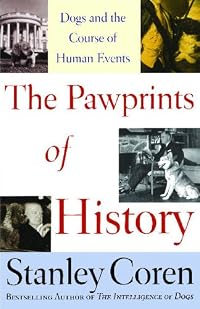
The Pawprints of History: Dogs and the Course of Human Events
by Stanley Coren
On This Page
Description
As history's great figures strut across the stage, Coren guides us from the wings, lovingly picking out the canine cameos and giving every dog of distinction its day. He vividly depicts the dogs that have played a significant role in the lives of many historical figures, and shows how their relationships with their people have directly influenced the course of world events. In this unparalleled chronicle, we see how Florence Nightingale's chance encounter with a wounded dog changed her life show more by leading her to the vocation of nursing. We learn why Dr. Freud's Chow Chow attended all of his therapy sessions and how the life of the Fifth Dalai Lama was saved by a dog who shared his bed. From canines who accompanied the rulers of ancient Egypt to those belonging to the presidents of the United States, dogs have been companions as well as political symbols and instruments of public relations - including Calvin Coolidge's collie Prudence Prim, who had a cheerful collection of fancy hats, and Bill Clinton's chocolate Lab, Buddy, who made timely appearances to help his master through photo opportunities. In this definitive collection of canine greatness, bursting with tales of famous figures and their four-legged catalysts Coren convincingly documents that wherever are found the footprints of history, there too one will find the pawprints. show lessTags
Recommendations

















Member Reviews
One of my dog book goals is to make my own list of ‘best dog books. With Pawprints of History, I kept going back and forth if it should be in that category, but finally decided, it fits enough of my criteria to be in my shelf for ‘dogs-favorite-books.’ Overall, there was great information and lots I would like to save and to share. Some chapters were truly great, and worthy of pushing others to read enthusiastically, but other chapters I were not as passionate about or contained sad information on some endings for dogs.
I like to include quotes in my reviews and there were a LOT of quotes I would like to share. I finally got an app ‘Text Fairy’ so I can take a picture of text from my hard copy book, and it will OCR it into show more text. I would not want anyone to use those kinds of tools to steal intellectual property, but in this case, I am pushing people to buy and read the book. Since I want to share a lot of good stuff, I am putting this review in as having ‘spoilers’ but there is still the rest of the stories and information so still recommend you get the book.
I will cover thoughts and quotes per chapter in the time.
1. Sentinels and Symbols
This chapter had a page or two on various famous people influenced or saved by dogs. Alexander Pope was saved by a dog who went on to live longer to write more poetry, including penning the epigram:
‘Histories are more full of examples of the fidelity of dogs than of friends.”
Loved the story of Florence Nightengale in this chapter. To save a dog’s life from a farmer who would have killed it after it was injured and thought to be not able to work, Florence instead was able to nurse it back to go back to the farmer. The very next night, Florence Nightengale had a dream where she heard the voice of God informing her that she had a mission. ‘Inter her mind sprang the belief that this whole incident was a sign from God to tell her that she should devote her life to healing others.’
2. The Saint and Irish Dogs
This chapter has stories of Saint Roche, Saint Margaret of Cortona, and Saint Patrick with dogs who played influential roles in the stories.
3. The Angry Prince and the Welsh Dog
This chapter tells the tale of Prince Llywelyn and the heroic dog Gelert. This is a well-known tale for us dog readers, with a Welsh prince who has a faithful dog, but returning home, finds his tent torn up, his infant son gone, and the dog covered in blood. The prince runs a spear through the dog, only later to find that the dog had been in a terrible fight killing a wolf and the infant was safe. This chapter includes the controversy about the facts ‘from the actions of an innkeeper who was trying to attract visitors, and a poet who recorded and embellished the tale.’ Of the poet, Robert William Spencer, it is said towards the end of the chapter:
‘Spencer was interested in the dramatic aspect of the story, so perhaps he can be forgiven for designating the wrong location for the events, the wrong breed for the dog, the wrong dog’s name, and other details of the incident that are also not quite correct. He did accomplish his goal, after all, in the he did pen a moving and memorable poem.’
Overall, I enjoyed the story, but you hate it when a good legend is muddled up when you learn related facts. I did however really like, “Perhaps it is for that reason that Cylart lives today in a Welsh expression: Yr wyn edivaru cymmaint dr Gwr a laddodd ei Vilgi, which translates roughly as “I am as sorry and remorseful as the man who slew his greyhound.”
4. The Devil Dog of the English Civil War
This story tells of where dogs played a role in starting a revolution, and a role in losing a war. The short version is King Charles loved his dogs and hunting and, in his hunting, forced hardship on his people. He also took dogs away from people and ‘Seizure of dogs for the kings hunt or for the baiting ring was extremely unpopular.’
5. The Companions of the Prussian Emperor
This chapter is on King Frederick II of Prussia. Like all his chapters, the author gives a sentence or two usually in the first paragraph on what the chapter is about. For this one:
‘He compensated for his lack of intimate human relationships by developing an abiding love for (and perhaps even a psychological dependence upon) his dogs. In this history the dogs are not so much an agent of events but rather an integral part of the life of this very successful but wounded man.’
6. The Conquistador’s Dogs
In the first paragraph of this chapter, it has:
‘What most people do not know is that dogs played a vital role in the European conquest of the New World. Unfortunately, it is also one of the most brutal chapters in man’s long association with dogs, so perhaps we have not so much have forgotten this history as pushed it out of our collective memory.’
While I think the info in this chapter is helpful to know, it is not pleasant to know. I could give you some additional quotes from this chapter, but just know the Spanish Conquistador’s were horrible in the way they used the dogs to intimidate and kill people treating dogs as mere weapons.
The chapter does finish with a nice story on a lady who had the dog sicced on her and the dog didn’t kill her.
‘The governor shook his head in astonishment. “Free her,” he commanded, “and send her safely back to her people. Then let us leave this place for now. I will not permit the compassion and forgiveness of a dog to outshine that of a true Christian.”
7. The Dogs of the Scottish Writer
This chapter is on Sir Walter Scott. It tells how his books and writing style ‘…were born in part because of a love of dogs.’
He became a lawyer and was good at writing, but-
‘Unfortunately for his clients, although his defense arguments were often amusing and literary, they were also often unsuccessful.’
He did learn from one of his criminal clients though –
“Always keep a terrier that barks, rather than a large dog, which you think may serve as a more formidable guard, but may spend most of its time sleeping. Size doesn’t matter, just the sound.”
Scott became a ballad collector. It was Scott’s affinity with dogs that helped him make friends with the farmers who would tell him the ballads. When approaching a farm, he would greet all the dogs of the household first. It relates how one farmer turned to another and said, “Well, Robin, the devil have me if I’m fearful of him now. He’s just a child like ourselves, I think. A man who is so hearty with dogs is one a farmer can understand and talk to himself.”
Washington Irving described Scott from a visit with him one day:
“In our walk he would frequently pause in conversation to notice his dogs and speak to them as if they were rational companions, and indeed there appears to be a vast deal of rationality that these faithful attendants of man derived from their close intimacy with him.”
The chapters in the books on a specific person from history have a lot of information in them including the information on the dogs. We learn that for 15 years Scott writes anonymously, and after the first book Waverly, he went by ‘From the author of Waverly’. He did this so his writing would not tarnish his respectability for his law career. It was Scott’s mentions of dogs in his writing, and use of the same names as his dogs that eventually allowed sleuths to figure out that Scott was the author of the books.
A part of this chapter I would like finish by relating is this bit-
‘Perhaps the best known of Scott’s literary dogs appear in the novel Guy Mannering. It describes a fictional farmer named Dandie Dinmont who kept a house full of dogs, including some terriers know as the “Immortal six.”
‘While Dandie Dinmont was a fictional character, there was a real man who came close to the description painted by Scott. This was James Davidson of Hawick, who lived very near the spot where Scott placed the fictional Dinmont farm and kept a pack of dogs that were almost identical to those described by the author. People were soon calling him Dandie Dinmont and coming to him to purchase dogs like those described in the novel. These dogs ultimately were given the breed name of Dandie
Dinmont terriers, and versions of them can be seen in many dogs shows around the world under that title.’
8. Dogs in the Opera House
This was one of my favorite chapters. It is on Richard Wilhelm Wagner, who also had dogs that were his solace and inspiration.
‘Few biographers, however, have noted the fact that Wagner lived a life that was full of dogs. His dogs inspired him, worried him, were the focus of much of his joy and his philosophical thinking and at least twice placed his life in jeopardy. One even rests besides him in his grave.’
One of his first dogs was Robber, a Newfoundland, which is a dog close to my heart as I miss my previous Newfies. He had to flee the city of Riga, the capital of Larvia, which at the time was part of Russia to go to Paris. He had to sneak out of town with the 160 pound dog in a small boat. Then when he got to London, he had to ride in small cabs, where – ‘the narrow cabs then in use where meant to carry two people facing each other, so we had to lay our huge dog crosswise, his head through one window and the tail through the other.’
When Robber wonders off, Wagner gets a puppy, from the description a English toy spaniel or a Cavalier king Charles spaniel named Peps. This is when Wagner started drawing exclusively on Germanic and Norse myths for his story lines starting with Tannhaüser and Contest of Singers on the Wrtburg. ‘This was also the first opera that he wrote with, and some say for, Peps. The dog was required to be present when Wagner composed. A special stool was provided for him, although at times he would also climb up on other pieces of furniture to obtain a better vantage point. Wagner would play on the piano, or sing passages, while keeping his eyes on Peps to see how he reacted.’
‘Peps was a particularly sensitive dog. When Wagner would talk to him (as he often did) and his speech would turn into a harangue against some perceived enemy, the dog would respond the the escalating tone of his master’s voice by jumping up and barking, all the while spinning around as if looking for the composer’s foes. Peps also appeared to be sensitive to the emotional tone of music. As Wagner composed on the piano, or sang passages he was working on, he noticed that Peps responded differently to particular melodies or musical phrases. For instance, certain passages in E-flat major caused an occasional excited manner. This caused Wagner to consider the possibility of associating specific musical kyes with particular moods or emotions in the drama. In Tannhaüser, this translated to linking the key of E-flat major with the concept of holy love and salvation, while E major is tied to the notion of sensual love and debauchery-all of which seemed consistent with Pep’s reactions.’
After Peps died:
‘The new dog was given the name Fips, and he took Pep’s place on the stool next to the piano while Wagner worked. Fips went on walks with Wagner, and one day they were walking though a nearby park. Fips detected something, perhaps the scent of a squirrel, and began to cast around through the cover of dry autumn leaves that lay on the ground. As the dog searched the ground with quick back-and-forth swings, he scattered the leaves. Wagner laughed and observed, “You look as lost as Siegfied in the woods searching for the dragon.” Then he stopped a moment and listened to the sounds that the dog’s feet made on the dry brown leaves as he ran from side to side sniffing. “Ah Fipsel,” he said out loud, “you have composed a fine piece of music this morning. Let’s go home and write it down.”
9. The Talking Dog
I learned in this chapter that a dog played an important role in the life of the inventory of the telephone, Alexander Graham Bell. When he was twelve his mother began to lose her hearing which inspired Bell to be interested in teaching language to the deaf.
There were two viewpoints towards the deaf, one is known as oralism, emphasizing the development of oral language skills in deaf individuals. Opposed to the oralist view are the advocates of sign language. Since the signs are made with the hands, this viewpoint is often called manualism. ‘Bell felt that the manualist view was wrong because of a dog.’ Bell thought that by teaching a deaf person to emit a continuous sound and shaping their mouth and lips they could learn to communicate. To prove this he trained his pet Skye terrier emit a continuous growl and from there:
‘Bell’s ultimate goal was reached when the dog was able to say in a distinct and intelligible manner the complete sentence, ‘How are you, Grandmama?” (In truth, the actual sounds pronounced were the sequence “ow ah oo, ga ma-ma.”)
Bell’s experiments with the dog, and then teaching deaf people led to a connection to someone who financed his inventions which allowed him to purchase apparatus and to hire Thomas Watson.
10. The Dog on the Therapist’s couch
This chapter is on Sigmund Freud. His fondness for dogs developed during the last two decades of his life. It was during this period that he suffered from cancer of the jaw and would eventually undergo thirty-three operations before he died. He refused to take painkillers as it would numb his mind would not let him think clearly and continue his research and writing.
As far as dogs go, first there was Wolf was acquired as a companion for his daughter Anna, who still became a comfort for Sigmund. Then Sigmund was gifted with a Chow, well actually two, after the first one was run over in the street at a young age. Freud would often take this dog named Jofi in psychotherapy sessions and found having a dog helped with the sessions, especially with children or adolescents. Freud speculated a bit as to the cause-
‘Since the dog appears to be unmoved by anything that the patient says, Freud concluded that this gives the patient a sense of safety and acceptance. Even when the patient describes very painful or embarrassing moments, the dog doesn’t react, except perhaps with a calm glance in the patient’s direction. This gives the patient some confidence that all is well and anything can be expressed in this place, which is a reassuring feeling. Freud recorded this information in his notes, and it would eventually encourage the systematic use of dogs in therapy.’
11. For the Love of Dogs and Other Beasts
This chapter was one with good and bad points. It tells the story of Richard Martin, credited with beginning the animal welfare movement. It is good that his efforts at passing laws preventing cruelty to animals, with one of his first efforts being to criminalize dog fighting.
The bad part is that his actions got using dogs as draft animals banned. While there were some who may have mistreated them. Most took care of their dogs. The dogs usually slept with the family. Often dogs were the poor mans work horse, like the person peddling knife sharpening. With the ban:
‘Overall, estimates are that during the first year of the ban on dog transportation and the imposition of the dog tax on service dogs, between 150,000 to 250,000 dogs were freed from their “slavery” by being put to death, while countless other were simply abandoned to their own resources.’
12. The Dog Shogun
This story was about a Shogun named Tokugawa Tsunayoshi who put dogs lives over peoples, so much so that perceived slights by people was punishable by death. His animal welfare laws over the thirty-six year reign of Tsunayoshi caused an estimated 60,000 to 200,000 people to be put to death or exiled. Not one of my favorite chapters.
13. The Dog Law and the Mary Ellen Case
In this story we learn of Henry Bergh who was influential in bringing animal welfare laws in the United States after learning of the RSPCA in England.
‘Just as in the case of the RSPCA, he was interested in stopping the sport of dog-fighting and the use of dogs to pull carts. He was also particularly offended by another form of “slavery” that dogs were subjected to. This concerned the plight of turnspit dogs.’
What this chapter is more about how Bergh’s championing of rights for dogs, grew into laws protecting cruelty to children. He would go about to restaurants to see if they returned to using dogs for turnspits and:
‘It was during this campaign that the use of dogs in treadmills that Bergh began to realize there was a clear relationship between animal abuse and child abuse. On two occasions, Bergh returned to businesses where owners had been accused of abusing turnspit dogs. In both cases he was simply checking to make sure the owners had not returned to their former practices. Bergh was astounded to find that although the dogs were no longer being used, Negro children had replaced them in the wheels.’
It had only been around ten years earlier that slavery had been abolished in the United States.
The rest of the chapter is on the Mary Ellen case where Bergh and his organization fought for a child in a court case and were able to use the laws set up for animals to apply to children which eventually lead to more extended and specific laws to protect children.
14. The Emperor and His Dogs of Misfortune
This chapter relates to Napoleon Bonaparte and his mostly unfortunate encounters with dogs. I liked the parts that involved Newfoundland dogs, including one that gave away an important note, and the one that most people know of who saved his life. As much as he didn’t like dogs though, he admired their fidelity.
15. Conversations with Dogs
This chapter starts with some discussion on
‘Psychologists have found that the way that we talk to dogs is very similar to Motherese, and they have dubbed this form of language “Doggerel.” Doggerel sounds quite different from the speech that we would use around other adults. Sentences are much shorter, averaging around four words (as opposed to ten or eleven words when we speak to adults). We use many more commands to our dogs, saying things like “Come over here” or “Get off the chair.” Strangely enough, we also ask twice as many questions of our dogs than we do of humans, even though we really don’t seem to expect any answers. The questions are usually trivial conversational questions, like “How do you feel today, puppy?’ In addition we use a lot more tag questions when we speak to dogs. A tag question is where one makes an observation and then turns it into a question at the very end, such as saying, “You're thirsty, aren't you?” Also, when we talk to our dogs we are also twenty times more likely to rephrase and then repeat things than we would with humans; an example of rephrasing and repeating would be “You are a good dog. What a good dog.”
Wow, rest of review in comments show less
I like to include quotes in my reviews and there were a LOT of quotes I would like to share. I finally got an app ‘Text Fairy’ so I can take a picture of text from my hard copy book, and it will OCR it into show more text. I would not want anyone to use those kinds of tools to steal intellectual property, but in this case, I am pushing people to buy and read the book. Since I want to share a lot of good stuff, I am putting this review in as having ‘spoilers’ but there is still the rest of the stories and information so still recommend you get the book.
I will cover thoughts and quotes per chapter in the time.
1. Sentinels and Symbols
This chapter had a page or two on various famous people influenced or saved by dogs. Alexander Pope was saved by a dog who went on to live longer to write more poetry, including penning the epigram:
‘Histories are more full of examples of the fidelity of dogs than of friends.”
Loved the story of Florence Nightengale in this chapter. To save a dog’s life from a farmer who would have killed it after it was injured and thought to be not able to work, Florence instead was able to nurse it back to go back to the farmer. The very next night, Florence Nightengale had a dream where she heard the voice of God informing her that she had a mission. ‘Inter her mind sprang the belief that this whole incident was a sign from God to tell her that she should devote her life to healing others.’
2. The Saint and Irish Dogs
This chapter has stories of Saint Roche, Saint Margaret of Cortona, and Saint Patrick with dogs who played influential roles in the stories.
3. The Angry Prince and the Welsh Dog
This chapter tells the tale of Prince Llywelyn and the heroic dog Gelert. This is a well-known tale for us dog readers, with a Welsh prince who has a faithful dog, but returning home, finds his tent torn up, his infant son gone, and the dog covered in blood. The prince runs a spear through the dog, only later to find that the dog had been in a terrible fight killing a wolf and the infant was safe. This chapter includes the controversy about the facts ‘from the actions of an innkeeper who was trying to attract visitors, and a poet who recorded and embellished the tale.’ Of the poet, Robert William Spencer, it is said towards the end of the chapter:
‘Spencer was interested in the dramatic aspect of the story, so perhaps he can be forgiven for designating the wrong location for the events, the wrong breed for the dog, the wrong dog’s name, and other details of the incident that are also not quite correct. He did accomplish his goal, after all, in the he did pen a moving and memorable poem.’
Overall, I enjoyed the story, but you hate it when a good legend is muddled up when you learn related facts. I did however really like, “Perhaps it is for that reason that Cylart lives today in a Welsh expression: Yr wyn edivaru cymmaint dr Gwr a laddodd ei Vilgi, which translates roughly as “I am as sorry and remorseful as the man who slew his greyhound.”
4. The Devil Dog of the English Civil War
This story tells of where dogs played a role in starting a revolution, and a role in losing a war. The short version is King Charles loved his dogs and hunting and, in his hunting, forced hardship on his people. He also took dogs away from people and ‘Seizure of dogs for the kings hunt or for the baiting ring was extremely unpopular.’
5. The Companions of the Prussian Emperor
This chapter is on King Frederick II of Prussia. Like all his chapters, the author gives a sentence or two usually in the first paragraph on what the chapter is about. For this one:
‘He compensated for his lack of intimate human relationships by developing an abiding love for (and perhaps even a psychological dependence upon) his dogs. In this history the dogs are not so much an agent of events but rather an integral part of the life of this very successful but wounded man.’
6. The Conquistador’s Dogs
In the first paragraph of this chapter, it has:
‘What most people do not know is that dogs played a vital role in the European conquest of the New World. Unfortunately, it is also one of the most brutal chapters in man’s long association with dogs, so perhaps we have not so much have forgotten this history as pushed it out of our collective memory.’
While I think the info in this chapter is helpful to know, it is not pleasant to know. I could give you some additional quotes from this chapter, but just know the Spanish Conquistador’s were horrible in the way they used the dogs to intimidate and kill people treating dogs as mere weapons.
The chapter does finish with a nice story on a lady who had the dog sicced on her and the dog didn’t kill her.
‘The governor shook his head in astonishment. “Free her,” he commanded, “and send her safely back to her people. Then let us leave this place for now. I will not permit the compassion and forgiveness of a dog to outshine that of a true Christian.”
7. The Dogs of the Scottish Writer
This chapter is on Sir Walter Scott. It tells how his books and writing style ‘…were born in part because of a love of dogs.’
He became a lawyer and was good at writing, but-
‘Unfortunately for his clients, although his defense arguments were often amusing and literary, they were also often unsuccessful.’
He did learn from one of his criminal clients though –
“Always keep a terrier that barks, rather than a large dog, which you think may serve as a more formidable guard, but may spend most of its time sleeping. Size doesn’t matter, just the sound.”
Scott became a ballad collector. It was Scott’s affinity with dogs that helped him make friends with the farmers who would tell him the ballads. When approaching a farm, he would greet all the dogs of the household first. It relates how one farmer turned to another and said, “Well, Robin, the devil have me if I’m fearful of him now. He’s just a child like ourselves, I think. A man who is so hearty with dogs is one a farmer can understand and talk to himself.”
Washington Irving described Scott from a visit with him one day:
“In our walk he would frequently pause in conversation to notice his dogs and speak to them as if they were rational companions, and indeed there appears to be a vast deal of rationality that these faithful attendants of man derived from their close intimacy with him.”
The chapters in the books on a specific person from history have a lot of information in them including the information on the dogs. We learn that for 15 years Scott writes anonymously, and after the first book Waverly, he went by ‘From the author of Waverly’. He did this so his writing would not tarnish his respectability for his law career. It was Scott’s mentions of dogs in his writing, and use of the same names as his dogs that eventually allowed sleuths to figure out that Scott was the author of the books.
A part of this chapter I would like finish by relating is this bit-
‘Perhaps the best known of Scott’s literary dogs appear in the novel Guy Mannering. It describes a fictional farmer named Dandie Dinmont who kept a house full of dogs, including some terriers know as the “Immortal six.”
‘While Dandie Dinmont was a fictional character, there was a real man who came close to the description painted by Scott. This was James Davidson of Hawick, who lived very near the spot where Scott placed the fictional Dinmont farm and kept a pack of dogs that were almost identical to those described by the author. People were soon calling him Dandie Dinmont and coming to him to purchase dogs like those described in the novel. These dogs ultimately were given the breed name of Dandie
Dinmont terriers, and versions of them can be seen in many dogs shows around the world under that title.’
8. Dogs in the Opera House
This was one of my favorite chapters. It is on Richard Wilhelm Wagner, who also had dogs that were his solace and inspiration.
‘Few biographers, however, have noted the fact that Wagner lived a life that was full of dogs. His dogs inspired him, worried him, were the focus of much of his joy and his philosophical thinking and at least twice placed his life in jeopardy. One even rests besides him in his grave.’
One of his first dogs was Robber, a Newfoundland, which is a dog close to my heart as I miss my previous Newfies. He had to flee the city of Riga, the capital of Larvia, which at the time was part of Russia to go to Paris. He had to sneak out of town with the 160 pound dog in a small boat. Then when he got to London, he had to ride in small cabs, where – ‘the narrow cabs then in use where meant to carry two people facing each other, so we had to lay our huge dog crosswise, his head through one window and the tail through the other.’
When Robber wonders off, Wagner gets a puppy, from the description a English toy spaniel or a Cavalier king Charles spaniel named Peps. This is when Wagner started drawing exclusively on Germanic and Norse myths for his story lines starting with Tannhaüser and Contest of Singers on the Wrtburg. ‘This was also the first opera that he wrote with, and some say for, Peps. The dog was required to be present when Wagner composed. A special stool was provided for him, although at times he would also climb up on other pieces of furniture to obtain a better vantage point. Wagner would play on the piano, or sing passages, while keeping his eyes on Peps to see how he reacted.’
‘Peps was a particularly sensitive dog. When Wagner would talk to him (as he often did) and his speech would turn into a harangue against some perceived enemy, the dog would respond the the escalating tone of his master’s voice by jumping up and barking, all the while spinning around as if looking for the composer’s foes. Peps also appeared to be sensitive to the emotional tone of music. As Wagner composed on the piano, or sang passages he was working on, he noticed that Peps responded differently to particular melodies or musical phrases. For instance, certain passages in E-flat major caused an occasional excited manner. This caused Wagner to consider the possibility of associating specific musical kyes with particular moods or emotions in the drama. In Tannhaüser, this translated to linking the key of E-flat major with the concept of holy love and salvation, while E major is tied to the notion of sensual love and debauchery-all of which seemed consistent with Pep’s reactions.’
After Peps died:
‘The new dog was given the name Fips, and he took Pep’s place on the stool next to the piano while Wagner worked. Fips went on walks with Wagner, and one day they were walking though a nearby park. Fips detected something, perhaps the scent of a squirrel, and began to cast around through the cover of dry autumn leaves that lay on the ground. As the dog searched the ground with quick back-and-forth swings, he scattered the leaves. Wagner laughed and observed, “You look as lost as Siegfied in the woods searching for the dragon.” Then he stopped a moment and listened to the sounds that the dog’s feet made on the dry brown leaves as he ran from side to side sniffing. “Ah Fipsel,” he said out loud, “you have composed a fine piece of music this morning. Let’s go home and write it down.”
9. The Talking Dog
I learned in this chapter that a dog played an important role in the life of the inventory of the telephone, Alexander Graham Bell. When he was twelve his mother began to lose her hearing which inspired Bell to be interested in teaching language to the deaf.
There were two viewpoints towards the deaf, one is known as oralism, emphasizing the development of oral language skills in deaf individuals. Opposed to the oralist view are the advocates of sign language. Since the signs are made with the hands, this viewpoint is often called manualism. ‘Bell felt that the manualist view was wrong because of a dog.’ Bell thought that by teaching a deaf person to emit a continuous sound and shaping their mouth and lips they could learn to communicate. To prove this he trained his pet Skye terrier emit a continuous growl and from there:
‘Bell’s ultimate goal was reached when the dog was able to say in a distinct and intelligible manner the complete sentence, ‘How are you, Grandmama?” (In truth, the actual sounds pronounced were the sequence “ow ah oo, ga ma-ma.”)
Bell’s experiments with the dog, and then teaching deaf people led to a connection to someone who financed his inventions which allowed him to purchase apparatus and to hire Thomas Watson.
10. The Dog on the Therapist’s couch
This chapter is on Sigmund Freud. His fondness for dogs developed during the last two decades of his life. It was during this period that he suffered from cancer of the jaw and would eventually undergo thirty-three operations before he died. He refused to take painkillers as it would numb his mind would not let him think clearly and continue his research and writing.
As far as dogs go, first there was Wolf was acquired as a companion for his daughter Anna, who still became a comfort for Sigmund. Then Sigmund was gifted with a Chow, well actually two, after the first one was run over in the street at a young age. Freud would often take this dog named Jofi in psychotherapy sessions and found having a dog helped with the sessions, especially with children or adolescents. Freud speculated a bit as to the cause-
‘Since the dog appears to be unmoved by anything that the patient says, Freud concluded that this gives the patient a sense of safety and acceptance. Even when the patient describes very painful or embarrassing moments, the dog doesn’t react, except perhaps with a calm glance in the patient’s direction. This gives the patient some confidence that all is well and anything can be expressed in this place, which is a reassuring feeling. Freud recorded this information in his notes, and it would eventually encourage the systematic use of dogs in therapy.’
11. For the Love of Dogs and Other Beasts
This chapter was one with good and bad points. It tells the story of Richard Martin, credited with beginning the animal welfare movement. It is good that his efforts at passing laws preventing cruelty to animals, with one of his first efforts being to criminalize dog fighting.
The bad part is that his actions got using dogs as draft animals banned. While there were some who may have mistreated them. Most took care of their dogs. The dogs usually slept with the family. Often dogs were the poor mans work horse, like the person peddling knife sharpening. With the ban:
‘Overall, estimates are that during the first year of the ban on dog transportation and the imposition of the dog tax on service dogs, between 150,000 to 250,000 dogs were freed from their “slavery” by being put to death, while countless other were simply abandoned to their own resources.’
12. The Dog Shogun
This story was about a Shogun named Tokugawa Tsunayoshi who put dogs lives over peoples, so much so that perceived slights by people was punishable by death. His animal welfare laws over the thirty-six year reign of Tsunayoshi caused an estimated 60,000 to 200,000 people to be put to death or exiled. Not one of my favorite chapters.
13. The Dog Law and the Mary Ellen Case
In this story we learn of Henry Bergh who was influential in bringing animal welfare laws in the United States after learning of the RSPCA in England.
‘Just as in the case of the RSPCA, he was interested in stopping the sport of dog-fighting and the use of dogs to pull carts. He was also particularly offended by another form of “slavery” that dogs were subjected to. This concerned the plight of turnspit dogs.’
What this chapter is more about how Bergh’s championing of rights for dogs, grew into laws protecting cruelty to children. He would go about to restaurants to see if they returned to using dogs for turnspits and:
‘It was during this campaign that the use of dogs in treadmills that Bergh began to realize there was a clear relationship between animal abuse and child abuse. On two occasions, Bergh returned to businesses where owners had been accused of abusing turnspit dogs. In both cases he was simply checking to make sure the owners had not returned to their former practices. Bergh was astounded to find that although the dogs were no longer being used, Negro children had replaced them in the wheels.’
It had only been around ten years earlier that slavery had been abolished in the United States.
The rest of the chapter is on the Mary Ellen case where Bergh and his organization fought for a child in a court case and were able to use the laws set up for animals to apply to children which eventually lead to more extended and specific laws to protect children.
14. The Emperor and His Dogs of Misfortune
This chapter relates to Napoleon Bonaparte and his mostly unfortunate encounters with dogs. I liked the parts that involved Newfoundland dogs, including one that gave away an important note, and the one that most people know of who saved his life. As much as he didn’t like dogs though, he admired their fidelity.
15. Conversations with Dogs
This chapter starts with some discussion on
‘Psychologists have found that the way that we talk to dogs is very similar to Motherese, and they have dubbed this form of language “Doggerel.” Doggerel sounds quite different from the speech that we would use around other adults. Sentences are much shorter, averaging around four words (as opposed to ten or eleven words when we speak to adults). We use many more commands to our dogs, saying things like “Come over here” or “Get off the chair.” Strangely enough, we also ask twice as many questions of our dogs than we do of humans, even though we really don’t seem to expect any answers. The questions are usually trivial conversational questions, like “How do you feel today, puppy?’ In addition we use a lot more tag questions when we speak to dogs. A tag question is where one makes an observation and then turns it into a question at the very end, such as saying, “You're thirsty, aren't you?” Also, when we talk to our dogs we are also twenty times more likely to rephrase and then repeat things than we would with humans; an example of rephrasing and repeating would be “You are a good dog. What a good dog.”
Wow, rest of review in comments show less
One of my dog book goals is to make my own list of ‘best dog books. With Pawprints of History, I kept going back and forth if it should be in that category, but finally decided, it fits enough of my criteria to be in my shelf for ‘dogs-favorite-books.’ Overall, there was great information and lots I would like to save and to share. Some chapters were truly great, and worthy of pushing others to read enthusiastically, but other chapters I were not as passionate about or contained sad information on some endings for dogs.
I like to include quotes in my reviews and there were a LOT of quotes I would like to share. I finally got an app ‘Text Fairy’ so I can take a picture of text from my hard copy book, and it will OCR it into show more text. I would not want anyone to use those kinds of tools to steal intellectual property, but in this case, I am pushing people to buy and read the book. Since I want to share a lot of good stuff, I am putting this review in as having ‘spoilers’ but there is still the rest of the stories and information so still recommend you get the book.
I will cover thoughts and quotes per chapter in the time.
1. Sentinels and Symbols
This chapter had a page or two on various famous people influenced or saved by dogs. Alexander Pope was saved by a dog who went on to live longer to write more poetry, including penning the epigram:
‘Histories are more full of examples of the fidelity of dogs than of friends.”
Loved the story of Florence Nightengale in this chapter. To save a dog’s life from a farmer who would have killed it after it was injured and thought to be not able to work, Florence instead was able to nurse it back to go back to the farmer. The very next night, Florence Nightengale had a dream where she heard the voice of God informing her that she had a mission. ‘Inter her mind sprang the belief that this whole incident was a sign from God to tell her that she should devote her life to healing others.’
2. The Saint and Irish Dogs
This chapter has stories of Saint Roche, Saint Margaret of Cortona, and Saint Patrick with dogs who played influential roles in the stories.
3. The Angry Prince and the Welsh Dog
This chapter tells the tale of Prince Llywelyn and the heroic dog Gelert. This is a well-known tale for us dog readers, with a Welsh prince who has a faithful dog, but returning home, finds his tent torn up, his infant son gone, and the dog covered in blood. The prince runs a spear through the dog, only later to find that the dog had been in a terrible fight killing a wolf and the infant was safe. This chapter includes the controversy about the facts ‘from the actions of an innkeeper who was trying to attract visitors, and a poet who recorded and embellished the tale.’ Of the poet, Robert William Spencer, it is said towards the end of the chapter:
‘Spencer was interested in the dramatic aspect of the story, so perhaps he can be forgiven for designating the wrong location for the events, the wrong breed for the dog, the wrong dog’s name, and other details of the incident that are also not quite correct. He did accomplish his goal, after all, in the he did pen a moving and memorable poem.’
Overall, I enjoyed the story, but you hate it when a good legend is muddled up when you learn related facts. I did however really like, “Perhaps it is for that reason that Cylart lives today in a Welsh expression: Yr wyn edivaru cymmaint dr Gwr a laddodd ei Vilgi, which translates roughly as “I am as sorry and remorseful as the man who slew his greyhound.”
4. The Devil Dog of the English Civil War
This story tells of where dogs played a role in starting a revolution, and a role in losing a war. The short version is King Charles loved his dogs and hunting and, in his hunting, forced hardship on his people. He also took dogs away from people and ‘Seizure of dogs for the kings hunt or for the baiting ring was extremely unpopular.’
5. The Companions of the Prussian Emperor
This chapter is on King Frederick II of Prussia. Like all his chapters, the author gives a sentence or two usually in the first paragraph on what the chapter is about. For this one:
‘He compensated for his lack of intimate human relationships by developing an abiding love for (and perhaps even a psychological dependence upon) his dogs. In this history the dogs are not so much an agent of events but rather an integral part of the life of this very successful but wounded man.’
6. The Conquistador’s Dogs
In the first paragraph of this chapter, it has:
‘What most people do not know is that dogs played a vital role in the European conquest of the New World. Unfortunately, it is also one of the most brutal chapters in man’s long association with dogs, so perhaps we have not so much have forgotten this history as pushed it out of our collective memory.’
While I think the info in this chapter is helpful to know, it is not pleasant to know. I could give you some additional quotes from this chapter, but just know the Spanish Conquistador’s were horrible in the way they used the dogs to intimidate and kill people treating dogs as mere weapons.
The chapter does finish with a nice story on a lady who had the dog sicced on her and the dog didn’t kill her.
‘The governor shook his head in astonishment. “Free her,” he commanded, “and send her safely back to her people. Then let us leave this place for now. I will not permit the compassion and forgiveness of a dog to outshine that of a true Christian.”
7. The Dogs of the Scottish Writer
This chapter is on Sir Walter Scott. It tells how his books and writing style ‘…were born in part because of a love of dogs.’
He became a lawyer and was good at writing, but-
‘Unfortunately for his clients, although his defense arguments were often amusing and literary, they were also often unsuccessful.’
He did learn from one of his criminal clients though –
“Always keep a terrier that barks, rather than a large dog, which you think may serve as a more formidable guard, but may spend most of its time sleeping. Size doesn’t matter, just the sound.”
Scott became a ballad collector. It was Scott’s affinity with dogs that helped him make friends with the farmers who would tell him the ballads. When approaching a farm, he would greet all the dogs of the household first. It relates how one farmer turned to another and said, “Well, Robin, the devil have me if I’m fearful of him now. He’s just a child like ourselves, I think. A man who is so hearty with dogs is one a farmer can understand and talk to himself.”
Washington Irving described Scott from a visit with him one day:
“In our walk he would frequently pause in conversation to notice his dogs and speak to them as if they were rational companions, and indeed there appears to be a vast deal of rationality that these faithful attendants of man derived from their close intimacy with him.”
The chapters in the books on a specific person from history have a lot of information in them including the information on the dogs. We learn that for 15 years Scott writes anonymously, and after the first book Waverly, he went by ‘From the author of Waverly’. He did this so his writing would not tarnish his respectability for his law career. It was Scott’s mentions of dogs in his writing, and use of the same names as his dogs that eventually allowed sleuths to figure out that Scott was the author of the books.
A part of this chapter I would like finish by relating is this bit-
‘Perhaps the best known of Scott’s literary dogs appear in the novel Guy Mannering. It describes a fictional farmer named Dandie Dinmont who kept a house full of dogs, including some terriers know as the “Immortal six.”
‘While Dandie Dinmont was a fictional character, there was a real man who came close to the description painted by Scott. This was James Davidson of Hawick, who lived very near the spot where Scott placed the fictional Dinmont farm and kept a pack of dogs that were almost identical to those described by the author. People were soon calling him Dandie Dinmont and coming to him to purchase dogs like those described in the novel. These dogs ultimately were given the breed name of Dandie
Dinmont terriers, and versions of them can be seen in many dogs shows around the world under that title.’
8. Dogs in the Opera House
This was one of my favorite chapters. It is on Richard Wilhelm Wagner, who also had dogs that were his solace and inspiration.
‘Few biographers, however, have noted the fact that Wagner lived a life that was full of dogs. His dogs inspired him, worried him, were the focus of much of his joy and his philosophical thinking and at least twice placed his life in jeopardy. One even rests besides him in his grave.’
One of his first dogs was Robber, a Newfoundland, which is a dog close to my heart as I miss my previous Newfies. He had to flee the city of Riga, the capital of Larvia, which at the time was part of Russia to go to Paris. He had to sneak out of town with the 160 pound dog in a small boat. Then when he got to London, he had to ride in small cabs, where – ‘the narrow cabs then in use where meant to carry two people facing each other, so we had to lay our huge dog crosswise, his head through one window and the tail through the other.’
When Robber wonders off, Wagner gets a puppy, from the description a English toy spaniel or a Cavalier king Charles spaniel named Peps. This is when Wagner started drawing exclusively on Germanic and Norse myths for his story lines starting with Tannhaüser and Contest of Singers on the Wrtburg. ‘This was also the first opera that he wrote with, and some say for, Peps. The dog was required to be present when Wagner composed. A special stool was provided for him, although at times he would also climb up on other pieces of furniture to obtain a better vantage point. Wagner would play on the piano, or sing passages, while keeping his eyes on Peps to see how he reacted.’
‘Peps was a particularly sensitive dog. When Wagner would talk to him (as he often did) and his speech would turn into a harangue against some perceived enemy, the dog would respond the the escalating tone of his master’s voice by jumping up and barking, all the while spinning around as if looking for the composer’s foes. Peps also appeared to be sensitive to the emotional tone of music. As Wagner composed on the piano, or sang passages he was working on, he noticed that Peps responded differently to particular melodies or musical phrases. For instance, certain passages in E-flat major caused an occasional excited manner. This caused Wagner to consider the possibility of associating specific musical kyes with particular moods or emotions in the drama. In Tannhaüser, this translated to linking the key of E-flat major with the concept of holy love and salvation, while E major is tied to the notion of sensual love and debauchery-all of which seemed consistent with Pep’s reactions.’
After Peps died:
‘The new dog was given the name Fips, and he took Pep’s place on the stool next to the piano while Wagner worked. Fips went on walks with Wagner, and one day they were walking though a nearby park. Fips detected something, perhaps the scent of a squirrel, and began to cast around through the cover of dry autumn leaves that lay on the ground. As the dog searched the ground with quick back-and-forth swings, he scattered the leaves. Wagner laughed and observed, “You look as lost as Siegfied in the woods searching for the dragon.” Then he stopped a moment and listened to the sounds that the dog’s feet made on the dry brown leaves as he ran from side to side sniffing. “Ah Fipsel,” he said out loud, “you have composed a fine piece of music this morning. Let’s go home and write it down.”
9. The Talking Dog
I learned in this chapter that a dog played an important role in the life of the inventory of the telephone, Alexander Graham Bell. When he was twelve his mother began to lose her hearing which inspired Bell to be interested in teaching language to the deaf.
There were two viewpoints towards the deaf, one is known as oralism, emphasizing the development of oral language skills in deaf individuals. Opposed to the oralist view are the advocates of sign language. Since the signs are made with the hands, this viewpoint is often called manualism. ‘Bell felt that the manualist view was wrong because of a dog.’ Bell thought that by teaching a deaf person to emit a continuous sound and shaping their mouth and lips they could learn to communicate. To prove this he trained his pet Skye terrier emit a continuous growl and from there:
‘Bell’s ultimate goal was reached when the dog was able to say in a distinct and intelligible manner the complete sentence, ‘How are you, Grandmama?” (In truth, the actual sounds pronounced were the sequence “ow ah oo, ga ma-ma.”)
Bell’s experiments with the dog, and then teaching deaf people led to a connection to someone who financed his inventions which allowed him to purchase apparatus and to hire Thomas Watson.
10. The Dog on the Therapist’s couch
This chapter is on Sigmund Freud. His fondness for dogs developed during the last two decades of his life. It was during this period that he suffered from cancer of the jaw and would eventually undergo thirty-three operations before he died. He refused to take painkillers as it would numb his mind would not let him think clearly and continue his research and writing.
As far as dogs go, first there was Wolf was acquired as a companion for his daughter Anna, who still became a comfort for Sigmund. Then Sigmund was gifted with a Chow, well actually two, after the first one was run over in the street at a young age. Freud would often take this dog named Jofi in psychotherapy sessions and found having a dog helped with the sessions, especially with children or adolescents. Freud speculated a bit as to the cause-
‘Since the dog appears to be unmoved by anything that the patient says, Freud concluded that this gives the patient a sense of safety and acceptance. Even when the patient describes very painful or embarrassing moments, the dog doesn’t react, except perhaps with a calm glance in the patient’s direction. This gives the patient some confidence that all is well and anything can be expressed in this place, which is a reassuring feeling. Freud recorded this information in his notes, and it would eventually encourage the systematic use of dogs in therapy.’
11. For the Love of Dogs and Other Beasts
This chapter was one with good and bad points. It tells the story of Richard Martin, credited with beginning the animal welfare movement. It is good that his efforts at passing laws preventing cruelty to animals, with one of his first efforts being to criminalize dog fighting.
The bad part is that his actions got using dogs as draft animals banned. While there were some who may have mistreated them. Most took care of their dogs. The dogs usually slept with the family. Often dogs were the poor mans work horse, like the person peddling knife sharpening. With the ban:
‘Overall, estimates are that during the first year of the ban on dog transportation and the imposition of the dog tax on service dogs, between 150,000 to 250,000 dogs were freed from their “slavery” by being put to death, while countless other were simply abandoned to their own resources.’
12. The Dog Shogun
This story was about a Shogun named Tokugawa Tsunayoshi who put dogs lives over peoples, so much so that perceived slights by people was punishable by death. His animal welfare laws over the thirty-six year reign of Tsunayoshi caused an estimated 60,000 to 200,000 people to be put to death or exiled. Not one of my favorite chapters.
13. The Dog Law and the Mary Ellen Case
In this story we learn of Henry Bergh who was influential in bringing animal welfare laws in the United States after learning of the RSPCA in England.
‘Just as in the case of the RSPCA, he was interested in stopping the sport of dog-fighting and the use of dogs to pull carts. He was also particularly offended by another form of “slavery” that dogs were subjected to. This concerned the plight of turnspit dogs.’
What this chapter is more about how Bergh’s championing of rights for dogs, grew into laws protecting cruelty to children. He would go about to restaurants to see if they returned to using dogs for turnspits and:
‘It was during this campaign that the use of dogs in treadmills that Bergh began to realize there was a clear relationship between animal abuse and child abuse. On two occasions, Bergh returned to businesses where owners had been accused of abusing turnspit dogs. In both cases he was simply checking to make sure the owners had not returned to their former practices. Bergh was astounded to find that although the dogs were no longer being used, Negro children had replaced them in the wheels.’
It had only been around ten years earlier that slavery had been abolished in the United States.
The rest of the chapter is on the Mary Ellen case where Bergh and his organization fought for a child in a court case and were able to use the laws set up for animals to apply to children which eventually lead to more extended and specific laws to protect children.
14. The Emperor and His Dogs of Misfortune
This chapter relates to Napoleon Bonaparte and his mostly unfortunate encounters with dogs. I liked the parts that involved Newfoundland dogs, including one that gave away an important note, and the one that most people know of who saved his life. As much as he didn’t like dogs though, he admired their fidelity.
15. Conversations with Dogs
This chapter starts with some discussion on
‘Psychologists have found that the way that we talk to dogs is very similar to Motherese, and they have dubbed this form of language “Doggerel.” Doggerel sounds quite different from the speech that we would use around other adults. Sentences are much shorter, averaging around four words (as opposed to ten or eleven words when we speak to adults). We use many more commands to our dogs, saying things like “Come over here” or “Get off the chair.” Strangely enough, we also ask twice as many questions of our dogs than we do of humans, even though we really don’t seem to expect any answers. The questions are usually trivial conversational questions, like “How do you feel today, puppy?’ In addition we use a lot more tag questions when we speak to dogs. A tag question is where one makes an observation and then turns it into a question at the very end, such as saying, “You're thirsty, aren't you?” Also, when we talk to our dogs we are also twenty times more likely to rephrase and then repeat things than we would with humans; an example of rephrasing and repeating would be “You are a good dog. What a good dog.”
Wow, rest of review in comments show less
I like to include quotes in my reviews and there were a LOT of quotes I would like to share. I finally got an app ‘Text Fairy’ so I can take a picture of text from my hard copy book, and it will OCR it into show more text. I would not want anyone to use those kinds of tools to steal intellectual property, but in this case, I am pushing people to buy and read the book. Since I want to share a lot of good stuff, I am putting this review in as having ‘spoilers’ but there is still the rest of the stories and information so still recommend you get the book.
I will cover thoughts and quotes per chapter in the time.
1. Sentinels and Symbols
This chapter had a page or two on various famous people influenced or saved by dogs. Alexander Pope was saved by a dog who went on to live longer to write more poetry, including penning the epigram:
‘Histories are more full of examples of the fidelity of dogs than of friends.”
Loved the story of Florence Nightengale in this chapter. To save a dog’s life from a farmer who would have killed it after it was injured and thought to be not able to work, Florence instead was able to nurse it back to go back to the farmer. The very next night, Florence Nightengale had a dream where she heard the voice of God informing her that she had a mission. ‘Inter her mind sprang the belief that this whole incident was a sign from God to tell her that she should devote her life to healing others.’
2. The Saint and Irish Dogs
This chapter has stories of Saint Roche, Saint Margaret of Cortona, and Saint Patrick with dogs who played influential roles in the stories.
3. The Angry Prince and the Welsh Dog
This chapter tells the tale of Prince Llywelyn and the heroic dog Gelert. This is a well-known tale for us dog readers, with a Welsh prince who has a faithful dog, but returning home, finds his tent torn up, his infant son gone, and the dog covered in blood. The prince runs a spear through the dog, only later to find that the dog had been in a terrible fight killing a wolf and the infant was safe. This chapter includes the controversy about the facts ‘from the actions of an innkeeper who was trying to attract visitors, and a poet who recorded and embellished the tale.’ Of the poet, Robert William Spencer, it is said towards the end of the chapter:
‘Spencer was interested in the dramatic aspect of the story, so perhaps he can be forgiven for designating the wrong location for the events, the wrong breed for the dog, the wrong dog’s name, and other details of the incident that are also not quite correct. He did accomplish his goal, after all, in the he did pen a moving and memorable poem.’
Overall, I enjoyed the story, but you hate it when a good legend is muddled up when you learn related facts. I did however really like, “Perhaps it is for that reason that Cylart lives today in a Welsh expression: Yr wyn edivaru cymmaint dr Gwr a laddodd ei Vilgi, which translates roughly as “I am as sorry and remorseful as the man who slew his greyhound.”
4. The Devil Dog of the English Civil War
This story tells of where dogs played a role in starting a revolution, and a role in losing a war. The short version is King Charles loved his dogs and hunting and, in his hunting, forced hardship on his people. He also took dogs away from people and ‘Seizure of dogs for the kings hunt or for the baiting ring was extremely unpopular.’
5. The Companions of the Prussian Emperor
This chapter is on King Frederick II of Prussia. Like all his chapters, the author gives a sentence or two usually in the first paragraph on what the chapter is about. For this one:
‘He compensated for his lack of intimate human relationships by developing an abiding love for (and perhaps even a psychological dependence upon) his dogs. In this history the dogs are not so much an agent of events but rather an integral part of the life of this very successful but wounded man.’
6. The Conquistador’s Dogs
In the first paragraph of this chapter, it has:
‘What most people do not know is that dogs played a vital role in the European conquest of the New World. Unfortunately, it is also one of the most brutal chapters in man’s long association with dogs, so perhaps we have not so much have forgotten this history as pushed it out of our collective memory.’
While I think the info in this chapter is helpful to know, it is not pleasant to know. I could give you some additional quotes from this chapter, but just know the Spanish Conquistador’s were horrible in the way they used the dogs to intimidate and kill people treating dogs as mere weapons.
The chapter does finish with a nice story on a lady who had the dog sicced on her and the dog didn’t kill her.
‘The governor shook his head in astonishment. “Free her,” he commanded, “and send her safely back to her people. Then let us leave this place for now. I will not permit the compassion and forgiveness of a dog to outshine that of a true Christian.”
7. The Dogs of the Scottish Writer
This chapter is on Sir Walter Scott. It tells how his books and writing style ‘…were born in part because of a love of dogs.’
He became a lawyer and was good at writing, but-
‘Unfortunately for his clients, although his defense arguments were often amusing and literary, they were also often unsuccessful.’
He did learn from one of his criminal clients though –
“Always keep a terrier that barks, rather than a large dog, which you think may serve as a more formidable guard, but may spend most of its time sleeping. Size doesn’t matter, just the sound.”
Scott became a ballad collector. It was Scott’s affinity with dogs that helped him make friends with the farmers who would tell him the ballads. When approaching a farm, he would greet all the dogs of the household first. It relates how one farmer turned to another and said, “Well, Robin, the devil have me if I’m fearful of him now. He’s just a child like ourselves, I think. A man who is so hearty with dogs is one a farmer can understand and talk to himself.”
Washington Irving described Scott from a visit with him one day:
“In our walk he would frequently pause in conversation to notice his dogs and speak to them as if they were rational companions, and indeed there appears to be a vast deal of rationality that these faithful attendants of man derived from their close intimacy with him.”
The chapters in the books on a specific person from history have a lot of information in them including the information on the dogs. We learn that for 15 years Scott writes anonymously, and after the first book Waverly, he went by ‘From the author of Waverly’. He did this so his writing would not tarnish his respectability for his law career. It was Scott’s mentions of dogs in his writing, and use of the same names as his dogs that eventually allowed sleuths to figure out that Scott was the author of the books.
A part of this chapter I would like finish by relating is this bit-
‘Perhaps the best known of Scott’s literary dogs appear in the novel Guy Mannering. It describes a fictional farmer named Dandie Dinmont who kept a house full of dogs, including some terriers know as the “Immortal six.”
‘While Dandie Dinmont was a fictional character, there was a real man who came close to the description painted by Scott. This was James Davidson of Hawick, who lived very near the spot where Scott placed the fictional Dinmont farm and kept a pack of dogs that were almost identical to those described by the author. People were soon calling him Dandie Dinmont and coming to him to purchase dogs like those described in the novel. These dogs ultimately were given the breed name of Dandie
Dinmont terriers, and versions of them can be seen in many dogs shows around the world under that title.’
8. Dogs in the Opera House
This was one of my favorite chapters. It is on Richard Wilhelm Wagner, who also had dogs that were his solace and inspiration.
‘Few biographers, however, have noted the fact that Wagner lived a life that was full of dogs. His dogs inspired him, worried him, were the focus of much of his joy and his philosophical thinking and at least twice placed his life in jeopardy. One even rests besides him in his grave.’
One of his first dogs was Robber, a Newfoundland, which is a dog close to my heart as I miss my previous Newfies. He had to flee the city of Riga, the capital of Larvia, which at the time was part of Russia to go to Paris. He had to sneak out of town with the 160 pound dog in a small boat. Then when he got to London, he had to ride in small cabs, where – ‘the narrow cabs then in use where meant to carry two people facing each other, so we had to lay our huge dog crosswise, his head through one window and the tail through the other.’
When Robber wonders off, Wagner gets a puppy, from the description a English toy spaniel or a Cavalier king Charles spaniel named Peps. This is when Wagner started drawing exclusively on Germanic and Norse myths for his story lines starting with Tannhaüser and Contest of Singers on the Wrtburg. ‘This was also the first opera that he wrote with, and some say for, Peps. The dog was required to be present when Wagner composed. A special stool was provided for him, although at times he would also climb up on other pieces of furniture to obtain a better vantage point. Wagner would play on the piano, or sing passages, while keeping his eyes on Peps to see how he reacted.’
‘Peps was a particularly sensitive dog. When Wagner would talk to him (as he often did) and his speech would turn into a harangue against some perceived enemy, the dog would respond the the escalating tone of his master’s voice by jumping up and barking, all the while spinning around as if looking for the composer’s foes. Peps also appeared to be sensitive to the emotional tone of music. As Wagner composed on the piano, or sang passages he was working on, he noticed that Peps responded differently to particular melodies or musical phrases. For instance, certain passages in E-flat major caused an occasional excited manner. This caused Wagner to consider the possibility of associating specific musical kyes with particular moods or emotions in the drama. In Tannhaüser, this translated to linking the key of E-flat major with the concept of holy love and salvation, while E major is tied to the notion of sensual love and debauchery-all of which seemed consistent with Pep’s reactions.’
After Peps died:
‘The new dog was given the name Fips, and he took Pep’s place on the stool next to the piano while Wagner worked. Fips went on walks with Wagner, and one day they were walking though a nearby park. Fips detected something, perhaps the scent of a squirrel, and began to cast around through the cover of dry autumn leaves that lay on the ground. As the dog searched the ground with quick back-and-forth swings, he scattered the leaves. Wagner laughed and observed, “You look as lost as Siegfied in the woods searching for the dragon.” Then he stopped a moment and listened to the sounds that the dog’s feet made on the dry brown leaves as he ran from side to side sniffing. “Ah Fipsel,” he said out loud, “you have composed a fine piece of music this morning. Let’s go home and write it down.”
9. The Talking Dog
I learned in this chapter that a dog played an important role in the life of the inventory of the telephone, Alexander Graham Bell. When he was twelve his mother began to lose her hearing which inspired Bell to be interested in teaching language to the deaf.
There were two viewpoints towards the deaf, one is known as oralism, emphasizing the development of oral language skills in deaf individuals. Opposed to the oralist view are the advocates of sign language. Since the signs are made with the hands, this viewpoint is often called manualism. ‘Bell felt that the manualist view was wrong because of a dog.’ Bell thought that by teaching a deaf person to emit a continuous sound and shaping their mouth and lips they could learn to communicate. To prove this he trained his pet Skye terrier emit a continuous growl and from there:
‘Bell’s ultimate goal was reached when the dog was able to say in a distinct and intelligible manner the complete sentence, ‘How are you, Grandmama?” (In truth, the actual sounds pronounced were the sequence “ow ah oo, ga ma-ma.”)
Bell’s experiments with the dog, and then teaching deaf people led to a connection to someone who financed his inventions which allowed him to purchase apparatus and to hire Thomas Watson.
10. The Dog on the Therapist’s couch
This chapter is on Sigmund Freud. His fondness for dogs developed during the last two decades of his life. It was during this period that he suffered from cancer of the jaw and would eventually undergo thirty-three operations before he died. He refused to take painkillers as it would numb his mind would not let him think clearly and continue his research and writing.
As far as dogs go, first there was Wolf was acquired as a companion for his daughter Anna, who still became a comfort for Sigmund. Then Sigmund was gifted with a Chow, well actually two, after the first one was run over in the street at a young age. Freud would often take this dog named Jofi in psychotherapy sessions and found having a dog helped with the sessions, especially with children or adolescents. Freud speculated a bit as to the cause-
‘Since the dog appears to be unmoved by anything that the patient says, Freud concluded that this gives the patient a sense of safety and acceptance. Even when the patient describes very painful or embarrassing moments, the dog doesn’t react, except perhaps with a calm glance in the patient’s direction. This gives the patient some confidence that all is well and anything can be expressed in this place, which is a reassuring feeling. Freud recorded this information in his notes, and it would eventually encourage the systematic use of dogs in therapy.’
11. For the Love of Dogs and Other Beasts
This chapter was one with good and bad points. It tells the story of Richard Martin, credited with beginning the animal welfare movement. It is good that his efforts at passing laws preventing cruelty to animals, with one of his first efforts being to criminalize dog fighting.
The bad part is that his actions got using dogs as draft animals banned. While there were some who may have mistreated them. Most took care of their dogs. The dogs usually slept with the family. Often dogs were the poor mans work horse, like the person peddling knife sharpening. With the ban:
‘Overall, estimates are that during the first year of the ban on dog transportation and the imposition of the dog tax on service dogs, between 150,000 to 250,000 dogs were freed from their “slavery” by being put to death, while countless other were simply abandoned to their own resources.’
12. The Dog Shogun
This story was about a Shogun named Tokugawa Tsunayoshi who put dogs lives over peoples, so much so that perceived slights by people was punishable by death. His animal welfare laws over the thirty-six year reign of Tsunayoshi caused an estimated 60,000 to 200,000 people to be put to death or exiled. Not one of my favorite chapters.
13. The Dog Law and the Mary Ellen Case
In this story we learn of Henry Bergh who was influential in bringing animal welfare laws in the United States after learning of the RSPCA in England.
‘Just as in the case of the RSPCA, he was interested in stopping the sport of dog-fighting and the use of dogs to pull carts. He was also particularly offended by another form of “slavery” that dogs were subjected to. This concerned the plight of turnspit dogs.’
What this chapter is more about how Bergh’s championing of rights for dogs, grew into laws protecting cruelty to children. He would go about to restaurants to see if they returned to using dogs for turnspits and:
‘It was during this campaign that the use of dogs in treadmills that Bergh began to realize there was a clear relationship between animal abuse and child abuse. On two occasions, Bergh returned to businesses where owners had been accused of abusing turnspit dogs. In both cases he was simply checking to make sure the owners had not returned to their former practices. Bergh was astounded to find that although the dogs were no longer being used, Negro children had replaced them in the wheels.’
It had only been around ten years earlier that slavery had been abolished in the United States.
The rest of the chapter is on the Mary Ellen case where Bergh and his organization fought for a child in a court case and were able to use the laws set up for animals to apply to children which eventually lead to more extended and specific laws to protect children.
14. The Emperor and His Dogs of Misfortune
This chapter relates to Napoleon Bonaparte and his mostly unfortunate encounters with dogs. I liked the parts that involved Newfoundland dogs, including one that gave away an important note, and the one that most people know of who saved his life. As much as he didn’t like dogs though, he admired their fidelity.
15. Conversations with Dogs
This chapter starts with some discussion on
‘Psychologists have found that the way that we talk to dogs is very similar to Motherese, and they have dubbed this form of language “Doggerel.” Doggerel sounds quite different from the speech that we would use around other adults. Sentences are much shorter, averaging around four words (as opposed to ten or eleven words when we speak to adults). We use many more commands to our dogs, saying things like “Come over here” or “Get off the chair.” Strangely enough, we also ask twice as many questions of our dogs than we do of humans, even though we really don’t seem to expect any answers. The questions are usually trivial conversational questions, like “How do you feel today, puppy?’ In addition we use a lot more tag questions when we speak to dogs. A tag question is where one makes an observation and then turns it into a question at the very end, such as saying, “You're thirsty, aren't you?” Also, when we talk to our dogs we are also twenty times more likely to rephrase and then repeat things than we would with humans; an example of rephrasing and repeating would be “You are a good dog. What a good dog.”
Wow, rest of review in comments show less
interesting, funny, known-and-not-so-well-known tidbits about dogs in history. for instance: did you know napoleons wife josephine had a little dog that repeatedly bit him when he wanted to get amourous? no wonder he was cranky!
Ratings
Members
- Recently Added By
Author Information

25 Works 2,419 Members
Stanley Coren is a professor emeritus of psychology at the University of British Columbia. He is the author of The Intelligence of Dogs and other bestsellers about dogs and is the winner of the Maxwell Medal of Excellence from the Dog Writers Association of America. He, his wife, and their three dogs live in Vancouver, British Columbia.
Common Knowledge
Classifications
Statistics
- Members
- 147
- Popularity
- 220,515
- Reviews
- 3
- Rating
- (3.56)
- Languages
- English, Hungarian
- Media
- Paper, Ebook
- ISBNs
- 4