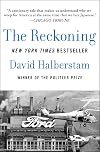
The Reckoning
by David Halberstam
On This Page
Description
Told with panoramic detail and gripping insight, The Reckoning is the inside story of automakers Ford and Nissanand the collapse of America's industrial supremacy After generations of creating high-quality automotive products, American industrialists began losing ground to the Japanese auto industry in the decades after World War II. David Halberstam, with his signature precision and absorbing narrative style, traces this power shift by delving into the boardrooms and onto the factory floors show more of the America's Ford Motor Company and Japan's Nissan. Different in every wayfrom their reactions to labor problems to their philosophies and leadership stylesthe two companies stand as singular testaments to the challenges brought by the rise of the global economy. With intriguing vignettes about Henry Ford, Lee Iacocca, and other visionary industrial leaders, The Reckoning remains a powerful and enlightening story about manufacturing in the modern age, and how America fell woefully behind. This ebook features an extended biography of David Halberstam. show lessTags
Recommendations



































Member Reviews
Reading this book is a massive undertaking. I only did so because someone whose opinion I trust recommended it to me, and while there were times when I wondered if I would ever finish it and almost forgot what it was like to read anything but a long, dense history of the American and Japanese auto industries, I’m glad I finished it. Someone once advised that we should only read books we disagree with. I disagree with that, but The Reckoning is a good argument for occasionally reading a book unlike what you usually read. It’s also one of those books that is so rich, so dense, and so detailed that you wish you could remember a third of what passes through your brain as you scan its pages. There were times while reading that I wished show more Halberstam had an editor as severe as some of the Japanese managers her describes, but, in hindsight, I wouldn’t know what to cut. Each of the 54 chapters contributes to the “soft drama,” the finale of which falls in the late 1980s.
In his author’s note, Halberstam calls the story he tells “soft drama—something profound that has taken place so quietly, in such small increments, that it is barely visible to the naked eye.” That’s an apt description of the book in which he intertwines the stories of dozens of people, some who appear on page 10 and reappear 600 pages later, whose efforts, ideas, and personalities fostered the rise of Nissan and the decline of Ford. (Readers might speak of the “Japanese and American industries,” as I did above, but Halberstam focuses on these two companies as representative examples.) The ways in which Japanese creativity and intellectual power had to be rechanneled into a new industry after the War—and the ways in which the American equivalents fell into complacency—makes for an oddly compelling read, “oddly” because there are almost no incidents of “hard drama.” All of the action takes place in boardrooms, design labs, and factory floors.
Halberstam is very good at teaching his reader about figures he or she may not recognize. Before reading, I was unfamiliar with Joseph Dodge, who was sent by MacArthur to reimagine Japan according to America’s dictates and who brought an austerity to the country that, in the long run, made its industries much more competitive. I had never heard of Ed Lundy, the CFO of Ford who epitomized the idea that finance should always trump design, that one was better served by “whiz kids” than “car men.” And I was certainly unaware of any of the men who propelled Nissan, such as the engineer Minoru Tanaka or the first president of Nissan U.S.A., Yutaka Katayama. But Halberstam also spends time with figures that the reader assumes he already understands, such as Robert McNamara, Walter Reuther, Lee Iacocca, and Henry Ford. Each of these is given substantial and illuminating treatment.
Halberstam is skillful at telling the stories of complementary figures, such as Henry Ford II and Katsuji Kawamata. His treatment of the careers of Walter Reuther (who led the U.A.W.) and Ichior Shioji (who led the J.A.W.) is an interesting look at how unions arise, why they were needed, and how they become extensions of the management they once sought to control. (One also naturally contrasts them with their contemporary counterparts and notes the differences.) He is also terrific at capturing managerial styles, as he does in his description of the puritanical Philip Caldwell, who brought the Ford Fiesta to Europe and became the first non-Ford to run the company: “Caldwell’s meetings seemed to last forever. The joke went that it wasn’t bad enough that Caldwell kept them there for six hours at a time, but that because he never drank coffee or tea, he never had to go to the bathroom. Some men claimed that he pissed chalk. Others said that if a colleague stubbornly resisted something Caldwell wanted, Caldwell waited until his opponent went to the bathroom and then called for a vote.” But Caldwell, for all of his unease around anyone who contradicted him and the frustrations he caused, saved Ford. Reading The Reckoning after Isaacson's perfect Steve Jobs allows a reader to think about all the different models of leadership and the merits and drawbacks of each.
If you’re interested in the working of massive companies, arguments between engineers, the incredible and contentious debate to bring smaller cars onto American roads, the ways in which a nation’s cultural norms are translated into their work ethics, how small ideas lead to revolutionary ones, and the stories of interesting yet occasional awful people, you’ll enjoy the book. You may end up reading it for the same reason I did—not because you care about cars but because you enjoy good writing. show less
In his author’s note, Halberstam calls the story he tells “soft drama—something profound that has taken place so quietly, in such small increments, that it is barely visible to the naked eye.” That’s an apt description of the book in which he intertwines the stories of dozens of people, some who appear on page 10 and reappear 600 pages later, whose efforts, ideas, and personalities fostered the rise of Nissan and the decline of Ford. (Readers might speak of the “Japanese and American industries,” as I did above, but Halberstam focuses on these two companies as representative examples.) The ways in which Japanese creativity and intellectual power had to be rechanneled into a new industry after the War—and the ways in which the American equivalents fell into complacency—makes for an oddly compelling read, “oddly” because there are almost no incidents of “hard drama.” All of the action takes place in boardrooms, design labs, and factory floors.
Halberstam is very good at teaching his reader about figures he or she may not recognize. Before reading, I was unfamiliar with Joseph Dodge, who was sent by MacArthur to reimagine Japan according to America’s dictates and who brought an austerity to the country that, in the long run, made its industries much more competitive. I had never heard of Ed Lundy, the CFO of Ford who epitomized the idea that finance should always trump design, that one was better served by “whiz kids” than “car men.” And I was certainly unaware of any of the men who propelled Nissan, such as the engineer Minoru Tanaka or the first president of Nissan U.S.A., Yutaka Katayama. But Halberstam also spends time with figures that the reader assumes he already understands, such as Robert McNamara, Walter Reuther, Lee Iacocca, and Henry Ford. Each of these is given substantial and illuminating treatment.
Halberstam is skillful at telling the stories of complementary figures, such as Henry Ford II and Katsuji Kawamata. His treatment of the careers of Walter Reuther (who led the U.A.W.) and Ichior Shioji (who led the J.A.W.) is an interesting look at how unions arise, why they were needed, and how they become extensions of the management they once sought to control. (One also naturally contrasts them with their contemporary counterparts and notes the differences.) He is also terrific at capturing managerial styles, as he does in his description of the puritanical Philip Caldwell, who brought the Ford Fiesta to Europe and became the first non-Ford to run the company: “Caldwell’s meetings seemed to last forever. The joke went that it wasn’t bad enough that Caldwell kept them there for six hours at a time, but that because he never drank coffee or tea, he never had to go to the bathroom. Some men claimed that he pissed chalk. Others said that if a colleague stubbornly resisted something Caldwell wanted, Caldwell waited until his opponent went to the bathroom and then called for a vote.” But Caldwell, for all of his unease around anyone who contradicted him and the frustrations he caused, saved Ford. Reading The Reckoning after Isaacson's perfect Steve Jobs allows a reader to think about all the different models of leadership and the merits and drawbacks of each.
If you’re interested in the working of massive companies, arguments between engineers, the incredible and contentious debate to bring smaller cars onto American roads, the ways in which a nation’s cultural norms are translated into their work ethics, how small ideas lead to revolutionary ones, and the stories of interesting yet occasional awful people, you’ll enjoy the book. You may end up reading it for the same reason I did—not because you care about cars but because you enjoy good writing. show less
David Halberstam wrote The Reckoning in 1986 to explore a simple question – why was an industry as strong and storied as the American car industry brought to its knees by competition from far less experienced Japanese upstarts?
I read The Reckoning in 2013. As a fan of David Halberstam, I knew to expect strong writing and narrative, but I wondered how relevant I would find this history, given that close to 30 years had elapsed since its publication. Would it be filled with predictions of Japanese world domination and paeans to the cultural superiority of the Japanese?
Anything but. The Reckoning’s relevance today is almost haunting – the discussions of topics such as Detroit’s addiction to large automobiles, the pressure to show more underinvest to meet Wall Street expectations, and the relationship between government and industry could have been written during the most recent crisis in 2008-2009. Prescient for 1986, a chapter near the end explores whether political forces at home might stifle Japan’s further economic expansion.
The Reckoning is also a good history, using two companies, Nissan and Ford, to illustrate the general trajectory of the industry. Halberstam explores both companies’ histories in detail (my paperback version is 750 pages long), giving the reader an understanding of what forces drove the actions of each company, as well as anecdotes and personal histories that bring the stories alive, such as the head of Nissan’s western U.S. division prying the “Fair Lady” label off their first entry into the sports car market in 1970 (he replaced it with their internal designation, the 240Z).
While some of the content in “The Reckoning” may be of less interest now than it was to the 1986 audience – we are probably less interested in the power struggle between Lee Iacocca and Henry Ford, for example - “The Reckoning” still provides today’s readers plenty of lessons about corporate and national competitiveness. show less
I read The Reckoning in 2013. As a fan of David Halberstam, I knew to expect strong writing and narrative, but I wondered how relevant I would find this history, given that close to 30 years had elapsed since its publication. Would it be filled with predictions of Japanese world domination and paeans to the cultural superiority of the Japanese?
Anything but. The Reckoning’s relevance today is almost haunting – the discussions of topics such as Detroit’s addiction to large automobiles, the pressure to show more underinvest to meet Wall Street expectations, and the relationship between government and industry could have been written during the most recent crisis in 2008-2009. Prescient for 1986, a chapter near the end explores whether political forces at home might stifle Japan’s further economic expansion.
The Reckoning is also a good history, using two companies, Nissan and Ford, to illustrate the general trajectory of the industry. Halberstam explores both companies’ histories in detail (my paperback version is 750 pages long), giving the reader an understanding of what forces drove the actions of each company, as well as anecdotes and personal histories that bring the stories alive, such as the head of Nissan’s western U.S. division prying the “Fair Lady” label off their first entry into the sports car market in 1970 (he replaced it with their internal designation, the 240Z).
While some of the content in “The Reckoning” may be of less interest now than it was to the 1986 audience – we are probably less interested in the power struggle between Lee Iacocca and Henry Ford, for example - “The Reckoning” still provides today’s readers plenty of lessons about corporate and national competitiveness. show less
I thought from the cover that this was a period and thus maybe dated considering of Japanese disruption of the American car market back in the 80s. If anything, that is a merely the denouement of a consideration of the history of both nation's auto industries, largely from WWII to the early '80s. The author focuses on Ford and the corresponding Japanese #2, Nissan. On the Ford side, the eventual modernization and broadening of the company's scope seems to have occured in spite of Henry Ford the found -- he comes across as heading toward paranoid seclusion -- and his grandson Henry II who comes across as a disinterested, petulant drunk. Of course, Chrysler (apparently perennially in need of rescue) gets a lot of coverage as the Iacocca show more era is a bit of a post-Ford venture.
The Japanese side is really a tale of a broken nation -- broken even in spirit -- finding will and in America friendly opportunity and then succeeding through the hard work, diligence and attention to quality lacking for too long on the large car-loving other side of the Pacific where fat times got translated into pay (from laborer to CEO) and benefits too dear for indefinite support. show less
The Japanese side is really a tale of a broken nation -- broken even in spirit -- finding will and in America friendly opportunity and then succeeding through the hard work, diligence and attention to quality lacking for too long on the large car-loving other side of the Pacific where fat times got translated into pay (from laborer to CEO) and benefits too dear for indefinite support. show less
Though a bit dated, this is an excellent dissection of the rise of the Japanese auto industry and the struggles of their American counterparts.
02-25-2000
This was a very interesting book, most especially because I read it 14 years after its publication. The author, completing this before the internet was even a blip in everyday consciousness, based his conclusions on a "pre-net" analysis. Concerned with industry, and unaware of the computer revolution only then beginning, this book is an artifact of its time, only 14 years after publication.
It was a very interesting read, particularly because of the mini-biographies it contains. Well-written, but a bit light. Fascinating however, as a record of the state of thinking about economics at the time, and some nicely done summation of the history of post-war Japan.
This was a very interesting book, most especially because I read it 14 years after its publication. The author, completing this before the internet was even a blip in everyday consciousness, based his conclusions on a "pre-net" analysis. Concerned with industry, and unaware of the computer revolution only then beginning, this book is an artifact of its time, only 14 years after publication.
It was a very interesting read, particularly because of the mini-biographies it contains. Well-written, but a bit light. Fascinating however, as a record of the state of thinking about economics at the time, and some nicely done summation of the history of post-war Japan.
Detroit auto makers had it made, then the Japanese moved in and upended the auto business. David Halberstam looks at how this happened, why it happened, and mostly how it could have been prevented. A history of car making in two countries and how the Japanese out foxed the dominant American car makers.
As the US watches the CEOs of it three major auto manufacturers now in December 2008 it is truly shocking how this book, written over 20 years ago is so "right on" right how. Halberstam starts his book with predictions about limited oil and moves through describing the auto industry's mistakes, focusing on Ford. Halberstam was a real Cassandar.
Here is another Amazon review that agrees with me
Now, updating this July 2009. After watching the meltdown of Chrylsler and GM, Hlberstamp's predictions become even more ironic. He was so right.
As always with David Halberstam, this book is a monument to relentless reporting - he must surely be the most energetic reporter of our times. It presents vivid pictures of the insides of Ford and Nissan, show more with an eye toward developing his main theme: that America really blew it, that the Japanese are gonna take over, that the American economy is going down the tubes. Too bad that entire theme is ridiculously wrong. The book came out in 1986, just as the American economy was gearing up to reinvent itself, as it had many times before, and as it will many times again. As a history of the car industry, the book is dandy; as another of Halberstam's attempts to explain the world, it's an exercise in hubris. show less
Here is another Amazon review that agrees with me
Now, updating this July 2009. After watching the meltdown of Chrylsler and GM, Hlberstamp's predictions become even more ironic. He was so right.
As always with David Halberstam, this book is a monument to relentless reporting - he must surely be the most energetic reporter of our times. It presents vivid pictures of the insides of Ford and Nissan, show more with an eye toward developing his main theme: that America really blew it, that the Japanese are gonna take over, that the American economy is going down the tubes. Too bad that entire theme is ridiculously wrong. The book came out in 1986, just as the American economy was gearing up to reinvent itself, as it had many times before, and as it will many times again. As a history of the car industry, the book is dandy; as another of Halberstam's attempts to explain the world, it's an exercise in hubris. show less
Members
- Recently Added By
Author Information

43+ Works 16,051 Members
David Halberstam was born on April 10, 1934 in New York City and later attended Harvard University. After graduating in 1955, Halberstam worked at a small daily newspaper until he attained a position at the Nashville Tennessean. Halberstam has written over 20 books including The Children, a written account of his coverage of the Civil Rights show more Movement; The Best and Brightest, which was a bestseller; and The Game and October, 1964, both detailing his fascination of sports. Halberstam also won a Pulitzer Prize for his reports on the Vietnam War while working for the New York Times. He was killed in a car crash on April 23, 2007 at the age of 73. (Bowker Author Biography) show less
Some Editions
Awards and Honors
Awards
Distinctions
Work Relationships
Common Knowledge
- Canonical title
- The Reckoning
- Original publication date
- 1986
- People/Characters
- Lee Iacocca; Robert S. McNamara; W. Edwards Deming; Henry Ford
Classifications
- Genres
- Nonfiction, History, General Nonfiction, Business
- DDC/MDS
- 338.4 — Society, government, & culture Economics Production Secondary industries and services
- LCC
- HD9710 .U52 .H28 — Social sciences Industries. Land use. Labor Industries. Land use. Labor Special industries and trades Mechanical industries
- BISAC
Statistics
- Members
- 688
- Popularity
- 41,557
- Reviews
- 9
- Rating
- (4.20)
- Languages
- English
- Media
- Paper, Ebook
- ISBNs
- 7
- ASINs
- 5