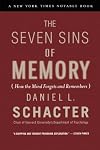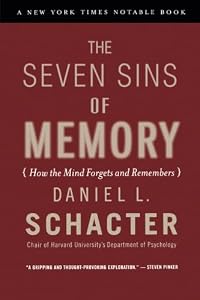
The Seven Sins of Memory: How the Mind Forgets and Remembers
by Daniel L. Schacter
On This Page
Description
"Daniel L. Schacter, chairman of Harvard University's Psychology Department and a leading expert on memory, has developed the first framework that describes the basic memory miscues we all encounter. Just like the seven deadly sins, the seven memory sins appear routinely in everyday life. Schacter explains how transience reflects a weakening of memory over time, how absent-mindedness occurs when failures of attention sabotage memory, and how blocking happens when we can't retrieve a name we show more know well. Three other sins involve distorted memories: misattribution (assigning a memory to the wrong source), suggestibility (implanting false memories), and bias (rewriting the past based on present beliefs). The seventh sin, persistence, concerns intrusive recollections that we cannot forget - even when we wish we could. Although these sins may cause difficulties, as Schacter notes, they're surprisingly vital to a keen mind."--Jacket. show lessTags
Recommendations





Member Reviews
Schacter approaches his task like a teacher. He focuses on seven problems with memory that have undoubtedly been experienced by the average reader:
1. Transience - Our memories weaken over time.
2. Absent-mindedness - We don't focus on what we need to remember.
3. Blocking - It's in our memory somewhere, but we can't find it.
4. Misattribution - We are wrong about where we learned something.
5. Suggestibility - Other people can "plant" false memories in us.
6. Bias - We rewrite the past with the pen of present beliefs.
7. Persistence - We keep remembering things we'd like to forget.
For each of these problems, he gives understandable examples. In the final chapter, the problems are discussed as a group, and the author states the opinion that show more these problems are a small price to pay for a memory capability that performs extraordinarily well.
In the early part of the book, there are references to specific functions of the various lobes of the brain and how those lobes may affect the processes of memory. As the discussion moves on to the rest of the “sins,” there are fewer references to objective scientific data, and more references to hypotheses and activity testing of various types. Professor Schacter does a thorough job of referencing the works of other psychologists, and summarizing their opinions.
An informative book, intended for non-technical people who want an overview of the field and a basic understanding of academic progress. show less
1. Transience - Our memories weaken over time.
2. Absent-mindedness - We don't focus on what we need to remember.
3. Blocking - It's in our memory somewhere, but we can't find it.
4. Misattribution - We are wrong about where we learned something.
5. Suggestibility - Other people can "plant" false memories in us.
6. Bias - We rewrite the past with the pen of present beliefs.
7. Persistence - We keep remembering things we'd like to forget.
For each of these problems, he gives understandable examples. In the final chapter, the problems are discussed as a group, and the author states the opinion that show more these problems are a small price to pay for a memory capability that performs extraordinarily well.
In the early part of the book, there are references to specific functions of the various lobes of the brain and how those lobes may affect the processes of memory. As the discussion moves on to the rest of the “sins,” there are fewer references to objective scientific data, and more references to hypotheses and activity testing of various types. Professor Schacter does a thorough job of referencing the works of other psychologists, and summarizing their opinions.
An informative book, intended for non-technical people who want an overview of the field and a basic understanding of academic progress. show less
This book talks about seven memory miscues that irritate people and argues that they indicate a memory that is working well. It is well written and contains a bibliography and other source notes if you are interested in following the matter further. It also contains tips on how to deal with the mistakes that your memory might make, which also works pretty nice.
An interesting and readable book, but I don't know that it was all that applicable to me or my life. I read it because it sounded intriguing, but I have no idea what I got out of it. It would probably be more helpful to me if I were involved with psychology or neuroscience. I kind of get that a part of my brain could lead me to forget where I left my keys, but I know I'll still end up searching for them when I need to leave my apartment!
Slightly tedious discussion of the memory faults of
Transience
Absent Mindedness
Blocking
Misattribution
Suggestibility
Bias
Persistence & Depression
This final chapter is a discussion of whether these faults are vices or virtues.
Transience
Absent Mindedness
Blocking
Misattribution
Suggestibility
Bias
Persistence & Depression
This final chapter is a discussion of whether these faults are vices or virtues.
Ratings
Members
- Recently Added By
Lists

The Great Courses: The Learning Brain
61 works; 1 member

The Great Courses: Brain Myths Exploded
7 works; 1 member
Author Information

27 Works 1,287 Members
Daniel L. Schacter is the William R. Kenan Jr. Professor of Psychology in the Department of Psychology at Harvard University. He has been elected to the National Academy of Sciences and received numerous awards for his research, and is also the author of many books on memory and neuropsychology.
Awards and Honors
Awards
Notable Lists
Common Knowledge
- Canonical title*
- Los siete pecados de la memoria
- Original publication date
- 2001
- Dedication
- For my family: Susan, Hannah, and Emily
- First words
- (Introduction): In Yasunari Kawabata's unsettling short story "Yumimura," a novelits receives and unexpected visit from a woman who says she knew him thirty years earlier.
On October 3, 1995, the most sensational criminal trial of our time reached a stunning conclusion: a jury acquitted O. J. Simpson of murder. - Last words
- (Click to show. Warning: May contain spoilers.)Memory's vices are also its virtues, elements of a bridge across time which allows us to link the mind with the world.
- Blurbers
- Pinker, Steven; Skloot, Floyd; Williams, David; Groopman, Jerome; Hall, Stephen S.
*Some information comes from Common Knowledge in other languages. Click "Edit" for more information.
Classifications
Statistics
- Members
- 578
- Popularity
- 50,707
- Reviews
- 5
- Rating
- (3.77)
- Languages
- 5 — English, German, Hungarian, Portuguese, Spanish
- Media
- Paper, Audiobook, Ebook
- ISBNs
- 20
- UPCs
- 2
- ASINs
- 4