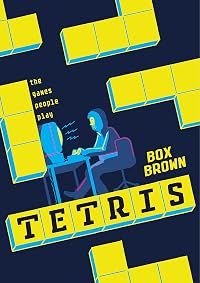
Tetris: The Games People Play
by Box Brown (Author, Illustrator)
On This Page
Description
"It is, perhaps, the perfect video game. Simple yet addictive, Tetris delivers an irresistible, unending puzzle that has players hooked. Play it long enough and you'll see those brightly colored geometric shapes everywhere. You'll see them in your dreams. Alexey Pajitnov had big ideas about games. In 1984, he created Tetris in his spare time while developing software for the Soviet government. Once Tetris emerged from behind the Iron Curtain, it was an instant hit. Nintendo, Atari, show more Sega--game developers big and small all wanted Tetris. A bidding war was sparked, followed by clandestine trips to Moscow, backroom deals, innumerable miscommunications, and outright theft. In this graphic novel, New York Times--bestselling author Box Brown untangles this complex history and delves deep into the role games play in art, culture, and commerce. For the first time and in unparalleled detail, Tetris: The Games People Play tells the true story of the world's most popular video game."--Page [2] of cover. show lessTags
Recommendations
































Member Reviews
As the title says, this graphic novel is about Tetris, but it's also about Nintendo and (to a lesser extent) Atari/Tengen.
This graphic novel's art style wasn't to my taste at all, but I picked this up more for its subject matter than how it looked. I've read a few video game history books and therefore knew a little Tetris history before going in. It was also one of the games I played a lot on my family's NES growing up. This book included a good deal more information than I'd previously known.
While this was an interesting read, I really wish the flow hadn't been so choppy. It started off with a brief mention of some sort of ancient Egyptian game, and then there was so much about Nintendo that this, at times, felt at least as much like show more a history of Nintendo as a history of Tetris.
It didn't help that the legal and political history of Tetris was a genuinely tangled nightmare. I had trouble keeping track of all the people and companies involved, and what everyone's motivations were and what they'd been promised.
Nothing about the general tone of the graphic novel prepared me for the moment when it was revealed that Vladimir Pokhilko, a friend of Tetris creator Alexey Pajitnov who was involved in the development and marketing of the game,committed murder-suicide, killing his wife and their son. We literally went from a page with grinning men (Henk Rogers and Alexey) to body bags.
Anyway, this was occasionally unfocused and confusing, but still a decent read overall.
(Original review posted on A Library Girl's Familiar Diversions.) show less
This graphic novel's art style wasn't to my taste at all, but I picked this up more for its subject matter than how it looked. I've read a few video game history books and therefore knew a little Tetris history before going in. It was also one of the games I played a lot on my family's NES growing up. This book included a good deal more information than I'd previously known.
While this was an interesting read, I really wish the flow hadn't been so choppy. It started off with a brief mention of some sort of ancient Egyptian game, and then there was so much about Nintendo that this, at times, felt at least as much like show more a history of Nintendo as a history of Tetris.
It didn't help that the legal and political history of Tetris was a genuinely tangled nightmare. I had trouble keeping track of all the people and companies involved, and what everyone's motivations were and what they'd been promised.
Nothing about the general tone of the graphic novel prepared me for the moment when it was revealed that Vladimir Pokhilko, a friend of Tetris creator Alexey Pajitnov who was involved in the development and marketing of the game,
Anyway, this was occasionally unfocused and confusing, but still a decent read overall.
(Original review posted on A Library Girl's Familiar Diversions.) show less
I really wanted to like this. I'm a huge Tetris fan, and was already pretty familiar with the Tetris origin story. I'm also a huge graphic novel fan, and was primed to enjoy the combination of the two. In fact, I lay down and read the book in an hour or two the night I got it, and immediately rated it 5-stars on Goodreads, even though I knew at the time I had some reservations. But I didn't write a review. I didn't think about it deeply enough to articulate those reservations to myself.
I had a chance to re-read it this morning, and realized immediately what was wrong. Two things: 1. the story is barely about Tetris. It is some parts about Tetris, in the middle mostly, but it has a beginning that makes all kinds of statements about games show more and the origins of games that is written in a very declarative style. These statements are written as if they are fact: some about the origins of senet (one of the first board games); some about which came first, art or games; and some hasty conclusions about the motivations of people as they play games. I would go so far as to say that all of these statements, written as if they are absolute truths, written as if they are well-researched facts, are entirely subjective at best and downright incorrect at worst.
Much later, after what I consider the best parts of the book in the middle, about the actual origination of Tetris, the book becomes primarily about the IP rights battle(s) that plagued Tetris for years. Don't get me wrong, there are many interesting stories in there, but I feel like they're so much less interesting than the origin of games and why we play games, ideas that the book begins with, makes poorly drawn conclusions about, and then abandons.
The entire book is written as if there is nothing subjective about it. These are depictions of facts. History. And after those first 30 pages about ancient history... pages with lots of statements I found suspect, I found it hard to read all the rest without a hefty suspicion. My skeptical hackles were up. The seeds of doubt had taken root. It's entirely possible the rest of the book is well researched, but I wish the book hadn't started as it did.
The second thing I disliked about the book was far more subjective. I loved the art style. The drawings in the book are awesome. But they are not, with a few pages of exceptions, at all inspired by Tetris.
Now maybe this is weird, but I'm a Tetris connoisseur. I've played every Tetris variant I can get my hands on. I've got ALL of the Tetris board games. I've got a collection of Tetris tee-shirts. So... I like Tetris art. And I really expected to find a bunch of it in this book. Overall, I was pretty disappointed. For the most part, pentominos are really only found on pages that depict the actual game itself. The cover is an exception, it is not what we find inside. show less
I had a chance to re-read it this morning, and realized immediately what was wrong. Two things: 1. the story is barely about Tetris. It is some parts about Tetris, in the middle mostly, but it has a beginning that makes all kinds of statements about games show more and the origins of games that is written in a very declarative style. These statements are written as if they are fact: some about the origins of senet (one of the first board games); some about which came first, art or games; and some hasty conclusions about the motivations of people as they play games. I would go so far as to say that all of these statements, written as if they are absolute truths, written as if they are well-researched facts, are entirely subjective at best and downright incorrect at worst.
Much later, after what I consider the best parts of the book in the middle, about the actual origination of Tetris, the book becomes primarily about the IP rights battle(s) that plagued Tetris for years. Don't get me wrong, there are many interesting stories in there, but I feel like they're so much less interesting than the origin of games and why we play games, ideas that the book begins with, makes poorly drawn conclusions about, and then abandons.
The entire book is written as if there is nothing subjective about it. These are depictions of facts. History. And after those first 30 pages about ancient history... pages with lots of statements I found suspect, I found it hard to read all the rest without a hefty suspicion. My skeptical hackles were up. The seeds of doubt had taken root. It's entirely possible the rest of the book is well researched, but I wish the book hadn't started as it did.
The second thing I disliked about the book was far more subjective. I loved the art style. The drawings in the book are awesome. But they are not, with a few pages of exceptions, at all inspired by Tetris.
Now maybe this is weird, but I'm a Tetris connoisseur. I've played every Tetris variant I can get my hands on. I've got ALL of the Tetris board games. I've got a collection of Tetris tee-shirts. So... I like Tetris art. And I really expected to find a bunch of it in this book. Overall, I was pretty disappointed. For the most part, pentominos are really only found on pages that depict the actual game itself. The cover is an exception, it is not what we find inside. show less
Graphic non-fiction is a growing genre because of its appeal to a younger audience. This does not follow a single individual, but instead is the birth story of the perennially popular game of Tetris. Tetris was originally a thought experiment of a Russian programmer, then an underground success shared freely via floppy disk. When the underground game found the west, there were several competing factions that wanted to market it and a lot of cold-war political complications. It is well done, but I did get bored in some parts. It was broken into chapters, so it was easy to read in pieces.
I'm on the fence about how much I liked this graphic novel. While it does provide a lot of information about the legal battles between electronic gaming giants like Atari and Nintendo over the game, I was hoping it would dig a little deeper into the psychology and the cultural phenomenon that is the game Tetris. It touched on the idea of gaming, but only gives you the tiniest taste of game theory before whisking you off and dumping you deep, deep into the well of rights battles. Also, I would really have loved to know more about Alexey's experiences since he is painted as kind of a happy-go-lucky, law abiding Soviet citizen, but then there is a hint of him having some animosity toward the state for taking all the money for the game near show more the end of the book. Ultimately, I think the book should have been titled _Tetris: Corporate Assholes vs. Soviet Bureaucracy_. show less
I’m not usually a fan of non-fiction, but this graphic novel that tells the story of how the video game Tetris became a sensation across the globe was fascinating!
Stuck between a 2/2.5 and a 3 because I enjoyed a lot of aspects of it, particularly the beginning and end which spoke more to what draws people to games and gaming in a psychological and philosophical sense. By contrast the middle section felt like a largely unbroken series of nearly identical businessmen sitting in board rooms, getting on and off planes, and arguing about contracts and the legal rights to Tetris. I get that this is actually what happened in terms of plot, but it also feels like all there is to take in visually as well. I found the graphic style pretty engaging for the most part, but I wish the bookend commentary on games and the battles over the distribution rights to Tetris were more connected thematically.
Had no idea there was such a story behind this ubiquitous game. The story is extremely effectively told.
Members
- Recently Added By
Lists

Gaming
7 works; 1 member

The Cold War
7 works; 1 member

Recommend the 20 best books you've read in the last five years
2,168 works; 606 members

Books Read in 2017
4,249 works; 130 members

Stories featuring characters who are mathematicians
42 works; 5 members

Top Five Books of 2021
604 works; 181 members

Books Read in 2023
5,638 works; 147 members

Best Graphic Novel Nonfiction
199 works; 101 members
Author Information

All Editions
Awards and Honors
Distinctions
Notable Lists
Common Knowledge
- Canonical title
- Tetris: The Games People Play
- Original publication date
- 2016-10-11
- People/Characters
- Alexey Pajitnov
- First words
- Alexey Pajitnov, computer scientist at Moscow Academy of Science Creator of Tetris
Earth, 1984
Two friends discuss the comings and goings of the universe and our place in it. - Last words
- (Click to show. Warning: May contain spoilers.)Is it any wonder Tetris is on permanent display at the Museum of Modern Art in New York?
Classifications
- Genres
- Technology, Graphic Novels & Comics, Teen
- DDC/MDS
- 794.8 — Arts & recreation Recreation, sports, and performing arts Indoor games of skill Electronic games
- LCC
- GV1469.15 .B68 — Geography, Anthropology and Recreation Recreation. Leisure Recreation. Leisure Games and amusements Indoor games and amusements Board games. Move games
- BISAC
Statistics
- Members
- 308
- Popularity
- 104,115
- Reviews
- 18
- Rating
- (3.68)
- Languages
- English, French, Italian, Polish
- Media
- Paper, Ebook
- ISBNs
- 9
- ASINs
- 1