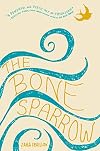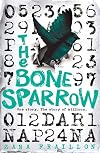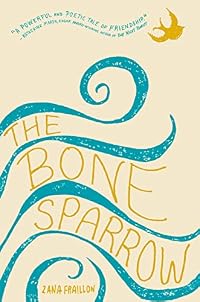
The Bone Sparrow
by Zana Fraillon
On This Page
Description
"Subhi's contained world as a refugee in an Australian permanent detention center rapidly expands when Jimmie arrives on the other side of the fence and asks him to read her late mother's stories to her"--Tags
Recommendations







Member Reviews
A raw, unflinching, powerful, and very necessary book.
(Full disclosure: I received a free electronic ARC for review through NetGalley. Trigger warning for violence.)
I find my notebook and pencil and I start to write. The letters flow from deep inside me without even a pause to worry about which way is which and where to put what. And my head fills with memories and stories from so long ago that fences weren’t even invented yet. Stories that haven’t even happened yet. Stories that the world won’t see for years and years. All those stories swirl through my head, but I suck them all in and tell them to wait. Because first I have to write the most important story of them all. The story which isn’t even a story. The story that has to show more be told, no matter how hard it is to tell.
Ten-year-old Subhi was born in an Australian detention center. Originally from Burma (Myanmar), his Maá and older sister Queeny (Noor) were forcibly removed by soldiers, put on a boat and compelled to set sail at gunpoint. His ba, a poet, was imprisoned by the government.
Their offense? Subhi and his family are Rohingya, an ethnic Muslim minority living in Buddhist-majority Myanmar. In the Author's Note, Fraillon explains that "the United Nations and Amnesty International have declared the Rohingya to be one of the most persecuted people on earth, and a recent investigation by Al Jazeera News suggested that the government of Myanmar is committing genocide in its treatment of the Rohingya. The Rohingya are being hunted into extinction."
For the past decade, they've been in limbo: unable to return to their native country, but unwelcome where they washed up. Like the United States, Australia has a policy of mandatory detention; refugees are treated much like criminals.
In order to keep his mind from turning to "mush," Subhi clings to stories - the familiar, well-worn tales of his family, and new ones belonging to the nine hundred other refugees who live in the detention center alongside him. Especially cherished are those stories dreamed up by his ba; stories of the Night Sea, which sometimes washes over Subhi's camp as he dreams, leaving cryptic treasures in its wake: A small statue of a knight. A little blue toy car. A sketch of a thousand birds in flight. A green coin rimmed with black smudges. Subhi believes that these are messages, sent by his ba - and that, one day, he'll come in person to rescue them from this non-existence.
Jimmie lives up the road from the detention center. While she and her brother Jonah have explored most of the abandoned houses in their defunct mining town, the aura of sadness and despair that permeates the center has kept them away. But on the third anniversary of her mother's death, overcome with a strange feeling of restlessness and curiosity, Jimmie sneaks out of her house and into the center. Also unable to sleep, Subhi is the only witness to this intruder, the ghostly girl with fiery red hair.
For a spell, he thinks he dreamed her up. That is, until she returns, her mother's diary tucked under her arm. Jimmie can't read, but Suhbi can - and he's desperate for some new reading material. And so the pair dive into the story of Jimmie's great-great-great-grandmother Anka, a girl who was born from an eggshell and rescued from a well. A girl who, like Subhi, was driven from her homeland at gunpoint.
Thus marks the beginning of a beautiful friendship - and also heralds tragedy and transformation, both inside the camp and without.
The Bone Sparrow is...well, it's spectacular. It's raw and unflinching, yet gentle enough for younger readers. Even though this is a middle-grade book, it speaks to audiences of all ages, and with force and beauty and power. Books like this are why you see such an hostile backlash against calls for greater representation and diversity in literature: Words matter. Stories are powerful. With reading comes empathy; with empathy comes compassion and change. Books like The Bone Sparrow can change hearts and minds and (hopefully) actions. If this book doesn't make you blubber and cry and bleed, then I just don't know.
The conditions in Subhi's camp are deplorable. There are food shortages, water shortages, and doctor shortages. What little food they do get is bad: past-date, filled with bugs, spoiled enough to give the whole camp food poisoning. (Subhi reports that he even found a human tooth in his gruel once.) They live in the desert, in tents without air conditioning, and suffer from "dust sickness." The kids do not attend school, nor is a teacher brought in to tutor them. Subhi only knows how to read because Queeny taught him - along with any other camp kid wishing to learn. The reading material is sparse, and as for toys? The children race lice and cockroaches for fun. Self-harming and suicide attempts are common enough that there's a whole section of the camp ("Ford") dedicated to inmates who need special protection - from themselves or others. Single men are segregated in their own area ("Alpha"), but it's not unusual for boys to be thrown in there five or ten years ahead of their time. Abuse runs rampant, both among the inmates (see: Alpha and Ford) and, more commonly, the guards.
“Coming here is a bit like waking up from a nightmare and then finding out that you aren’t awake at all,” Queeny told me one time when we saw a boy try to hurt himself.
You might wonder how much of this is true, or accurately reflects reality. According to the author, "The conditions I have described in this book have all been taken from reports of life in Australian detention centers." Given how we treat our prisoners in the U.S. - i.e., American citizens - this sounds totally believable. Refugees are like prisoners, but with even fewer rights.
In addition to illustrating the conditions in detention centers, Fraillon does a lovely job of humanizing some of the people imprisoned within their walls. Despite his predicament, Subhi manages to retain some of his innocence and optimism; he's a sweet and caring boy who you just want to enfold in your arms and never let go. Queeny and Eli are equally interesting: intelligent and brave, with an uncanny sense of how the world works (uncanny because they've been removed from it for so long). Queeny is often presented as a mean and annoying older sister - after all, this is Subhi's story - yet she's anything but, as Suhbi will eventually learn. Suffering from catatonic depression, Maá is mostly removed from the story, though we are treated to some lovely memories of her courtesy of Subhi.
Jimmie is charming too, and through her, we get a glimpse of how the outside world views the detention center. Mostly they are invisible, and that's the point. The government (corporation?) deliberately constructed the center on the outskirts of an isolated mining town so that few people would know of its existence: out of sight, out of mind. When Queeny and Eli hatch their plans, their primary goal is simply to compel the outside world to acknowledge their existence. To know that they're there, they're suffering, and they matter.
Jimmie looks at me and nods. “I know,” she says. “I hear you.”
But when Jimmie's community does think of people like Subhi, it's often with jealousy. In terms of the economy, things aren't exactly coming up roses, and a lot of the families in Jimmie's town are struggling (her own included). In their eyes, the refugees have got it good: three square meals a day, free housing and medical care, even trucks packed with shiny new bikes for the kids. (As to where they'll ride 'em, it's anyone's guess.) Of course, nothing could be further from the truth. But it's not like anyone would know the difference, since they couldn't visit the detention center even if they wanted to. Nope, the people in charge want the community to remain ignorant and apathetic; this makes it all too easy to scapegoat the refugees and pit various disadvantaged groups against one another, so that they don't unite and mobilize against those who profit off of oppression.
Buy this for your school or your library; for your son or daughter or niece or nephew; for your Trump-voting mom or your dad who's "sick of all these people coming over here." Put one in the hands of every stranger you meet on the street. This is a timely and necessary book, and one that everyone and anyone can benefit from reading.
Love trumps hate.
http://www.easyvegan.info/2016/11/04/the-bone-sparrow-by-zana-fraillon/ show less
(Full disclosure: I received a free electronic ARC for review through NetGalley. Trigger warning for violence.)
I find my notebook and pencil and I start to write. The letters flow from deep inside me without even a pause to worry about which way is which and where to put what. And my head fills with memories and stories from so long ago that fences weren’t even invented yet. Stories that haven’t even happened yet. Stories that the world won’t see for years and years. All those stories swirl through my head, but I suck them all in and tell them to wait. Because first I have to write the most important story of them all. The story which isn’t even a story. The story that has to show more be told, no matter how hard it is to tell.
Ten-year-old Subhi was born in an Australian detention center. Originally from Burma (Myanmar), his Maá and older sister Queeny (Noor) were forcibly removed by soldiers, put on a boat and compelled to set sail at gunpoint. His ba, a poet, was imprisoned by the government.
Their offense? Subhi and his family are Rohingya, an ethnic Muslim minority living in Buddhist-majority Myanmar. In the Author's Note, Fraillon explains that "the United Nations and Amnesty International have declared the Rohingya to be one of the most persecuted people on earth, and a recent investigation by Al Jazeera News suggested that the government of Myanmar is committing genocide in its treatment of the Rohingya. The Rohingya are being hunted into extinction."
For the past decade, they've been in limbo: unable to return to their native country, but unwelcome where they washed up. Like the United States, Australia has a policy of mandatory detention; refugees are treated much like criminals.
In order to keep his mind from turning to "mush," Subhi clings to stories - the familiar, well-worn tales of his family, and new ones belonging to the nine hundred other refugees who live in the detention center alongside him. Especially cherished are those stories dreamed up by his ba; stories of the Night Sea, which sometimes washes over Subhi's camp as he dreams, leaving cryptic treasures in its wake: A small statue of a knight. A little blue toy car. A sketch of a thousand birds in flight. A green coin rimmed with black smudges. Subhi believes that these are messages, sent by his ba - and that, one day, he'll come in person to rescue them from this non-existence.
Jimmie lives up the road from the detention center. While she and her brother Jonah have explored most of the abandoned houses in their defunct mining town, the aura of sadness and despair that permeates the center has kept them away. But on the third anniversary of her mother's death, overcome with a strange feeling of restlessness and curiosity, Jimmie sneaks out of her house and into the center. Also unable to sleep, Subhi is the only witness to this intruder, the ghostly girl with fiery red hair.
For a spell, he thinks he dreamed her up. That is, until she returns, her mother's diary tucked under her arm. Jimmie can't read, but Suhbi can - and he's desperate for some new reading material. And so the pair dive into the story of Jimmie's great-great-great-grandmother Anka, a girl who was born from an eggshell and rescued from a well. A girl who, like Subhi, was driven from her homeland at gunpoint.
Thus marks the beginning of a beautiful friendship - and also heralds tragedy and transformation, both inside the camp and without.
The Bone Sparrow is...well, it's spectacular. It's raw and unflinching, yet gentle enough for younger readers. Even though this is a middle-grade book, it speaks to audiences of all ages, and with force and beauty and power. Books like this are why you see such an hostile backlash against calls for greater representation and diversity in literature: Words matter. Stories are powerful. With reading comes empathy; with empathy comes compassion and change. Books like The Bone Sparrow can change hearts and minds and (hopefully) actions. If this book doesn't make you blubber and cry and bleed, then I just don't know.
The conditions in Subhi's camp are deplorable. There are food shortages, water shortages, and doctor shortages. What little food they do get is bad: past-date, filled with bugs, spoiled enough to give the whole camp food poisoning. (Subhi reports that he even found a human tooth in his gruel once.) They live in the desert, in tents without air conditioning, and suffer from "dust sickness." The kids do not attend school, nor is a teacher brought in to tutor them. Subhi only knows how to read because Queeny taught him - along with any other camp kid wishing to learn. The reading material is sparse, and as for toys? The children race lice and cockroaches for fun. Self-harming and suicide attempts are common enough that there's a whole section of the camp ("Ford") dedicated to inmates who need special protection - from themselves or others. Single men are segregated in their own area ("Alpha"), but it's not unusual for boys to be thrown in there five or ten years ahead of their time. Abuse runs rampant, both among the inmates (see: Alpha and Ford) and, more commonly, the guards.
“Coming here is a bit like waking up from a nightmare and then finding out that you aren’t awake at all,” Queeny told me one time when we saw a boy try to hurt himself.
You might wonder how much of this is true, or accurately reflects reality. According to the author, "The conditions I have described in this book have all been taken from reports of life in Australian detention centers." Given how we treat our prisoners in the U.S. - i.e., American citizens - this sounds totally believable. Refugees are like prisoners, but with even fewer rights.
In addition to illustrating the conditions in detention centers, Fraillon does a lovely job of humanizing some of the people imprisoned within their walls. Despite his predicament, Subhi manages to retain some of his innocence and optimism; he's a sweet and caring boy who you just want to enfold in your arms and never let go. Queeny and Eli are equally interesting: intelligent and brave, with an uncanny sense of how the world works (uncanny because they've been removed from it for so long). Queeny is often presented as a mean and annoying older sister - after all, this is Subhi's story - yet she's anything but, as Suhbi will eventually learn. Suffering from catatonic depression, Maá is mostly removed from the story, though we are treated to some lovely memories of her courtesy of Subhi.
Jimmie is charming too, and through her, we get a glimpse of how the outside world views the detention center. Mostly they are invisible, and that's the point. The government (corporation?) deliberately constructed the center on the outskirts of an isolated mining town so that few people would know of its existence: out of sight, out of mind. When Queeny and Eli hatch their plans, their primary goal is simply to compel the outside world to acknowledge their existence. To know that they're there, they're suffering, and they matter.
Jimmie looks at me and nods. “I know,” she says. “I hear you.”
But when Jimmie's community does think of people like Subhi, it's often with jealousy. In terms of the economy, things aren't exactly coming up roses, and a lot of the families in Jimmie's town are struggling (her own included). In their eyes, the refugees have got it good: three square meals a day, free housing and medical care, even trucks packed with shiny new bikes for the kids. (As to where they'll ride 'em, it's anyone's guess.) Of course, nothing could be further from the truth. But it's not like anyone would know the difference, since they couldn't visit the detention center even if they wanted to. Nope, the people in charge want the community to remain ignorant and apathetic; this makes it all too easy to scapegoat the refugees and pit various disadvantaged groups against one another, so that they don't unite and mobilize against those who profit off of oppression.
Buy this for your school or your library; for your son or daughter or niece or nephew; for your Trump-voting mom or your dad who's "sick of all these people coming over here." Put one in the hands of every stranger you meet on the street. This is a timely and necessary book, and one that everyone and anyone can benefit from reading.
Love trumps hate.
http://www.easyvegan.info/2016/11/04/the-bone-sparrow-by-zana-fraillon/ show less
fiction (children's middlegrade? /teen / adult) - harshness of refugee camps
The families in this story are of a Muslim minority fleeing persecution in Burma/Myanmar, living in a refugee camp in Australia (where they are not really wanted and are neglected), but their culture or religion isn't really a part of this story--just that they came from a different place where they spoke a different language. The families in this story could be refugees from ANYWHERE, trying to eke out an existence in a refugee camp ANYWHERE (conditions may vary from place to place, but I'm guessing most of them would pose a significant concern for human rights).
YOU WILL CRY SO HARD. I don't know that I'd give this to an actual child because YOU WILL CRY SO show more HARD, and there is a scene that is 10x more intense and traumatic than I was expecting, but it is a really good book. show less
The families in this story are of a Muslim minority fleeing persecution in Burma/Myanmar, living in a refugee camp in Australia (where they are not really wanted and are neglected), but their culture or religion isn't really a part of this story--just that they came from a different place where they spoke a different language. The families in this story could be refugees from ANYWHERE, trying to eke out an existence in a refugee camp ANYWHERE (conditions may vary from place to place, but I'm guessing most of them would pose a significant concern for human rights).
YOU WILL CRY SO HARD. I don't know that I'd give this to an actual child because YOU WILL CRY SO show more HARD, and there is a scene that is 10x more intense and traumatic than I was expecting, but it is a really good book. show less
This affecting story about an Australian-run camp for refugees from Myanmar's Rohingya Muslim minority, although a novel, could have come right out of the news. As The New York Times reports, "Myanmar has long persecuted the country’s Rohingya Muslim minority, denying it basic rights to citizenship, to marry, to worship and to an education. After violence unleashed in 2012 by Buddhist extremists drove tens of thousands of Rohingya out of their homes, many risked their lives to escape in smugglers’ boats; more than 100,000 others are living in squalid internment camps." A recent release of more than 2,000 complaints detailed allegations of horrifying conditions and abuse (including sexual abuse of children) in a refugee camp in the show more island nation of Naura, site of a refugee camp run by Australia. In 2015, the BBC reported that:
“Australia's policy of detaining asylum seekers in offshore facilities, for months, even years, has attracted strong criticism from bodies such as the United Nations. But government secrecy surrounding the operation of these isolated centres means many Australians know little about what life is like for those detained inside.”
The Bone Sparrow tells the story of some of these refugees through the eyes of ten-year-old Subhi, who, along with all of his family except his father, came from Myanmar, and was part of the Rohingya minority, or Muslim Indo-Aryan people who have been identified by human rights organizations as one of the most persecuted minorities in the world. The Rohingya have been trying to escape a genocidal government for years via rickety boats over the waters of the Strait of Malacca and the Andaman Sea. Many die trying to complete the journey. Subhi believes that his father, Ba, is trying to make his way to him, his mother Maa, and sister Queeny. Although it has been a very long time, and Subhi’s mother has fallen into a debilitating depressed state, sometimes Subhi finds tokens from his father he believes come from the sea. But then Subhi's best friend Eli, a "troublemaker" is taken away from the family compound, and Subhi feels even more alone.
Outside the camp we meet, in alternate chapters, a girl named Jimmie, ten years old like Subhi, who lost her mother to illness. She wants to know what goes on in “The Center” as the camp is known. She finds a way to steal inside at night, and begins a friendship with Subhi. Together, they find ways to find some respite from the loss and sorrow in their respective lives.
But in response to increased cruelty by the wardens, the relatively complacent mindset inside the Center changes. The refugees go on a hunger strike and try to alert the media to their plight. The wardens, called “jackets” by the detainees, strike back, and tragedy ensues.
The author said in an interview that the message of her book is one that should be discussed with children, since they will hear about these issues anyway, and it is a good opportunity to help them “imagine a different reality, imagine that the world doesn’t have to be this way.”
Evaluation: This poignant story is excellent. The author reports in her Afterword that the conditions she described in the book have all been taken from reports of life in Australian detention centers. Asylum seekers and refugees who come there are locked in detention centers indefinitely, and not allowed to resettle in Australia, ever. One can only hope those who read it will be inspired to think about the tragic situation of refugees in a new way. show less
“Australia's policy of detaining asylum seekers in offshore facilities, for months, even years, has attracted strong criticism from bodies such as the United Nations. But government secrecy surrounding the operation of these isolated centres means many Australians know little about what life is like for those detained inside.”
The Bone Sparrow tells the story of some of these refugees through the eyes of ten-year-old Subhi, who, along with all of his family except his father, came from Myanmar, and was part of the Rohingya minority, or Muslim Indo-Aryan people who have been identified by human rights organizations as one of the most persecuted minorities in the world. The Rohingya have been trying to escape a genocidal government for years via rickety boats over the waters of the Strait of Malacca and the Andaman Sea. Many die trying to complete the journey. Subhi believes that his father, Ba, is trying to make his way to him, his mother Maa, and sister Queeny. Although it has been a very long time, and Subhi’s mother has fallen into a debilitating depressed state, sometimes Subhi finds tokens from his father he believes come from the sea. But then Subhi's best friend Eli, a "troublemaker" is taken away from the family compound, and Subhi feels even more alone.
Outside the camp we meet, in alternate chapters, a girl named Jimmie, ten years old like Subhi, who lost her mother to illness. She wants to know what goes on in “The Center” as the camp is known. She finds a way to steal inside at night, and begins a friendship with Subhi. Together, they find ways to find some respite from the loss and sorrow in their respective lives.
But in response to increased cruelty by the wardens, the relatively complacent mindset inside the Center changes. The refugees go on a hunger strike and try to alert the media to their plight. The wardens, called “jackets” by the detainees, strike back, and tragedy ensues.
The author said in an interview that the message of her book is one that should be discussed with children, since they will hear about these issues anyway, and it is a good opportunity to help them “imagine a different reality, imagine that the world doesn’t have to be this way.”
Evaluation: This poignant story is excellent. The author reports in her Afterword that the conditions she described in the book have all been taken from reports of life in Australian detention centers. Asylum seekers and refugees who come there are locked in detention centers indefinitely, and not allowed to resettle in Australia, ever. One can only hope those who read it will be inspired to think about the tragic situation of refugees in a new way. show less
I had gone into The Bone Sparrow thinking it was based on a true story (I was convinced, in fact, before I started it. But though it’s pure fiction, it really is impactful in its own right. And there are elements of magical realism, which I really loved, and lifted the book out of some of its more harsh moments (especially since it’s middle grade).
Content warnings:
- lots and lots of abuse
- lt’s also hinted that boys are sometimes raped when housed with the older single men (in 1-2 scenes this is mentioned, but the word “rape” is never used)
- disturbing imagery (aka sewing mouths shut)
- some intense violence
- age-difference (pedophilia) romance in one of the stories in Jimmie's mother's book
Representation:
- Subhi and his family show more are Rohingya (Muslims from Burma/what’s now Myanmar, people who are - from what I learned in the afterward - the most persecuted people on Earth) --> also, Goodreads summary, really? "his mother and sister fled the violence of a distant homeland"? Really??
Subhi is a Rohingya refugee born in an Australian detention center, where he lives with his mother and sister, and awaits his father’s arrival. Though Subhi has only known what’s inside the fences, at night his father sends gifts from the outside to him through what Subhi calls the “Night Sea”, a storm of magic and whales the size of countries. As long as he has the Night Sea, he has a connection to his father. But when Subhi’s best friend joins a hunger strike, and when a girl intrudes on both the detention center and Subhi’s life, Subhi’s world becomes uncomfortably bigger. He’ll have to confront what’s going on in the center, his fears, and truths he’s buried too deep.
Right away, I was surprised at the beautiful writing; it wasn’t what I expected for a middle grade book (not that all middle grade writing is poor! This is just based on my recent experience with the genre in the past year). Middle grade fiction can still be beautiful and lyrical! Case in point: The Bone Sparrow.
It also tells the story from an interesting PoV: as Subhi's sister and friend are trying to get people to notice what’s going on in the detention center (strikes, contacting newspapers secretly), his own storyline itself doesn’t. The plot is involved with it because Subhi's connected to the people who are, but his plotline is a lot more personal, dealing with family, friends, and how his own life changes directly due to everything else going on inside the center. It’s a very childlike view of something enormous like that -- and it also helps to connect the dots for the book’s most impactful (but most awful) scene. It’s very difficult to say everything without spoiling too much …
While this all was beautiful, I wasn’t as fond of the girl who came to the detention center (and changed everything), Jimmie. Though she presented the story with a lot of magical realism, it was way too tough to suspend my disbelief. Even when they rebuilt the fences around the detention center (like ... even layers of fences), she would be able to find a way through them? Her character wasn’t particularly likable either, and she didn’t really seem to care much about other people. I don’t know … she kind of soured my reading experience.
But! All in all a beautiful middle grade novel, and definitely an important one (especially the bit about how all those guards, no matter how they seem nice, are pretty much all either rotten people or cowards who will do nothing when push comes to shove. Sorry! Had to say it. The book did, too). show less
Content warnings:
- lots and lots of abuse
- lt’s also hinted that boys are sometimes raped when housed with the older single men (in 1-2 scenes this is mentioned, but the word “rape” is never used)
- disturbing imagery (aka sewing mouths shut)
- some intense violence
- age-difference (pedophilia) romance in one of the stories in Jimmie's mother's book
Representation:
- Subhi and his family show more are Rohingya (Muslims from Burma/what’s now Myanmar, people who are - from what I learned in the afterward - the most persecuted people on Earth) --> also, Goodreads summary, really? "his mother and sister fled the violence of a distant homeland"? Really??
Subhi is a Rohingya refugee born in an Australian detention center, where he lives with his mother and sister, and awaits his father’s arrival. Though Subhi has only known what’s inside the fences, at night his father sends gifts from the outside to him through what Subhi calls the “Night Sea”, a storm of magic and whales the size of countries. As long as he has the Night Sea, he has a connection to his father. But when Subhi’s best friend joins a hunger strike, and when a girl intrudes on both the detention center and Subhi’s life, Subhi’s world becomes uncomfortably bigger. He’ll have to confront what’s going on in the center, his fears, and truths he’s buried too deep.
Right away, I was surprised at the beautiful writing; it wasn’t what I expected for a middle grade book (not that all middle grade writing is poor! This is just based on my recent experience with the genre in the past year). Middle grade fiction can still be beautiful and lyrical! Case in point: The Bone Sparrow.
It also tells the story from an interesting PoV: as Subhi's sister and friend are trying to get people to notice what’s going on in the detention center (strikes, contacting newspapers secretly), his own storyline itself doesn’t. The plot is involved with it because Subhi's connected to the people who are, but his plotline is a lot more personal, dealing with family, friends, and how his own life changes directly due to everything else going on inside the center. It’s a very childlike view of something enormous like that -- and it also helps to connect the dots for the book’s most impactful (but most awful) scene. It’s very difficult to say everything without spoiling too much …
While this all was beautiful, I wasn’t as fond of the girl who came to the detention center (and changed everything), Jimmie. Though she presented the story with a lot of magical realism, it was way too tough to suspend my disbelief. Even when they rebuilt the fences around the detention center (like ... even layers of fences), she would be able to find a way through them? Her character wasn’t particularly likable either, and she didn’t really seem to care much about other people. I don’t know … she kind of soured my reading experience.
But! All in all a beautiful middle grade novel, and definitely an important one (especially the bit about how all those guards, no matter how they seem nice, are pretty much all either rotten people or cowards who will do nothing when push comes to shove. Sorry! Had to say it. The book did, too). show less
I adored this book. It was a beautiful story with rich characters, figurative language, and an immensely challenging subject. Subhi, one of two story narrators, is a member of the Rohingya minority. He was born far away from home in an Australian detention center. In many ways he rises up above his everyday world of razor wire and dust with an incredible imagination, sense of humor, and childhood wonder. It was a touching story with memorable characters as well as conflicts. Subhi's dreams in his waking hours and his sleep inform his world and one day the tide pulls in an unfamiliar figure, Jimmie. It is never stated, but Jimmie is most likely Australian. Her mother passed away, leaving a collection of stories. Together Subhi and Jimmie show more form a close bond, sharing stories and forming new ones. The stories merge with the reality and like any good surrealist work you end up unsure what is fact and what is fiction in the most beautiful way. Subhi is not forcibly optimistic, but finds ways to contend with his reality. As he observes, his people are not wanted in Burma and they're not wanted here. Despite his stories, imaginations, and drawings he is not unaware of his circumstances, making him all the more admirable. This was one of the more memorable books I've read in a long time. show less
I don’t even know where to start with this devastating, yet enchanting story. Suhbi was born and raised in an Australian Detention Centre. All he knows is life within four walls (chain-linked fences) and to follow the rules of the Jackets (enforcers). He copes with remembering stories his mother told before she got sick, gifts from the Night Sea, and his talking, plastic Shakespeare duck. Until Jimmie breaks into the centre, and they become fast friends. Jimmie has her own problems at home, including not being able to read her late mother's notebook. Suhbi reads from the book, telling her the tales of her ancestors. In between the time when the children can meetup and escape into the stories, tension grows in the detention centre and show more eventually comes to a breaking point.
Both Suhbi and Jimmie have the same, simple hope - for love from your family and to know that you do exist.
A children’s book that can change anyone's perspective; children and adults alike. I highly, highly recommend reading this, since even as a fictionalized account, you become captivated by Suhbi and learn what it is like to grown up in fences all your life.
I was sadly ignorant of the refugees plight in Australia. This book brought to light this horrific issue, and my own awareness of my ignorance. I spent hours after finishing this short book researching the issue, and what can be done to fix this. Truly heartbreaking.
Read diverse. Read about different cultures. Read authors from a different country then yours. It might not fix the issues, but awareness is the first step.
Thank you to NetGalley for a copy in exchange for an unbiased review. show less
Both Suhbi and Jimmie have the same, simple hope - for love from your family and to know that you do exist.
A children’s book that can change anyone's perspective; children and adults alike. I highly, highly recommend reading this, since even as a fictionalized account, you become captivated by Suhbi and learn what it is like to grown up in fences all your life.
I was sadly ignorant of the refugees plight in Australia. This book brought to light this horrific issue, and my own awareness of my ignorance. I spent hours after finishing this short book researching the issue, and what can be done to fix this. Truly heartbreaking.
Read diverse. Read about different cultures. Read authors from a different country then yours. It might not fix the issues, but awareness is the first step.
Thank you to NetGalley for a copy in exchange for an unbiased review. show less
The plight of the characters in The Bone Sparrow is one that we all should be aware of as it's currently happening in refugee camps right now. It's a shocking, heartbreaking and sad story, made all the more frightening because it's a reality for far too many people.
The Bone Sparrow draws you into the lives of two young characters and their families, one living outside the fence of the refugee camp and one inside, who find each other and strike up a friendship. As the story progresses the violent and inhumane treatment of refugees is at the forefront and it's disturbing reading. But, as disturbing as the storyline is, it's also beautiful. The friendship between the two characters offers hope and an escape from reality for them both.
As show more the author points out in the afterword, this is really happening. These poor people are suffering and being treated worse than animals. It's not right. We need to step up. More needs to be done to help these poor souls.
There but for the grace of God, go I. show less
The Bone Sparrow draws you into the lives of two young characters and their families, one living outside the fence of the refugee camp and one inside, who find each other and strike up a friendship. As the story progresses the violent and inhumane treatment of refugees is at the forefront and it's disturbing reading. But, as disturbing as the storyline is, it's also beautiful. The friendship between the two characters offers hope and an escape from reality for them both.
As show more the author points out in the afterword, this is really happening. These poor people are suffering and being treated worse than animals. It's not right. We need to step up. More needs to be done to help these poor souls.
There but for the grace of God, go I. show less
Members
- Recently Added By
Lists

Best Australian Books of the 21st Century
88 works; 2 members
Author Information

16 Works 497 Members
Zana Fraillon was born in Melbourne Australia but spent her early childhood in San Francisco. She has always loved reading. She studied history at university and then trained to be a primary school teacher. Both have an influenced her writing. She is the author of No Stars to Wish on, The Bone Sparrow, and The Ones That Disappeared, which won the show more 2018 NSW Premier's Literary Awards, Ethel Turner Prize for Young Adult's Literature. She is the author of the Monstrum House series and co-author, with Lucia Masciullo, of the series When No-one's looking. (Bowker Author Biography) show less
Awards and Honors
Awards
Notable Lists
Common Knowledge
- Canonical title
- The Bone Sparrow
- Original publication date
- 2016-07-14
- Important places
- Australia
- Important events
- Rohingya genocide
Classifications
Statistics
- Members
- 341
- Popularity
- 92,448
- Reviews
- 13
- Rating
- (4.07)
- Languages
- Dutch, English, German, Greek
- Media
- Paper, Ebook
- ISBNs
- 24
- ASINs
- 2