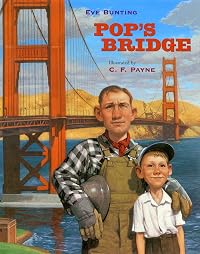
Pop's Bridge
by Eve Bunting
On This Page
Description
Robert and his friend Charlie are proud of their fathers, who are working on the construction of San Francisco's Golden Gate Bridge.Tags
Recommendations
Member Recommendations
Member Reviews
Pop’s Bridge does something that I love to see in a picture book: the main character grows. I feel as though many children believe that their parent is almost a superhero and that no matter what that parent does that they are the most important. This is made even more significant in this book as there is also a racial component to this comparison as Robert believes his welder father must be more important than the immigrant painters. The growth comes as Robert realizes that every person is important, especially in dangerous jobs where lives can be lost at any moment.
I really loved this book because of the way the words and pictures complimented each other. I had read this book last year for a project, and I remembered it very vividly when we were told to select a historical fiction book. One thing I loved about this story was the growth and development of the main character. This story is told from the perspective of a young boy named Robert. Robert's father is helping to build the Golden Gate Bridge. At the beginning of the story, Robert feels that his dad’s job is more important than his friend’s dad’s job because his dad is a sky walker and his friend’s dad is only a painter. By the end of the story, he realizes that they both played a very important part in building the bridge. At the show more beginning of the story he hid the last piece of the Golden Gate Bridge puzzle they were working on. He did this because he wanted his dad to put in the last piece instead of his friend’s dad. By the end of the story, he cuts the piece and half and asks both the fathers to put the last piece in together. I loved seeing the growth and maturity of Robert. The growth of the bridge seemed to symbolize the growth of Robert as well.
I also liked that at the end of the book, the author provided a factual note. This note told actual facts about the bridge’s construction and real life quotes from some of the individuals who were important to the bridge’s construction. This was a nice follow up to a very accurate realistic fiction story. In addition, it allowed the author to incorporate non-fictional information without forcing it into the story.
Lastly, I also liked the physical layout of the illustrations in this book. Most of the pages were set up with text on the left and illustrations on the right. The text was framed with a simple border, while the illustrations on the left side took up the entire page. I liked how large the illustrations were because they matched the immensity of the bridge being built. I also liked that the illustrations showed when the boys were looking through the binoculars. For example, the bags where the bridge breaks and men fall into the bay below, there is blackness around a circle-shaped illustration. This is supposed to show the real picture the boys are looking through the binocular. I think the overall message of this book is no person is more important than another. No matter what job a person has, that job is needed to create something bigger, and without those people that “something bigger” can’t be created. The overall message is to value and appreciate all people and what they do. show less
I also liked that at the end of the book, the author provided a factual note. This note told actual facts about the bridge’s construction and real life quotes from some of the individuals who were important to the bridge’s construction. This was a nice follow up to a very accurate realistic fiction story. In addition, it allowed the author to incorporate non-fictional information without forcing it into the story.
Lastly, I also liked the physical layout of the illustrations in this book. Most of the pages were set up with text on the left and illustrations on the right. The text was framed with a simple border, while the illustrations on the left side took up the entire page. I liked how large the illustrations were because they matched the immensity of the bridge being built. I also liked that the illustrations showed when the boys were looking through the binoculars. For example, the bags where the bridge breaks and men fall into the bay below, there is blackness around a circle-shaped illustration. This is supposed to show the real picture the boys are looking through the binocular. I think the overall message of this book is no person is more important than another. No matter what job a person has, that job is needed to create something bigger, and without those people that “something bigger” can’t be created. The overall message is to value and appreciate all people and what they do. show less
“Pop’s Bridge” is a historical fiction book that follows the construction of the Golden Gate Bridge. It is a thoughtful book that takes the reader into the mind of a child whose father is working on the construction of the bridge. The child feels a certain pride for his father’s part in the bridge with thoughts of “my pop built that bridge” and “no one can be as proud as I am…my dad is a skywalker,” but an accident gives him a new perspective. The art is complements the story nicely without overshadowing the message of understanding.
This book would be a good opening to a visit to San Francisco, and the author’s note at the end provides even more background into the bridge’s construction and its designer.
This book would be a good opening to a visit to San Francisco, and the author’s note at the end provides even more background into the bridge’s construction and its designer.
I enjoyed this book a lot more than I thought I would. The story is told by a young boy named, Robert as he recounts the days of his father, Pop, helping to build the Golden Gate Bridge. Pop was a high-iron man or a ":skywalker" as they were called. From Fort Point, Robert and his friend, Charlie would watch their father's everyday working on the construction of the bridge. Everyone was very excited about this historical event. While putting a puzzle together that depicted an artist's drawing of the not-yet completed bridge, Robert took one of the pieces and hid it in his room from Charlie, so that he could give it to his pop to complete the last piece of the puzzle since he had one of the hardest jobs and Charlie's father was only a show more painter.
However, one day while the boys were watching the construction, a piece of scaffolding fell and killed ten men. This happened right where Charlie's father was working. Luckily, he was not one of the men who fell. After the completion of the bridge in May, 1937, Robert took the last puzzle piece and cut it in half. He gave half to his pop and the other half to Charlie's father and together they completed the puzzle. Robert realized that no job was more important than the other on the bridge and that all of the workers were equally brave.
Although these were fictional characters, I learned through the Author's Note in the back of the book, that the accident did happen and the process and importance of the bridge were factual. I had ever even thought about the construction of the Golden Gate Bridge and to see it through the eyes of the the fictional character, Robert, made me realize what a great marvel of architecture it is and how amazing it must have been to see it come together.
In addition to the story line, I enjoyed the author's voice and imagery to express the thoughts and feelings of the characters throughout the book. For example, "It's like a giant harp," my pop says. "A harp for the angels to play." The author is explaining the architecture of the bridge and the sound the wind makes as it passes though the cables. show less
However, one day while the boys were watching the construction, a piece of scaffolding fell and killed ten men. This happened right where Charlie's father was working. Luckily, he was not one of the men who fell. After the completion of the bridge in May, 1937, Robert took the last puzzle piece and cut it in half. He gave half to his pop and the other half to Charlie's father and together they completed the puzzle. Robert realized that no job was more important than the other on the bridge and that all of the workers were equally brave.
Although these were fictional characters, I learned through the Author's Note in the back of the book, that the accident did happen and the process and importance of the bridge were factual. I had ever even thought about the construction of the Golden Gate Bridge and to see it through the eyes of the the fictional character, Robert, made me realize what a great marvel of architecture it is and how amazing it must have been to see it come together.
In addition to the story line, I enjoyed the author's voice and imagery to express the thoughts and feelings of the characters throughout the book. For example, "It's like a giant harp," my pop says. "A harp for the angels to play." The author is explaining the architecture of the bridge and the sound the wind makes as it passes though the cables. show less
In my opinion, this book was very good, and although it was a realism fictional book, it also gave some real facts about the Golden Gate Bridge. The language in this text was very descriptive and helped you feel like you were there, watching the bridge be built. “He climbs so high that sometimes clouds come down around his shoulders,” this part in the book is talking about his pop on the top of the bridge. I could visualize how high his pop was due to the description the author gave of the clouds. The illustrations are also very powerful and help enhance the story. Near the end of the story, where his pop and Charlie’s dad put the final puzzle piece in together, and say, “team effort”, the illustration shows them doing this show more and really ties the story together and makes you see what a team effort building the bridge was. The message the author was trying to get across was that a lot of things must be a team effort and although the boy felt like it was “pop’s bridge”, so many people contributed to build the bridge. At the end of the story, the boy realized this and was cheerful, knowing that his pop helped build the most beautiful bridge in the world. show less
Eve Bunting’s Pop’s Bridge is an entertaining read that utilizes inner and outer dialogue very effectively. The story follows two young boys that adore their dad and are very interested in his work on constructing the Golden Gate Bridge. After dramatic events and a flush of panic during the fall of the safety net and scaffolding, the sense of love and respect for their family, especially their father, is apparent and a critical component of the story.
The story follows Robert and Charlie as they look on in amazement as their father works his job as a construction worker on the Golden Gate Bridge. The dialogue provides character development that allows the reader to understand the depth of their love and respect from their father. show more The dialogue also shows their excitement when watching or learning about his work, which makes the climax more powerful and suspenseful. The panic in Charlie and Robert’s dialogue as they look for their dad after the scaffolding falls on the bridge underscores the panic as they frantically attempt to find their dad on the bridge as others fall into the water. Without the dialogue, it would be difficult for the reader o see the emotion in Robert, Charlie, and their father, thus creates a disconnect between the level of adoration hey have for their father and the amount that is visible to the reader. show less
The story follows Robert and Charlie as they look on in amazement as their father works his job as a construction worker on the Golden Gate Bridge. The dialogue provides character development that allows the reader to understand the depth of their love and respect from their father. show more The dialogue also shows their excitement when watching or learning about his work, which makes the climax more powerful and suspenseful. The panic in Charlie and Robert’s dialogue as they look for their dad after the scaffolding falls on the bridge underscores the panic as they frantically attempt to find their dad on the bridge as others fall into the water. Without the dialogue, it would be difficult for the reader o see the emotion in Robert, Charlie, and their father, thus creates a disconnect between the level of adoration hey have for their father and the amount that is visible to the reader. show less
I liked this book for three reasons. First, the descriptive language within the book was very powerful. For example, “He climbs so high that sometimes clouds come down around his shoulders,” this sentence in the book is talking about his father who is on the top of the bridge. The descriptive language the author used allows the reader to visualize how high up his father is. Next, the illustrations were colorful, bright, and unique. Each illustration showed the teamwork it took to complete given tasks. Lastly, the character development of each character within the book was realistic. For example, the young boy looks up to his Pop in the story and thinks that his father has the “best” job. Many children often think this, but most show more importantly the author wants young readers to value others. Overall, the main idea of this story is the importance of teamwork. show less
Members
- Recently Added By
Lists

A Child's Book Tour of San Francisco
15 works; 1 member
Author Information

276+ Works 51,893 Members
Eve Bunting was born in 1928 in Maghera, Ireland, as Anne Evelyn Bunting. She graduated from Northern Ireland's Methodist College in Belfast in 1945 and then studied at Belfast's Queen's College. She emigrated with her family in 1958 to California, and became a naturalized citizen in 1969. That same year, she began her writing career, and in 1972, show more her first book, "The Two Giants" was published. In 1976, "One More Flight" won the Golden Kite Medal, and in 1978, "Ghost of Summer" won the Southern California's Council on Literature for Children and Young People's Award for fiction. "Smokey Night" won the American Library Association's Randolph Caldecott Medal in 1995 and "Winter's Coming" was voted one of the 10 Best Books of 1977 by the New York Times. Bunting is involved in many writer's organizations such as P.E.N., The Authors Guild, the California Writer's Guild and the Society of Children's Book Writers. She has published stories in both Cricket, and Jack and Jill Magazines, and has written over 150 books in various genres such as children's books, contemporary, historic and realistic fiction, poetry, nonfiction and humor. (Bowker Author Biography) show less
All Editions
Awards and Honors
Awards
Notable Lists
Common Knowledge
- Canonical DDC/MDS
- 813
Classifications
Statistics
- Members
- 284
- Popularity
- 114,166
- Reviews
- 22
- Rating
- (4.20)
- Languages
- English
- Media
- Paper, Ebook
- ISBNs
- 4
- ASINs
- 3