My father's shop
by Satomi Ichikawa
On This Page
Description
While Mustafa strolls in Morocco's marketplace, a rooster starts to follow him and after he imitates the rooster, the nearby tourists all explain what sounds a rooster makes in their language.Tags
Recommendations


Member Reviews
“My Father’s Shop” tells the story of Mustafa, a young boy, son to a shop owner in Morocco; one day Mustafa finds a rug in the shop and discovers a large hole in the center—his father tells him he can keep the rug since he loves it so much. Mustafa runs through the marketplace with the rug over his head, drawing attention from a rooster and in turn, the tourists in the market. As the rooster and Mustafa run through the streets, Mustafa hears the tourists refer to the rooster in their own respective languages; Mustafa hears Japanese, English, Spanish and more. As he runs back to the shop, the tourists follow, bringing business to his father. The plot is very simple and to the point, however the importance of Mustafa’s cultural show more lesson and exposure to different kinds of people in a make-shift melting pot is very valuable. The book is meant for very early readers, and it is a great introduction to multicultural literature, for its message and the influential illustrations. The illustrations are done in beautiful watercolor and appropriate the mood of the story. The big idea of the story is to promote a curiosity and open mindedness for languages and cultures that differ from your own. show less
A Morrocan boy named Mustafa falls in love with a rug in his father’s shop and gets to keep it because it has a hole. He’s so happy about the rug that he runs through the marketplace with it over his head and a rooster notices him. The rooster crows making the sound "kho kho hou houuu” and the tourists in the market talk about how roosters sound different in their countries. Mustafa goes back to his father’s shop and tells him that he has learned how to speak "rooster” in five languages which brings the tourists to the shop as well.
I really enjoyed this book! It was fun to read and you could relate to the boys excitement over the rug. As an adult who works with children, I can relate to the child telling us he had learned to show more speak rooster! The colors were great too.
1. This book could be used with a lesson on Middle Eastern culture.
2. It could also be used with a lesson on farm animals. show less
I really enjoyed this book! It was fun to read and you could relate to the boys excitement over the rug. As an adult who works with children, I can relate to the child telling us he had learned to show more speak rooster! The colors were great too.
1. This book could be used with a lesson on Middle Eastern culture.
2. It could also be used with a lesson on farm animals. show less
My Father's Shop is a multicultural book in every sense of the word. Although its setting is Morocco, Mustafa interacts with tourists and shoppers from Spain, France, England, and Japan. The book simultaneously points out cultural differences and brings cultures together. Each group of tourists is dressed in the fashion of their country and calls the rooster in their own language; yet all of the rooster calls are similar, and all of the characters delight in Mustafa's garb - a brightly colored carpet over his head with a hole for his eyes.
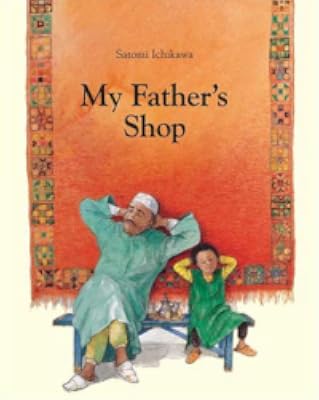
Japanese born Satomi Ichikawa may seem an unlikely author and illustrator for a book about a Moroccan carpet shop, however, she has lived in Paris for over thirty years. Morocco has a strong French show more presence, being once a protectorate of France. I have been fortunate enough to have visited Morocco and shopped in the busy Casbah marketplace. Ichikawa's colorful double spread paintings evoke the essence of the bazaar in their bright colors and details. The abundant, richly colored and patterned carpets are warm, typical and inviting, as is the silver teapot for mint tea, a common offering in shops and restaurants. Only the teeming crowds are missing. The locals are depicted in the varying head coverings, robes, sandals and slippers typical for the hot desert climate.
My Father's Shop has an exotic setting, but it is a story of inclusion and humor. The antics of little boy and a rooster are enough to warm the hearts of people from any country. The liner notes on the artwork are sparse, noting only that Ichikawa never attended art school.
On the 2007 United States Board on Books for Young People (USBBY) Outstanding International Booklist
CONNECTIONS
My Father's Shop makes an excellent introduction to a study of Morocco, and can also serve as a segue to a lesson on map reading or globes - finding the location of Morocco and the home countries of the tourists.
The colorful carpets can serve as an inspiration for an art class, examining the woven rugs of different cultures.
Public librarians might follow a reading of this story with multicultural or multilingual children's music. show less
Japanese born Satomi Ichikawa may seem an unlikely author and illustrator for a book about a Moroccan carpet shop, however, she has lived in Paris for over thirty years. Morocco has a strong French show more presence, being once a protectorate of France. I have been fortunate enough to have visited Morocco and shopped in the busy Casbah marketplace. Ichikawa's colorful double spread paintings evoke the essence of the bazaar in their bright colors and details. The abundant, richly colored and patterned carpets are warm, typical and inviting, as is the silver teapot for mint tea, a common offering in shops and restaurants. Only the teeming crowds are missing. The locals are depicted in the varying head coverings, robes, sandals and slippers typical for the hot desert climate.
My Father's Shop has an exotic setting, but it is a story of inclusion and humor. The antics of little boy and a rooster are enough to warm the hearts of people from any country. The liner notes on the artwork are sparse, noting only that Ichikawa never attended art school.
On the 2007 United States Board on Books for Young People (USBBY) Outstanding International Booklist
CONNECTIONS
My Father's Shop makes an excellent introduction to a study of Morocco, and can also serve as a segue to a lesson on map reading or globes - finding the location of Morocco and the home countries of the tourists.
The colorful carpets can serve as an inspiration for an art class, examining the woven rugs of different cultures.
Public librarians might follow a reading of this story with multicultural or multilingual children's music. show less
This book was very enjoyable to read. The little boy and his father were very well developed and the reader felt connected to both of them. The illustrations used in this book gave the reader insight into the world and environment that the boy was running around. It was very interesting to see the different languages used by the tourists, and having the different languages included in the book was an interesting feature. I think the main idea of this book is the importance of family, and also the importance of helping out family when you get the chance.
In my opinion, this was a great book. This book pushed readers to think about different cultures and languages. For example, it taught how to speak "rooster" in five different languages. Also, the characters are very believable. The main character, Mustafa, is from Moroco and it really depicts on his culture. Lastly, the book was filled with a variety of vibrant colors. This book really introduced diverse cultures and how we can all learn from each other and can come together as one.
The book My Father’s Shop by Satomi Ichikawa is a very interesting multicultural text. The book is about a father and son who work in a carpet shop/ The father tells his son that he needs to learn many different languages so that he is able to greet all of their customers. The son becomes slightly defiant and argues with his dad about having to study. The father then bribes his son by saying that if he learns new words in different languages he could keep the damaged carpet. The son then goes around town in his carpet and soon begins to learn new words.
This book shows that learning can not always be accomplished in the traditional sit down way. Instead, sometimes students need to have a different way of learning. The son was not show more interested in learning languages out of a textbook but was able to quickly pick up different languages when he went out to town. Even though the “words” the boy is learning are just the different sounds roosters make, he is still learning something new. I really enjoyed the way this material was presented. It teaches a lesson but in a fun and entertaining way. The illustrations also add to the story and you can see the different emotions the boy is feeling throughout the story. show less
This book shows that learning can not always be accomplished in the traditional sit down way. Instead, sometimes students need to have a different way of learning. The son was not show more interested in learning languages out of a textbook but was able to quickly pick up different languages when he went out to town. Even though the “words” the boy is learning are just the different sounds roosters make, he is still learning something new. I really enjoyed the way this material was presented. It teaches a lesson but in a fun and entertaining way. The illustrations also add to the story and you can see the different emotions the boy is feeling throughout the story. show less
This book was adorable, my favorite aspects were the illustrations. The author and illustrator, Satomi Ichikawa, did a great job connecting the pictures and words. This book entails an important message about diversity and hard work. I think the story line was great, the idea of a small boy having to learn foreign phrases before receiving a reward (the damaged rug) is such a relatable concept to children and adults.
Members
- Recently Added By
Lists

A Child's Book Tour of North Africa ::: Algeria, Morocco, Sahara
27 works; 3 members

FAB Pilot Books
15 works; 2 members

Favorite Picture and Board Books
480 works; 1 member
Author Information

61+ Works 1,816 Members
Awards and Honors
Common Knowledge
- Canonical title
- My father's shop
- Original title
- Le magasin de mon père
- Original publication date
- 2004
- People/Characters
- Mustafa
- Important places
- Morocco
- First words
- My name is Mustafa.
- Last words
- (Click to show. Warning: May contain spoilers.)I had brought all the tourists to my father's shop!
- Original language
- French
Classifications
Statistics
- Members
- 172
- Popularity
- 190,332
- Reviews
- 13
- Rating
- (4.28)
- Languages
- English, French
- Media
- Paper
- ISBNs
- 5