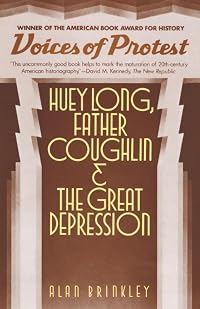
Voices of Protest: Huey Long, Father Coughlin and the Great Depression
by Alan Brinkley
On This Page
Description
The study of two demagogues, whose vast popularity explains much about Depression-era America. This is a book about two remarkable men-Huey P. Long, a first-term United States Senator from the red-clay, piney woods country of northern Louisiana; and Charles E. Coughlin, a Catholic priest from an industrial suburb near Detroit. From modest origins, they rose together in the early years of the Great Depression to become the two most successful leaders of national political dissidence of their era.Tags
Recommendations










Member Reviews
This 25-year old book that recounts the political scene over 85 years ago resonates to our political sensibilities even today. Professor Brinkley analyzes the populist dissident movements of the 1930's led by Huey Long and Father Charles Coughlin. (Although he distinguishes the differences between the populism of the 1890's and Long's and Coughlin's campaigns, the grass-roots populist reactions to the prevailing power institutions of the former time are conceptually akin to what happened in the 1930's and the early 21st century in American politics.)
The onset of the Depression sent shock waves throughout the country's political and social milieu. Long and Coughlin inspired mass protests against the purported causes of economic calamity show more and put forth solutions that they held would right things. Although their depictions of the causes of economic distress and their solutions were different they shared a common belief that the excesses of the capitalist system were, in a sense, the work of corporate and financial "villians". These elite classes created a system that resulted in gross inequities in the distribution of wealth among the people.
Both Long and Coughlin were charismatic figures extraordinarily adept at capturing widespread public support for their ideas. Both men were flamboyant and masterful at shaping public opinion through the use of publicity, especially the new phenomena of radio. Both were considered by their critics to be demagogues whose solutions were deeply flawed and unworkable. Long's approach was to redistribute personal wealth in excess of 1 million dollars to the rest of the nation so as to provide enough for a comfortable living for everyone. Coughlin pushed for reforms of the banking system by re-monetizing silver to back currency and eliminate private banks. While their solutions had a tinge of Socialism, both men were decidedly anti-Communist; indeed, they held that the excesses of capitalism presented the danger of pushing public sentiment toward Communism. Both men had a love-hate relationship with the new Roosevelt administration, trying at first to ingratiate themselves to gain influence over policy and later turning against Roosevelt when their overtures were rebuffed. The nation's political leaders considered Long and Coughlin politically dangerous opponents whose influence over millions of people could sway the outcome of political campaigns. The threat of third-party intervention in congressional and presidential elections was a major concern to the political establishment. This did not materialize because of two factors. While Long and Coughlin were quite able to stimulate episodic public outcry on issues neither had truly effective national political organizations. Long's "Share the Wealth Clubs" and Coughlin's "National Union for Social Justice" affiliates were undisciplined and ineffective as true political parties. Moreover, when, in the 1936 election, their adherents had to choose between Roosevelt and the maverick third-party candidates they stayed loyal to Roosevelt.
Both movements faded quickly after 1936. Huey Long was assassinated in 1935 and without his personal charisma his successors could not sustain his hold on the public. Coughlin was chastened by the overwhelming rejection by the voters of his candidate in 1936 and dropped out of view. He did re-emerge a short time later, but he adopted an anti-Semitic message that brought him to general disrepute.
It is interesting to consider the similarities between the appeal of these two figures and the successes of the Trump phenomena in 2016. There is the attack on the political establishment; in Trump's case against the Republicans, but also generally on the Washington political classes. There is the employment of demagoguery to attack opponents and to put forth simplistic solutions that were claimed to readily fix complex problems. There is the use of new media technology to communicate directly to people without needing to rely on existing institutional channels of communication. Perhaps most significant is the strategy of tapping into the angst of the middle class who have lost, or perceive they are about to lose, the economic and social status they have held. show less
The onset of the Depression sent shock waves throughout the country's political and social milieu. Long and Coughlin inspired mass protests against the purported causes of economic calamity show more and put forth solutions that they held would right things. Although their depictions of the causes of economic distress and their solutions were different they shared a common belief that the excesses of the capitalist system were, in a sense, the work of corporate and financial "villians". These elite classes created a system that resulted in gross inequities in the distribution of wealth among the people.
Both Long and Coughlin were charismatic figures extraordinarily adept at capturing widespread public support for their ideas. Both men were flamboyant and masterful at shaping public opinion through the use of publicity, especially the new phenomena of radio. Both were considered by their critics to be demagogues whose solutions were deeply flawed and unworkable. Long's approach was to redistribute personal wealth in excess of 1 million dollars to the rest of the nation so as to provide enough for a comfortable living for everyone. Coughlin pushed for reforms of the banking system by re-monetizing silver to back currency and eliminate private banks. While their solutions had a tinge of Socialism, both men were decidedly anti-Communist; indeed, they held that the excesses of capitalism presented the danger of pushing public sentiment toward Communism. Both men had a love-hate relationship with the new Roosevelt administration, trying at first to ingratiate themselves to gain influence over policy and later turning against Roosevelt when their overtures were rebuffed. The nation's political leaders considered Long and Coughlin politically dangerous opponents whose influence over millions of people could sway the outcome of political campaigns. The threat of third-party intervention in congressional and presidential elections was a major concern to the political establishment. This did not materialize because of two factors. While Long and Coughlin were quite able to stimulate episodic public outcry on issues neither had truly effective national political organizations. Long's "Share the Wealth Clubs" and Coughlin's "National Union for Social Justice" affiliates were undisciplined and ineffective as true political parties. Moreover, when, in the 1936 election, their adherents had to choose between Roosevelt and the maverick third-party candidates they stayed loyal to Roosevelt.
Both movements faded quickly after 1936. Huey Long was assassinated in 1935 and without his personal charisma his successors could not sustain his hold on the public. Coughlin was chastened by the overwhelming rejection by the voters of his candidate in 1936 and dropped out of view. He did re-emerge a short time later, but he adopted an anti-Semitic message that brought him to general disrepute.
It is interesting to consider the similarities between the appeal of these two figures and the successes of the Trump phenomena in 2016. There is the attack on the political establishment; in Trump's case against the Republicans, but also generally on the Washington political classes. There is the employment of demagoguery to attack opponents and to put forth simplistic solutions that were claimed to readily fix complex problems. There is the use of new media technology to communicate directly to people without needing to rely on existing institutional channels of communication. Perhaps most significant is the strategy of tapping into the angst of the middle class who have lost, or perceive they are about to lose, the economic and social status they have held. show less
I didn't read this exhaustively - I was more interested in Huey Long than Father Coughlin (who was a more bitter, anti-semitic figure, and flirted with fascism in a way that Long did not). I think I understand better now the nature of US dissent - that it is conservative, not radical, and that it tends to focus on the 'little man' - decentralisation and independence, not bigger government. This is something hard to comprehend for those with more immediate experience of radical European history. I am not sure I entirely buy the notion that centralisation of industrial capitalism just 'happens' historically without agency, and it is futile to resist it. But I may well be proved wrong.
an impressive piece of history...: I marvel at the depth and range written in Voices of Protest: Huey Long, Father Coughlin, and the Great Depression by Alan Brinkley. Without very much firsthand information from Huey Long and Charles Coughlin, Alan Brinkley was able to portray the lives of these two unlikely figureheads of the Great Depression. From their small town beginnings to their national prominence to their movement's downfalls, Huey Long's and Father Coughlin's stories are on display for the history buff or even the average reader.
The first three chapters are devoted to the rise of Huey Long. Starting in Louisiana, he gets his first opportunity to shine in the public limelight as a railroad comissioner. His grass roots show more campaigning and fight for the lower classes changed the landscape of Louisiana politics from a state voting along religious lines to one voting along economic lines. As governor and a senator of Louisiana, Huey Long continuously fought for the redistribution of wealth and the rights of the local institutions. Rising to national prominence after his campaigning for Hattie Caraway who was the first woman to be elected to a full term in the Senate, Long used his newfound popularity to influence American politics during the Great Depression like no other except for one (Coughlin of course). From his influence on the Presidential Election of 1932 to his Share Our Wealth Plan, Voices of Protest contains all of the information one would want to know about Huey Long's rise and sudden fall after he was assassinated.
After Alan Brinkley discusses Huey Long's rise, he delves into the rise of Father Charles Coughlin. Surrounded by Catholicism from a very young age, Charles Coughlin was destined to become a priest. After getting through seminary, he finally received a new parish in Royal Oaks, a suburb of Detroit. Coughlin was always thought of as a great orator, but even that wasn't enough to pay for the increasing debt incurred by the new parrish. To make money for the church, Coughlin went to the local radio station to use his special talents as an orator. His radio sermons were soon heard across the nation. His influence with the radio was tremendous, causing him to begin a series of politically based chats (starting with his dislike of communism) that would throw him into the political arena as a man of influencial capabilities. Coughlin's tumultuous relationship with Franklin Roosevelt and his National Union for Social Justice are a couple more of the many topics discussed in this section of Vioces of Protest.
Alan Brinkley then moves on to discuss the similarities of Huey Long's and Charles Coughlin's movements, along with their relation to other movements (Socialist, Progressive, Communist) of the time and the political forces that they each, in their own right, become. Alan Brinkley also touches on each of their efforts towards organization in their respective parties and discusses in depth the followers of each's movements, including some alliances that were created solely for Long's and Coughlin's advancement politically or for others advancement. Finally, Alan Brinkley brings Huey Long's and Charles Coughlin's stories to an end with their eventual downfall and also elucidates on the aftermath of those downfalls.
There are two main quotes I would like to share here that I enjoyed as I read Voices of Protest. The first is on page 216 when Alan Brinkley discusses the uneasy alliances, and it is as follows: "Were these many protest movements to unite into a single force, they might be capable of toppling the entire structure of traditional party politics." The second is on page 243 when Brinkley discusses the downfalls of Long and Coughlin, and it is as follows: "Far more troubling for the crusades Long and Coughlin were preparing was a single, debilitating weakness: inability to wean their followers from Franklin Roosevelt." Both of these quotes represent hom much political power Long and Coughlin could have had and how much political power Franklin Roosevelt actually had. It is impressive to think about and enjoyable to read about, so I would highly recommend this book to anyone and everyone. Everyone enjoy!
show less
The first three chapters are devoted to the rise of Huey Long. Starting in Louisiana, he gets his first opportunity to shine in the public limelight as a railroad comissioner. His grass roots show more campaigning and fight for the lower classes changed the landscape of Louisiana politics from a state voting along religious lines to one voting along economic lines. As governor and a senator of Louisiana, Huey Long continuously fought for the redistribution of wealth and the rights of the local institutions. Rising to national prominence after his campaigning for Hattie Caraway who was the first woman to be elected to a full term in the Senate, Long used his newfound popularity to influence American politics during the Great Depression like no other except for one (Coughlin of course). From his influence on the Presidential Election of 1932 to his Share Our Wealth Plan, Voices of Protest contains all of the information one would want to know about Huey Long's rise and sudden fall after he was assassinated.
After Alan Brinkley discusses Huey Long's rise, he delves into the rise of Father Charles Coughlin. Surrounded by Catholicism from a very young age, Charles Coughlin was destined to become a priest. After getting through seminary, he finally received a new parish in Royal Oaks, a suburb of Detroit. Coughlin was always thought of as a great orator, but even that wasn't enough to pay for the increasing debt incurred by the new parrish. To make money for the church, Coughlin went to the local radio station to use his special talents as an orator. His radio sermons were soon heard across the nation. His influence with the radio was tremendous, causing him to begin a series of politically based chats (starting with his dislike of communism) that would throw him into the political arena as a man of influencial capabilities. Coughlin's tumultuous relationship with Franklin Roosevelt and his National Union for Social Justice are a couple more of the many topics discussed in this section of Vioces of Protest.
Alan Brinkley then moves on to discuss the similarities of Huey Long's and Charles Coughlin's movements, along with their relation to other movements (Socialist, Progressive, Communist) of the time and the political forces that they each, in their own right, become. Alan Brinkley also touches on each of their efforts towards organization in their respective parties and discusses in depth the followers of each's movements, including some alliances that were created solely for Long's and Coughlin's advancement politically or for others advancement. Finally, Alan Brinkley brings Huey Long's and Charles Coughlin's stories to an end with their eventual downfall and also elucidates on the aftermath of those downfalls.
There are two main quotes I would like to share here that I enjoyed as I read Voices of Protest. The first is on page 216 when Alan Brinkley discusses the uneasy alliances, and it is as follows: "Were these many protest movements to unite into a single force, they might be capable of toppling the entire structure of traditional party politics." The second is on page 243 when Brinkley discusses the downfalls of Long and Coughlin, and it is as follows: "Far more troubling for the crusades Long and Coughlin were preparing was a single, debilitating weakness: inability to wean their followers from Franklin Roosevelt." Both of these quotes represent hom much political power Long and Coughlin could have had and how much political power Franklin Roosevelt actually had. It is impressive to think about and enjoyable to read about, so I would highly recommend this book to anyone and everyone. Everyone enjoy!
show less
Very helpful in understanding the state of political thought prevalent in the 1920's and 1930's. The divisions are not unlike those of today. These were people mastering the newest technology of the time, radio and its promise.
2732 Voices of Protest: Huey Long, Father Coughlin and the Great Depression, by Alan Brinkley (read 16 Apr 1995) (National Book Award history prize in 1983) This is a carefully researched 1982 book. It is not unfair to Father Coughlin, but shows he was not a very logical man. He was born in Hamilton, Ontario, on 25 Oct 1891. In 1926 he was assigned to Royal Oak, Mich. and there was no church there then. He began giving sermons on the radio and then got into political broadcasts. I can barely remember hearing the talks on the radio. He did not give too many after 1936. He only got anti-Semitic in 1938. He retired at age 72 and died at 88. The book also tells of Huey Long. This is a thoughtful and most worthwhile book.
Ratings
Members
- Recently Added By
Lists

r/AskHistorians' Recommended Books
1,068 works; 18 members

Works Cited in The History of White People by Nell Irvin Painter
321 works; 2 members
Author Information

37+ Works 3,045 Members
Alan Brinkley was born in 1949. He earned his Ph.D. at Harvard University and taught at MIT and Harvard as well as City University of New York and Princeton University before joining the Columbia faculty in 1991. He is the Allan Nevins Professor of History at Columbia University, where he was also Provost from 2003 - 2009. He is a historian of the show more New Deal. A prolific essayist, Brinkley writes regularly in magazines such as The New York Review of Books, the New York Times Book Review, Newsweek and The New Republic and is an advocate for progressive issues. Brinkley has won a John Simon Guggenheim Foundation Fellowship, the National Book Award for History, and numerous other prizes and fellowships, and was elected a member of the American Academy of Arts and Sciences. He also serves as a board member or trustee of several academic and policy research institutions and chairs the board of The Century Foundation. His works include Liberalism and Its Discontents, Franklin Delano Roosevelt, and The Publisher: Henry Luce and His American Century. (Bowker Author Biography) show less
Awards and Honors
Awards
Common Knowledge
- Canonical title
- Voices of Protest: Huey Long, Father Coughlin and the Great Depression
- Alternate titles
- Voices of Protest: Huey Long, Father Coughlin & the Great Depression
- Original publication date
- 1982-04-12
- People/Characters
- Huey Long; Charles Coughlin (Charles Edward Coughlin, priest)
- Important places
- Louisiana, USA
- Important events
- Great Depression
- Dedication
- To Anita Gordon
- First words
- This is a book about two remarkable men -- Huey P. Long, a first-term United States Senator from the red-clay, piney-woods country of northern Louisiana; and Charles E. Coughlin, a Catholic priest from an industrial suburb ne... (show all)ar Detroit. [Preface]
The sixth winter of the Great Depression was much like those that had preceded it and those that would follow. [Prologue]
Early in Huey Long's adult life, before he had become a political figure of any significance, well before he had accumulated the remarkable power that would make him a national phenomenon and that would ultimately destroy him... (show all), he sent a letter to the editor of the New Orleans Item. [Chapter 1] - Last words
- (Click to show. Warning: May contain spoilers.)But the careers of Huey Long and Father Coughlin suggested, if nothing else, that the long struggle against the new economic order had already entered its twilight.
(Click to show. Warning: May contain spoilers.)There he lived quietly until his death in 1979, saying mass each morning in a private chapel, observing the world he had tried to shape, and spending idle moments, perhaps, remembering better days. [Epilogue] - Blurbers
- Woodward, C. Vann; O'Connell, Shaun; Kennedy, David M.
- Original language
- English
- Canonical DDC/MDS
- 973.916
- Canonical LCC
- E806
Classifications
- Genres
- History, Nonfiction, General Nonfiction, Politics and Government, Biography & Memoir
- DDC/MDS
- 973.916 — History & geography History of North America United States 1901- World Wars and Depression Era (1901-1953) Herbert Hoover (1929-1933) Great Depression, Wall Street Crash of 1929,
- LCC
- E806 — History of the United States United States Twentieth century Franklin Delano Roosevelt's administrations,
- BISAC
Statistics
- Members
- 385
- Popularity
- 81,591
- Reviews
- 6
- Rating
- (3.70)
- Languages
- English
- Media
- Paper, Ebook
- ISBNs
- 3
- ASINs
- 2