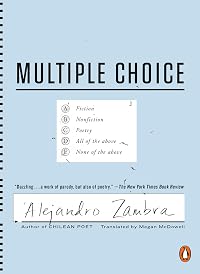
Multiple Choice
by Alejandro Zambra
On This Page
Description
"NAMED ONE OF THE BEST BOOKS OF THE SUMMER BY THE WALL STREET JOURNAL, ELLE, THE HUFFINGTON POST AND PUREWOW "Latin America's new literary star." --The New Yorker "Brilliant. Like a literary exercise for the mind, but strangely fun to decode."--Elle "The most talked-about writer to come out of Chile since Bolaño," (The New York Times Book Review), Alejandro Zambra is celebrated around the world for his strikingly original, slyly funny, daringly unconventional fiction. Now, at the height show more of his powers, Zambra returns with his most audaciously brilliant book yet. Written in the form of a standardized test, Multiple Choice invites the reader to respond to virtuoso language exercises and short narrative passages through multiple-choice questions that are thought-provoking, usually unanswerable, and often absurd. It offers a new kind of reading experience, one in which the reader participates directly in the creation of meaning, and the nature of storytelling itself is called into question. At once funny, poignant, and political, Multiple Choice is about love and family, authoritarianism and its legacies, and the conviction that, rather than learning to think for ourselves, we are trained to obey and repeat. Serious in its literary ambition and playful in its execution, it confirms Alejandro Zambra as one of the most important writers working in any language"-- show lessTags
Recommendations

Member Reviews
In Multiple Choice, Chilean novelist Alejandro Zambra has used one the more clever framing devices I can recall seeing: the book is structured in the format of the standardized entrance exam that high school students used to take when applying to universities in Chile. So, the story the author tells is packaged in a series of 90 multiple choice questions involving the usual familiar tasks employed on those exams, such as word elimination, sentence completion, or reading comprehension. The subject matter conveyed in these questions covers a broad range of topics, from silly and humorous word play to more serious reflections on past relationships, the challenges of raising children, and coming of age in the country during the Pinochet show more regime.
As inventive as I found this structure to be, however, reading this book was at least a little frustrating. In fact, I ultimately had a problem thinking of this as being a fully formed novel, or even a work of fiction that rises to the level of cohesive story-telling. Besides being barely 100 pages long, the format of the book actually got in the way at times and created a very fragmented reading experience. It was not until the three long passages comprising the final “Reading Comprehension” section that the reader feels the full impact of Zambra’s talent for writing affecting prose. Still, Multiple Choice was fresh, original, and quite imaginative. For those reasons alone, it is well worth the brief effort it will take to enjoy it. show less
As inventive as I found this structure to be, however, reading this book was at least a little frustrating. In fact, I ultimately had a problem thinking of this as being a fully formed novel, or even a work of fiction that rises to the level of cohesive story-telling. Besides being barely 100 pages long, the format of the book actually got in the way at times and created a very fragmented reading experience. It was not until the three long passages comprising the final “Reading Comprehension” section that the reader feels the full impact of Zambra’s talent for writing affecting prose. Still, Multiple Choice was fresh, original, and quite imaginative. For those reasons alone, it is well worth the brief effort it will take to enjoy it. show less
What Happens When Constrained Writing Doesn't Follow Its Constraints?
Constrained writing, including Oulipo, depends in part on its constraints, or at least it advertises itself as depending on them. In the clearest cases, the constraint is simple and known to the reader, as in the Oulipean lipogram. In other instances, the constraints are multiple or private, and they lead the reader to puzzle over the text, deducing its departures from some normative path.
Since so much experimental writing is constrained in some way, it's interesting to ask what happens when the writing fails to follow its own rules. Alejandro Zambra's "Multiple Choice" is a good example. In a note at the end of the novel, Zambra says he modeled it on the Chilean show more Academic Verbal Aptitude Test for 1993, which was clearly modeled on North American scholastic aptitude tests from the 1950s onward. In translation, the book presents itself as a reasonable facsimile of the SAT I took years ago.
The novel starts with a half-title page:
"I. Excluded Term
In exercises 1 through 24, mark the answer that corresponds to the word whose meaning has no relation to either the heading or the other words listed."
The next page begins:
"1. MULTIPLE
A) manifold
B) numerous
C) untold
D) five
E) two"
Except for the playful similarity of D) and E), this question is fairly standard. I began, for fun, with a pencil, marking my text as I went. (The final page of the novel is the answer sheet, with the open circles meant to be filled in with those soft pencils they used to distribute.)
The first sign that there won't always be right answers is on p. 5:
"8. BEAR
A) endure
B) tolerate
C) abide
D) panda
E) kangaroo"
This is, I thought, too obvious a marker that the novel won't be answerable, because it plays too simple-mindedly on the two meanings of "bear." On the next page there is this:
"10. COPY
A) cut
B) paste
C) cut
D) paste
E) undo"
This has a correct answer, by the test's logic, but the first four choices make it obvious that something else is at stake. Since this is a novel, I concluder Zambra wants readers to assume that he is introducing a metanarrative here: the narrator's voice will appear in this novel in the form of playful interventions within the aptitude test form itself. This strategy develops for several pages.
But soon another kind of question appears:
"16. PROTECT
A) care for
B) cover for
C) dote on
D) watch over
E) book after."
Again there is a correct answer (B), but it points in a different direction: it feels like "Multiple Choice" is going to have a plot, and it's going to turn on betrayal, care, or fidelity.
Let me call the first kind of metanarrative question, the one in question #10, "Playing with texts" (PWT). This second sort of question could be called "Playing with plots" (PWP). A third sort of question seems to speak for the narrator's mood:
"21. SPARE
A) time
B) room
C) change
D) tire
E) life."
Let me call this one "Playing with existentialism" (PWE). There are questions of this sort throughout, which use surprise choices to convey a sense of existential randomness or general blackness. Part one of the book's five parts ends with several more PWP questions, in which loyalty and fidelity are again at stake.
A reader can use these three kinds of questions to go most of the way through the book. Here is one more example, from Part two, where you're supposed to pick the best order of the sentences:
"27. A CHILD
1. You dream that you lose a child.
2. You wake up.
3. You cry.
4. You lose a child.
5. You cry.
A) 1-2-4-3-5
B) 1-2-3-5-4
C) 2-3-4-5-1
D) 3-4-5-1-2
E) 4-5-3-1-2"
There is no reason to work at this one as a test-taker has to, because it is an example of PWP and PWE. Once questions like this begin to appear, readers like me who were trying to see how far they'd get pretending they were students may put their pencils down. Questions like these are signs to the reader that they don't need to think like students. But what, exactly, does the achievement-test form contribute once a reader stops searching for optimal answers?
The book's title suggests that readers should think of life's multiple choices, but only a small percentage of the questions in the book actually lead to branching narratives. Perhaps, then, it matters that the novel is a test, because several stories in the book -- the stories get longer as the book goes on -- have to do with cheating. But I think cheating is only a convenient theme, not the book's central concern, which is more like regret and reconciliation. What, then, is contributed by questions that do not ask to be read as questions? Let me call questions like the one I just quoted "No reason to play" (NRP). They become the predominant sort of question, and it reaches the point where the final ten or twenty questions in the book are just pastiches of actual achievement test sorts of questions, and add very little to what is already apparent in the texts themselves.
In short -- and I am abbreviating an entire book full of my notes -- PWT becomes PWE and PWP as readers begin to care more about nascent plots and narrator's concerns than with the test, and finally the test form itself becomes a superficial style, because there's No reason to play, NRP. About halfway through, I noticed that it seemed Zambra was dividing his time between thinking up entertaining new forms of questions and answers (PWT) and hinting at the narrator's life. The two purposes divided: the constrained writing began to be a constraint, or at least an irrelevance, to the author's interest in constructing stories about his narrator's life. The jokes got more obvious, there were more uninteresting choices, and even some false notes (as when the "fucking voice faker" suddenly appears, p. 52).
The novel doesn't fail because it fails to follow its constraints. (It does follow them, all the way to the last page.) It fails because the narrator, and by implication the author, becomes interested in things that do not require the constraints. And as I watch the implied author's attention divide in that way, between the increasingly superficial game of the test and the increasingly compelling stories of the narrator's failures, I find myself losing interest in the book, because the glue between those is what makes constrained writing work -- at least in this case. show less
Constrained writing, including Oulipo, depends in part on its constraints, or at least it advertises itself as depending on them. In the clearest cases, the constraint is simple and known to the reader, as in the Oulipean lipogram. In other instances, the constraints are multiple or private, and they lead the reader to puzzle over the text, deducing its departures from some normative path.
Since so much experimental writing is constrained in some way, it's interesting to ask what happens when the writing fails to follow its own rules. Alejandro Zambra's "Multiple Choice" is a good example. In a note at the end of the novel, Zambra says he modeled it on the Chilean show more Academic Verbal Aptitude Test for 1993, which was clearly modeled on North American scholastic aptitude tests from the 1950s onward. In translation, the book presents itself as a reasonable facsimile of the SAT I took years ago.
The novel starts with a half-title page:
"I. Excluded Term
In exercises 1 through 24, mark the answer that corresponds to the word whose meaning has no relation to either the heading or the other words listed."
The next page begins:
"1. MULTIPLE
A) manifold
B) numerous
C) untold
D) five
E) two"
Except for the playful similarity of D) and E), this question is fairly standard. I began, for fun, with a pencil, marking my text as I went. (The final page of the novel is the answer sheet, with the open circles meant to be filled in with those soft pencils they used to distribute.)
The first sign that there won't always be right answers is on p. 5:
"8. BEAR
A) endure
B) tolerate
C) abide
D) panda
E) kangaroo"
This is, I thought, too obvious a marker that the novel won't be answerable, because it plays too simple-mindedly on the two meanings of "bear." On the next page there is this:
"10. COPY
A) cut
B) paste
C) cut
D) paste
E) undo"
This has a correct answer, by the test's logic, but the first four choices make it obvious that something else is at stake. Since this is a novel, I concluder Zambra wants readers to assume that he is introducing a metanarrative here: the narrator's voice will appear in this novel in the form of playful interventions within the aptitude test form itself. This strategy develops for several pages.
But soon another kind of question appears:
"16. PROTECT
A) care for
B) cover for
C) dote on
D) watch over
E) book after."
Again there is a correct answer (B), but it points in a different direction: it feels like "Multiple Choice" is going to have a plot, and it's going to turn on betrayal, care, or fidelity.
Let me call the first kind of metanarrative question, the one in question #10, "Playing with texts" (PWT). This second sort of question could be called "Playing with plots" (PWP). A third sort of question seems to speak for the narrator's mood:
"21. SPARE
A) time
B) room
C) change
D) tire
E) life."
Let me call this one "Playing with existentialism" (PWE). There are questions of this sort throughout, which use surprise choices to convey a sense of existential randomness or general blackness. Part one of the book's five parts ends with several more PWP questions, in which loyalty and fidelity are again at stake.
A reader can use these three kinds of questions to go most of the way through the book. Here is one more example, from Part two, where you're supposed to pick the best order of the sentences:
"27. A CHILD
1. You dream that you lose a child.
2. You wake up.
3. You cry.
4. You lose a child.
5. You cry.
A) 1-2-4-3-5
B) 1-2-3-5-4
C) 2-3-4-5-1
D) 3-4-5-1-2
E) 4-5-3-1-2"
There is no reason to work at this one as a test-taker has to, because it is an example of PWP and PWE. Once questions like this begin to appear, readers like me who were trying to see how far they'd get pretending they were students may put their pencils down. Questions like these are signs to the reader that they don't need to think like students. But what, exactly, does the achievement-test form contribute once a reader stops searching for optimal answers?
The book's title suggests that readers should think of life's multiple choices, but only a small percentage of the questions in the book actually lead to branching narratives. Perhaps, then, it matters that the novel is a test, because several stories in the book -- the stories get longer as the book goes on -- have to do with cheating. But I think cheating is only a convenient theme, not the book's central concern, which is more like regret and reconciliation. What, then, is contributed by questions that do not ask to be read as questions? Let me call questions like the one I just quoted "No reason to play" (NRP). They become the predominant sort of question, and it reaches the point where the final ten or twenty questions in the book are just pastiches of actual achievement test sorts of questions, and add very little to what is already apparent in the texts themselves.
In short -- and I am abbreviating an entire book full of my notes -- PWT becomes PWE and PWP as readers begin to care more about nascent plots and narrator's concerns than with the test, and finally the test form itself becomes a superficial style, because there's No reason to play, NRP. About halfway through, I noticed that it seemed Zambra was dividing his time between thinking up entertaining new forms of questions and answers (PWT) and hinting at the narrator's life. The two purposes divided: the constrained writing began to be a constraint, or at least an irrelevance, to the author's interest in constructing stories about his narrator's life. The jokes got more obvious, there were more uninteresting choices, and even some false notes (as when the "fucking voice faker" suddenly appears, p. 52).
The novel doesn't fail because it fails to follow its constraints. (It does follow them, all the way to the last page.) It fails because the narrator, and by implication the author, becomes interested in things that do not require the constraints. And as I watch the implied author's attention divide in that way, between the increasingly superficial game of the test and the increasingly compelling stories of the narrator's failures, I find myself losing interest in the book, because the glue between those is what makes constrained writing work -- at least in this case. show less
Entirely unique. The reader gets to participate in the creation of meaning, free to decide between any of several narratives presented in clean, sly, cutting language, even in translation. Absolutely delightful. If you need structure, resolution, or hand-holding, though, this may present a challenge.
Multiple Choice, Alejandro Zambra
This is a funny book. It is not like anything else you have ever read. The books is short and the pages are filled with questions, some inane, some inspirational, some insightful, some downright ridiculous and laughable, but hidden within the questions is an investigation of human nature, politics, marriage and divorce, love and hate, loyalty and infidelity, morality and immorality, the happenstance and the extraordinarily well planned, the everyday occurrences and the exceptional moments of life. The thing that all of the questions and sections in this test example seemed to have in common, was an overlay of humorous hypocrisy.
It is a presentation of the mundane and the extraordinary, the absurd and show more the rational all within the 100+ pages of this book. If nothing else, at times this book will make you chuckle, smile, and shake your head in bewilderment. Then, it will make you think about the messages Zambra so artfully intimates, subtly and overtly, as he expresses ideas from the political to the spiritual, from the moral to the amoral, from the ridiculous to the sublime. It won’t take long to read, but it will be what can only be described as a delightful experience. Although you may not realize it, as you read, what you think is a very lighthearted gallivant through every day events will instead, in the end, provide you with a very profound message about life. This author says so much with so few words!
FYI: If I was a student, and if this was my entrance exam, I probably would not have gotten my degree. This spoof on the Exam, for students in Chile, points out the failures of these tests to adequately judge performance and qualifications. Often test questions can be confusing, may have double meanings, and some might even seem to require extra sensory perception!
***This is a review of an Advanced Uncorrected Proof. show less
This is a funny book. It is not like anything else you have ever read. The books is short and the pages are filled with questions, some inane, some inspirational, some insightful, some downright ridiculous and laughable, but hidden within the questions is an investigation of human nature, politics, marriage and divorce, love and hate, loyalty and infidelity, morality and immorality, the happenstance and the extraordinarily well planned, the everyday occurrences and the exceptional moments of life. The thing that all of the questions and sections in this test example seemed to have in common, was an overlay of humorous hypocrisy.
It is a presentation of the mundane and the extraordinary, the absurd and show more the rational all within the 100+ pages of this book. If nothing else, at times this book will make you chuckle, smile, and shake your head in bewilderment. Then, it will make you think about the messages Zambra so artfully intimates, subtly and overtly, as he expresses ideas from the political to the spiritual, from the moral to the amoral, from the ridiculous to the sublime. It won’t take long to read, but it will be what can only be described as a delightful experience. Although you may not realize it, as you read, what you think is a very lighthearted gallivant through every day events will instead, in the end, provide you with a very profound message about life. This author says so much with so few words!
FYI: If I was a student, and if this was my entrance exam, I probably would not have gotten my degree. This spoof on the Exam, for students in Chile, points out the failures of these tests to adequately judge performance and qualifications. Often test questions can be confusing, may have double meanings, and some might even seem to require extra sensory perception!
***This is a review of an Advanced Uncorrected Proof. show less
Multiple Choice is a novel in the form of a multiple choice test. Initially, I wondered how Zambra would use the format to tell story, and worried it might be gimmicky. In another author's hands, it would be. Zambra manages to communicate great depth of feeling in spite of, and because of, such a limiting format. It's not a book for less adventurous readers, but if you appreciate literature in a unique style, check this one out.
Ohmygosh, this. This this this. I wanted to cry. I wanted to laugh. I want to find the Spanish edition and puzzle my way through it (in both senses.) I am by no means finished with this. I want to go through sections every year and reflect on how life changes.
Surprising little crafty book. It follows the model of the exam chileans need to pass to enter university. Using questions and their proposed alternative answers, it triggers provoking thoughts and play with outcomes with very little words and great effect.
One of those unique books that plays with form to give a new meaning. Glad to have it in paper.
One of those unique books that plays with form to give a new meaning. Glad to have it in paper.
Members
- Recently Added By
Lists

Books Read in 2017
4,249 works; 130 members

Gimmicks
56 works; 12 members
Author Information

18+ Works 2,844 Members
Some Editions
Awards and Honors
Awards
Distinctions
Notable Lists
Common Knowledge
- Original publication date
- 2016
- First words
- In exercises 1 through 24, mark the answer that corresponds to the word whose meaning has no relation either to the heading or the other words listed.
- Quotations
- Another thing, while I have the chance, about dogs and cats: parents want their children to be dogs, but children are always cats. Parents want to domesticate their children, but children are like cats: you can't domesticate ... (show all)them. (p. 100)
- Last words
- (Click to show. Warning: May contain spoilers.)I would give my father a parrot, but first I would teach it to say: fucking asshole, fucking asshole, fucking asshole.
Classifications
- Genres
- Fiction and Literature, General Fiction
- DDC/MDS
- 863.7 — Literature & rhetoric Spanish Literature Spanish fiction 21st Century
- LCC
- PQ8098.36 .A43 .F3313 — Language and Literature French, Italian, Spanish and Portuguese literatures Spanish literature Provincial, local, colonial, etc. Spanish America
- BISAC
Statistics
- Members
- 476
- Popularity
- 64,023
- Reviews
- 25
- Rating
- (3.88)
- Languages
- 8 — Dutch, English, German, Greek, Italian, Portuguese, Spanish, Turkish
- Media
- Paper, Ebook
- ISBNs
- 20
- ASINs
- 4