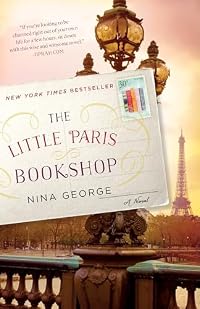
The Little Paris Bookshop
by Nina George
On This Page
Description
“There are books that are suitable for a million people, others for only a hundred. There are even remedies—I mean books—that were written for one person only…A book is both medic and medicine at once. It makes a diagnosis as well as offering therapy. Putting the right novels to the appropriate ailments: that’s how I sell books.”Monsieur Perdu calls himself a literary apothecary. From his floating bookstore in a barge on the Seine, he prescribes novels for the hardships of show more life. Using his intuitive feel for the exact book a reader needs, Perdu mends broken hearts and souls. The only person he can't seem to heal through literature is himself; he's still haunted by heartbreak after his great love disappeared. She left him with only a letter, which he has never opened.
After Perdu is finally tempted to read the letter, he hauls anchor and departs on a mission to the south of France, hoping to make peace with his loss and discover the end of the story. Joined by a bestselling but blocked author and a lovelorn Italian chef, Perdu travels along the country’s rivers, dispensing his wisdom and his books, showing that the literary world can take the human soul on a journey to heal itself.
Internationally bestselling and filled with warmth and adventure, The Little Paris Bookshop is a love letter to books, meant for anyone who believes in the power of stories to shape people's lives.
Includes a PDF of Recipes and Jean Perdu’s Emergency Literary Pharmacy.
. show less
Tags
Recommendations


Member Reviews
Oh my, what an incredible book. It is a roller coaster of emotion, from smiles, giggles and laughs all the way through to crying your eyes out and feeling heartbroken. Although i'm sure there are people who can read this book and never feel a thing, which is entirely possible if you refuse to surrender yourself to the story and characters, but then what's the point in reading a book if not to surrender to it completely?
Characters... There isn't one awful character, everyone in this book is nice, or funny in some way, even the grumpy lock keepers and their moustachioed wives with dogs that wee on Max's hands bring a smile or giggle to you. And that's what makes this book so hard to take in places, you can fall in love with show more the characters and feel for them so completely. Other books have those nasty characters, the evil ones to balance the good, and that holds you in balance and never lets you fly off into the good characters so much, this book doesn't hold you back from that.
Places... Nina is a genius when it comes to putting you into a place, a room, even a simple field. The way she describes tastes, textures, sounds, sights, smells, makes it all feel like a dream you are in. She never overdoes it, and always when the story needs it.
Emotions... You feel them along with the characters as you are taken into their lives. So many haven't loved for 21 years (or there abouts). 21 seems like the magic number in this book. You have to go 21 years without love to be a main character in this book. But none of it ever seems unreal, just a coincidence. This book is about losing, about finding, about tragedy, about love, about dying, about living, its got the most wonderful high moments and most heartbreaking lows.
Story... The best bit. And that's the bit where i will use the last book i read to draw a few comparisons.
This was my second reading of this book, having last read it just over 2 years ago before i started writing reviews.
One thing i remember when reading it last time was that it reminded me of 'Heart of Darkness' and so the plan was to wait a couple of years and then come back to it having read 'Heart of Darkness' immediately before and then write a review of both books and see if there were any similarities.
These two books are so similar, yet so very different. The template is definitely there, that of the river boat voyage, the bizarre encounters along the way and the deeply emotional journey of our boat captains. We begin one sitting on the Thames in London while the other begins sitting on the Seine in Paris. A description of companions ensues before we are taken on our voyages. And there's where they differ.
In HoD we are on a voyage up river into the centre of the land, into the darkness and ignorance of man's soul and what he's truly capable of at his worse. While in TLPB we are on a voyage down river to the sea, into the light and opening up of a man's soul from 21 years of darkness and ignorance, and we're shown what people are truly capable of at their best.
Whereas in HoD we have Kurtz and his fiance, in TLPB we have Luc and Manan's diary.
In HoD the final conversation with Kurtz is replaced with the final entry in Manan's diary, while Luc replaces the crazy Russian.
The bizarre encounters along the banks are quite awful episodes in HoD as they expose Marlow to ever more wrong, and dim the light ever further, while in TLPB the bizarre encounters along the banks expose Jean to ever more right, and turn on the light ever brighter.
And instead of pilgrims on the boat they are replaced with a runaway writer, a cook, and another writer who has been waiting for the love of her life to turn up; while the cannibals are replaced with 2 cats.
And no, i have no idea if Nina has even read 'Heart of Darkness', maybe she has, maybe she hasn't. And even if she has, was that any influence on 'The Little Paris Bookshop'? I could write and ask, but i simply love the not knowing because it really doesn't matter. What mattered was that the first time i read TLPB i could barely remember reading HoD, it had been decades, and both were read while under the influence of alcohol, numbed, but this time i decided to read them one immediately after the other and i have been sober for 22 months. This time i wasn't numbed by alcohol and really felt both books, i really felt that i read them both, and i really felt that they complemented each other in so many ways.
To be taken right into the depth's of Charles Marlow's darkness in HoD and be left hanging there at the end only to go immediately to the depths of Jean Perdu's darkness in Paris and be then taken back into the light was quite the literary journey, and definitely one i would very much recommend for anyone looking for a true roller-coaster experience.
But however, and whatever, you want to read, just make sure 'The Little Paris Bookshop' is on your 'To Read' pile, everyone should read this book.
I have also read 'The Little Breton Bistro' but wasn't writing reviews at that time either. But i assure you, it's also a wonderful book. And Nina's latest book, 'The Book of Dreams' is now out, which i'll most certainly get around to as soon as i've re-read 'The Little Breton Bistro'. show less
Characters... There isn't one awful character, everyone in this book is nice, or funny in some way, even the grumpy lock keepers and their moustachioed wives with dogs that wee on Max's hands bring a smile or giggle to you. And that's what makes this book so hard to take in places, you can fall in love with show more the characters and feel for them so completely. Other books have those nasty characters, the evil ones to balance the good, and that holds you in balance and never lets you fly off into the good characters so much, this book doesn't hold you back from that.
Places... Nina is a genius when it comes to putting you into a place, a room, even a simple field. The way she describes tastes, textures, sounds, sights, smells, makes it all feel like a dream you are in. She never overdoes it, and always when the story needs it.
Emotions... You feel them along with the characters as you are taken into their lives. So many haven't loved for 21 years (or there abouts). 21 seems like the magic number in this book. You have to go 21 years without love to be a main character in this book. But none of it ever seems unreal, just a coincidence. This book is about losing, about finding, about tragedy, about love, about dying, about living, its got the most wonderful high moments and most heartbreaking lows.
Story... The best bit. And that's the bit where i will use the last book i read to draw a few comparisons.
This was my second reading of this book, having last read it just over 2 years ago before i started writing reviews.
One thing i remember when reading it last time was that it reminded me of 'Heart of Darkness' and so the plan was to wait a couple of years and then come back to it having read 'Heart of Darkness' immediately before and then write a review of both books and see if there were any similarities.
These two books are so similar, yet so very different. The template is definitely there, that of the river boat voyage, the bizarre encounters along the way and the deeply emotional journey of our boat captains. We begin one sitting on the Thames in London while the other begins sitting on the Seine in Paris. A description of companions ensues before we are taken on our voyages. And there's where they differ.
In HoD we are on a voyage up river into the centre of the land, into the darkness and ignorance of man's soul and what he's truly capable of at his worse. While in TLPB we are on a voyage down river to the sea, into the light and opening up of a man's soul from 21 years of darkness and ignorance, and we're shown what people are truly capable of at their best.
Whereas in HoD we have Kurtz and his fiance, in TLPB we have Luc and Manan's diary.
In HoD the final conversation with Kurtz is replaced with the final entry in Manan's diary, while Luc replaces the crazy Russian.
The bizarre encounters along the banks are quite awful episodes in HoD as they expose Marlow to ever more wrong, and dim the light ever further, while in TLPB the bizarre encounters along the banks expose Jean to ever more right, and turn on the light ever brighter.
And instead of pilgrims on the boat they are replaced with a runaway writer, a cook, and another writer who has been waiting for the love of her life to turn up; while the cannibals are replaced with 2 cats.
And no, i have no idea if Nina has even read 'Heart of Darkness', maybe she has, maybe she hasn't. And even if she has, was that any influence on 'The Little Paris Bookshop'? I could write and ask, but i simply love the not knowing because it really doesn't matter. What mattered was that the first time i read TLPB i could barely remember reading HoD, it had been decades, and both were read while under the influence of alcohol, numbed, but this time i decided to read them one immediately after the other and i have been sober for 22 months. This time i wasn't numbed by alcohol and really felt both books, i really felt that i read them both, and i really felt that they complemented each other in so many ways.
To be taken right into the depth's of Charles Marlow's darkness in HoD and be left hanging there at the end only to go immediately to the depths of Jean Perdu's darkness in Paris and be then taken back into the light was quite the literary journey, and definitely one i would very much recommend for anyone looking for a true roller-coaster experience.
But however, and whatever, you want to read, just make sure 'The Little Paris Bookshop' is on your 'To Read' pile, everyone should read this book.
I have also read 'The Little Breton Bistro' but wasn't writing reviews at that time either. But i assure you, it's also a wonderful book. And Nina's latest book, 'The Book of Dreams' is now out, which i'll most certainly get around to as soon as i've re-read 'The Little Breton Bistro'. show less
Every once in a while the description of a novel is perfect! "...The Little Paris Bookshop is a love letter to books, meant for anyone who believes in the power of stories to shape people's lives."
I have been a reader since I was a little child. My first memories of reading are of my Mother reading a different story to me every night from "365 Bedtime Stories" by Nan Gilbert (pseudonym). I still have this dearly loved book. My Mother and my Father were readers. Especially as an only child, books have been my constant companion. Books have taught and mentored me, inspired me, entertained me, comforted me, allowed me to travel to locations where I might never have the opportunity to visit or live in person, broadened my views and show more opinions, increased my vocabulary, and soothed my soul with a sense of peace and tranquility.
For all of those reasons, this novel enveloped me between the book covers in a wonderful story of Monsieur Perdu and his bookstore, a floating barge on the Seine or a literary apothecary. But Monsieur Perdu needs something that he has been able to offer to others but has not been able to find himself. After 20 years, he begins on an odyssey of his own to heal his heart.
Although I sometimes feel the emotions of a novel intensely, I rarely am actually brought to tears. As I finished reading the novel I realized tears had fallen down my face. There was a death in my family that occurred a long time ago and particularly as the beginning of August comes, sometimes I am taken back to the joyous memories of yesterday but sometimes I am deeply saddened for all that has been experienced without this loved one. When I was reading this novel, I felt as though Monsieur Perdu was saying things that I have felt so deeply over the years and never once voiced aloud. Sometimes there are no words for one's grief. Sometimes you read a novel and discover that there is someone that can describe what you have felt and it comforts you as nothing else could. show less
I have been a reader since I was a little child. My first memories of reading are of my Mother reading a different story to me every night from "365 Bedtime Stories" by Nan Gilbert (pseudonym). I still have this dearly loved book. My Mother and my Father were readers. Especially as an only child, books have been my constant companion. Books have taught and mentored me, inspired me, entertained me, comforted me, allowed me to travel to locations where I might never have the opportunity to visit or live in person, broadened my views and show more opinions, increased my vocabulary, and soothed my soul with a sense of peace and tranquility.
For all of those reasons, this novel enveloped me between the book covers in a wonderful story of Monsieur Perdu and his bookstore, a floating barge on the Seine or a literary apothecary. But Monsieur Perdu needs something that he has been able to offer to others but has not been able to find himself. After 20 years, he begins on an odyssey of his own to heal his heart.
Although I sometimes feel the emotions of a novel intensely, I rarely am actually brought to tears. As I finished reading the novel I realized tears had fallen down my face. There was a death in my family that occurred a long time ago and particularly as the beginning of August comes, sometimes I am taken back to the joyous memories of yesterday but sometimes I am deeply saddened for all that has been experienced without this loved one. When I was reading this novel, I felt as though Monsieur Perdu was saying things that I have felt so deeply over the years and never once voiced aloud. Sometimes there are no words for one's grief. Sometimes you read a novel and discover that there is someone that can describe what you have felt and it comforts you as nothing else could. show less
I only decided to borrow this book on a whim because of the setting suggested by the title, and I am very glad that I didn't pay for the privilege. What a load of sentimental, pretentious drivel. The best way to describe the 'plot', such as it isn't, is to imagine hundreds of those little motivational books, full of trite advice on life and love, all mashed together into one novel-length edition. 'Jean Perdu', who owns the only decent idea in the story - a floating bookshop, originally moored on the Seine, where he dispenses books tailored to meet his customers' emotional needs - is 'lost' (see what she did there) and looking for a new love, to help him get over the old one. The old one, Manon, was one of those nauseating fictional show more women who captivate men with their passion for - well - sex, basically, but who walked out of his life twenty years ago and promptly died. Jean meets up with a young author and an old friend, and they float down to the south of France, where Jean plans to lay the ghost of Manon to rest. And that's it. Even with the REALLY BIG PRINT and spaces between chapters, the whole thing still took far too long to read. If I owned a book barge, I would throw this novel overboard. show less
In a bit of a strange twist, I didn't want to like this book. Despite the critical acclaim (and the shining endorsement by Oprah, herself), my twee-meter does have a failsafe built right in, and I was half-heartedly concerned that it was going to be all fluff and little substance. Yet I persisted in purchasing it anyway and gave it my divided attention through a relatively slow start. Quickly getting used to the languid pace, I dumped my preconceived notions in the Seine and went along for the ride – and in the end, I was glad to have done it.
Nina George presents an earnest, charming peek at French existentialism through German eyes in an utterly European context. In short, to this American The Little Paris Bookshop feels like an show more anthemic meeting of The Adventures of Tom Sawyer and Cannery Row as witnessed by Frances Mayes – but this is simply not how most Americans live, and the voice is distinctly Continental. There are many quirks, foibles, and suspensions-of-disbelief – small things – to enjoy throughout the journey, but the big (perhaps biggest) human themes are blended together in order to create a touchingly relevant tableau of love, loss, ennui, joy, and friendship.
These things aren't for everyone, but virtually everyone will confront them during a given lifetime. Some, of course, are "luckier" than others and everyone has a different threshold of comfort with the traumas of existing. We can't escape these themes in real life, so I found the book valuable and rather surprisingly hopeful, given the many long-suffering characters within and the grief-stricken storyline that tracks right up until the last page. Yet George respectfully whispers a (very Teutonic) message on the undulating fields of lavender and battering scirocco that feature as formidable characters in their own right: being alive hurts, but every heart-flutter and paper-cut is sweet and eminently worth the cost.
This might not be what you're looking for in The Little Paris Bookshop (which I feel is a poor title for the English edition; compare to the German Das Lavendelzimmer), but it could be said that we often learn the most poignant lessons when we're faced the other way. Death is inevitable, but the memory of life is interminable. Scars and ghosts bind us to pain and hollow out our capacity to live and love. Friendship often lies in the most neglected places. And perhaps most important, at least for me: while in the very center of despair, the depth of the human heart always hopes, and in that there is great truth and great beauty. show less
Nina George presents an earnest, charming peek at French existentialism through German eyes in an utterly European context. In short, to this American The Little Paris Bookshop feels like an show more anthemic meeting of The Adventures of Tom Sawyer and Cannery Row as witnessed by Frances Mayes – but this is simply not how most Americans live, and the voice is distinctly Continental. There are many quirks, foibles, and suspensions-of-disbelief – small things – to enjoy throughout the journey, but the big (perhaps biggest) human themes are blended together in order to create a touchingly relevant tableau of love, loss, ennui, joy, and friendship.
These things aren't for everyone, but virtually everyone will confront them during a given lifetime. Some, of course, are "luckier" than others and everyone has a different threshold of comfort with the traumas of existing. We can't escape these themes in real life, so I found the book valuable and rather surprisingly hopeful, given the many long-suffering characters within and the grief-stricken storyline that tracks right up until the last page. Yet George respectfully whispers a (very Teutonic) message on the undulating fields of lavender and battering scirocco that feature as formidable characters in their own right: being alive hurts, but every heart-flutter and paper-cut is sweet and eminently worth the cost.
This might not be what you're looking for in The Little Paris Bookshop (which I feel is a poor title for the English edition; compare to the German Das Lavendelzimmer), but it could be said that we often learn the most poignant lessons when we're faced the other way. Death is inevitable, but the memory of life is interminable. Scars and ghosts bind us to pain and hollow out our capacity to live and love. Friendship often lies in the most neglected places. And perhaps most important, at least for me: while in the very center of despair, the depth of the human heart always hopes, and in that there is great truth and great beauty. show less
This book was exactly what I needed to read when I read it. I thought it would be a cute, rather trite book from the title and description -- a fun read but not much weight. But I was totally wrong. I ended up reading it in two big chunks of time, because I needed to be able to sit down and savor the words and story, not read it in quick snatches. The author has a way of describing intense emotions and healing -- as well as the joys and power of books and reading -- in beautiful ways that just really clicked with me. I'm so surprised that there hasn't been more popularity for this book, and that so many reviewers disliked it! For me, the book was deeply affecting and expressive in so many unexpected and cathartic ways.
"Reading--an endless journey; a long, indeed never-ending journey that made one more temperate as well as more loving and kind. Max had set out on that journey. With each book he would absorb more of the world, things and people."
I almost didn't finish this book because of the attitude towards adultery. I'm glad I persevered because it is an otherwise excellent tale about the role of good literature in our lives as well as the stages of grief.
I almost didn't finish this book because of the attitude towards adultery. I'm glad I persevered because it is an otherwise excellent tale about the role of good literature in our lives as well as the stages of grief.
What an absolutely wonderful story! This book is one of the best I have read in a long time. The story makes you feel so deeply for the main character and the supporting characters. Your heart aches and swells for Perdu, the owner of what he calls his literary apothecary, a boat bookshop in Paris. He chooses books for his customers based on what they need in their lives. He lives in an apartment bustling with so many different personalities and yet he is alone. The story delves into why he is alone and what happens when he decides he no longer wants to be alone. I loved the relationships formed by the main character, Perdu, the young writer, Max, the lovable Italian rouge, Cuneo, and the heartbroken Catherine. The memory of love lost show more ... the chance at love found ... the desire to move on in life ... this book has it all and I found myself laughing out loud and crying at times. It was a book that took me longer than most to read because I purposely slowed down since I didn't feel ready to part with the characters. I will definitely return to this book again. It seems a balm to the soul. show less
Members
- Recently Added By
Lists

novels in or about bookshops (or libraries)
59 works; 21 members

Top Five Books of 2020
982 works; 348 members

Books Read in 2017
4,249 works; 130 members

Books Read in 2015
3,299 works; 129 members

Carole's List
445 works; 13 members

Western & Northern Europe
60 works; 1 member
International Dublin Literary Award Longlist 2017
147 works; 3 members

Books Read in 2020
4,379 works; 124 members

Dublin Literary Award Longlist 2017
147 works; 2 members

Book Club Suggestions for 2020
27 works; 2 members

Books Read in 2018
4,360 works; 110 members

Paris, City of Lights
103 works; 17 members

Novels Set in Stores
14 works; 2 members

DNF List
1 work; 1 member
Author Information

26+ Works 6,116 Members
Nina George was born on August 30, 1973 in Bielefeld Germany. Shs is a German writer, best known as the author of The Little Paris Bookshop. She has published 26 books (novels, mysteries and non-fiction) as well as over hundred short stories and more than 600 columns. George has worked as a cop reporter, columnist and managing editor for a wide show more range of publications, including Hamburger Abendblatt, Die Welt, Der Hamburger, as well as TV Movie and Federwelt. In 2012 and 2013 she won the DeLiA and the Glauser-Prize. In 2014, she delivered the keynote address in Berlin at the German Writer¿s Conference to 140 attending writers. She made the New York Tmes Best Seller List in 2015 with her title The Little Paris Bookshop. (Bowker Author Biography) show less
Some Editions
Awards and Honors
Awards
Distinctions
Series
Belongs to Publisher Series
Knaur Taschenbuch (50977)
Common Knowledge
- Canonical title
- The Little Paris Bookshop
- Original title
- Das Lavendelzimmer; Das Bücherschiff des Monsieur Perdu
- Original publication date
- 2013
- People/Characters
- Jean Albert Victor Perdu; Maximilian "Max" Jordan; Manon Morello Basset; Catherine Le P.; Luc Basset; Salvatore Cuneo (show all 8); Samantha "Samy" Le Trequesser; Victoria Basset
- Important places
- Paris, France; Provence, France; 27 Rue Montagnard; Sanary-sur-Mer, Provence-Alpes-Côte d'Azur, France; Bonnieux, Provence-Alpes-Côte d'Azur, France
- Dedication
- I dedicate this novel to my father,
JOACHIM ALBERT GEORGE,
known as Broad Jo.
March 20, 1938 (Sawade/Eichwaldau)—
April 4, 2011 (Hamelin)
Papa,
you were the only person who read everything... (show all) I ever
wrote from the moment I learned to write. I will miss
you at all times. I see you in every ray of evening
light and in every wave of every sea.
You left in mid sentence.
Nina George,
January 2013
Dedicated to the departed.
. . . . . . . . . . . . . . . . . . . . . . . . . . . .
And to those who go on loving them. - First words*
- Wie konnte es nur passieren, dass ich mich dazu überreden liess?
- Quotations
- Memories are like wolves. You can't lock them away and hope they leave you alone.
"What is wrong with old? Age isn't a disease. We all grow old, even books. But are you, is anyone, worth less, or less important, because they've been around for longer?"
"Books keep stupidity at bay. And vain hopes. And vain men. They undress you with love, strength and knowledge. It's love from within. Make your choice: book or …"
You only really get to know your husband when he walks out on you.
"As long as she doesn't turn out too smart for men."
"For the stupid ones, she will, Madame. But who wants them anyway? A stupid man is every woman's downfall."
"Books are more than doctors, of course. Some novels are loving, lifelong companions; some give you a clip around the ear; others are friends who wrap you in warm towels when you've got those autumn blues. And some . . . well... (show all), some are pink candy floss that tingles in your brain for three seconds and leaves a blissful void. Like a short, torrid love affair."
And that's why it hurts so much. When women stop loving, men fall into a void of their own making.
"We cannot decide to love. We cannot compel anyone to love us. There's no secret recipe, only love itself. And we are at its mercy—there's nothing we can do."
Small love. Big love. Wasn't it terrible that love came in several sizes?
"Some words can cut you," mumbled Cuneo, "like razor blades in your ear and on your tongue."
Nobody would ever wise up if they hadn't at some stage been young and stupid.
Habit is a vain and treacherous goddess. She lets nothing disrupt her rule. She smothers one desire after another: the desire to travel, the desire for a better job or a new love. She stops us from living as we would like, be... (show all)cause habit prevents us from asking ourselves whether we continue to enjoy doing what we do.
"We all live in wishableness," she said. "Each in a different kind."
"Do you know that there's a halfway world between each ending and each new beginning? It's called the hurting time...Some thresholds are too wide to be taken in one stride."
It takes only one word to hurt a woman, a matter of seconds, one stupid, impatient blow of the crop. But winning back her trust takes years. And sometimes there isn't the time. - Last words
- (Click to show. Warning: May contain spoilers.)Only when the colors had paled and the world had turned to shadow did Perdu drain his glass of Manon to the last drop.
(Click to show. Warning: May contain spoilers.)Epilogue
(Also known as living.) - Blurbers
- Pekkanen, Sarah; Morgenpost, Hamburger; Magazine, Tina; Lovett, Charlie
- Original language
- German
- Canonical DDC/MDS
- 833.92
*Some information comes from Common Knowledge in other languages. Click "Edit" for more information.
Classifications
Statistics
- Members
- 4,494
- Popularity
- 3,261
- Reviews
- 221
- Rating
- (3.47)
- Languages
- 16 — Danish, Dutch, English, Finnish, French, German, Greek, Hungarian, Italian, Korean, Polish, Portuguese, Russian, Spanish, Swedish, Vietnamese
- Media
- Paper, Audiobook, Ebook
- ISBNs
- 67
- UPCs
- 1
- ASINs
- 13