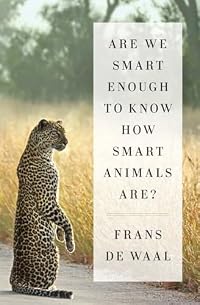
Are We Smart Enough to Know How Smart Animals Are?
by Frans de Waal
On This Page
Description
From world-renowned biologist and primatologist Frans de Waal comes this groundbreaking work on animal intelligence destined to become a classic.What separates your mind from an animal's? Maybe you think it's your ability to design tools, your sense of self, or your grasp of past and future--all traits that have helped us define ourselves as the planet's preeminent species. But in recent decades, these claims have been eroded--or even disproved outright--by a revolution in the study of show more animal cognition.Take the way octopuses use coconut shells as tools; elephants that classify humans by age, gender, and language; or Ayumu, the young male chimpanzee at Kyoto University whose flash memory puts that of humans to shame. Based on research involving crows, dolphins, parrots, sheep, wasps, bats, whales, and of course chimpanzees and bonobos, Frans de Waal explores both the scope and the depth of animal intelligence. He offers a firsthand account of how science has stood traditional behaviorism on its head by revealing how smart animals really are--and how we've underestimated their abilities for too long.People often assume a cognitive ladder, from lower to higher forms, with our own intelligence at the top. But what if it is more like a bush, with cognition taking different, often incomparable, forms? Would you presume yourself dumber than a squirrel because you're less adept at recalling the locations of hundreds of buried acorns? Or would you judge your perception of your surroundings as more sophisticated than that of a echolocating bat?De Waal reviews the rise and fall of the mechanistic view of animals and opens our minds to the idea that animal minds are far more intricate and complex than we have assumed. De Waal's landmark work will convince you to rethink everything you thought you knew about animal--and human--intelligence. show lessTags
Recommendations










Member Recommendations
Member Reviews
De Waal deconstructs every myth that humans have invented about how intelligence sets humans apart from animals. From tool use to language to anticipating the future, there is no metric that humans can devise (and they do keep changing the bar as often as possible) that can prove that human intelligence is greater, in any way, than that of all other animals.
I really enjoyed the first part of the book, which talks about the oldest history of cognitive science, both of humans and of animals, and the very weird things that humans used to think about animals. (It’s so odd to me that anyone who has ever interacted with a pet could think that animals can’t have personalities). Once you get further into the book, it feels reactionary. When show more the proponents of “humans are definitively more intelligent” move the bar, de Waal proves them wrong, and they just move the bar again. It’s a losing battle. I’d much rather the book talked about cool types of intelligence that animals have, especially those that humans DON’T have. Overall it was a very enjoyable book. I listened to part of it as an audiobook narrated by Sean Runnette, which was very good. I would warn, however, that although there is a leopard on the cover of most editions, there is no discussion of leopards in the book and in fact most of it is about chimpanzees (if I had known this I would not have scheduled my book club to read it right after the Goodall book.) show less
I really enjoyed the first part of the book, which talks about the oldest history of cognitive science, both of humans and of animals, and the very weird things that humans used to think about animals. (It’s so odd to me that anyone who has ever interacted with a pet could think that animals can’t have personalities). Once you get further into the book, it feels reactionary. When show more the proponents of “humans are definitively more intelligent” move the bar, de Waal proves them wrong, and they just move the bar again. It’s a losing battle. I’d much rather the book talked about cool types of intelligence that animals have, especially those that humans DON’T have. Overall it was a very enjoyable book. I listened to part of it as an audiobook narrated by Sean Runnette, which was very good. I would warn, however, that although there is a leopard on the cover of most editions, there is no discussion of leopards in the book and in fact most of it is about chimpanzees (if I had known this I would not have scheduled my book club to read it right after the Goodall book.) show less
Relative to other such non-fiction books regarding the natural world that I've read, this to me is a four star read.
As an over the hill naturalist student I still try to keep up with natural sciences research papers and books, and having read some of the author's previous books I was curious to read this one. To my perspective, in this book Frans De Waal presents a well-balanced, informative, lay-level description of the state of his science (Primatology and Ethology), his thinking, and a bit of history that has led to the current state of understanding. All this in the vein of:
"What we observe is not nature in itself, but nature exposed to our method of questioning."—Werner Heisenberg (1958)
There are some repeated mentions, albeit show more out of necessity in being applicable to or contrasting with differing contexts. In other words, rather than superfluous bits I see such as a scientific mind trying hard to convey understanding of complex subject matter. He can also be a little cutting at times, for the most part appropriately so from my perspective:
"What a bizarre animal we are that the only question we can ask in relation to our place in nature is 'Mirror, mirror on the wall, who is the smartest of them all?'”
If anything captures the gist of this book it is:
"That all mammalian brains operate in essentially the same way has also been found in other domains. Behind these similarities is a much deeper message, of course. Instead of treating mental processes as a black box, as Skinner and his followers had done, we are now prying open the box to reveal a wealth of neural homologies. These show a shared evolutionary background to mental processes and offer a powerful argument against human-animal dualism.
. . .
"We are moving ever closer to Darwin’s continuity stance, according to which the human-animal difference is one of degree, not kind."
Think of the Clark's nutcracker (Nucifraga columbiana) which squirrels away more than twenty thousand pine nuts, in hundreds of different locations over many square miles, and in the winter manages to recover most of them. Cognition, in good part, is relative to survival in any evolved life form, and in turn if a species becomes weedy can lead to excesses that prompt demise in Nature's balancing act.
This month I came across a research paper which further reinforces Frans De Waal's thinking.
Titled MRI scans of the brains of 130 mammals, including humans, indicate equal connectivity, it can be seen at https://www.sciencedaily.com/releases/2020/07/200720112216.htm
This book can also be enlightening if the reader looks at it from another angle. That is, thinking about the evolutionary aspect of human proclivities. Most striking might be chimpanzee politics, which Frans De Waal mentions in this book and wrote an earlier (1982) book on. Chimpanzees are of course one of our close cousins, a sister taxon to the human lineage. Such can be enlightening in understanding our societal and governing issues.
"The greatest of human discoveries in the future will be the discovery of human intimacy with all other modes of being that live with us on this planet." ~ Thomas Berry
"A human being is part of a whole, called by us the Universe, a part limited in time and space. He experiences himself, his thoughts and feelings, as something separated from the rest - a kind of optical delusion of his consciousness. This delusion is a kind of prison for us, restricting us to our personal desires and ...to affection for a few persons nearest us. Our task must be to free ourselves from this prison by widening our circles of compassion to embrace all living creatures and the whole of nature in its beauty." - Albert Einstein show less
As an over the hill naturalist student I still try to keep up with natural sciences research papers and books, and having read some of the author's previous books I was curious to read this one. To my perspective, in this book Frans De Waal presents a well-balanced, informative, lay-level description of the state of his science (Primatology and Ethology), his thinking, and a bit of history that has led to the current state of understanding. All this in the vein of:
"What we observe is not nature in itself, but nature exposed to our method of questioning."—Werner Heisenberg (1958)
There are some repeated mentions, albeit show more out of necessity in being applicable to or contrasting with differing contexts. In other words, rather than superfluous bits I see such as a scientific mind trying hard to convey understanding of complex subject matter. He can also be a little cutting at times, for the most part appropriately so from my perspective:
"What a bizarre animal we are that the only question we can ask in relation to our place in nature is 'Mirror, mirror on the wall, who is the smartest of them all?'”
If anything captures the gist of this book it is:
"That all mammalian brains operate in essentially the same way has also been found in other domains. Behind these similarities is a much deeper message, of course. Instead of treating mental processes as a black box, as Skinner and his followers had done, we are now prying open the box to reveal a wealth of neural homologies. These show a shared evolutionary background to mental processes and offer a powerful argument against human-animal dualism.
. . .
"We are moving ever closer to Darwin’s continuity stance, according to which the human-animal difference is one of degree, not kind."
Think of the Clark's nutcracker (Nucifraga columbiana) which squirrels away more than twenty thousand pine nuts, in hundreds of different locations over many square miles, and in the winter manages to recover most of them. Cognition, in good part, is relative to survival in any evolved life form, and in turn if a species becomes weedy can lead to excesses that prompt demise in Nature's balancing act.
This month I came across a research paper which further reinforces Frans De Waal's thinking.
Titled MRI scans of the brains of 130 mammals, including humans, indicate equal connectivity, it can be seen at https://www.sciencedaily.com/releases/2020/07/200720112216.htm
This book can also be enlightening if the reader looks at it from another angle. That is, thinking about the evolutionary aspect of human proclivities. Most striking might be chimpanzee politics, which Frans De Waal mentions in this book and wrote an earlier (1982) book on. Chimpanzees are of course one of our close cousins, a sister taxon to the human lineage. Such can be enlightening in understanding our societal and governing issues.
"The greatest of human discoveries in the future will be the discovery of human intimacy with all other modes of being that live with us on this planet." ~ Thomas Berry
"A human being is part of a whole, called by us the Universe, a part limited in time and space. He experiences himself, his thoughts and feelings, as something separated from the rest - a kind of optical delusion of his consciousness. This delusion is a kind of prison for us, restricting us to our personal desires and ...to affection for a few persons nearest us. Our task must be to free ourselves from this prison by widening our circles of compassion to embrace all living creatures and the whole of nature in its beauty." - Albert Einstein show less
Frans de Waal wants to change our understanding of our place in the world of living things. The tradition, and the bias supporting it, is that human beings are uniquely intelligent, enabling unique abilities to plan, coordinate, and adapt our behavior, our physical environment, and our social organizations. De Waal supports a “continuity” theory, stressing commonalities between human and animal cognitive capabilities. This is the latest in a series of books to that purpose.
De Waal cites convincing instances of intelligent behavior across a pretty wide variety of species — apes, monkeys, dogs, aquatic mammals, octopuses, elephants, crows and other corvids, even insects. Not all exhibit all kinds of cognition, but planning, tool show more use, tool fashioning, social structuring and maintenance, and more show up in degrees across so many species that it’s hard to come away thinking that the difference between human intelligence and that of other animals is sharp at all. And there are certainly cognitive tasks on which animals outperform humans.
One especially interesting experiment that de Waal cites involves a memory task (recalling a flashed sequence of numbers) that seems designed for human intelligence. But chimpanzees not only do better than humans, they continue to do better even when human subjects are given an unfair training advantage.
But the point isn’t what species is smarter than what other species. This is a core point in the book — intelligence, or cognition, is not one thing. Intelligence is diverse— the intelligent planning a chimpanzee displays in carrying tools to situations of anticipated usefulness, the intelligence of a female chimpanzee in diagnosing and suppressing conflicts within a chimp group, the collection and transportation of coconut shells by octopuses to use as hiding places, the use of a mirror by an elephant to examine parts of its body it can’t otherwise see, . . . Even within a single category like tool use, cognitive behavior takes different forms — the ability to recognize a useful tool in or out of the context of its use, the ability to modify a tool given the resources at hand, and on and on.
Instead of a scale of intelligence with species placed upon it, de Waal urges us to think in terms of a bush — with branches sprouting in all different directions, diversity and variety rather than more and less or higher and lower.
One key to knowing intelligence, or cognition, when we see it, according to de Waal, is that intelligence is ecologically bound. As he says, animals are as smart as they need to be. Each has developed the capacities it needs to meet the challenges of its ecological niche. If you are going to apply tests to determine whether or not an animal can behave intelligently, you need to construct the test to accord with the relevant ecological context. If you don’t you’ll get a false negative.
For example, De Waal cites an experiment to determine whether different species are able to use an available tool to bring a treat (a banana) within reach. The animal is placed behind bars, with the banana just out of reach. A stick lies nearby, and the task is to recognize that it can be used to pull the banana closer. Chimps pass the test easily. Gibbons, close relatives to chimps, do not. Why? Gibbons are almost exclusively arboreal, while chimps spend time both in trees and on the ground. Picking objects up off the ground is not something natural to gibbons (and their hands aren’t well suited to it). But when the experiment is reconstructed, using a suspended string as the potential tool, the gibbon readily passes the test. A stick on the ground is not a potential tool, but a suspended string is. It’s not a matter of being smart or not, it’s a matter of what elicits intelligence, given the species’ adaptation to the challenges of its environmental niche.
One response to the instances of apparently intelligent behavior that de Waal and others cite is that, yes, various species perform well at these tasks and even exhibit complex behaviors of these sorts in the wild, but they do it differently than we do it. They don’t consciously think through problems and come up with solutions. Their behavior is mechanical or instinctive, perhaps genetically programmed, whereas only ours is truly intelligent.
That argument is available to opponents of animal intelligence. De Waal’s response to it is a kind of extended Occam’s Razor — similar behavior indicates that similar processes and mechanisms are at work to produce it. If the chimpanzee, or other species, does what, for us, would involve thinking through a problem and devising a solution, then that’s likely what the chimp is doing, too.
Like Occam’s Razor, such a principle is not foolproof. De Waal cites an example himself. Paperwasps, like humans and other primates, are very good at facial recognition — they can readily distinguish one individual of their species from another. But the neurological structures of primates and wasps are sufficiently different that the similar behavior looks to be a matter of “convergent evolution” rather than shared evolutionary path.
In other instances, though, the neuroscience seems to support De Waal’s principle. Areas of the brains of monkeys and humans, for example, seem similarly activated in situations involving facial recognition and other task types.
De Waal’s big message should not get lost in the details. The details do seem to support his general claim that there is more continuity than discontinuity between human cognition and animal cognition. The degree of abstraction and flexibility in human intelligence may make us think we have something that animals have none of, but we didn’t get it in a bolt of evolutionary lightning. And when we realize that “we are not alone” as an intelligent species, we may find ourselves, as we have grudgingly done ever since Darwin’s time, changing both our regard for ourselves and our regard for other species. show less
De Waal cites convincing instances of intelligent behavior across a pretty wide variety of species — apes, monkeys, dogs, aquatic mammals, octopuses, elephants, crows and other corvids, even insects. Not all exhibit all kinds of cognition, but planning, tool show more use, tool fashioning, social structuring and maintenance, and more show up in degrees across so many species that it’s hard to come away thinking that the difference between human intelligence and that of other animals is sharp at all. And there are certainly cognitive tasks on which animals outperform humans.
One especially interesting experiment that de Waal cites involves a memory task (recalling a flashed sequence of numbers) that seems designed for human intelligence. But chimpanzees not only do better than humans, they continue to do better even when human subjects are given an unfair training advantage.
But the point isn’t what species is smarter than what other species. This is a core point in the book — intelligence, or cognition, is not one thing. Intelligence is diverse— the intelligent planning a chimpanzee displays in carrying tools to situations of anticipated usefulness, the intelligence of a female chimpanzee in diagnosing and suppressing conflicts within a chimp group, the collection and transportation of coconut shells by octopuses to use as hiding places, the use of a mirror by an elephant to examine parts of its body it can’t otherwise see, . . . Even within a single category like tool use, cognitive behavior takes different forms — the ability to recognize a useful tool in or out of the context of its use, the ability to modify a tool given the resources at hand, and on and on.
Instead of a scale of intelligence with species placed upon it, de Waal urges us to think in terms of a bush — with branches sprouting in all different directions, diversity and variety rather than more and less or higher and lower.
One key to knowing intelligence, or cognition, when we see it, according to de Waal, is that intelligence is ecologically bound. As he says, animals are as smart as they need to be. Each has developed the capacities it needs to meet the challenges of its ecological niche. If you are going to apply tests to determine whether or not an animal can behave intelligently, you need to construct the test to accord with the relevant ecological context. If you don’t you’ll get a false negative.
For example, De Waal cites an experiment to determine whether different species are able to use an available tool to bring a treat (a banana) within reach. The animal is placed behind bars, with the banana just out of reach. A stick lies nearby, and the task is to recognize that it can be used to pull the banana closer. Chimps pass the test easily. Gibbons, close relatives to chimps, do not. Why? Gibbons are almost exclusively arboreal, while chimps spend time both in trees and on the ground. Picking objects up off the ground is not something natural to gibbons (and their hands aren’t well suited to it). But when the experiment is reconstructed, using a suspended string as the potential tool, the gibbon readily passes the test. A stick on the ground is not a potential tool, but a suspended string is. It’s not a matter of being smart or not, it’s a matter of what elicits intelligence, given the species’ adaptation to the challenges of its environmental niche.
One response to the instances of apparently intelligent behavior that de Waal and others cite is that, yes, various species perform well at these tasks and even exhibit complex behaviors of these sorts in the wild, but they do it differently than we do it. They don’t consciously think through problems and come up with solutions. Their behavior is mechanical or instinctive, perhaps genetically programmed, whereas only ours is truly intelligent.
That argument is available to opponents of animal intelligence. De Waal’s response to it is a kind of extended Occam’s Razor — similar behavior indicates that similar processes and mechanisms are at work to produce it. If the chimpanzee, or other species, does what, for us, would involve thinking through a problem and devising a solution, then that’s likely what the chimp is doing, too.
Like Occam’s Razor, such a principle is not foolproof. De Waal cites an example himself. Paperwasps, like humans and other primates, are very good at facial recognition — they can readily distinguish one individual of their species from another. But the neurological structures of primates and wasps are sufficiently different that the similar behavior looks to be a matter of “convergent evolution” rather than shared evolutionary path.
In other instances, though, the neuroscience seems to support De Waal’s principle. Areas of the brains of monkeys and humans, for example, seem similarly activated in situations involving facial recognition and other task types.
De Waal’s big message should not get lost in the details. The details do seem to support his general claim that there is more continuity than discontinuity between human cognition and animal cognition. The degree of abstraction and flexibility in human intelligence may make us think we have something that animals have none of, but we didn’t get it in a bolt of evolutionary lightning. And when we realize that “we are not alone” as an intelligent species, we may find ourselves, as we have grudgingly done ever since Darwin’s time, changing both our regard for ourselves and our regard for other species. show less
"Има идеи, които са толкова глупави, че само много умен човек може да вярва в тях. "
Убеждавам се във верността на горната сентенция всеки път, когато чета за историята на човешката мисъл и особено история на науката. Всеки път, когато се сблъскам с някое старо научно виждане, отдавна опровергано и поглеждайки назад - наивно и антиинтуитивно, никога не забравям, че поколения учени са намирали доказателства show more за него, искрено са вярвали и са защитавали правотата му.
Всеки селянин, работник в зоопарк или дори само собственик на куче ще ви каже, че животните могат да мислят до известна степен, някои по-добре от други. Съвременното виждане на биологията, етологията (науката за поведението), невро-психологията и еволюционната психология се синтезира в горе долу същото: "Разликата в мисленето на животните и хората е в степента, а не в начина." т.е. процесите, чрез които живите същества обработват информацията и вземат решения не се различават кардинално, а напротив - произхождат един от друг и постепенно са еволюирали към по сложни при различните видове (и най-сложни при приматите и по-специално - хората).
Да, но между тия двете (простонародното и съвременното научно) осъзнавания стоят повече от век научни и (даже в момента) хуманитарни опити да се докаже, че разликата между човека и животните е космическа, че докато човекът притежава уникално съзнание и себеосъзнаване, животните напротив - са някакъв вид машини, движени изцяло от рефлекси.
Именно това развитие на науката и хуманитаристиката проследява в книгата си Франс де Ваал, като описва различните виждания относно мисленето и мозъка на животните (вкл птици и по-низши животни) от различните научни течения, техните опити и изводи, докато обяснява най-новите изследвания и резултати и показва с интересни примери как и до колко различните животни мислят. show less
Убеждавам се във верността на горната сентенция всеки път, когато чета за историята на човешката мисъл и особено история на науката. Всеки път, когато се сблъскам с някое старо научно виждане, отдавна опровергано и поглеждайки назад - наивно и антиинтуитивно, никога не забравям, че поколения учени са намирали доказателства show more за него, искрено са вярвали и са защитавали правотата му.
Всеки селянин, работник в зоопарк или дори само собственик на куче ще ви каже, че животните могат да мислят до известна степен, някои по-добре от други. Съвременното виждане на биологията, етологията (науката за поведението), невро-психологията и еволюционната психология се синтезира в горе долу същото: "Разликата в мисленето на животните и хората е в степента, а не в начина." т.е. процесите, чрез които живите същества обработват информацията и вземат решения не се различават кардинално, а напротив - произхождат един от друг и постепенно са еволюирали към по сложни при различните видове (и най-сложни при приматите и по-специално - хората).
Да, но между тия двете (простонародното и съвременното научно) осъзнавания стоят повече от век научни и (даже в момента) хуманитарни опити да се докаже, че разликата между човека и животните е космическа, че докато човекът притежава уникално съзнание и себеосъзнаване, животните напротив - са някакъв вид машини, движени изцяло от рефлекси.
Именно това развитие на науката и хуманитаристиката проследява в книгата си Франс де Ваал, като описва различните виждания относно мисленето и мозъка на животните (вкл птици и по-низши животни) от различните научни течения, техните опити и изводи, докато обяснява най-новите изследвания и резултати и показва с интересни примери как и до колко различните животни мислят. show less
If you read only one book on animal cognition or cognitive ethology, make it this one. If you've read a bunch, as I have, read this anyway. There are some that are more interesting, or more focused, but this is the best current summary of the field, at least for a popular audience that I can find. It concisely provides history, anecdotes, references to other works and studies, a look at the future, and plenty of hard science.
I sincerely doubt I'll ever read another book published before this. As you probably know, I have enjoyed quite a few already, but the field is evolving, methodologies are being refined, younger (and more diverse) scientists have bravely thrown off the shackles of the behavorists and of the dogma of human vs. show more animal, and it's become time we think more about Darwin's understanding of comparative intelligence as one of degree, not kind.
Exemplar tidbits abound.
Think of Clever Hans – though it's true that the horse couldn't count, he certainly was smart enough to understand human body language. (It wasn't just his showman owner who could evoke the right number of hooftaps via cues too subtle for most audiences to see.)
“[M]ale but not female experimenters induce so much stress in mice that it affects their responses.... This means, of course, that mouse studies conducted by men may have different outcomes.... [M]ethodological details matter.”
Re' comparing children's abilities to those of apes: “Since experimenters are supposed to be bland and neutral, they do not engage in … niceties. This doesn't help make the ape feel at ease and identify with the experimenter. Children, however, are encouraged to do so. Moreover, only the children are interacting with a member of their own species....”
Examples like that make me admire apes even more, because I'm beginning to think of them as being able to get along in both ape and human social groups. Consider them to be bi-lingual, or bi-cultural....
Re' experiments in cooperation, recalling human psychological investigation into game theory and concepts of fairness—remember from school or other readings how most humans will react to a peer getting a bigger reward so resentfully that they'll sacrifice their own, smaller reward to take that bigger reward away from the other? Well, de Waal and Sarah Brosnan have done further similar studies on primates, and have seen that what is likely really going on is not resentment. Rather, it's a strategy towards cooperative equalization of outcomes. Apes have even been known to reject an unfair *larger* reward!
And re' how to measure physical evidence of a smarter brain (eg, larger doesn't make humans special, because whales and elephants, etc.); “Each octopus has nearly two thousand suckers, every single one equipped with its own ganglion of half a million neurons.... on top of a 65-million neuron brain. In addition, it has a chain of ganglia along its arms.... Instead of a single central command... more like the Internet.”
That makes me admire Montgomery's recent “The Soul of an Octopus” book even more.
Juvenile rhesus and stumptail monkeys were placed together for five months. “These macaques have strikingly different temperaments: rhesus are a quarrelsome, noncilatory bunch, whereas stumptails are laid-back and pacific.... After a long period of exposure, the rhesus monkeys developed peacemaking skills on a par with those of their more tolerant counterparts. Evn after separation from the stumptails, the rhesus showed nearly four times more friendly reunions following fights than is typical of their species. These new and improved rhesus monkeys confirmed the power of conformism.”
On that happy note, I'll stop giving you free samples of the book, and again encourage you to read it for yourself.
....
I just encountered a children's poem that reminded me of this book, by Aileen Fisher:
_*Little Talk*_
Don't you think it's probable
that beetles, bugs, and bees
talk about a lot of things-
you know, such things as these:
The kind of weather where they live
in jungles tall with grass
and earthquakes in their villages
whenever people pass!
Of course, we'll never know if bugs
talk very much at all,
because our ears are far too big
for talk that is so small. show less
I sincerely doubt I'll ever read another book published before this. As you probably know, I have enjoyed quite a few already, but the field is evolving, methodologies are being refined, younger (and more diverse) scientists have bravely thrown off the shackles of the behavorists and of the dogma of human vs. show more animal, and it's become time we think more about Darwin's understanding of comparative intelligence as one of degree, not kind.
Exemplar tidbits abound.
Think of Clever Hans – though it's true that the horse couldn't count, he certainly was smart enough to understand human body language. (It wasn't just his showman owner who could evoke the right number of hooftaps via cues too subtle for most audiences to see.)
“[M]ale but not female experimenters induce so much stress in mice that it affects their responses.... This means, of course, that mouse studies conducted by men may have different outcomes.... [M]ethodological details matter.”
Re' comparing children's abilities to those of apes: “Since experimenters are supposed to be bland and neutral, they do not engage in … niceties. This doesn't help make the ape feel at ease and identify with the experimenter. Children, however, are encouraged to do so. Moreover, only the children are interacting with a member of their own species....”
Examples like that make me admire apes even more, because I'm beginning to think of them as being able to get along in both ape and human social groups. Consider them to be bi-lingual, or bi-cultural....
Re' experiments in cooperation, recalling human psychological investigation into game theory and concepts of fairness—remember from school or other readings how most humans will react to a peer getting a bigger reward so resentfully that they'll sacrifice their own, smaller reward to take that bigger reward away from the other? Well, de Waal and Sarah Brosnan have done further similar studies on primates, and have seen that what is likely really going on is not resentment. Rather, it's a strategy towards cooperative equalization of outcomes. Apes have even been known to reject an unfair *larger* reward!
And re' how to measure physical evidence of a smarter brain (eg, larger doesn't make humans special, because whales and elephants, etc.); “Each octopus has nearly two thousand suckers, every single one equipped with its own ganglion of half a million neurons.... on top of a 65-million neuron brain. In addition, it has a chain of ganglia along its arms.... Instead of a single central command... more like the Internet.”
That makes me admire Montgomery's recent “The Soul of an Octopus” book even more.
Juvenile rhesus and stumptail monkeys were placed together for five months. “These macaques have strikingly different temperaments: rhesus are a quarrelsome, noncilatory bunch, whereas stumptails are laid-back and pacific.... After a long period of exposure, the rhesus monkeys developed peacemaking skills on a par with those of their more tolerant counterparts. Evn after separation from the stumptails, the rhesus showed nearly four times more friendly reunions following fights than is typical of their species. These new and improved rhesus monkeys confirmed the power of conformism.”
On that happy note, I'll stop giving you free samples of the book, and again encourage you to read it for yourself.
....
I just encountered a children's poem that reminded me of this book, by Aileen Fisher:
_*Little Talk*_
Don't you think it's probable
that beetles, bugs, and bees
talk about a lot of things-
you know, such things as these:
The kind of weather where they live
in jungles tall with grass
and earthquakes in their villages
whenever people pass!
Of course, we'll never know if bugs
talk very much at all,
because our ears are far too big
for talk that is so small. show less
The most fascinating aspect of this book is about the various descriptions of animal intelligence (though there are plenty in here), but more about the incredible lengths otherwise very intelligent people will go to deny the existence of intelligence in anything other than a human. These are PhDs, people you would expect would be open to new ideas. Rather, they use their intelligence to develop even more convoluted explanations as to why animals cannot be intelligent. If anything, this book made me question (even more than I already do) whether human beings are intelligent.
Short answer: no, of course we’re not. For a lot of reasons, but mostly because of thousands of years of cultural confirmation bias.
For the long answer, you can’t go wrong reading this book. De Waal writes a very readable treatise on the subject – where we started regarding our beliefs about animal intelligence, and how we got to where we are today, using a well balanced blend of anecdotes and scientific experiments. While his area of study is primatology, he also delves into research conducted by colleagues on birds, elephants, dogs, a few fish wales, dolphins, and the octopus. He systematically addresses each of the arguments that have been made as to what sets humans apart, and how these arguments have been torn down by show more research over time.
The book didn’t get the full 5 stars because, oddly enough, I felt De Waal was being too politic about at least one question: why are researchers, scientists and laypeople so historically stubborn about insisting that humans are above, and superior to, all other animals? To me, that answer is obvious, though I can see why scientists equate objectivity with atheism. The truth of the matter is that the Western world has been culturally inculcated by Judeo-Christian teachings, whether scientists like it or not, on such a fundamental level, that I doubt many are aware of it. Specifically, Genesis 1:28:
And God blessed them, saying: Increase and multiply, and fill the earth, and subdue it, and rule over the fishes of the sea, and the fowls of the air, and all living creatures that move upon the earth.
Personally – and this is just me – I’ve always had doubts about the original translation of Gen. 1:28 – specifically the words “subdue” and “rule”; I have to wonder if the original language wasn’t closer to something akin to ‘guard’ or ‘protect’, given that Earth may be our home, but it isn’t our house, so to speak. And while I’m going a bit off topic here, I’ll also just say that I do believe that God gave us something that separates us from the other animals: free will. In all my readings and my meagre experiences, we’re the only animals that can choose to be evil for the sake of being evil; we’re the only animals that can choose to hurt ourselves; we’re the only animals that will push our own boundaries just for the sake of pushing them.
Anyway – back on topic – De Waal doesn’t address deeply embedded cultural bias, which struck me as odd. But that’s really my only niggling objection. Overall I thoroughly enjoyed the book and found much in it that made me think hard about animal intelligence and what it means to be aware of self, others and our surroundings. But then again, I’m his audience: I have always believed animals are smart, aware, and cognisant and that humans have never been as special as we think we are. show less
For the long answer, you can’t go wrong reading this book. De Waal writes a very readable treatise on the subject – where we started regarding our beliefs about animal intelligence, and how we got to where we are today, using a well balanced blend of anecdotes and scientific experiments. While his area of study is primatology, he also delves into research conducted by colleagues on birds, elephants, dogs, a few fish wales, dolphins, and the octopus. He systematically addresses each of the arguments that have been made as to what sets humans apart, and how these arguments have been torn down by show more research over time.
The book didn’t get the full 5 stars because, oddly enough, I felt De Waal was being too politic about at least one question: why are researchers, scientists and laypeople so historically stubborn about insisting that humans are above, and superior to, all other animals? To me, that answer is obvious, though I can see why scientists equate objectivity with atheism. The truth of the matter is that the Western world has been culturally inculcated by Judeo-Christian teachings, whether scientists like it or not, on such a fundamental level, that I doubt many are aware of it. Specifically, Genesis 1:28:
And God blessed them, saying: Increase and multiply, and fill the earth, and subdue it, and rule over the fishes of the sea, and the fowls of the air, and all living creatures that move upon the earth.
Personally – and this is just me – I’ve always had doubts about the original translation of Gen. 1:28 – specifically the words “subdue” and “rule”; I have to wonder if the original language wasn’t closer to something akin to ‘guard’ or ‘protect’, given that Earth may be our home, but it isn’t our house, so to speak. And while I’m going a bit off topic here, I’ll also just say that I do believe that God gave us something that separates us from the other animals: free will. In all my readings and my meagre experiences, we’re the only animals that can choose to be evil for the sake of being evil; we’re the only animals that can choose to hurt ourselves; we’re the only animals that will push our own boundaries just for the sake of pushing them.
Anyway – back on topic – De Waal doesn’t address deeply embedded cultural bias, which struck me as odd. But that’s really my only niggling objection. Overall I thoroughly enjoyed the book and found much in it that made me think hard about animal intelligence and what it means to be aware of self, others and our surroundings. But then again, I’m his audience: I have always believed animals are smart, aware, and cognisant and that humans have never been as special as we think we are. show less
Members
- Recently Added By
Published Reviews
ThingScore 75
... De Waal argues that we should attempt to understand a species’ intelligence only within its own context, or umwelt: the animal’s “self-centered subjective world, which represents only a small tranche of all available worlds.” There are many different forms of intelligence; each should be valuated only relative to its environment. “It seems highly unfair to ask if a squirrel can show more count to 10 if counting is not really what a squirrel’s life is about,” de Waal writes. (A squirrel’s life is about remembering where it stored its nuts; its intelligence is geospatial intelligence.) And yet, there’s apparently a long history of scientists ignoring this truth. For example, they’ve investigated chimpanzees’ ability to recognize faces by testing whether the chimps can recognize human faces, instead of faces of other chimps. (They do the former poorly and the latter quite well.) They’ve performed the famous mirror test — to gauge whether an animal recognizes the figure in a mirror as itself — on elephants using a too-small, human-size mirror. Such blind spots are, ultimately, a failure of empathy — a failure to imagine the experiment, or the form of intelligence it’s testing for, through the animal’s eyes. De Waal compares it to “throwing both fish and cats into a swimming pool” and seeing who can swim... show less
added by rybie2
Lists

Books Read in 2016
4,666 works; 197 members

2017 Notable Books for Adults
26 works; 5 members

Books about Animals
86 works; 4 members

Favorite Animal Non-Fiction
293 works; 144 members

Books in the Bibliography of Humans: A Monstrous History by Surekha Davies
346 works; 1 member
Author Information

30+ Works 6,057 Members
Frans De Waal has been named one of Time magazine's 100 Most Influential People. The author of The Bonobo and the Atheist, among many other works, he is the C. H. Candler Professor in Emory University's Psychology Department and director of the Living Links Center at the Yerkes National Primate Research Center. He lives in Atlanta, Georgia.
Some Editions
Awards and Honors
Awards
Distinctions
Common Knowledge
- Canonical title
- Are We Smart Enough to Know How Smart Animals Are?
- Original title
- Are We Smart Enough to Know How Smart Animals Are?
- Original publication date
- 2016
- Important places
- Burger Zoo, Arnhem, the Netherlands
- Dedication
- For Catherine, whom I was smart enough to marry
- First words
- One early November morning, while the days were getting colder, I noticed that Franje, a female chimpanzee, was gathering all the straw from her bedroom. (Prologue)
Opening his eyes, Gregor Samsa woke up inside the body of an unspecified animal. (Chapter 1) - Last words
- (Click to show. Warning: May contain spoilers.)In doing so, I am sure we will discover many magic wells, including some as yet beyond our imagination.
- Original language
- English
Classifications
Statistics
- Members
- 1,350
- Popularity
- 17,645
- Reviews
- 55
- Rating
- (3.94)
- Languages
- 10 — Dutch, English, Estonian, Finnish, French, Italian, Polish, Spanish, Turkish, Portuguese (Portugal)
- Media
- Paper, Audiobook, Ebook
- ISBNs
- 36
- ASINs
- 9