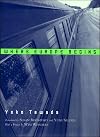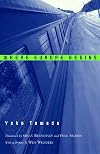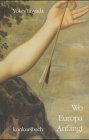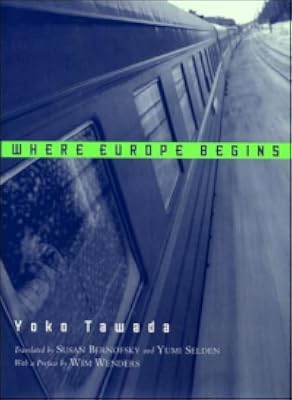
Where Europe Begins: Stories
by Yōko Tawada
On This Page
Description
Chosen as a 2005Times Literary Supplement Book of the Year,Where Europe Begins has been described by the Russian literary phenomenon Victor Pelevin as "a spectacular journey through a world of colliding languages and multiplying cities." In these stories' disparate settings--Japan, Siberia, Russia, and Germany--the reader becomes as much a foreigner as the author, or the figures that fill this book: the ghost of a burned woman, a traveler on the Trans-Siberian railroad, a mechanical doll, a show more tongue, a monk who leaps into his own reflection. Through the timeless artof storytelling, Yoko Tawada discloses the virtues of bewilderment, estrangement, andHilaritas: the goddess of rejoicing. show lessTags
Recommendations




Member Reviews
Most of the words that came out of my mouth had nothing to do with how I felt. But at the same time I realized that my native tongue didn’t have words for how I felt either. It’s just that this never occurred to me until I’d begun to live in a foreign language.
There are some works where I must be content with the single fish I have managed to catch. The flopping thing might not make much sense, or be very pretty, or in general be anything other than weird in a way I can't wrap my head around. I'd prefer being disturbed to this state of the uneasily vague, for disturbance implies something to disturb and eventually discover through the most sinister of echolocation. Instead, I have a fish, and as I have no interest in becoming show more fluent in both Japanese and German, the fish will suffice.
As in other museums as well, a power relationship is illustrated here: that which is represented is always something that has been destroyed.
The word not being said that I may have found out quicker had I read the original Japanese/German (each story is in one or the other but whether I want to discover which is in what has not been answered with the affirmative) is reality. Metonymy's a popular concept these days but it is not often that the entire mediating principle is sidestepped completely, leaving the interaction between letter of story of culture of world of living and the body a direct impact rather than a muffled rationality. You can't talk your way out of this one.
“How did you get such an Asian face?”
“What are you talking about, Mother? I am Asian.”
“That’s not what I meant. You’ve started to have one of those faces like Japanese people in American movies.”
Before I dropped a class due to the professor changing their grading principle every time we met, we were looking at ads, murals, public property pictures built upon principles of patriarchal dominance where the theme song of a woman not getting into the higher echelons of art unless naked and splayed in ink and oil has changed very little in the intervening centuries. We are walking portraits of what others have continually registered as carefully constructed otherwise; I don't know about your language, but I'm having enough trouble with picking apart my androcentric context with my androcentric English without even thinking about taking on another.
Apparently it was standard practice to retouch the photo of a suicide to make her look unattractive.
There's blood and sex and death and giant tongues and drowning monks and maybe lesbians? It's less of a sexual attraction and more the voice of the gods, or however we each individually process our integrated In the beginning was the Word.
The human body, too, contains many booths in which translation are made. I suspect that these are all translations for which no original exists. There are people, though, who assume that everyone is given an original text at birth. They call the place in which these texts are stored a soul.
I could continue my thought and take this as a references to my indoctrinated Catholicism, or I could take a second to step outside the process. Both at the same time and then some, though. That's the translation.
Most readers don’t like to read short texts because they have so little time. They would rather go for a walk in a long novel and not have to change. The short texts would go for a walk inside their bodies, which they would find exhausting.show less
Where Europe Begins, prefaced by the German film director Wim Wenders, has three parts: “The Bath,” translated from the Japanese by Yumi Selden, and “Where Europe Begins” and “The Guest,” translated from German by Susan Bernofsky.
“Where Europe Begins,” one of the eight stories from the section with the same title, is, like many of Tawada’s short stories, an unusual mixture of fairy-tale motifs and travel essay. Essay-like ruminations provoked by various landscapes and places are interspersed with folktales of various origins—Japanese, European, Samoyedic—often retold from a contemporary perspective, and with creation myths, of which we are never sure whether they are indeed culturally specific or they are in fact show more false creation myths—the author’s fictions. The effect of this mixture is a certain unsettling strangeness hard to define: on the one hand, the myth seeps into contemporary reality; on the other, reality itself is described in what appears to be an essay-like narrative, but even here the narrator’s voice, although an alter ego of the author, is fictional.
“Where Europe Begins,” written in the first person, with paragraphs titled “Diary excerpt” and “Excerpt from my first travel narrative,” seems a very convincing autobiographical “travel narrative” that tells the story of the narrator’s first encounter with Europe. As a child, the narrator wanted to go to Moscow, depicted as a magic city, the kind of city that exists only in a writer’s imagination, a paradise already lost before being found. Eventually, she does go to Moscow, but once she gets there, the story ends with the provocative and very ambiguous sentence (at least from the point of view of an European) “I realized I was standing in the middle of Europe” (146). In an interview, Tawada has mentioned that she wrote this story before she took the Trans-Siberian and went to Moscow; in other words, she invented the reality before actually living it. show less
“Where Europe Begins,” one of the eight stories from the section with the same title, is, like many of Tawada’s short stories, an unusual mixture of fairy-tale motifs and travel essay. Essay-like ruminations provoked by various landscapes and places are interspersed with folktales of various origins—Japanese, European, Samoyedic—often retold from a contemporary perspective, and with creation myths, of which we are never sure whether they are indeed culturally specific or they are in fact show more false creation myths—the author’s fictions. The effect of this mixture is a certain unsettling strangeness hard to define: on the one hand, the myth seeps into contemporary reality; on the other, reality itself is described in what appears to be an essay-like narrative, but even here the narrator’s voice, although an alter ego of the author, is fictional.
“Where Europe Begins,” written in the first person, with paragraphs titled “Diary excerpt” and “Excerpt from my first travel narrative,” seems a very convincing autobiographical “travel narrative” that tells the story of the narrator’s first encounter with Europe. As a child, the narrator wanted to go to Moscow, depicted as a magic city, the kind of city that exists only in a writer’s imagination, a paradise already lost before being found. Eventually, she does go to Moscow, but once she gets there, the story ends with the provocative and very ambiguous sentence (at least from the point of view of an European) “I realized I was standing in the middle of Europe” (146). In an interview, Tawada has mentioned that she wrote this story before she took the Trans-Siberian and went to Moscow; in other words, she invented the reality before actually living it. show less
Some passages from Where Europe Begins:
If they didn’t manage the operation properly and cut off some necessary part of her, she would not be completely back. If it came to that, I could donate a body part of my own. I could give at least one. Many of the body’s organs come in twos. I have two ears. Two lungs. I think there might even be two of the uterus, but I don’t remember now.
*
When talking to a large company over dinner, one is not so much looking for things to say as walking along a narrow road trying not to touch things one shouldn’t and somehow making one’s way forward.
*
To some extent, one has to forgive them on account of their youth, but I can’t forgive people who use their youth as an excuse to oppress others.
*
Most show more of the words that came out of my mouth had nothing to do with how I felt. But at the same time I realized that my native tongue didn’t have words for how I felt either. It’s just that this never occurred to me until I’d begun to live in a foreign language.
Often it sickened me to hear people speak their native tongues fluently. It was as if they were unable to think and feel anything but what their language so readily served up to them.
*
But can one understand the language of cells at all? The question brings to mind the image of yet another cell: the booth for simultaneous interpreters. At international congresses you often see these beautiful transparent booths in which people stand telling stories: they translate, so actually they are retelling tales that already exist. The lip movements and gestures of each interpreter and the way each of them glances about as she speaks are so various it’s difficult to believe they are all translating a single, shared text. And perhaps, it isn’t really a single shared text after all, perhaps the translators, by translating, demonstrate that this text is really many texts at once. The human body, too, contains many booths in which translations are made. I suspect that these are all translations for which no original exists. There are people, though, who assume that everyone is given an original text at birth. They call the place in which these texts are stored a soul.
*
A theatre, for example, is often a place where the dead can speak. A simple example is found in Hamlet: the dead father comes on stage and tells how he was killed by his brother. That is the decisive moment in this play, without which neither Hamlet nor the audience would have access to the past. They would have to go on believing the story of the murderer, who claimed Hamlet’s father had been bitten by a poisonous snake. Through the dead man’s story we learn a bit of the past that otherwise would have remained obscure. The theatre is the place where knowledge not accessible to us becomes audible. In other places, we almost always hear only the tales of the living. They force their stories on us to justify themselves, and so that they will be able to go on living, like Hamlet’s uncle. The tales told by the dead are fundamentally different, because their stories are not told to conceal their wounds.
. show less
If they didn’t manage the operation properly and cut off some necessary part of her, she would not be completely back. If it came to that, I could donate a body part of my own. I could give at least one. Many of the body’s organs come in twos. I have two ears. Two lungs. I think there might even be two of the uterus, but I don’t remember now.
*
When talking to a large company over dinner, one is not so much looking for things to say as walking along a narrow road trying not to touch things one shouldn’t and somehow making one’s way forward.
*
To some extent, one has to forgive them on account of their youth, but I can’t forgive people who use their youth as an excuse to oppress others.
*
Most show more of the words that came out of my mouth had nothing to do with how I felt. But at the same time I realized that my native tongue didn’t have words for how I felt either. It’s just that this never occurred to me until I’d begun to live in a foreign language.
Often it sickened me to hear people speak their native tongues fluently. It was as if they were unable to think and feel anything but what their language so readily served up to them.
*
But can one understand the language of cells at all? The question brings to mind the image of yet another cell: the booth for simultaneous interpreters. At international congresses you often see these beautiful transparent booths in which people stand telling stories: they translate, so actually they are retelling tales that already exist. The lip movements and gestures of each interpreter and the way each of them glances about as she speaks are so various it’s difficult to believe they are all translating a single, shared text. And perhaps, it isn’t really a single shared text after all, perhaps the translators, by translating, demonstrate that this text is really many texts at once. The human body, too, contains many booths in which translations are made. I suspect that these are all translations for which no original exists. There are people, though, who assume that everyone is given an original text at birth. They call the place in which these texts are stored a soul.
*
A theatre, for example, is often a place where the dead can speak. A simple example is found in Hamlet: the dead father comes on stage and tells how he was killed by his brother. That is the decisive moment in this play, without which neither Hamlet nor the audience would have access to the past. They would have to go on believing the story of the murderer, who claimed Hamlet’s father had been bitten by a poisonous snake. Through the dead man’s story we learn a bit of the past that otherwise would have remained obscure. The theatre is the place where knowledge not accessible to us becomes audible. In other places, we almost always hear only the tales of the living. They force their stories on us to justify themselves, and so that they will be able to go on living, like Hamlet’s uncle. The tales told by the dead are fundamentally different, because their stories are not told to conceal their wounds.
. show less
Ratings
Members
- Recently Added By
Author Information

78+ Works 2,768 Members
Some Editions
Work Relationships
Is contained in
Common Knowledge
- Canonical title
- Where Europe Begins: Stories
- Original publication date
- 2002 (Eng. transl.) (Eng. transl.)
- Original language
- German; Japanese
- Disambiguation notice
- Collection of stories, including The bath and A guest, do not combine with the collection of eight stories published as Wo Europa anfängt originally published in 1991
Classifications
- Genres
- Fiction and Literature, General Fiction
- DDC/MDS
- 833.914 — Literature & rhetoric German & related literatures German fiction 1900- 1900-1990 1945-1990
- LCC
- PT2682 .A87 .W44 — Language and Literature German, Dutch and Scandinavian literatures German literature Individual authors or works 1961-2000
- BISAC
Statistics
- Members
- 140
- Popularity
- 232,976
- Reviews
- 3
- Rating
- (3.75)
- Languages
- English, German
- Media
- Paper, Ebook
- ISBNs
- 4
- ASINs
- 1