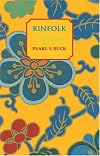
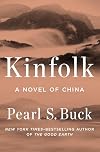
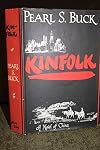
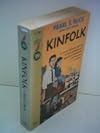
Kinfolk
by Pearl S. Buck
On This Page
Description
A tale of four Chinese-American siblings in New York, and their bewildering return to their rootsIn Kinfolk, a sharp dissection of the expatriate experience, Pearl S. Buck unfurls the story of a Chinese family living in New York. Dr. Liang is a comfortably well-off professor of Confucian philosophy, who spreads the notion of a pure and unchanging homeland. Under his influence, his four grown children decide to move to China, despite having spent their whole lives in America. As the siblings show more try in various ways to adjust to a new place and culture, they learn that the definition of home is far different from what they expected.This ebook features an illustrated biography of Pearl S. Buck including rare images from the author's estate. show lessTags
Recommendations




















Member Reviews
Is this novel how Pearl Buck supposed China would recover after World War II? It seems so. The message is plain and simple: respect for tradition while making way for modern science and technology. Written before the Communist victory and ouster of Chiang Kai-shek from the Chinese mainland, Kinfolk and Buck underestimate the ferocity of the forces of revolution that would sweep away her beloved traditions forever. Against the backdrop of the current year, 2018, such seems even more true.
Again, as with all Buck novels, the story is intriguing. But Kinfolk revealed a side of her I had never encountered before. For in it, she displays a mastery of comedic banter among the Liang family that counterpoints the very serious social developments show more molding and, in some cases, whisking away individual lives. So strong was it at times that I began to have a nagging feeling that I had seen these characterizations work within a dramatic plot before. Then, it hit me. I swear that Kinfolk at times resembles a Charlie Chan movie (I like Charlie Chan, for what it's worth). The elder Chinese patriarch forever quoting Confucius, while his Americanized children, especially Number One and Number Two Sons, seem determined to express their American manners and ways of speech ever more aggressively. The same even happens with Charlie's daughters. At any rate, the comedic tone of the novel is given free rein, so much so that the one notable death is almost treated dismissively.
How much of Chinese culture and society do we understand from Buck's novels? I'm not sure. I do know we come to quite a clear understanding of Pearl Buck's understanding of Chinese culture. Yet no matter how much Buck wished otherwise, she was always an outsider, someone who did not and could not belong. Her zealotry in "converting" the Chinese to her way of thinking reflected all too American values that simply were misplaced in China. Her dreams of emancipated women, elevated peasants, and widespread freedom within a traditional collectivized family oriented culture were just not fated to work. For all of the appeals of Kinfolk and Buck to the contrary, there will never be a bridge of unity between East and West. The reality is there to see, today. Oddly enough, it is the Japanese, whose civilization Buck excoriated in Dragon Seed, who have come closest to meeting her ideal of the future. show less
Again, as with all Buck novels, the story is intriguing. But Kinfolk revealed a side of her I had never encountered before. For in it, she displays a mastery of comedic banter among the Liang family that counterpoints the very serious social developments show more molding and, in some cases, whisking away individual lives. So strong was it at times that I began to have a nagging feeling that I had seen these characterizations work within a dramatic plot before. Then, it hit me. I swear that Kinfolk at times resembles a Charlie Chan movie (I like Charlie Chan, for what it's worth). The elder Chinese patriarch forever quoting Confucius, while his Americanized children, especially Number One and Number Two Sons, seem determined to express their American manners and ways of speech ever more aggressively. The same even happens with Charlie's daughters. At any rate, the comedic tone of the novel is given free rein, so much so that the one notable death is almost treated dismissively.
How much of Chinese culture and society do we understand from Buck's novels? I'm not sure. I do know we come to quite a clear understanding of Pearl Buck's understanding of Chinese culture. Yet no matter how much Buck wished otherwise, she was always an outsider, someone who did not and could not belong. Her zealotry in "converting" the Chinese to her way of thinking reflected all too American values that simply were misplaced in China. Her dreams of emancipated women, elevated peasants, and widespread freedom within a traditional collectivized family oriented culture were just not fated to work. For all of the appeals of Kinfolk and Buck to the contrary, there will never be a bridge of unity between East and West. The reality is there to see, today. Oddly enough, it is the Japanese, whose civilization Buck excoriated in Dragon Seed, who have come closest to meeting her ideal of the future. show less
Dr. Liang, fed up with the Chinese government's restrictions on intellectuals, moved his family to New York. Twenty-some years later, he is more concerned with teaching his students the ideal of what China used to be than what it actually is. His wife misses her homeland and has not adjusted to America. Their oldest son, James, has just graduated medical school at the top of his class and goes back to the rural ancestral village in China to help the people against his father's wishes. Daughters Mary and Louise follow James to China to keep Louise away from American boys, and younger son Peter accompanies his sisters against his will and becomes convinced that the revolution encouraged by the growing Communist party is the only way to show more force the Chinese people to change for their own good. None of the children find China to be what they expected, but they all find something to devote their lives to there.
Pearl Buck does an excellent job of portraying a family that has lived their lives torn between two countries and unable to really be a part of either. I had a bit of trouble getting into this novel, however, because as long as it was, it seemed to meander most of the time without going anywhere. She still paints a beautiful portrait of her characters, though; this just isn't the best book I've read by her. show less
Pearl Buck does an excellent job of portraying a family that has lived their lives torn between two countries and unable to really be a part of either. I had a bit of trouble getting into this novel, however, because as long as it was, it seemed to meander most of the time without going anywhere. She still paints a beautiful portrait of her characters, though; this just isn't the best book I've read by her. show less
Excellent characters and a nice in-depth look at contrasting experiences, loyalties, needs and perceptions of the Chinese-American children of a traditional Chinese couple living in New York after WWII. The way the different children react to the reality of China made this a very interesting read.
I think I read this a really long time ago. Now that I'm an adult and more knowledgeable about Chinese history and human relationships I can value the strength in the writing.
I think this was published prior to _The Lion, the Witch, and the Wardrobe_, or at least at about the same time. It's not likely that Buck ever read Lewis' novel, but _Kinfolk_ and _LWW_ have unexpectedly much in common. It begins with the "Four Children" of both -- note how disconcertingly similar each of them are (James and Mary relative to Peter and Susan especially) -- and it sort of goes on from there. I think it's just a coincidence, but it's one of the stranger ones. What would Carl Jung have to say about this, I wonder...?
Very interesting book, and as always when the author writes about China, there’s a deep cultural understanding that comes with it.
Dragged at times, but worth a look,
Members
- Recently Added By
Author Information

430+ Works 37,093 Members
Pearl S. Buck, June 26, 1892 - March 6, 1973 Pearl Sydenstricker Buck was an American author, best know for her novels about China. Buck was born on June 26, 1892, in Hillsboro, West Virginia, but as the daughter of Presbyterian missionaries she was taken to China in infancy. She received her early education in Shanghai, but returned to the United show more States to attend college, and graduated from Randolph-Macon Woman's College in Virginia in 1914. Buck became a university teacher there and married John Lossing Buck, an agricultural economist, in 1917. Buck and her husband both taught in China, and she published magazine articles about life there. Her first novel East Wind, West Wind was published in 1930. Buck achieved international success with The Good Earth, which won the Pulitzer Prize in 1932. This story of a Chinese peasant family's struggle for survival was later made into a MGM film. Buck resigned from the Presbyterian Board of Foreign Missions after publishing an article that was critical of missionaries. She returned to the United States because of political unrest in China. Buck's novels during this period include Sons, A House Divided, and The Mother. She also wrote biographies of her father (Fighting Angel) and her mother (The Exile). She won the Nobel Prize for Literature in 1938. During her career, Buck published over 70 books: novels, nonfiction, story collections, children's books, and translations from the Chinese. She also wrote under the pseudonym John Sedges. In the United States, Buck was active in the civil rights and women's rights movements. In 1942 she founded the East and West Association to promote understanding between Asia and the West. In 1949, Buck established Welcome House, the first international interracial adoption agency. In 1964, she established the Pearl S. Buck foundation to sponsor support for Amerasian children who were not considered adoptable. Pearl Buck died in Danbury, Vermont, on March 6, 1973. (Bowker Author Biography) show less
Some Editions
Awards and Honors
Distinctions
Work Relationships
Contains
Common Knowledge
- Canonical title
- Kinfolk
- Original title
- Kinfolk
- Alternate titles
- Kinfolk: A Novel of China and America
- Original publication date
- 1949
- First words
- The theater in Chinatown was crowded to the doors.
- Last words
- (Click to show. Warning: May contain spoilers.)And life, James knew, was what he wanted.
Classifications
- Genres
- General Fiction, Fiction and Literature, Historical Fiction
- DDC/MDS
- 813.52 — Literature & rhetoric American literature in English American fiction in English 1900-1999 1900-1945
- LCC
- PS3503 .U198 .K56 — Language and Literature American literature American literature Individual authors 1900-1960
- BISAC
Statistics
- Members
- 380
- Popularity
- 81,986
- Reviews
- 9
- Rating
- (3.65)
- Languages
- 8 — Dutch, English, Finnish, French, German, Italian, Norwegian (Bokmål), Portuguese
- Media
- Paper, Ebook
- ISBNs
- 10
- ASINs
- 28