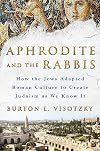
Aphrodite and the Rabbis: How the Jews Adapted Roman Culture to Create Judaism as We Know It
by Burton L. Visotzky
On This Page
Description
"Hard to believe but true: - The Passover Seder is a Greco-Roman symposium banquet - The Talmud rabbis presented themselves as Stoic philosophers - Synagogue buildings were Roman basilicas - Hellenistic rhetoric professors educated sons of well-to-do Jews - Zeus-Helios is depicted in synagogue mosaics across ancient Israel - The Jewish courts were named after the Roman political institution, the Sanhedrin - In Israel there were synagogues where the prayers were recited in Greek. Historians show more have long debated the (re)birth of Judaism in the wake of the destruction of Jerusalem and the Temple cult by the Romans in 70 CE. What replaced that sacrificial cult was at once something new-indebted to the very culture of the Roman overlords-even as it also sought to preserve what little it could of the old Israelite religion. The Greco-Roman culture in which rabbinic Judaism grew in the first five centuries of the Common Era nurtured the development of Judaism as we still know and celebrate it today. Arguing that its transformation from a Jerusalem-centered cult to a world religion was made possible by the Roman Empire, Rabbi Burton Visotzky presents Judaism as a distinctly Roman religion. Full of fascinating detail from the daily life and culture of Jewish communities across the Hellenistic world, Aphrodite and the Rabbis will appeal to anyone interested in the development of Judaism, religion, history, art and architecture. "-- show lessTags
Recommendations



















Member Reviews
Visotzky is a recognized scholar on Midrash and he opens this book with a story that draws readers into his search for Roman-Jewish cultural melding. He writes: “Even as some rabbinic texts depicted Rome as the enemy, there is overwhelming evidence that Judaism took root in Roman soil, imbibed its nourishment, and grafted the good and pruned the bad from the Roman Empire, until a vibrant new religion – Judaism - arose from the wreckage of the Israelite religion and the Temple cult, nurtured by the very empire that had destroyed it.” He supports this argument in ten chapters, each of which explores a particular influence of Roman culture had on Jewish life. Although the focus of this book is the intersection of Hellenic and Jewish show more culture, Visotzky concludes by drawing a parallel between the Jews of Ancient Rome and American Jewry today. An important message from a book that is scholarly and a worthwhile read. show less
I was really thrilled to receive this informative book on how elements of Greco-Roman culture have influenced the development of post-Second Temple Judaism! Titus destroyed the Temple in 70AD. The rabbi-professor author wrote simply enough for an educated layperson. I am always looking for works on how one religion or culture influences another; this one fit the bill nicely.
The author discusses how the religion had to change; no longer was there a central spot for animal sacrifice. The rabbi [teacher or master] system developed; each rabbi was like a philosopher--surrounding himself with a group of students [or disciples]. I never realized the term "rabbi" for Jesus was a New Testament anachronism. Judaism borrowed loan-words from show more Greek or Latin, written in Hebrew letters, that were incorporated into their law/rhetoric or philosophy. Each synagogue [a Greek loan-word] began praying in the vernacular. The order of the Passover Seder follows that of a Greek symposium--but lacking the raucous entertainment following the meal, conversation, and prayers. Of most interest to me was the incorporation of Roman architecture, e.g., the basilica, and interior decorations--floor mosaics and murals. This was new to me: Rabbi Gamaliel, an important figure, and St. Paul's teacher, declared the only forbidden images would be those specifically designed to be worshipped. So I understand now the Jews' use of the human figure and animals in their art is purely aesthetic. Usually the figures are dressed in Greek or Roman style; the author mentions a Moses at the Burning Bush in chiton and himation and a wall painting at Dura-Europas of Ahasuerus [in Persian dress] and Esther in Greco-Roman dress with tiara. The world map at an ancient synagogue--now in use as a church--at Madaba in Jordan is worth mentioning. In many places, most notably Sepporis, there are floor mosaics of a zodiac with figures representing the seasons and a Helios and quadriga [4-horse chariot] in the center.
I really learned a lot and this book will always be a great reference. As the book is an ARC, there's no index yet, which lack I hope will be rectified when the book is released. I hope the pictures will be made sharper; in my copy details were indistinct.
Very highly recommended. show less
The author discusses how the religion had to change; no longer was there a central spot for animal sacrifice. The rabbi [teacher or master] system developed; each rabbi was like a philosopher--surrounding himself with a group of students [or disciples]. I never realized the term "rabbi" for Jesus was a New Testament anachronism. Judaism borrowed loan-words from show more Greek or Latin, written in Hebrew letters, that were incorporated into their law/rhetoric or philosophy. Each synagogue [a Greek loan-word] began praying in the vernacular. The order of the Passover Seder follows that of a Greek symposium--but lacking the raucous entertainment following the meal, conversation, and prayers. Of most interest to me was the incorporation of Roman architecture, e.g., the basilica, and interior decorations--floor mosaics and murals. This was new to me: Rabbi Gamaliel, an important figure, and St. Paul's teacher, declared the only forbidden images would be those specifically designed to be worshipped. So I understand now the Jews' use of the human figure and animals in their art is purely aesthetic. Usually the figures are dressed in Greek or Roman style; the author mentions a Moses at the Burning Bush in chiton and himation and a wall painting at Dura-Europas of Ahasuerus [in Persian dress] and Esther in Greco-Roman dress with tiara. The world map at an ancient synagogue--now in use as a church--at Madaba in Jordan is worth mentioning. In many places, most notably Sepporis, there are floor mosaics of a zodiac with figures representing the seasons and a Helios and quadriga [4-horse chariot] in the center.
I really learned a lot and this book will always be a great reference. As the book is an ARC, there's no index yet, which lack I hope will be rectified when the book is released. I hope the pictures will be made sharper; in my copy details were indistinct.
Very highly recommended. show less
This review was written for LibraryThing Member Giveaways.
Aphrodite and the Rabbis by Burton L. Visotzky is an interesting view on post-70CE Judaism, Roman culture of the period and most importantly where the two converged.
The destruction of the Temple led to a new type of Judaism, namely rabbinic Judaism. It seems that both contemporary Judaism and contemporary Christianity owe a lot of their appearance to cultures within which they had to adapt. While I was very familiar with the Christian equivalent (Christmas overlaid on Saturnalia, for instance) I was ignorant of the influence Roman culture had on Judaism.
I would highly recommend this book to anyone interested in Jewish history or Roman history. The writing is engaging and the concepts, both theological and cultural, are presented show more clearly.
Reviewed from a copy made available via LibraryThing. show less
The destruction of the Temple led to a new type of Judaism, namely rabbinic Judaism. It seems that both contemporary Judaism and contemporary Christianity owe a lot of their appearance to cultures within which they had to adapt. While I was very familiar with the Christian equivalent (Christmas overlaid on Saturnalia, for instance) I was ignorant of the influence Roman culture had on Judaism.
I would highly recommend this book to anyone interested in Jewish history or Roman history. The writing is engaging and the concepts, both theological and cultural, are presented show more clearly.
Reviewed from a copy made available via LibraryThing. show less
This review was written for LibraryThing Member Giveaways.
Ratings
Members
- Recently Added By
Lists

Judaism & Israel
104 works; 2 members
Author Information
13+ Works 580 Members
Burton L. Visotzky holds the Nathan and Janet Appleman Chair of Midrash and Interreligious Studies at the Jewish Theological Seminary of America. He lives in New York City
Classifications
- Genres
- Religion & Spirituality, Nonfiction, History, Literature Studies and Criticism, General Nonfiction
- DDC/MDS
- 296.3 — Religion Other religions Judaism Jewish philosophy
- LCC
- BM536 .R66 .V57 — Philosophy, Psychology and Religion Judaism Judaism Relation of Judaism to special subject fields Religions
- BISAC
Statistics
- Members
- 105
- Popularity
- 308,594
- Reviews
- 3
- Rating
- (4.07)
- Languages
- English
- Media
- Paper, Ebook
- ISBNs
- 2
- ASINs
- 1