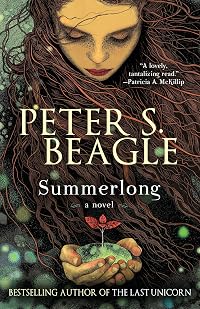
Summerlong
by Peter S. Beagle
On This Page
Description
"It is a dark and stormy Puget Sound winter--until the arrival of Lioness Lazos. Even the weather takes notice when Lioness appears, as if out of nowhere, waiting tables in a diner. As though compelled, a complicated family brings the young woman into their lives. Energetic Joanna, academic Abe, and lovelorn Lily each fall under Lioness's spell, and she in turn awakens their long-hidden dreams and desires. As an impossibly beautiful spring leads into a perfect summer, Lioness's influence show more only grows. But lingering in her past is a dark secret--and summer days must pass"--Page 4 of cover. show lessTags
Recommendations














Member Reviews
This is a gentle and thoughtful book about the dissolution and formation of friendships, relationships, and the fascination of gods.
What? Well, honestly, it's about a middle-aged couple and their mild and complicated relationship in a comfortable middle-class household, where she becomes disillusioned and he discovers a new love, and such things are mirrored interestingly with the inclusion and complicated immersion into a particularly well-beloved Greek Myth, walking the earth.
The whole book is rather introspective in effect, if not always in action, diving heavier into interpersonal reactions and how easy it is to be lost in ideas, in gut-reactions, and the misery of not knowing what you want, or in taking what you think you want, show more learning that it was all a mistake.
Of course, this is a rather deep exploration of both points of view in the grand myth of Persephone and Hades, too, so it's actually rather rich in contemplation.
If what you're looking for is straight magical realism in comfortable middle-class topes, you'll find a mild tale with deep and fascinating characters that pop with detail, but don't expect much in the way of plot. Expect thematic exploration, interpersonal angst, and an attempt to discover some sort of balance with summer and winter. Growing older doesn't always mean growing wiser, after all. show less
What? Well, honestly, it's about a middle-aged couple and their mild and complicated relationship in a comfortable middle-class household, where she becomes disillusioned and he discovers a new love, and such things are mirrored interestingly with the inclusion and complicated immersion into a particularly well-beloved Greek Myth, walking the earth.
The whole book is rather introspective in effect, if not always in action, diving heavier into interpersonal reactions and how easy it is to be lost in ideas, in gut-reactions, and the misery of not knowing what you want, or in taking what you think you want, show more learning that it was all a mistake.
Of course, this is a rather deep exploration of both points of view in the grand myth of Persephone and Hades, too, so it's actually rather rich in contemplation.
If what you're looking for is straight magical realism in comfortable middle-class topes, you'll find a mild tale with deep and fascinating characters that pop with detail, but don't expect much in the way of plot. Expect thematic exploration, interpersonal angst, and an attempt to discover some sort of balance with summer and winter. Growing older doesn't always mean growing wiser, after all. show less
But that ending!
(Full disclosure: I received a free electronic ARC for review through NetGalley. This review contains clearly marked spoilers.)
"He could never have distinguished the rescued young orca of a week before from the rest of the pod, but there was no mistaking the slender figure poised on the slanting bluff that had long since been Joanna’s daffodil bed, before a tremor had sliced it in two. Lioness Lazos was standing there, not at all like a witch, arms raised to order tides and powers to her bidding, but as calmly as the great dorsals themselves: greeting, perhaps, but never commanding, even seeming at one point to wave them diffidently away. And still the orcas danced for her."
I can count the number of childhood favorites show more that have managed to hold up over time on one hand, and The Last Unicorn is of them. (The book and the animated film, which is a double rarity.) Up until Summerlong, it was also my only experience with Peter S. Beagle. I own several of his titles - The Innkeeper's Song, The Line Between, Mirror Kingdoms; accumulated at garage and library sales, mostly - but so far they've been languishing in the middle of a ginormous TBR pile.
Summerlong is quite evocative of The Last Unicorn, yet still its own beast. It has the same quirky charm and dreamlike quality, but also feels much more adult. (Thanks in no small part to the older protagonists and copious - yet tasteful - sex scenes.) While the story does boast some wonderful elements - not the least of which is Beagle's distinctive, fanciful writing - overall it fell a little short of my expectations. Which is perhaps a bit unfair: bound up as it is in all sorts of childhood feels and '80s nostalgia, The Last Unicorn is maybe not the best (or most objective) reference point.
The story begins in February, with the arrival of a beautiful and mysterious stranger on Gardner Island. Lioness Lazos quickly and seamlessly integrates herself into island life, stumbling into a waitressing job at the Skyliner Diner - which is where Abe Aronson and his longtime girlfriend Joanna Delvecchio find her. Before the bill's been settled, they have offered to let Lioness stay in Abe's garage, rent-free. Being in close proximity to Lioness does that to a person: makes them take leave of their senses, and gladly so. She is, in a word, enchanting.
Lioness's appearance on the island coincides with an early and gentle spring. The weather warms; flowers bloom; grass grows lush and verdant. It rains, but mostly only at night, when the residents of Gardner Island are tucked soundly in their beds. A pod of orcas swims perilously close to shore, seemingly dancing for Lioness. Abe's Christmas brew - which, for years, has been a failure of epic proportions - is for once a delicious success. Most of this Abe and Joanna can chalk up to coincidence - that is, until the day Abe witnesses Jesse Yandell from next door pull a bouquet of flowers from under the soil and present it to a frowning Lioness, who makes him rebury it. When Abe goes digging for the flowers later, there's nothing to be found.
Despite the strangeness of it all, Abe and Joanna want nothing more than to protect their new friend. For it's clear that Lioness is on the run, from someone or something, and her troubles - much like her magic - threaten to infect the island.
I liked the story, but didn't love it; found it enjoyable, but not especially memorable. The writing, especially surrounding Lioness and her earthly magic, is lovely, yet the plot is somewhat predictable. I won't drop any spoilers, but you've definitely heard of Lioness.
** Caution: Spoilers ahead! **
I think some of my ambivalence is due to the ending. You don't often see stories starring an older couple that's been together for twenty-something years; more common are bodice-ripping romances featuring starry-eyed teenagers and young adults. Abe and Joanna's relationship is rather refreshing: practical and comfortable, with neither party particularly interested in marriage or even cohabitation. They both have their own lives, yet also clearly care for one another. While they can get along just fine on their own, there's also a fair amount of emotional codependence (and I don't mean that in an unhealthy way); they're best friends and also lovers. That I can even apply that term - lovers - to people who are 65 and 56, respectively, is kind of awesome.
So yeah, I was pretty pissed when Abe cheated on Joanna - truly, I did not see that coming - and despite my general rule that literary ladies should always kick philandering men to the curb, part of me wanted to see them reconcile. Especially since they shared this one, gigantic, life-altering secret.
I suppose there's an argument to be made that both parties blossomed after the dissolution of their partnership: Abe finding his passion in playing harmonica with local blues band Simply Blue, and Joanna finally overcoming her fear of water to take up kayaking. Yet it's not entirely clear to me why they couldn't have done this before; there's almost nothing in the story to suggest that they stifle each other. idk, maybe I'm missing something?
** End of spoilers! **
Otherwise, I wasn't always feeling it. It's difficult to pinpoint exactly why, so perhaps I'll just chalk it up to "not for me." But longtime Peter S. Beagle fans will most likely enjoy it.
http://www.easyvegan.info/2016/09/07/summerlong-by-peter-s-beagle/ show less
(Full disclosure: I received a free electronic ARC for review through NetGalley. This review contains clearly marked spoilers.)
"He could never have distinguished the rescued young orca of a week before from the rest of the pod, but there was no mistaking the slender figure poised on the slanting bluff that had long since been Joanna’s daffodil bed, before a tremor had sliced it in two. Lioness Lazos was standing there, not at all like a witch, arms raised to order tides and powers to her bidding, but as calmly as the great dorsals themselves: greeting, perhaps, but never commanding, even seeming at one point to wave them diffidently away. And still the orcas danced for her."
I can count the number of childhood favorites show more that have managed to hold up over time on one hand, and The Last Unicorn is of them. (The book and the animated film, which is a double rarity.) Up until Summerlong, it was also my only experience with Peter S. Beagle. I own several of his titles - The Innkeeper's Song, The Line Between, Mirror Kingdoms; accumulated at garage and library sales, mostly - but so far they've been languishing in the middle of a ginormous TBR pile.
Summerlong is quite evocative of The Last Unicorn, yet still its own beast. It has the same quirky charm and dreamlike quality, but also feels much more adult. (Thanks in no small part to the older protagonists and copious - yet tasteful - sex scenes.) While the story does boast some wonderful elements - not the least of which is Beagle's distinctive, fanciful writing - overall it fell a little short of my expectations. Which is perhaps a bit unfair: bound up as it is in all sorts of childhood feels and '80s nostalgia, The Last Unicorn is maybe not the best (or most objective) reference point.
The story begins in February, with the arrival of a beautiful and mysterious stranger on Gardner Island. Lioness Lazos quickly and seamlessly integrates herself into island life, stumbling into a waitressing job at the Skyliner Diner - which is where Abe Aronson and his longtime girlfriend Joanna Delvecchio find her. Before the bill's been settled, they have offered to let Lioness stay in Abe's garage, rent-free. Being in close proximity to Lioness does that to a person: makes them take leave of their senses, and gladly so. She is, in a word, enchanting.
Lioness's appearance on the island coincides with an early and gentle spring. The weather warms; flowers bloom; grass grows lush and verdant. It rains, but mostly only at night, when the residents of Gardner Island are tucked soundly in their beds. A pod of orcas swims perilously close to shore, seemingly dancing for Lioness. Abe's Christmas brew - which, for years, has been a failure of epic proportions - is for once a delicious success. Most of this Abe and Joanna can chalk up to coincidence - that is, until the day Abe witnesses Jesse Yandell from next door pull a bouquet of flowers from under the soil and present it to a frowning Lioness, who makes him rebury it. When Abe goes digging for the flowers later, there's nothing to be found.
Despite the strangeness of it all, Abe and Joanna want nothing more than to protect their new friend. For it's clear that Lioness is on the run, from someone or something, and her troubles - much like her magic - threaten to infect the island.
I liked the story, but didn't love it; found it enjoyable, but not especially memorable. The writing, especially surrounding Lioness and her earthly magic, is lovely, yet the plot is somewhat predictable. I won't drop any spoilers, but you've definitely heard of Lioness.
** Caution: Spoilers ahead! **
I think some of my ambivalence is due to the ending. You don't often see stories starring an older couple that's been together for twenty-something years; more common are bodice-ripping romances featuring starry-eyed teenagers and young adults. Abe and Joanna's relationship is rather refreshing: practical and comfortable, with neither party particularly interested in marriage or even cohabitation. They both have their own lives, yet also clearly care for one another. While they can get along just fine on their own, there's also a fair amount of emotional codependence (and I don't mean that in an unhealthy way); they're best friends and also lovers. That I can even apply that term - lovers - to people who are 65 and 56, respectively, is kind of awesome.
So yeah, I was pretty pissed when Abe cheated on Joanna - truly, I did not see that coming - and despite my general rule that literary ladies should always kick philandering men to the curb, part of me wanted to see them reconcile. Especially since they shared this one, gigantic, life-altering secret.
I suppose there's an argument to be made that both parties blossomed after the dissolution of their partnership: Abe finding his passion in playing harmonica with local blues band Simply Blue, and Joanna finally overcoming her fear of water to take up kayaking. Yet it's not entirely clear to me why they couldn't have done this before; there's almost nothing in the story to suggest that they stifle each other. idk, maybe I'm missing something?
** End of spoilers! **
Otherwise, I wasn't always feeling it. It's difficult to pinpoint exactly why, so perhaps I'll just chalk it up to "not for me." But longtime Peter S. Beagle fans will most likely enjoy it.
http://www.easyvegan.info/2016/09/07/summerlong-by-peter-s-beagle/ show less
Abe is a retired history professor living on Gardner Island. He has been attempting to write a book for years and loves to play the blues on his harmonica. Joanna lives in Seattle when she is not on the island with Abe. She is an airline attendant doing her best to avoid retirement and worrying about her adult daughter, Lily who seems to have a preternatural knack for finding the most unsuitable lovers. Abe and Joanna have a long-term relation that is, if not exciting, comfortable despite or perhaps because of their long periods of separation. It is a relationship sustained more by friendship and familiarity than by passion. They have learned to make compromises to make their relationship work: Abe limits the amount of time he plays his show more harmonica because it irritates Joanna and she keeps secret her yearning to go on a long kayaking trip despite having never kayaked because she knows Abe would worry especially when he learns that she wants to go alone.
When they meet Lioness, a new young waitress at their favourite diner who is looking for a warm place to stay, they offer her their garage But no one is more surprised than they at this offer. They are usually very careful about protecting their privacy but there is just something about this young woman. For one thing, her arrival on the island seems to coincide with an unusual period of seemingly endless summer.
But it soon becomes apparent that Lioness is hiding something in her past that will have an impact on the seeming idyllic life on Gardner Island. When this past finally catches up with her, she decides to break the impasse that exists in Abe’s and Joanna’s relationship. On the surface, her method seems cruel and completely out of character but is, in fact, a last gift. As in the myth that inspired this novel, as much as we may hate it, summer must end so that we can prepare for winter, and familiarity and peace in a relationship is not enough if it is purchased at the expense of our dreams; sometimes, like the bandaid on a cut, there is required a quick and painful yank to remove it so that the air can get in –the shock may be upsetting, there may be blood and it may hurt for a while but, eventually, it is clear that it was necessary if real healing is to occur.
Summerlong by author Peter S. Beagle is a beautiful tale mixing myth with reality written in the lyrical prose that is his trademark. It is a reminder that life is too short to spend it in a rut no matter how comfortable and that we need the seasons in our lives as much as we need them in the year. It is a story about taking risks, of letting go of the past to enjoy the future, that summer is not the end but rather a new beginning, a time to harvest what we have spent our spring and summer sowing. In many ways, it reminded me as much of Eccleastes 3:1-8 as it did mythology:
To Everything there is a season, and a time for every purpose under heaven
Thanks to Netgalley and Tachyon Publications for the opportunity to read this book in exchange for an honest review show less
When they meet Lioness, a new young waitress at their favourite diner who is looking for a warm place to stay, they offer her their garage But no one is more surprised than they at this offer. They are usually very careful about protecting their privacy but there is just something about this young woman. For one thing, her arrival on the island seems to coincide with an unusual period of seemingly endless summer.
But it soon becomes apparent that Lioness is hiding something in her past that will have an impact on the seeming idyllic life on Gardner Island. When this past finally catches up with her, she decides to break the impasse that exists in Abe’s and Joanna’s relationship. On the surface, her method seems cruel and completely out of character but is, in fact, a last gift. As in the myth that inspired this novel, as much as we may hate it, summer must end so that we can prepare for winter, and familiarity and peace in a relationship is not enough if it is purchased at the expense of our dreams; sometimes, like the bandaid on a cut, there is required a quick and painful yank to remove it so that the air can get in –the shock may be upsetting, there may be blood and it may hurt for a while but, eventually, it is clear that it was necessary if real healing is to occur.
Summerlong by author Peter S. Beagle is a beautiful tale mixing myth with reality written in the lyrical prose that is his trademark. It is a reminder that life is too short to spend it in a rut no matter how comfortable and that we need the seasons in our lives as much as we need them in the year. It is a story about taking risks, of letting go of the past to enjoy the future, that summer is not the end but rather a new beginning, a time to harvest what we have spent our spring and summer sowing. In many ways, it reminded me as much of Eccleastes 3:1-8 as it did mythology:
To Everything there is a season, and a time for every purpose under heaven
Thanks to Netgalley and Tachyon Publications for the opportunity to read this book in exchange for an honest review show less
This novel has some of the most beautiful prose. Everything is described with loving detail; I could smell the spring in the PNW and feel the damp air. (of course, I have been in the Pacific Northwest enough to have a head start on that, but still) Early in the book I started caring about the characters.
Joanna Delvecchio is the head steward on a regular Seattle/Chicago run, and counting the days left before she can retire. She’s had a 20-some year relationship with Abe Aronson, retired history professor, which she refuses to admit is a relationship. Her daughter, Lily, can’t seem to find the right woman. It’s a nice life, with great regularity to it. When they meet the new waitress at their favorite little restaurant, she rocks show more the lives of all of them.
Lioness Lazos, needing a place to stay, moves into Abe’s garage. She has nearly nothing and is fine with that. She is hiding from someone and traveling lightly. But things start changing the minute she arrives. Abe and Del start living out their dreams apart from each other. Lily falls in love with Lioness. The neighbor kids learn how to produce flowers from bare soil… instantly. Spring comes early and lasts all summer and fall.
It’s obvious pretty quickly that this is not your average novel but a fairy tale. I figured out who Lioness really was pretty quickly. While I knew what would have to happen with Lioness, I did not expect what she would do before giving in to it. And I do know *why* she did it. That’s one of my quibbles with the book: Lioness is a cypher. Everyone loves her on sight, but she does little and says little. Of course she’s a magical being, but still. She’s interacting on a human level, so I expected more humanity from her. She had to know that what she did would destroy Abe and Del’s relationship; did she think she was doing them some sort of favor? Or did she just not care, and was indulging herself? The ending left me angry at her and at Abe.
Still, even though I was not happy with the ending, I enjoyed most of the book too much to not like it as a whole. It was a magical read and I rushed through it, not wanting to stop reading. I guess I just expected a happy ending from a fairy tale like this! show less
Joanna Delvecchio is the head steward on a regular Seattle/Chicago run, and counting the days left before she can retire. She’s had a 20-some year relationship with Abe Aronson, retired history professor, which she refuses to admit is a relationship. Her daughter, Lily, can’t seem to find the right woman. It’s a nice life, with great regularity to it. When they meet the new waitress at their favorite little restaurant, she rocks show more the lives of all of them.
Lioness Lazos, needing a place to stay, moves into Abe’s garage. She has nearly nothing and is fine with that. She is hiding from someone and traveling lightly. But things start changing the minute she arrives. Abe and Del start living out their dreams apart from each other. Lily falls in love with Lioness. The neighbor kids learn how to produce flowers from bare soil… instantly. Spring comes early and lasts all summer and fall.
It’s obvious pretty quickly that this is not your average novel but a fairy tale. I figured out who Lioness really was pretty quickly. While I knew what would have to happen with Lioness, I did not expect what she would do before giving in to it. And I do know *why* she did it. That’s one of my quibbles with the book: Lioness is a cypher. Everyone loves her on sight, but she does little and says little. Of course she’s a magical being, but still. She’s interacting on a human level, so I expected more humanity from her. She had to know that what she did would destroy Abe and Del’s relationship; did she think she was doing them some sort of favor? Or did she just not care, and was indulging herself? The ending left me angry at her and at Abe.
Still, even though I was not happy with the ending, I enjoyed most of the book too much to not like it as a whole. It was a magical read and I rushed through it, not wanting to stop reading. I guess I just expected a happy ending from a fairy tale like this! show less
I jumped at the chance to review this book. It's been a while since I've read anything by Beagle, and really looked forward to this new book. It's a bit different than a lot of mainstream fantasy these days. It's not readily apparent this is a fantasy, first of all, until well into the story. Second, the main characters are in their 50's and 60's, which was a nice refreshing change. People past middle-age deserve to have some fantasy stories, too. Third, the fantasy aspect is kind of secondary. It's there and it's interesting, but for the most part, the story is about Abe and Del and their relationship and lives.
Del and Abe are fairly comfortable in their their routine, with Del living in Seattle and Abe living on one of the islands in show more Puget Sound. Then Lioness enters their lives and things start changing. The book moves rather slowly for the first half, with little things happening to show something isn't quite normal about Lioness. And then the second half of the book. Whoa boy. The predictably stupid thing happens and Abe tries to win back Del.
Because of the focus on Abe and Del's relationship, Lioness and her assorted magical doings aren't important. It could have been any other book where an establish couple end up not being a couple any more. But the addition of Lioness and adds some extra flavor.It was particularly interesting that she is Persephone, and not what I had expected when she first showed up in the book.
I have a hard time trying to reconcile my feelings about this book. I did enjoy reading it but the whole thing felt rather off. I never connected with the main characters nor got immersed in the story. Something about the narrative style held me at arm's length.
Review copy courtesy of the publisher via NetGalley. show less
Del and Abe are fairly comfortable in their their routine, with Del living in Seattle and Abe living on one of the islands in show more Puget Sound. Then Lioness enters their lives and things start changing. The book moves rather slowly for the first half, with little things happening to show something isn't quite normal about Lioness. And then the second half of the book. Whoa boy. The predictably stupid thing happens and Abe tries to win back Del.
Because of the focus on Abe and Del's relationship, Lioness and her assorted magical doings aren't important. It could have been any other book where an establish couple end up not being a couple any more. But the addition of Lioness and adds some extra flavor.
I have a hard time trying to reconcile my feelings about this book. I did enjoy reading it but the whole thing felt rather off. I never connected with the main characters nor got immersed in the story. Something about the narrative style held me at arm's length.
Review copy courtesy of the publisher via NetGalley. show less
I received this novel as an advanced copy from NetGalley in exchange for an honest review.
I love the classic fantasy story with adventure and romance and plot twists and magic. But it can get very scripted and boring, because everyone wants to stick to the same mold. This story gave me the opportunity to break away from the stereotypical stories that form this genre, and try something new.
On a rainy February night, like every other, Abe and his long-time girlfriend Joanna head to their favorite local restaurant and meet waitress Lioness Lazos, who is new in town and has no place of her own. From the moment they meet her, they are intrigued and enchanted and cannot help but be drawn to her. Joanna is quick to suggest that Lioness move in show more to Abe's garage, and Lioness agrees happily. Joanne and Abe could never have predicted that this one event would change their lives forever.
I quite enjoyed this novel, even though it was very different from what I had expected. There are so many things that set this novel apart from other fantasy fiction stories that I read, so I'm just going to list them here:
The characters are quite old. Abe is 65, and Joanna is somewhere in her 50s. For someone who reads a great deal of fantasy novels starring teens and young adults, seeing an older character who is more than just a "wise" person or a caregiver for the protagonist was unusual as well as refreshing. It gave the story a different feel, and allowed for it to be more than just a fantasy story. The characters had a wisdom and worldliness that is not seen in characters who are much younger and less experienced, and this allowed for a lot of introspection and character development to occur.
The myth that was used took me by surprise. I don't know what I was expecting, but at about the halfway point I realized what the author was hinting at, and it made me so excited. I love mythology, but only if it is done right. And in this story, it is done right. It isn't a tale of good versus evil (which is a very common theme in fantasy - and most other genres of fiction) but rather a story of lust, love, responsibility, and change. Having the author examine these themes in a classic mythology story was a really great experience for me as a reader.
There was no crazy action plot. The discovery of Lioness's true identity served as a catalyst, but not one I expected. It led to growth in the characters and changes in relationship dynamics, rather than some kind of crazy magical adventure. It allowed for tension to brew between all of the different players in the story, and demonstrated how nothing can be taken for granted, and one small thing can make you question your entire life.
I don't want to keep listing every single little thing, but the point is that this novel took a fantasy concept and turned it into something that resembles realistic fiction. It explored a person's development, with all of the different events that could influence this process. This made it a unique reading experience for me, and I thoroughly enjoyed it. The one criticism I have is that the sudden impulsiveness that Joanna starts to show is very abrupt and took me aback. It didn't seem to have a rhyme or reason, it just came out of nowhere and I just wish there had been more of a lead into it. Apart from that, this was a really nice story to read, and I hope to read more by this author in the future! show less
I love the classic fantasy story with adventure and romance and plot twists and magic. But it can get very scripted and boring, because everyone wants to stick to the same mold. This story gave me the opportunity to break away from the stereotypical stories that form this genre, and try something new.
On a rainy February night, like every other, Abe and his long-time girlfriend Joanna head to their favorite local restaurant and meet waitress Lioness Lazos, who is new in town and has no place of her own. From the moment they meet her, they are intrigued and enchanted and cannot help but be drawn to her. Joanna is quick to suggest that Lioness move in show more to Abe's garage, and Lioness agrees happily. Joanne and Abe could never have predicted that this one event would change their lives forever.
I quite enjoyed this novel, even though it was very different from what I had expected. There are so many things that set this novel apart from other fantasy fiction stories that I read, so I'm just going to list them here:
The characters are quite old. Abe is 65, and Joanna is somewhere in her 50s. For someone who reads a great deal of fantasy novels starring teens and young adults, seeing an older character who is more than just a "wise" person or a caregiver for the protagonist was unusual as well as refreshing. It gave the story a different feel, and allowed for it to be more than just a fantasy story. The characters had a wisdom and worldliness that is not seen in characters who are much younger and less experienced, and this allowed for a lot of introspection and character development to occur.
The myth that was used took me by surprise. I don't know what I was expecting, but at about the halfway point I realized what the author was hinting at, and it made me so excited. I love mythology, but only if it is done right. And in this story, it is done right. It isn't a tale of good versus evil (which is a very common theme in fantasy - and most other genres of fiction) but rather a story of lust, love, responsibility, and change. Having the author examine these themes in a classic mythology story was a really great experience for me as a reader.
There was no crazy action plot. The discovery of Lioness's true identity served as a catalyst, but not one I expected. It led to growth in the characters and changes in relationship dynamics, rather than some kind of crazy magical adventure. It allowed for tension to brew between all of the different players in the story, and demonstrated how nothing can be taken for granted, and one small thing can make you question your entire life.
I don't want to keep listing every single little thing, but the point is that this novel took a fantasy concept and turned it into something that resembles realistic fiction. It explored a person's development, with all of the different events that could influence this process. This made it a unique reading experience for me, and I thoroughly enjoyed it. The one criticism I have is that the sudden impulsiveness that Joanna starts to show is very abrupt and took me aback. It didn't seem to have a rhyme or reason, it just came out of nowhere and I just wish there had been more of a lead into it. Apart from that, this was a really nice story to read, and I hope to read more by this author in the future! show less
Summerlong is not a book filled with action, suspense, steamy romance, or even mystery.
I had guessed at the theme of it and true identity of Lioness within the first few chapters. It was confirmed for me before I even got half way and I frightened my cat with my loud declaration of "I knew it!" Personally I adore mythology and one of my favorites was the story of Persephone and Hades, so knowing that Lioness was Persephone on the run just made me more eager to continue reading.
That said this book is a beautifully written work. Beagle truly has a way with words. The only way I can describe it is lyrical. I found myself carried away by the story and the people in it. All the characters felt like real people. Granted there were moments show more where the dialogue was too lyrical, beautiful writing making people speak as most people wouldn't in life, but it wasn't enough to pull me from the characters or their story.
I also think the length is perfect for the novel. Not only does it make it a nice quick read but if it had been much longer I could see it taking away from the story itself. Some stories are meant to be shorter than others.
All in all I'm very happy I picked up this book and I would recommend it to anyone looking for a read with a focus on real human relationships, faults and all, with a sprinkling of the fantastical. show less
I had guessed at the theme of it and true identity of Lioness within the first few chapters. It was confirmed for me before I even got half way and I frightened my cat with my loud declaration of "I knew it!" Personally I adore mythology and one of my favorites was the story of Persephone and Hades, so knowing that Lioness was Persephone on the run just made me more eager to continue reading.
That said this book is a beautifully written work. Beagle truly has a way with words. The only way I can describe it is lyrical. I found myself carried away by the story and the people in it. All the characters felt like real people. Granted there were moments show more where the dialogue was too lyrical, beautiful writing making people speak as most people wouldn't in life, but it wasn't enough to pull me from the characters or their story.
I also think the length is perfect for the novel. Not only does it make it a nice quick read but if it had been much longer I could see it taking away from the story itself. Some stories are meant to be shorter than others.
All in all I'm very happy I picked up this book and I would recommend it to anyone looking for a read with a focus on real human relationships, faults and all, with a sprinkling of the fantastical. show less
Members
- Recently Added By
Lists

2017 Hugo Eligible Novels
145 works; 14 members

Books Read in 2017
4,249 works; 130 members

Books Read in 2025
4,091 works; 97 members
Author Information

128+ Works 22,021 Members
Peter S. Beagle was born in Manhattan in April of 1939. During his senior year of high school, Beagle entered a poem and a short story in the 1955 Scholastic Writing Awards Contest, not knowing that the Grand Prize was a college education. He won that prize and went on to spend four years at the University of Pittsburgh after graduating from high show more school in 1955. In his sophomore year at the University of Pittsburgh, Beagle entered another contest, winning first place again in Seventeen Magazine's Short Story Contest. At the age of 19, he published "A Fine and Private Place." Beagle graduated college with a degree in Creative Writing and a Spanish minor and then spent a year overseas. When he returned, his new-found agent had enrolled him in a writing workshop at Stanford. After his first few published stories, Beagle supported himself and his family as a freelancer for many years. In the 70's he began to write screenplays, as well as take up the hobby of singing folk songs at a local club. Beagle has published music as well as books, both his passions, and both lucrative. Beagle gives lectures and readings at universities, and also hosts writing workshops at schools such as the University of Washington and Clarion West. His works have been translated into 15 languages. Beagle has also written a script for Star Trek: The Next Generation and the screenplay for the animated feature version of The Lord of the Rings. In 1987, Beagle's "The Last Unicorn" was proclaimed the Number 5 All Time Fantasy Novel. That same year, "The Innkeeper's Song" won the Mythopoetic Fantasy Award. In 1997, "The Unicorn Sonata" won the Locus Poll Award for Best Novella, and in 1998, "Giant Bones" won the same award as well as being nominated for the 1998 World Fantasy Award. (Bowker Author Biography) show less
Some Editions
Awards and Honors
Awards
Common Knowledge
- Original publication date
- 2016-09-06
- Important places
- Garden Island, Washington, USA; Seattle, Washington, USA; Chicago, Illinois, USA
- Dedication
- To Peggy Carlisle, who earned it all
- First words
- With so many flights coming in, from so many different points of the compass, he had no way of knowing certainly whether this one was hers.
- Last words
- (Click to show. Warning: May contain spoilers.)She looked back once and waved. He kept the engine running, to stay warm.
- Publisher's editor
- Weisman, Jacob; Fagundes, Rachel
- Blurbers
- McKillip, Patricia A.; Bobet, Leah
- Original language
- English
Classifications
Statistics
- Members
- 286
- Popularity
- 112,707
- Reviews
- 13
- Rating
- (3.63)
- Languages
- English
- Media
- Paper, Ebook
- ISBNs
- 3
- ASINs
- 1