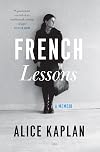
French Lessons: A Memoir
by Alice Kaplan
On This Page
Description
Brilliantly uniting the personal and the critical, French Lessons is a powerful autobiographical experiment. It tells the story of an American woman escaping into the French language and of a scholar and teacher coming to grips with her history of learning. Kaplan begins with a distinctly American quest for an imaginary France of the intelligence. But soon her infatuation with all things French comes up against the dark, unimagined recesses of French political and cultural life. The daughter show more of a Jewish lawyer who prosecuted Nazi war criminals at Nuremburg, Kaplan grew up in the 1960s in the Midwest. After her father's death when she was seven, French became her way of "leaving home" and finding herself in another language and culture. In spare, midwestern prose, by turns intimate and wry, Kaplan describes how, as a student in a Swiss boarding school and later in a junior year abroad in Bordeaux, she passionately sought the French "r," attentively honed her accent, and learned the idioms of her French lover. When, as a graduate student, her passion for French culture turned to the elegance and sophistication of its intellectual life, she found herself drawn to the language and style of the novelist Louis-Ferdinand Celine. At the same time she was repulsed by his anti-Semitism. At Yale in the late 70s, during the heyday of deconstruction she chose to transgress its apolitical purity and work on a subject "that made history impossible to ignore:" French fascist intellectuals. Kaplan's discussion of the "de Man affair" ? the discovery that her brilliant and charismatic Yale professor had written compromising articles for the pro-Nazi Belgian press ?and her personal account of the paradoxes of deconstruction are among the most compelling available on this subject. French Lessons belongs in the company of Sartre's Words and the memoirs of Nathalie Sarraute, Annie Ernaux, and Eva Hoffman. No book so engrossingly conveys both the excitement of learning and the moral dilemmas of the intellectual life. show lessTags
Recommendations
























Member Reviews
Being a former third-culture kid and current expat, I read a lot of immigrant and transcultural lit, so, unless it was as bad as "Emily in Paris," there was no way that "French Lessons was getting less than three stars from me. But I'm happy to report that it's a genuinely good book, which is more remarkable still when one considers that the author was relatively young when she wrote it.
I can't predict other readers' reactions, but I'm not sure that I'd call much in "French Lessons" revelatory. The book's forté is that Kaplan gets the small stuff right. She describes how she struggled to pronounce specific sounds in French. She recalls how one of her French boyfriends used to edit her letters to him, making a "t-t-t" sound by putting show more his tongue up against the roof of his mouth, something that is, apparently, characteristically French. (And, yes, quelle jerkface!) She learns to cross her sevens and loop her twos, which is, incidentally, something that I also do. Most importantly, perhaps, she provides a good description of what it's like to crave assimilation into a culture that you know will probably not wholly accept you.
This last point -- which I think is central to much of the expat experience -- is especially important because Kaplan decides to focus her doctoral thesis on collaborationist French intellectuals. In fact, she got the opportunity to interview one of the last pro-Vichy intellectuals. I'd call this an act of tremendous bravery, and not just because Kaplan is Jewish: it's one thing to want to live in a culture or country not your own, but it takes a special kind of moral clarity to get past the heady rush of leaving your own native land behind to in order to identify how your new culture chosen culture is also flawed. And flawed her subjects were -- even taking into account his horrible political background, the letter she receives from her interview subject is almost unbelievably hurtful.
I'm happy to say that the book ends on a positive note. In an afterword, Kaplan tells us that "French Lessons" did better than expected, commercially, and that her risky decision to write a midlife memoir paid of handsomely from a professional point of view. As we leave her, she's planning her next project: learning an Algerian-French dialect that few people outside of Algeria ever try to learn. At this point, I wished her well. As a person who was born and raised overseas, I never once considered studying a foreign language in college. But Kaplan's books is illuminating for a number of reasons. "French Lessons" ably shows how hard people who undertake this sort of endeavor work -- the sheer hours she dedicated to learning every variety of French is impressive. This book also argues that French Studies is useful specifically because it holds a mirror up to French culture that native-born French people might be unwilling to look into. Lastly, and, for me, most importantly, it justifies the desire that some people have to voluntarily leave their cultures of origin to adapt, as best they can, to a place where speak, live, and do almost everything differently. show less
I can't predict other readers' reactions, but I'm not sure that I'd call much in "French Lessons" revelatory. The book's forté is that Kaplan gets the small stuff right. She describes how she struggled to pronounce specific sounds in French. She recalls how one of her French boyfriends used to edit her letters to him, making a "t-t-t" sound by putting show more his tongue up against the roof of his mouth, something that is, apparently, characteristically French. (And, yes, quelle jerkface!) She learns to cross her sevens and loop her twos, which is, incidentally, something that I also do. Most importantly, perhaps, she provides a good description of what it's like to crave assimilation into a culture that you know will probably not wholly accept you.
This last point -- which I think is central to much of the expat experience -- is especially important because Kaplan decides to focus her doctoral thesis on collaborationist French intellectuals. In fact, she got the opportunity to interview one of the last pro-Vichy intellectuals. I'd call this an act of tremendous bravery, and not just because Kaplan is Jewish: it's one thing to want to live in a culture or country not your own, but it takes a special kind of moral clarity to get past the heady rush of leaving your own native land behind to in order to identify how your new culture chosen culture is also flawed. And flawed her subjects were -- even taking into account his horrible political background, the letter she receives from her interview subject is almost unbelievably hurtful.
I'm happy to say that the book ends on a positive note. In an afterword, Kaplan tells us that "French Lessons" did better than expected, commercially, and that her risky decision to write a midlife memoir paid of handsomely from a professional point of view. As we leave her, she's planning her next project: learning an Algerian-French dialect that few people outside of Algeria ever try to learn. At this point, I wished her well. As a person who was born and raised overseas, I never once considered studying a foreign language in college. But Kaplan's books is illuminating for a number of reasons. "French Lessons" ably shows how hard people who undertake this sort of endeavor work -- the sheer hours she dedicated to learning every variety of French is impressive. This book also argues that French Studies is useful specifically because it holds a mirror up to French culture that native-born French people might be unwilling to look into. Lastly, and, for me, most importantly, it justifies the desire that some people have to voluntarily leave their cultures of origin to adapt, as best they can, to a place where speak, live, and do almost everything differently. show less
I loved the first 2/3 of this book, chronicling Kaplan's youth in Minnesota, the boarding school in Switzerland, her desire to learn French and live French. Her writing is witty, present, and engaging...until the last third of the book which reads like a textbook on French history and literary theory. It lost the personal touch that was so compelling in the earlier part of the book. I found myself skipping and skimming to the end.
Alice Kaplan’s French Lessons is two books in one. In one sense, it is a linguistic autobiography, the story of her relationship with the French language from her childhood year in a Swiss boarding school through her current position as a professor at Duke University. In another, it is a psychological memoir, analysing how the author’s relationship with language developed from her experiences as a child, an adolescent, and finally an adult.
In a piece about the difficulty of translating French Lessons into French, Kaplan has commented that she sees herself as occupying an in-between place, an intermediate spot between two languages and cultures. As such, her memoir will be of interest to anyone who has learned a second language or show more lived in a different culture. Whether it is her recollections of her initial attempts to learn French in Switzerland, her laborious efforts to perfect her linguistic skills and become a part of French culture as a university student in Bordeaux, or the intellectual passion for literature and teaching that has characterized her life as an adult, Kaplan’s experiences will strike a chord with readers who are themselves bilingual or bicultural, or who want to be.
The only parts of French Lessons which seem less engaging to the general reader are the sections that deal with the strictly academic aspect of Kaplan’s language background. Her reflections on Céline and her study of French fascism that formed the basis of her Ph.D. dissertation are certainly relevant to her story. As one of her primary intellectual interests and also as the setting for a dramatic personal story, the author’s study of fascism and collaborationism certainly needs to be part of the book. However, the amount of detail involved, including accounts of university departmental politics, become a bit tedious to readers whose interests lie somewhere other than academe.
Nonetheless, French Lessons is a fascinating account of an American’s love affair with the French language. Kaplan’s self-reflection provides a surprising insight into the role a second language can play in one’s life. It affects intellectual development, social activities, professional life. In fact, a second language weaves itself so thoroughly into the fabric of existence that it becomes part of every aspect of life. French Lessons is a book that I wish I’d thought of writing before Alice Kaplan did. But everyone’s story is unique, and so perhaps Kaplan’s greatest contribution is in inspiring her readers to consider and to appreciate the role of language in our own lives. show less
In a piece about the difficulty of translating French Lessons into French, Kaplan has commented that she sees herself as occupying an in-between place, an intermediate spot between two languages and cultures. As such, her memoir will be of interest to anyone who has learned a second language or show more lived in a different culture. Whether it is her recollections of her initial attempts to learn French in Switzerland, her laborious efforts to perfect her linguistic skills and become a part of French culture as a university student in Bordeaux, or the intellectual passion for literature and teaching that has characterized her life as an adult, Kaplan’s experiences will strike a chord with readers who are themselves bilingual or bicultural, or who want to be.
The only parts of French Lessons which seem less engaging to the general reader are the sections that deal with the strictly academic aspect of Kaplan’s language background. Her reflections on Céline and her study of French fascism that formed the basis of her Ph.D. dissertation are certainly relevant to her story. As one of her primary intellectual interests and also as the setting for a dramatic personal story, the author’s study of fascism and collaborationism certainly needs to be part of the book. However, the amount of detail involved, including accounts of university departmental politics, become a bit tedious to readers whose interests lie somewhere other than academe.
Nonetheless, French Lessons is a fascinating account of an American’s love affair with the French language. Kaplan’s self-reflection provides a surprising insight into the role a second language can play in one’s life. It affects intellectual development, social activities, professional life. In fact, a second language weaves itself so thoroughly into the fabric of existence that it becomes part of every aspect of life. French Lessons is a book that I wish I’d thought of writing before Alice Kaplan did. But everyone’s story is unique, and so perhaps Kaplan’s greatest contribution is in inspiring her readers to consider and to appreciate the role of language in our own lives. show less
This book wasn't what I expected. From the description I thought it would explore how a person's thinking process and inner life changes as they become fluent in another language. This was more or a memoir, covering the writer's many extended visits to France == first as a high school student and then as an undergrad and a grad student == and her experiences with people there, including other students and residents of the country. It may appeal to people who have learned and taught languages at the university level. It didn't speak to me and at about the half-way point I realized it wasn't going to, so I stopped reading . That's not something I do very often. The book was very well reviewed, and it is well written. It just was not for me.
A free read from the University of Chicago Press. I share Kaplan's fascination with the French language, although not her skill with it, but that wasn't enough to make the book more than mildly interesting. I was interested by the ethical issues around her interview of the Holocaust denier but overall found the book a bit too much of the 'look at me aren't I clever' genre to be enjoyable.
Interesting memoir about a woman who loved French language and culture and how she used it to hide her real self. I'd like to learn French ever since I had a taste of it in the 4th grade! This was a good book which I got for free at the end of the public library big sale.
A dark look into France during and through world war II, and it's attitude toward Jews. And also a woman's journey through that world learning French.
Members
- Recently Added By
Lists

Great Books About Language
73 works; 48 members
Author Information

15+ Works 944 Members
Alice Kaplan is the author of numerous books, including Dreaming in French, The Interpreter, French Lessons, and The Collaborator, the last of which was a finalist for the National Book Award and the National Book Critics Circle Award.
Awards and Honors
Notable Lists
Common Knowledge
- Original publication date
- 1993
- People/Characters
- Alice Kaplan
- Important places
- USA
- First words
- "Let's get her to say it." My sister was ambitious for me. "She's only three." My brother was the skeptic.
- Last words
- (Click to show. Warning: May contain spoilers.)All my life I've used and abused my gift for language. I'm tempted, down to the last page, to wrap things up too neatly in words.
Classifications
- Genres
- Biography & Memoir, Nonfiction, General Nonfiction
- DDC/MDS
- 448.0071173 — Language French & related languages Standard French usage (Prescriptive linguistics) standard subdivisions and translating Education And Research
- LCC
- PC2064 .K36 .A3 — Language and Literature Romanic languages Romance French
- BISAC
Statistics
- Members
- 369
- Popularity
- 84,793
- Reviews
- 9
- Rating
- (3.68)
- Languages
- English
- Media
- Paper, Ebook
- ISBNs
- 6
- ASINs
- 3