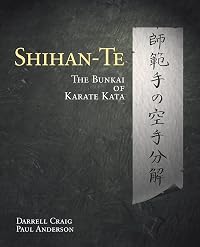
Shihan-te : the bunkai of kata
by Darrell Craig
On This Page
Description
In many schools around the world, the various kata of Karate are taught and practiced. Unfortunately, not many know or care to teach the bunkai that give the forms their true meaning. Finally, these secrets are revealed.Tags
Member Reviews
In the martial arts, kata are the pre-arranged and choreographed dance-like forms used to convey the intricacies of a particuar style to the practitioner. In a sense they are the physical form of an oral tradition, (a form of knowledge transference that many believe extends back several thousands years), training not only the body, but the mind and spirit. Kata are the basis for which modern day karate technques have developed and hence kata are considered the 'textbooks' of the martial arts. Kata is often called the mother of Karate.
Bunkai is a kind of analysis (meaning, 'to disassemble')-a much neglected form of study within Karate. These self-defense applications are what give the kata their true meaning and purpose. For the old show more masters, those of whom may have only practiced one or two kata their entire lives, the repetitions demanded of kata never became a burden because of the meanng, the bunkai. In thousands of schools around the world today, the various kata of Karate are taught and practiced. Unfortunately, not many know, or care to teach, the bunkai, referring to them as mysterious 'secrets.' Remarkable well done, Shihan-Te: The Bunkai of Karate Kata, these 'secrets' are revealed.
Practical for all styles of karate. The key to understanding karate...and yourself! Discover the rich history and deeper meanng of the martial arts.
Darrell Max Craig is a highly regarded teacher of many of Japanese martial arts, and a pioneer in their development in the West for over forty ryears. He holds multiple black belts and is a U.S. Kendo champion, leading the U.S. Kendo team to the world championships. In 1973 he was awarded the title of 'Shihan,' or 'Master Teacher.' Among his many books on the subject is the widely praised The Heart of Kendo. He lives in Houston, Texas.
Paul Andersen (co-author) is a student of Darrell Craig and professional technical writer. He lives in Houston, Texas.
Contents
Dedication
Foreword
Acknowledements
Chapter One: The bunkai of kata
Why write about bunkai of kata
To disassemble kata
Historical context of karate
Kata today in the twenty-first centruy
The triangle of teaching
Chapter Two: Traditional kata: The lost soul
The source of kata
The secrecy demanded of kata
The oral tradition of kata
The two schools of karate: exhibition and traditional
Chapter Three: Some know better
Everthing in life is kata
The modern teaching of old ways
Boxers and ballerinas
The creeping effect of novice teachers
Kata's staying power
Language, translation, misinterpretation and ignorance
Bunkai, oyo, henka and kakushi
Zanshi, finishing with attention
See the light or feel the heat
Chapter Four: The four elements of kata: Bunkai, oyo, henka, kakushi
Bunkai, the first element
Oyo, the second element
Henka, the third element
Kakushi, the fourth element
Capturing the intended sense
Chapter Five: demonstrating the four elements of a kata
Demonstrating bunkai
Demonstrating oyo
Demonstrating henka
Demonstrating kakushi
Conclusion: The practical application of bunkai
Chapter Six: Waza descriptions
Chapter Seven: My introduction to kata
Glossary
Index show less
Bunkai is a kind of analysis (meaning, 'to disassemble')-a much neglected form of study within Karate. These self-defense applications are what give the kata their true meaning and purpose. For the old show more masters, those of whom may have only practiced one or two kata their entire lives, the repetitions demanded of kata never became a burden because of the meanng, the bunkai. In thousands of schools around the world today, the various kata of Karate are taught and practiced. Unfortunately, not many know, or care to teach, the bunkai, referring to them as mysterious 'secrets.' Remarkable well done, Shihan-Te: The Bunkai of Karate Kata, these 'secrets' are revealed.
Practical for all styles of karate. The key to understanding karate...and yourself! Discover the rich history and deeper meanng of the martial arts.
Darrell Max Craig is a highly regarded teacher of many of Japanese martial arts, and a pioneer in their development in the West for over forty ryears. He holds multiple black belts and is a U.S. Kendo champion, leading the U.S. Kendo team to the world championships. In 1973 he was awarded the title of 'Shihan,' or 'Master Teacher.' Among his many books on the subject is the widely praised The Heart of Kendo. He lives in Houston, Texas.
Paul Andersen (co-author) is a student of Darrell Craig and professional technical writer. He lives in Houston, Texas.
Contents
Dedication
Foreword
Acknowledements
Chapter One: The bunkai of kata
Why write about bunkai of kata
To disassemble kata
Historical context of karate
Kata today in the twenty-first centruy
The triangle of teaching
Chapter Two: Traditional kata: The lost soul
The source of kata
The secrecy demanded of kata
The oral tradition of kata
The two schools of karate: exhibition and traditional
Chapter Three: Some know better
Everthing in life is kata
The modern teaching of old ways
Boxers and ballerinas
The creeping effect of novice teachers
Kata's staying power
Language, translation, misinterpretation and ignorance
Bunkai, oyo, henka and kakushi
Zanshi, finishing with attention
See the light or feel the heat
Chapter Four: The four elements of kata: Bunkai, oyo, henka, kakushi
Bunkai, the first element
Oyo, the second element
Henka, the third element
Kakushi, the fourth element
Capturing the intended sense
Chapter Five: demonstrating the four elements of a kata
Demonstrating bunkai
Demonstrating oyo
Demonstrating henka
Demonstrating kakushi
Conclusion: The practical application of bunkai
Chapter Six: Waza descriptions
Chapter Seven: My introduction to kata
Glossary
Index show less
Members
- Recently Added By
Lists

Karate Kata books: Traditional Okinawan
18 works; 1 member
Author Information

9 Works 356 Members
Darrell Max Craig operated the Houston Budokan, inc., a traditional Japanese martial arts school in Texas, for 49 years. He began his training while in the U.S. Marine Corps, studying in Japan with Gogen Yamaguchi in 1956, and in Okinawa with Zenryo Shimabukuro beginning in 1958. While in Okinawa, he also began the study of Okinawan weapon arts. show more Among other ranks, he holds 7th Dan in Kendo, 6th Dan in each of Shito Ryu Karate, Junse Gosbin Budo Jujitsu, laido, and Okinawan Kobudo and 4th Dan in each of Jo Do Osae Aikido, Kodokan Judo and Osae Junse Aikido, He was a member of Team USA in 1985 at the 6th World Kendo Championships in Paris, France. He is considered one of the "Pioneers of Kendo in the United States of America" by the United States Kendo Federation. show less
Classifications
- Genres
- Sports and Leisure, Nonfiction
- DDC/MDS
- 796.815 — Arts & recreation Recreation, sports, and performing arts Sports Wrestling / Martial Arts, Judo, Karate Martial arts Asian martial arts
- LCC
- GV1114.3 .C723 — Geography, Anthropology and Recreation Recreation. Leisure Recreation. Leisure Sports Fighting sports: Bullfighting, boxing, fencing, etc.
- BISAC
Statistics
- Members
- 7
- Popularity
- 2,735,262
- Reviews
- 1
- Languages
- English
- Media
- Paper
- ISBNs
- 1