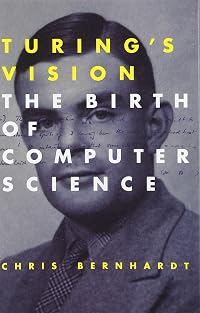
Turing's Vision: The Birth of Computer Science (MIT Press)
by Chris Bernhardt
On This Page
Description
In 1936, when he was just twenty-four years old, Alan Turing wrote a remarkable paper in which he outlined the theory of computation, laying out the ideas that underlie all modern computers. This groundbreaking and powerful theory now forms the basis of computer science. In Turing's Vision, Chris Bernhardt explains the theory, Turing's most important contribution, for the general reader. Bernhardt argues that the strength of Turing's theory is its simplicity, and that, explained in a show more straightforward manner, it is eminently understandable by the nonspecialist. As Marvin Minsky writes, "The sheer simplicity of the theory's foundation and extraordinary short path from this foundation to its logical and surprising conclusions give the theory a mathematical beauty that alone guarantees it a permanent place in computer theory." Bernhardt begins with the foundation and systematically builds to the surprising conclusions. He also views Turing's theory in the context of mathematical history, other views of computation (including those of Alonzo Church), Turing's later work, and the birth of the modern computer.In the paper, "On Computable Numbers, with an Application to the Entscheidungsproblem," Turing thinks carefully about how humans perform computation, breaking it down into a sequence of steps, and then constructs theoretical machines capable of performing each step. Turing wanted to show that there were problems that were beyond any computer's ability to solve; in particular, he wanted to find a decision problem that he could prove was undecidable. To explain Turing's ideas, Bernhardt examines three well-known decision problems to explore the concept of undecidability; investigates theoretical computing machines, including Turing machines; explains universal machines; and proves that certain problems are undecidable, including Turing's problem concerning computable numbers. show lessTags
Recommendations



Member Reviews
I love Gödel, Escher, Bach, but GEB is over 800 discursive pages. Turing's Vision is a short translate of Turing's key paper "On Computable Numbers, with an Application to the Entscheidungsproblem". Turing paper conclusively proved a key result in mathematics, that some questions cannot be answered "yes" or "no", but will drift in infinite indeterminability. And second, his model of a simple machine with states and an infinite memory provided a conceptual design for the first universal computers as opposed to electro-mechanical calculating machines.
While no one programs pure Turing machines, instead working with friendly abstractions, the Turing machine is the strongest model of computation that we know how to build (stronger ones show more involve breaking the laws of physics). Bernhardt offers simple and elegantly explained proofs by contradiction to show the powers and limits of this class of machines. While the arguments are fuzzier than pure math demands, this is also a book that is almost thrilling in its readability, and it's a math book! show less
While no one programs pure Turing machines, instead working with friendly abstractions, the Turing machine is the strongest model of computation that we know how to build (stronger ones show more involve breaking the laws of physics). Bernhardt offers simple and elegantly explained proofs by contradiction to show the powers and limits of this class of machines. While the arguments are fuzzier than pure math demands, this is also a book that is almost thrilling in its readability, and it's a math book! show less
A relatively easy-reading treatment of what everyone should know about computability theory, centered around Alan Turing's 1936 paper ("On Computable Numbers ...") but also including good coverage of finite automata, universal-computability models other than Turing machines, and Cantorian cardinalities and diagonalization proofs. Editing slips such as missing words are rather too numerous.
Ratings
Members
- Recently Added By
Lists

Dan Luu's Programming book list
46 works; 1 member

Computer Go Brrr
15 works; 1 member

In Our Time books
4,934 works; 2 members
Author Information

6 Works 248 Members
Chris Bernhardt is Professor of Mathematics at Fairfield University and the author of Turing's Vision: The Birth of Computer Science (MIT Press).
Awards and Honors
Notable Lists
Classifications
Statistics
- Members
- 95
- Popularity
- 339,487
- Reviews
- 2
- Rating
- (3.92)
- Languages
- English
- Media
- Paper, Audiobook, Ebook
- ISBNs
- 7
- ASINs
- 2