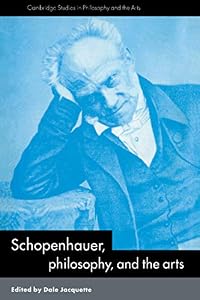
Schopenhauer, Philosophy and the Arts (Cambridge Studies in Philosophy and the Arts)
by Dale Jacquette 
Cambridge Studies In Philosophy And The Arts
On This Page
Description
This collection brings together thirteen essays by some of the most respected contemporary scholars of Schopenhauer's aesthetics from a wide spectrum of philosophical perspectives. The dynamics of the empirical will and Will as a thing-in-itself in the interplay of Schopenhauer's metaphysics and philosophy of fine art has important implications for the freedom, salvation and tragic suffering of the artist, the representation of Platonic Ideas in art, and the role of artistic inspiration, show more emotion and aesthetic pleasure in the beautiful and sublime. These essays examine the unique theory Schopenhauer developed to explain the life and work of the artist, and the influence his aesthetic philosophy has had on subsequent artistic traditions in such diverse areas as music, painting, poetry, literature and architecture. The authors present Schopenhauer's thought as a vital and enduring contribution to aesthetic theory, and to the idealist vision which continues to guide Romantic and neo-Romantic art. show lessTags
Member Reviews
One of the most engaging collection of essays I have come across in quite some time. As a way of sharing the richness contained in the pages of this book, below are a number of points made by Shehira Doss-Davezac in her essay Schopenhauer According to the Symbolists: Philosophical Roots of Late 19th Century French Aesthetic Theory.
• Schopenhauer promised through art, the viewer will experience 1) a loss of self, 2) a feeling of ecstasy and 3) an intuitive vision of the absolute. These are three qualities the French Symbolist writers and artists yearned. And the science of the day could certainly not satisfy their longing.
• For Schopenhauer, through aesthetic contemplation, we reach the painless state of the gods, for we are for the show more moment set free from the miserable striving of the will; we can have this temporary aesthetic release in our contemplation of both the natural world and art.
• The French artists and writers felt that the positivism and scientism of the day ignored our spiritual needs and neglected intuition. In keeping with Schopenhauer, they believed it is our intuition that moves us well beyond the limits of reason.
• The relative existence of objects make them symbols, not independent entities – emphasis on the interpreting subjective self - NATURE SEEN AS SYMBOL.
• The world is only representation – Schopenhauer's work appeared to the French as a theory of art more than a formal philosophy.
• The Symbolists displayed a tendency to transform all the arts into a kind of music.
• Schopenhauer said arts not science point to the thing-in-itself and ultimate truth.
• The Symbolists aspired to an art not of mimesis but expression – art that was a creation of supernal, that is, celestial beauty.
• Schopenhauer said the soul has innate sentiments and the imagination of artists and poets is able to give form and life to the imagination– style is the physiognomy of the spirit.
• All the French Symbolists favored a sensual response to nature, but asked that the response be sublimated through a world of Ideas --- (at a later date, Jung would use "world of the collective unconscious") – art’s mission is to open a window onto the ultimate realm of truth.
• For both Schopenhauer and the French Symbolists, art is beyond reason; art is an evocative magic; reaching a state of unremitting bliss.
• Baudelaire, like Schopenhauer, saw raw nature as carnal, struggle, hate and ugliness, as the voice of self-interest.
• The French Symbolists agreed with Schopenhauer that art mitigates the evil of the world – rescues nature from its materiality.
• The Symbolists followed Schopenhauer in how art can transform nature into Idea (I liken this to the Jungian archetype) for the sake of the soul.
• The Symbolists were eschewing the outward skin for the inward symbol.
• Schopenhauer’s “Idea" opposes the notion of "Concept." The concept is abstract and discursive; the Idea is always an object of perception (I liken the Idea to a Jungian archetype).
• Schopenhauer posited that art manifests the Idea visually rather than conceptually – the communication of Idea can only take place on the path of perception.
• For both Schopenhauer and the Symbolists, real artists work from pure feeling intuitively; imitators or mannerists start from a concept.
• Symbolism is to clothe the idea in a sensitive form.
• Symbolists wanted to extract art from the roots in the active world and from all practical needs and desires.
• For the Symbolists, "Realism"" is a crude understanding.
• For Schopenhauer, allegorical and conceptual art is distant, limited, cold and dry – we, as viewers, feel cheated when we view this kind of art.
• True art conveys an idea of ultimate reality rather than reality itself.
• Aesthetic mode of contemplation: 1) knowledge of object as Idea 2) self-consciousness of the knowing subject not as individual but as pure, will-less subject of knowledge.
• Schopenhauer showed the Symbolists that salvation and ecstasy could be achieved only by the artist’s renunciation of the ordinary world of perception.
• Disinterested contemplation leads to profound wisdom.
• For the ordinary person, the Idea (what Jung calls the archetype) remains hidden beneath layers of phenomenon.
• For Baudelaire, great art is the result of seeing in a disconnected way, as though in a hieroglyphic dream.
• Imagination extends our horizons. Imagination is mystical perception revealing its secret affinity to a human soul and the realm of spirit.
• The French experimented with new language of forms which would be capable of embodying rather than illustrating Ideas. This new language was to be subjective, expressive, and free from any accepted formula.
• For Schopenhauer, creativity involves the imagination not reason – extraordinary rather than ordinary perception – AND WHAT THE ARTIST ACHIEVES IS REPEATED TO SOME EXTENT BY THE VIEWER – this type of mysticism can save us from brutalism, utilitarianism and becoming a sensualist.
• Synesthesia, that is, one sense crossing over into another sense, for example, sights becoming sounds, became a favorite game of the Symbolist writers and painters.
I have outlined the other essays in this collection in the comments section below, beginning with comment #11.
German philosopher Arthur Schopenhauer, 1788- 1860 show less
This is one of the most thought-provoking collection of essays I have come across in quite some time. As a way of sharing the richness of what is contained in the pages of this book, below are a number of points made by Shehira Doss-Davezac in her essay ‘Schopenhauer according to the Symbolists: the philosophical roots of late 19th century French aesthetic theory’.
• Schopenhauer promised that through art, one will experience a loss of self, a feeling of ecstasy and an intuitive vision of the absolute. These are 3 qualities the French Symbolist writers and artists yearned. And the science of the day could certainly not satisfy their longing.
• For Schopenhauer, through aesthetic contemplation, we reach the painless state of the show more gods, for we are for the moment set free from the miserable striving of the will; we can have this temporary aesthetic release in our contemplation of both the natural world and art.
• The French artists and writers felt that the positivism and scientism of the day ignored our spiritual needs, neglecting intuition. It is our intuition that moves us well beyond the limits of reason.
• The relative existence of objects make them symbols, not independent entities – emphasis on the interpreting subjective self --- NATURE SEEN AS SYMBOL.
• The world is only representation – Schopenhauer's work appeared to the French as a theory of art more than a formal philosophy.
• The Symbolists displayed a tendency to transform all the arts into a kind of music.
• Schopenhauer said arts not science point to the thing-in-itself and ultimate truth.
• The Symbolists aspired to an art not of mimesis but expression – art that was a creation of supernal, that is, celestial beauty.
• Schopenhauer said the soul has innate sentiments and the imagination of artists and poets is able to give form and life to the imagination– style is the physiognomy of the spirit.
• All the French Symbolists favored a sensual response to nature, but asked that the response be sublimated through a world of Ideas --- (at a later date, Jung would use ‘world of the collective unconscious’) – art’s mission is to open a window onto the ultimate realm of truth.
• For both Schopenhauer and the French Symbolists, art is beyond reason; art is an evocative magic; reaching a state of unremitting bliss.
• Baudelaire, like Schopenhauer, saw raw nature as carnal, struggle, hate and ugliness, as the voice of self-interestedness.
• The French Symbolists agreed with Schopenhauer that art mitigates the evil of the world – rescues nature from its materiality.
• The Symbolists followed Schopenhauer in how art can transform nature into Idea (I liken this to the Jungian archetype) for the sake of the soul.
• The Symbolists were eschewing the outward skin for the inward symbol.
• Schopenhauer’s “Idea’ opposes the notion of ‘Concept’. The concept is abstract and discursive; the Idea is always an object of perception (I liken the Idea to a Jungian archetype).
• Schopenhauer posited that art manifests the Idea visually rather than conceptually – the communication of Idea can only take place on the path of perception.
• For both Schopenhauer and the Symbolists, real artists work from pure feeling intuitively; imitators or mannerists start from a concept.
• Symbolism is to clothe the idea in a sensitive form.
• Symbolists wanted to extract art from the roots in the active world and from all practical needs and desires.
• For the Symbolists, ‘Realism’ is a crude understanding.
• For Schopenhauer, allegorical and conceptual art is distant, limited, cold and dry – we, as viewers, feel cheated when we view this kind of art.
• True art conveys an idea of ultimate reality rather than reality itself.
• Aesthetic mode of contemplation: 1) knowledge of object as Idea 2) self-consciousness of the knowing subject not as individual but as pure, will-less subject of knowledge.
• Schopenhauer showed the Symbolists that salvation and ecstasy could be achieved only by the artist’s renunciation of the ordinary world of perception.
• Disinterested contemplation leads to profound wisdom.
• For the ordinary person, the Idea (what Jung calls the archetype) remains hidden beneath layers of phenomenon.
• For Baudelaire, great art is the result of seeing in a disconnected way, as though in a hieroglyphic dream.
• Imagination extends our horizons. Imagination is mystical perception revealing its secret affinity to a human soul and the realm of spirit.
• The French experimented with new language of forms which would be capable of embodying rather than illustrating Ideas. This new language was to be subjective, expressive, and free from any accepted formula.
• For Schopenhauer, creativity involves the imagination not reason – extraordinary rather than ordinary perception – AND WHAT THE ARTIST ACHIEVES IS REPEATED TO SOME EXTENT BY THE VIEWER – this type of mysticism can save us from brutalism, utilitarianism and becoming a sensualist.
• Synesthesia, that is, one sense crossing over into another sense, for example, sights becoming sounds, became a favorite game of the Symbolist writers and painters. show less
• Schopenhauer promised that through art, one will experience a loss of self, a feeling of ecstasy and an intuitive vision of the absolute. These are 3 qualities the French Symbolist writers and artists yearned. And the science of the day could certainly not satisfy their longing.
• For Schopenhauer, through aesthetic contemplation, we reach the painless state of the show more gods, for we are for the moment set free from the miserable striving of the will; we can have this temporary aesthetic release in our contemplation of both the natural world and art.
• The French artists and writers felt that the positivism and scientism of the day ignored our spiritual needs, neglecting intuition. It is our intuition that moves us well beyond the limits of reason.
• The relative existence of objects make them symbols, not independent entities – emphasis on the interpreting subjective self --- NATURE SEEN AS SYMBOL.
• The world is only representation – Schopenhauer's work appeared to the French as a theory of art more than a formal philosophy.
• The Symbolists displayed a tendency to transform all the arts into a kind of music.
• Schopenhauer said arts not science point to the thing-in-itself and ultimate truth.
• The Symbolists aspired to an art not of mimesis but expression – art that was a creation of supernal, that is, celestial beauty.
• Schopenhauer said the soul has innate sentiments and the imagination of artists and poets is able to give form and life to the imagination– style is the physiognomy of the spirit.
• All the French Symbolists favored a sensual response to nature, but asked that the response be sublimated through a world of Ideas --- (at a later date, Jung would use ‘world of the collective unconscious’) – art’s mission is to open a window onto the ultimate realm of truth.
• For both Schopenhauer and the French Symbolists, art is beyond reason; art is an evocative magic; reaching a state of unremitting bliss.
• Baudelaire, like Schopenhauer, saw raw nature as carnal, struggle, hate and ugliness, as the voice of self-interestedness.
• The French Symbolists agreed with Schopenhauer that art mitigates the evil of the world – rescues nature from its materiality.
• The Symbolists followed Schopenhauer in how art can transform nature into Idea (I liken this to the Jungian archetype) for the sake of the soul.
• The Symbolists were eschewing the outward skin for the inward symbol.
• Schopenhauer’s “Idea’ opposes the notion of ‘Concept’. The concept is abstract and discursive; the Idea is always an object of perception (I liken the Idea to a Jungian archetype).
• Schopenhauer posited that art manifests the Idea visually rather than conceptually – the communication of Idea can only take place on the path of perception.
• For both Schopenhauer and the Symbolists, real artists work from pure feeling intuitively; imitators or mannerists start from a concept.
• Symbolism is to clothe the idea in a sensitive form.
• Symbolists wanted to extract art from the roots in the active world and from all practical needs and desires.
• For the Symbolists, ‘Realism’ is a crude understanding.
• For Schopenhauer, allegorical and conceptual art is distant, limited, cold and dry – we, as viewers, feel cheated when we view this kind of art.
• True art conveys an idea of ultimate reality rather than reality itself.
• Aesthetic mode of contemplation: 1) knowledge of object as Idea 2) self-consciousness of the knowing subject not as individual but as pure, will-less subject of knowledge.
• Schopenhauer showed the Symbolists that salvation and ecstasy could be achieved only by the artist’s renunciation of the ordinary world of perception.
• Disinterested contemplation leads to profound wisdom.
• For the ordinary person, the Idea (what Jung calls the archetype) remains hidden beneath layers of phenomenon.
• For Baudelaire, great art is the result of seeing in a disconnected way, as though in a hieroglyphic dream.
• Imagination extends our horizons. Imagination is mystical perception revealing its secret affinity to a human soul and the realm of spirit.
• The French experimented with new language of forms which would be capable of embodying rather than illustrating Ideas. This new language was to be subjective, expressive, and free from any accepted formula.
• For Schopenhauer, creativity involves the imagination not reason – extraordinary rather than ordinary perception – AND WHAT THE ARTIST ACHIEVES IS REPEATED TO SOME EXTENT BY THE VIEWER – this type of mysticism can save us from brutalism, utilitarianism and becoming a sensualist.
• Synesthesia, that is, one sense crossing over into another sense, for example, sights becoming sounds, became a favorite game of the Symbolist writers and painters. show less
Members
- Recently Added By
Author Information
29+ Works 512 Members
Dale Jacquette is Professor of Philosophy at Pennsylvania State University
Dale Jacquette is a LibraryThing Author, an author who lists their personal library on LibraryThing.
Series

Classifications
Statistics
- Members
- 13
- Popularity
- 1,765,098
- Reviews
- 2
- Rating
- (5.00)
- Languages
- English
- Media
- Paper, Ebook
- ISBNs
- 3