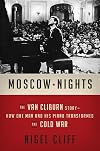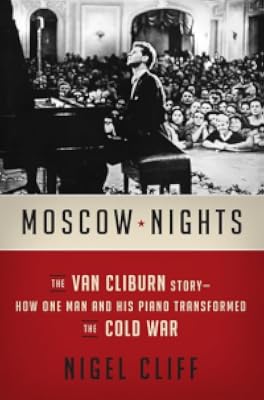
Moscow Nights: The Van Cliburn Story-How One Man and His Piano Transformed the Cold War
by Nigel Cliff
On This Page
Description
A dramatic account of the life of Cold War pianist Van Cliburn describes his early years as a musical prodigy in Texas and the ways he charmed both American and Russian audiences, helping to ease tensions between the two nations.--Publisher's description.Tags
Recommendations















Member Reviews
Engrossing story of how Texan pianist Van Cliburn won the first International Tchaikovsky Competition -- and the hearts of the Russian people -- at a time when tensions between the US and the USSR were almost at a breaking point. The author does an excellent job at placing Cliburn's story in the broader international context. Fascinating details emerge about the post-Stalin world of Nikita Khrushchev, who emerges as an interesting figure. -- A little languor crept in for a chapter or two (following the competition, as Cliburn temporarily recedes into the background), but, on the whole, a splendid achievement: part biography, part cultural/political history.
A really fascinating account of the pianist Van Cliburn and his attachment to Russia, and how that attachment affected his own life and Cold War politics. I knew nothing about this story at all when I picked up the book -- I knew nothing about Van Cliburn except that he was a pianist -- so I learned quite a bit. I think the author does a good job of describing the atmosphere of the Cold War and, later, the Cuban Missile Crisis, and also making it clear why the American intelligence community viewed Van Cliburn with some suspicion after his competition win in Russia.
Cliburn himself comes across as shockingly naive and more than a bit full of himself (at one point he arrives in Washington for a concert, realizes he doesn't have his show more tuxedo, and calls President Lyndon Johnson to see if he could borrow one -- Johnson obliged). It's believable, given his sheltered upbringing in a small Texas town and the behavior of his ever-present mother, who took helicopter parenting to a whole new level. But by the time the book reached the Sixties I was getting frustrated with him myself, so I can only imagine how exasperating he must have been to deal with.
And one of the few frustrations of the book is that you don't really get a sense of how the people around Cliburn dealt with him. I wouldn't call this a bio; its hyper-focus on Cliburn and Russia means that you don't get a full understanding of what he was like as a person, what his relationship with his mother was like, how he dealt with conflicts between his sexuality (he was gay) and his deep religious beliefs, or really anything else other than his attachment to Russia. That's not really a shortcoming of the book -- the subtitle makes it pretty clear what Cliff wants to focus on in this book -- but it did leave me wanting to know more. show less
Cliburn himself comes across as shockingly naive and more than a bit full of himself (at one point he arrives in Washington for a concert, realizes he doesn't have his show more tuxedo, and calls President Lyndon Johnson to see if he could borrow one -- Johnson obliged). It's believable, given his sheltered upbringing in a small Texas town and the behavior of his ever-present mother, who took helicopter parenting to a whole new level. But by the time the book reached the Sixties I was getting frustrated with him myself, so I can only imagine how exasperating he must have been to deal with.
And one of the few frustrations of the book is that you don't really get a sense of how the people around Cliburn dealt with him. I wouldn't call this a bio; its hyper-focus on Cliburn and Russia means that you don't get a full understanding of what he was like as a person, what his relationship with his mother was like, how he dealt with conflicts between his sexuality (he was gay) and his deep religious beliefs, or really anything else other than his attachment to Russia. That's not really a shortcoming of the book -- the subtitle makes it pretty clear what Cliff wants to focus on in this book -- but it did leave me wanting to know more. show less
This is for musicians and lovers of classical music and the Romantic composers, especially the Russians. Otherwise it is like reading a biography of a poet without knowing any of her poems. It is very readable and well written and researched. You get an interesting sidelight on cold war geopolitics, which Van Cliburn influenced for the better, perhaps materially. His Beatle-like adoration by the Russians from 1958 until his death in 2013 (and early veneration in the U.S.) never compromised his natural humility and humanity. He was a jewel: as innocent as possible of guile, immensely gracious and prodigiously talented. And his hands reached a 13th (from C to an A up in yonder octave.)
Wonderful book. I follow classical music -- have all my life. But for some reason, even though I am a fan of Russian music, Van Cliburn was never on my radar. Pure ignorance on my part. He was very interesting to read about and the book did a good job of putting him into the context of the Cold War so I also learned things about Khruschev and Gorbachev (and Nixon), and many other important political players, that I didn't know. The Cold War bits got a little tiresome for me towards the end, but overall I enjoyed the book, appreciated the information, and thought it very well written. Finding videos on YouTube of Cliburn playing at his original Tschaikovsky competition enriched my reading.
This is a biography of Van Cliburn, a classical pianist from Texas who became world famous when he won the first International Tchaikovsky Competition which took place in Moscow in 1958. He was beloved in Russia, all the way from Kruschchev down to young, female, screaming fans to the extent that it almost seemed like pre-Beatlemania craziness. All of this took place in the middle of the Cold War between Russia and the United States, and Cliburn was apolitical but seemed particularly naive to how he was being manipulated by both sides. It is certainly an interesting glimpse of the time period, and the author gives us a fair amount of background information on the machinations which took place between the governments and military. show more Cliburn himself was totally immersed in his music, even forgetting to eat at times, and appeared to be an emotionally stunted man-child who had an extraordinarily close relationship with his mother. It was an interesting read. show less
В 1958-м техасский пианист Харви Лейвен (Ван) Клиберн-мл. выиграл в Москве первый Международный конкурс им. П. И. Чайковского. Холодной войны молодой человек, вопреки названию книги, не остановил, но потепление на какое-то время вызвал. Россия страстно полюбила американца, да и его соотечественники были поражены неожиданным успехом пианиста за железным занавесом. Но спецслужбы обеих стран насторожились: до show more конца поверить в чистоту такого хеппи-энда они не могли, и, как принято говорить, дальнейшая жизнь Вана Клиберна уже никогда не была прежней. Его высокий талант безусловно признавался в США: он считался национальным достоянием, играл для всех президентов, получил много престижных премий, включая первую «Грэмми», продал миллионы пластинок, постоянно гастролировал и имел внушительную армию поклонниц как в США, так и в СССР. Однако положение друга двух враждующих систем имело и обратную сторону. Лишь недавно стали доступны архивные данные ФБР и ЦРУ, касающиеся умершего в 2013 году музыканта. Вместе с многочисленными интервью (в том числе с нашей стороны) это позволило создать книгу, из которой русскоязычный читатель может узнать подробности этой интересной и необычной судьбы. show less
Ratings
Members
- Recently Added By
Lists

Entertainment
174 works; 1 member

History: Eastern Europe
97 works; 2 members

Music Journalism and Biography
56 works; 1 member
Author Information
6+ Works 555 Members
Nigel Cliff is a historian and biographer. His first book, The Shakespeare Riots, was a finalist for the National Award for Arts Writing and was chosen as one of the Washington Post's best books of the year. His second book, The Last Crusade: The Epic Voyages of Vasco da Gama, was a New York Times Notable Book. His most recent book is a show more translation of The Travels by Marco Polo. A Former film and theater critic for The Times (London) and contributor to The Economist, he writes for a range of publications, including the New York Times Book Review. A fellow of Harris Manchester College, Oxford, he lives in London. show less
Awards and Honors
Awards
Distinctions
Common Knowledge
- Important events
- Cold War
Classifications
- Genres
- Music, Nonfiction, Biography & Memoir, General Nonfiction, History
- DDC/MDS
- 786.2092 — Arts & recreation Music Keyboard, mechanical, electrophonic, percussion instruments Pianos [formerly: keyboard string instuments]
- LCC
- ML417 .C67 .C65 — Music Literature on music Literature on music History and criticism Biography
- BISAC
Statistics
- Members
- 101
- Popularity
- 319,682
- Reviews
- 6
- Rating
- (4.06)
- Languages
- Dutch, English
- Media
- Paper, Ebook
- ISBNs
- 5
- ASINs
- 1